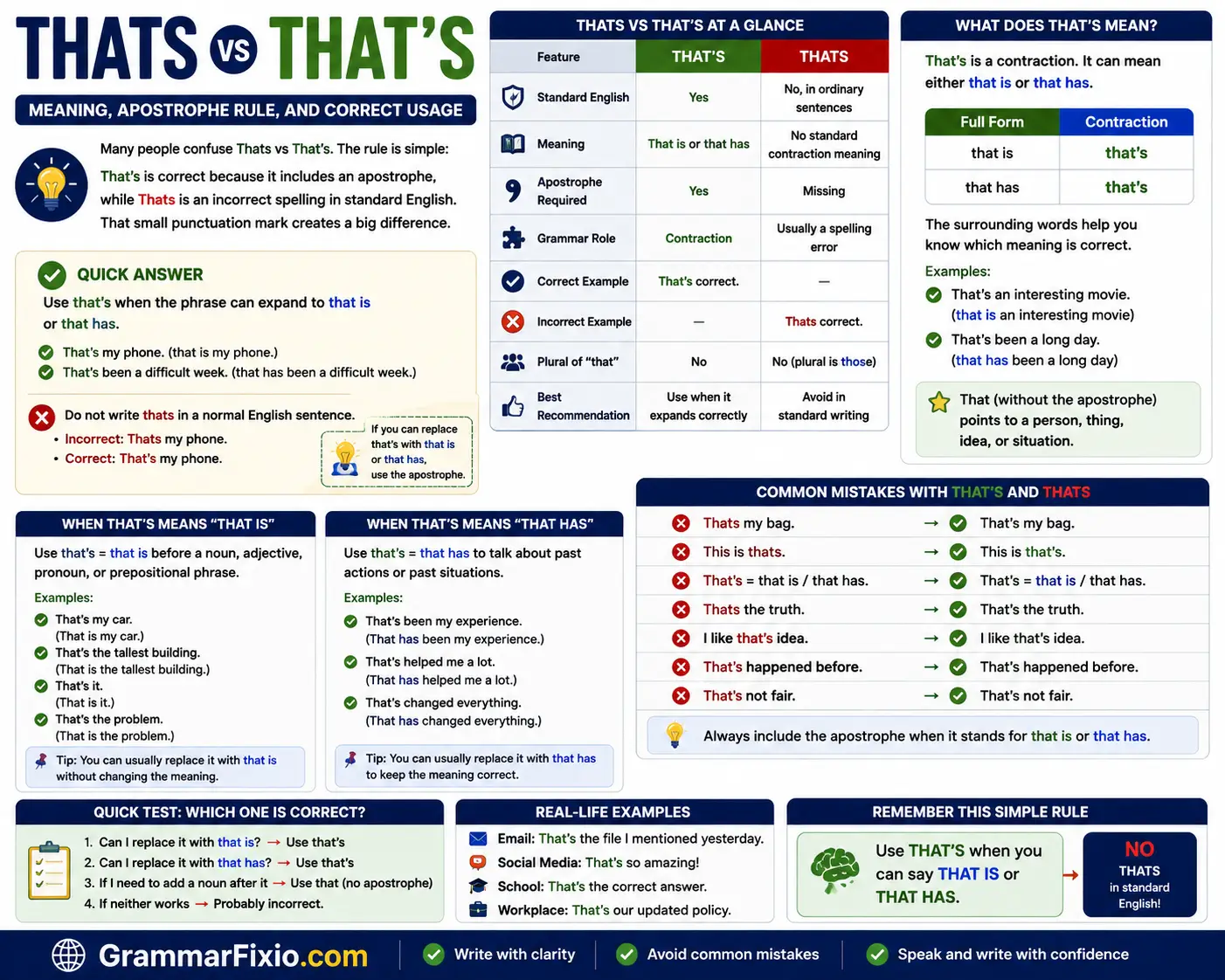
Many people searching Thats vs That’s want a quick answer. The rule is simple: That’s is correct because it includes an apostrophe, while Thats is an incorrect spelling mistake in standard English. Although both forms look almost the same, that small punctuation mark creates an important difference. This guide uses plain English, real examples, quick tests, and a useful table to help English learners and other writers understand the correct form with confidence.
The meaning becomes clear when you follow basic grammar rules and correct usage. Whether you write an email, blog, school assignment, social media post, texts, or professional documents, using That’s makes your English writing look accurate. It also helps you avoid common grammar mistakes, grammar mistake, error, wrong form, and common mistakes during proofreading.
I always recommend using simple memory tricks and checking every sentence before you publish or send it. Search results, common questions, answers, and resources people search for in 2026 all explain the same grammatical difference. With regular practice, you will remember, choose the right form, avoid the apostrophe difference mistakes, and write correctly every time.
Quick Answer: Is It Thats or That’s?
Use that’s when the phrase can expand to that is or that has.
- That’s my phone.
Meaning: That is my phone. - That’s been a difficult week.
Meaning: That has been a difficult week.
Do not write thats in a normal English sentence.
- Incorrect: Thats my phone.
- Correct: That’s my phone.
Also, thats is not the plural of that. The plural form is those.
- Singular: That is my package.
- Plural: Those are my packages.
The simplest rule is:
If you can replace that’s with that is or that has, use the apostrophe.
Thats vs That’s at a Glance
| Feature | That’s | Thats |
| Standard English form | Yes | No, in ordinary sentences |
| Meaning | That is or that has | No standard contraction meaning |
| Apostrophe required | Yes | Missing |
| Grammar role | Contraction | Usually a spelling error |
| Correct example | That’s correct. | — |
| Incorrect example | — | Thats correct. |
| Can show possession | No | No |
| Plural of “that” | No | No |
| Best recommendation | Use when it expands correctly | Avoid in standard writing |
The difference is straightforward. That’s has a real grammatical function, while thats usually reflects a missing apostrophe.
Read this also: ASF Meaning in Text: What Does ASF Mean in Texting and Social Media?
What Does That’s Mean?
That’s is a contraction. A contraction combines two words and uses an apostrophe to mark missing letters.
It can represent either:
- that is
- that has
The surrounding words tell you which meaning applies.
Compare:
- That’s expensive.
Meaning: That is expensive. - That’s changed everything.
Meaning: That has changed everything.
Although the spelling stays the same, the grammar after the contraction changes.
That’s as a Contraction
The apostrophe replaces omitted letters.
| Full Form | Contraction | Missing Letters |
| that is | that’s | i |
| that has | that’s | ha |
This pattern also appears in other contractions:
- it is → it’s
- she is → she’s
- he has → he’s
- what is → what’s
- who has → who’s
However, you still need context to identify the full meaning.
The Grammar Role of “That”
The word that often points to a person, object, idea, event, or situation.
For example:
- That is my desk.
- That was unexpected.
- That has happened before.
In the first two examples, that identifies something. In the third, it refers to a situation or event that has already been mentioned.
When that combines with is or has, the contraction becomes that’s.
When That’s Means “That Is”
The most common meaning of that’s is that is.
Use it before a noun, adjective, pronoun, phrase, or clause that describes or identifies something.
That’s Before a Noun Phrase
- That’s my jacket.
- That’s the correct answer.
- That’s a serious problem.
- That’s our new manager.
In each sentence, that’s means that is.
The word or phrase after it identifies the subject.
That’s Before an Adjective
- That’s helpful.
- That’s strange.
- That’s expensive.
- That’s unnecessary.
Here, the adjective describes the thing, idea, or situation represented by that.
For example:
- That’s strange.
- That is strange.
Both versions are correct. The contraction simply sounds more conversational.
That’s Before a Clause
That’s often introduces a longer explanation.
- That’s what I meant.
- That’s why I called.
- That’s how the machine works.
- That’s where we parked.
In each case, the phrase after that’s explains the identity, reason, method, or location.
Common Expressions With “That Is”
Several everyday expressions use that’s to mean that is.
| Expression | Meaning | Example |
| that’s all | nothing more | That’s all I need. |
| that’s it | finished or identified | That’s it—we’re done. |
| that’s right | correct or confirmed | That’s right, the meeting starts at nine. |
| that’s true | agreement with a statement | That’s true, but we still need more evidence. |
| that’s enough | no more is needed | That’s enough for today. |
| that’s why | introduces a reason | I was sick. That’s why I stayed home. |
| that’s what | identifies an idea or thing | That’s what the client requested. |
| that’s how | explains a method | That’s how I solved the problem. |
These expressions are common in speech, texting, email, and informal writing.
When That’s Means “That Has”
That’s can also mean that has when has works as a helping verb.
This usually happens in the present perfect tense, which connects a past action or change with the present.
Examples include:
- That’s happened before.
- That’s changed everything.
- That’s been helpful.
- That’s caused several delays.
- That’s become a major concern.
Each sentence can expand naturally:
- That has happened before.
- That has changed everything.
- That has been helpful.
- That has caused several delays.
- That has become a major concern.
Look for a Past Participle
When that’s means that has, it is usually followed by a past participle.
A past participle is a verb form used with helping verbs such as has, have, or had.
Common examples include:
- been
- happened
- changed
- caused
- improved
- become
- finished
- affected
- created
- increased
For example:
- That’s improved the process.
- That has improved the process.
The word improved is the past participle.
Irregular Past Participles
Not every past participle ends in -ed.
Examples include:
- been
- become
- gone
- written
- done
- seen
- taken
Therefore, you cannot identify the meaning only by looking for -ed.
Examples:
- That’s been difficult.
- That’s become more common.
- That’s done more harm than good.
In each sentence, that’s means that has.
When “That Has” Does Not Contract Naturally
The contraction that’s usually represents that has when has is a helping verb.
However, it does not normally replace has when has means possession in every sentence.
For example:
- That car has a new engine.
You would not normally contract this to:
- That car’s a new engine.
That version sounds as though that car is a new engine, which changes the meaning.
Similarly:
- That building has three entrances.
Do not rewrite it as:
- That building’s three entrances.
The second phrase sounds possessive and incomplete.
Therefore, use that’s for that has mainly when has helps form a perfect tense:
- That’s been repaired.
- That’s caused a problem.
How to Tell Whether That’s Means That Is or That Has
The next word usually provides the clue.
A Noun or Adjective Often Signals “That Is”
- That’s my bag.
- That’s unusual.
- That’s the final version.
These expand to:
- That is my bag.
- That is unusual.
- That is the final version.
A Past Participle Often Signals “That Has”
- That’s changed.
- That’s been approved.
- That’s caused confusion.
These expand to:
- That has changed.
- That has been approved.
- That has caused confusion.
Context Resolves Ambiguity
Some sentences may look unclear without context.
Consider:
- That’s finished.
This most naturally means:
- That is finished.
It describes the state of something.
Now compare:
- That’s finished the task.
This could mean:
- That has finished the task.
However, the subject that would need to refer to a machine, program, or process capable of finishing the task.
Finally:
- That’s been finished.
This clearly means:
- That has been finished.
When clarity matters, write the full form.
Why That’s Needs an Apostrophe
The apostrophe shows that letters are missing.
Without it, the contraction is incomplete.
- that is → that’s
- that has → that’s
The mark does not make the word plural. It also does not show possession.
The Apostrophe Is Not Optional
In formal and standard writing, omitting the apostrophe is an error.
Incorrect:
- Thats why I called.
- Thats been updated.
- Thats my order.
Correct:
- That’s why I called.
- That’s been updated.
- That’s my order.
People often omit apostrophes when typing quickly. However, casual speed does not change the grammar rule.
Why Texting Causes the Error
Mobile keyboards, hashtags, usernames, and fast typing often encourage punctuation-free writing.
For example, someone may text:
- thats fine
The meaning is easy to understand. Still, the standard form is:
- That’s fine.
In polished communication, always include the apostrophe.
Is Thats a Real Word?
Thats is not a standard English word in ordinary sentences.
It may appear in:
- Brand names
- Usernames
- Social media handles
- Hashtags
- Website addresses
- Stylized titles
- Informal notes
For example, a company could choose a name such as Thats Coffee. A username might also remove punctuation because the platform does not allow apostrophes.
However, branding rules do not change standard grammar.
Thats Is Not the Plural of That
The plural of that is those.
| Singular | Plural |
| that book | those books |
| that person | those people |
| that idea | those ideas |
| that is | those are |
Incorrect:
- Thats are expensive.
- I prefer thats.
- Thats books belong to me.
Correct:
- Those are expensive.
- I prefer those.
- Those books belong to me.
This distinction is important because that’s can never mean those.
The Main Difference Between Thats and That’s
The difference is the apostrophe and the grammatical meaning it creates.
That’s is a valid contraction. Thats usually has no role in a standard sentence.
Compare:
| Incorrect | Correct | Expansion |
| Thats my car. | That’s my car. | That is my car. |
| Thats been fixed. | That’s been fixed. | That has been fixed. |
| Thats why I left. | That’s why I left. | That is why I left. |
| Thats enough. | That’s enough. | That is enough. |
| Thats changed everything. | That’s changed everything. | That has changed everything. |
The apostrophe carries real grammatical information. Therefore, leaving it out is not merely a style choice.
Is That’s Possessive?
No. That’s never shows possession.
Its apostrophe only marks omitted letters from that is or that has.
This point can confuse writers because apostrophes often form possessive nouns.
For example:
- the student’s book
- the company’s policy
- the car’s engine
In those phrases, the apostrophe shows that something belongs to a noun.
However, that’s follows a different rule.
How to Show Possession After That
Use that before a possessive noun phrase.
- that student’s backpack
- that company’s policy
- that car’s engine
- that dog’s collar
The possessive apostrophe belongs to student, company, car, or dog.
Compare:
- That’s expensive.
Meaning: That is expensive. - That car’s engine is expensive.
Meaning: The engine belonging to that car is expensive.
That’s vs Its
Writers sometimes confuse that’s with its because both relate to apostrophe rules.
- that’s = that is or that has
- it’s = it is or it has
- its = belonging to it
Examples:
- That’s a useful feature.
- It’s a useful feature.
- The device lost its connection.
Unlike its, there is no possessive word spelled thats.
How to Use That’s in Different Types of Writing
That’s is common in speech and conversational writing. However, tone and context still matter.
Everyday Conversation
Contractions sound natural in spoken English.
- That’s my seat.
- That’s really funny.
- That’s not what I said.
- That’s happened to me before.
Using the full form may add emphasis:
- That is my seat.
- That has happened before.
Text Messages and Social Media
The contraction is normal in casual digital communication.
- That’s great!
- That’s why I messaged you.
- That’s been on my mind all day.
Even in casual writing, the apostrophe remains correct.
Professional Emails
That’s can sound friendly and natural in many business emails.
- That’s the version we approved.
- That’s been added to the schedule.
- That’s a helpful suggestion.
However, the full form may suit a more formal message:
- That is the version approved by the committee.
- That has been added to the official record.
Academic Writing
Some instructors and institutions allow contractions. Others prefer writers to avoid them.
Conversational academic writing may use:
- That’s one reason the results matter.
More formal academic prose may prefer:
- That is one reason the results matter.
Follow the required style guide. Also, use the full form when it improves clarity or emphasis.
Legal and Technical Writing
Legal, policy, and technical documents often avoid contractions because exact wording matters.
Instead of:
- That’s been verified.
A formal document may use:
- That has been verified.
The full form removes even minor ambiguity.
When to Avoid That’s
The contraction is correct, but it is not always the best stylistic choice.
When You Need Strong Emphasis
Contractions usually weaken stress on the helping verb.
Compare:
- That’s the answer.
- That is the answer.
The second version strongly emphasizes is.
When the Meaning Could Be Unclear
A reader may briefly wonder whether that’s means that is or that has.
For maximum clarity, expand it.
- Less direct: That’s changed.
- Clearer in some contexts: That has changed.
When Formal Style Requires Full Forms
Some academic, legal, or institutional styles restrict contractions.
In that case, use:
- that is
- that has
Consistency matters more than avoiding every contraction in all situations.
Common Phrases With That’s
Several fixed expressions are especially common in American English.
That’s All
That’s all means nothing more remains or is needed.
- That’s all I wanted to say.
- That’s all for today.
- That’s all the information we have.
The phrase expands to that is all.
That’s It
That’s it can express several meanings.
It may show completion:
- That’s it. We’re finished.
It may identify something:
- That’s it—the blue folder.
It may show frustration:
- That’s it! I’m leaving.
Context and tone determine the meaning.
That’s Why
That’s why introduces a reason or result.
- The train was delayed. That’s why I was late.
- She studied every night. That’s why she passed.
The full form is that is why.
That’s What
Use that’s what to identify an action, idea, or thing.
- That’s what I meant.
- That’s what the customer requested.
- That’s what we need to change.
That’s That
That’s that is an idiom meaning a matter is finished, decided, or no longer open for discussion.
- The contract is signed, and that’s that.
- We’ve made our decision, and that’s that.
That’s Right
That’s right confirms information or expresses agreement.
- “The deadline is Friday.”
“That’s right.”
It can also correct someone:
- No, that’s right. You were supposed to call today.
Common Mistakes With Thats and That’s
Most errors come from missing punctuation, misunderstood contractions, or confusion about plural forms.
Leaving Out the Apostrophe
Incorrect:
- Thats my final answer.
Correct:
- That’s my final answer.
The contraction means that is, so the apostrophe must replace the missing i.
Using That’s as a Plural
Incorrect:
- That’s are the books I ordered.
Correct:
- Those are the books I ordered.
That’s cannot mean those are.
Using That’s for Possession
Incorrect idea:
- Add an apostrophe because something belongs to “that.”
Correct structure:
- that company’s office
- that child’s coat
- that team’s coach
The possessive ending belongs to the noun after that.
Expanding That’s Incorrectly
Consider:
- That’s been canceled.
Correct expansion:
- That has been canceled.
Incorrect expansion:
- That is been canceled.
The word been requires has in this structure.
Writing Thats’, That’s’, or Thats
These forms are not standard alternatives.
Incorrect:
- thats
- thats’
- that’s’
Correct:
- that’s, when you mean that is or that has
Using That’s Instead of That Are
Incorrect:
- The books that’s on the table are mine.
Correct:
- The books that are on the table are mine.
That’s can mean that is, but it cannot mean that are.
Because books is plural, use are.
Trusting Autocorrect
Spell-checking tools may fail to flag thats in certain contexts, especially usernames, titles, hashtags, or copied text.
Therefore, use the expansion test instead of relying only on software.
That’s vs That Is vs That Has
The contraction and full forms may express the same grammar, but the tone can differ.
| Sentence | Meaning | Tone |
| That’s correct. | That is correct. | Natural and conversational |
| That is correct. | Same meaning | More formal or emphatic |
| That’s been corrected. | That has been corrected. | Natural and concise |
| That has been corrected. | Same meaning | More formal and explicit |
Use that’s when the sentence is clear and the tone allows contractions.
Use that is or that has when you need:
- Formality
- Strong emphasis
- Maximum clarity
- Technical precision
- Compliance with a style guide
That’s vs Related Contractions
Understanding similar forms makes the rule easier.
That’s vs It’s
- that’s = that is or that has
- it’s = it is or it has
Examples:
- That’s my order.
- It’s already ready.
- That’s been delayed.
- It’s been delayed.
The difference is the subject: that points to something, while it refers to something already identified.
That’s vs What’s
- what’s = what is or what has
Examples:
- What’s the problem?
- That’s the problem.
- What’s changed?
- That’s changed.
That’s vs There’s
- there’s = there is or there has
Examples:
- There’s a package outside.
- That’s my package.
- There’s been a mistake.
- That’s caused a delay.
That’s vs Who’s
- who’s = who is or who has
Examples:
- Who’s at the door?
- That’s my neighbor.
- Who’s finished the report?
- That’s been finished already.
Remember that whose is possessive, while that’s never is.
That’s vs Those
- that’s = that is or that has
- those = plural of that
Compare:
- That’s my chair.
- Those are my chairs.
- That’s been repaired.
- Those have been repaired.
Pronunciation of That’s
That’s is usually pronounced like thats, with no audible pause for the apostrophe.
A simple phonetic guide is:
- thats
The final sound is usually close to ts.
Because thats and that’s sound the same, spelling mistakes are common. The apostrophe affects written grammar, not pronunciation.
That Is vs That’s in Speech
The full form has two clear beats:
- that is
The contraction is shorter:
- that’s
Use the full form for emphasis:
- That is surprising.
Use the contraction for a neutral conversational tone:
- That’s surprising.
American and British English Usage
The apostrophe rule is the same in American English and British English.
Both use:
- that’s for that is
- that’s for that has
Neither variety treats thats as the normal standard form.
Style preferences may differ across publications. However, the grammar rule does not.
The Replacement Test
The fastest way to check your sentence is to expand the contraction.
Replace It With “That Is”
Sentence:
- That’s unusual.
Test:
- That is unusual.
The sentence works, so that’s is correct.
Replace It With “That Has”
Sentence:
- That’s improved our results.
Test:
- That has improved our results.
The sentence works, so that’s is correct.
If Neither Version Works
You may need another form.
Incorrect:
- That’s are mine.
Neither expansion works:
- That is are mine.
- That has are mine.
Correct:
- Those are mine.
Another example:
Incorrect:
- The files that’s missing are important.
Correct:
- The files that are missing are important.
Memory Tricks for Thats vs That’s
Use these simple reminders.
The Missing-Letters Trick
The apostrophe marks letters removed from:
- that is
- that has
Therefore, that’s needs the apostrophe.
The Expansion Rule
Read the sentence aloud with that is or that has.
If one version makes sense, write that’s.
The “Those” Reminder
When you need a plural form, use those.
- that book
- those books
Never use thats as a plural.
The Possession Warning
Remember:
That’s contracts words; it does not show ownership.
Correct and Incorrect Examples Explained
Correct Examples Where That’s Means That Is
- That’s my classroom.
It means that is my classroom. - That’s a useful suggestion.
The contraction introduces a noun phrase. - That’s unusual.
The adjective unusual describes the situation. - That’s why I emailed you.
The phrase introduces a reason. - That’s what the teacher said.
The phrase identifies the teacher’s statement. - That’s enough for today.
It means that is enough.
Correct Examples Where That’s Means That Has
- That’s happened before.
It means that has happened before. - That’s been approved.
The contraction works with the past participle been. - That’s caused several problems.
It describes a past action with a present result. - That’s improved our workflow.
It means that has improved our workflow. - That’s become more common.
Become is an irregular past participle. - That’s changed since last year.
The change began in the past and matters now.
Incorrect Examples With Thats
Incorrect:
- Thats my desk.
Correct:
- That’s my desk.
Incorrect:
- Thats been updated.
Correct:
- That’s been updated.
Incorrect:
- Thats why we left.
Correct:
- That’s why we left.
Each correction needs an apostrophe because letters are missing.
Examples Requiring Those or That Are
Incorrect:
- Thats the shoes I bought.
Possible correction:
- Those are the shoes I bought.
Incorrect:
- The students that’s absent need to email me.
Correct:
- The students that are absent need to email me.
Incorrect:
- That’s my two favorite songs.
Better:
- Those are my two favorite songs.
Real-Life Usage Scenarios
In a Text Message
Correct:
- That’s fine with me.
Incorrect in standard writing:
- Thats fine with me.
The second version may be understandable, but it omits required punctuation.
In a Professional Email
Natural:
- That’s the version we approved yesterday.
More formal:
- That is the version we approved yesterday.
Both are correct. The difference is tone.
In a School Assignment
Conversational:
- That’s one reason the character changes.
More formal:
- That is one reason the character changes.
Follow the teacher’s style requirements.
In Social Media Content
Correct ordinary caption:
- That’s what progress looks like.
A hashtag may appear without punctuation:
- #ThatsProgress
The hashtag format does not make thats standard in regular sentences.
In Customer Communication
Correct punctuation supports credibility.
Professional:
- That’s been corrected on your account.
More formal:
- That has been corrected on your account.
Incorrect:
- Thats been corrected on your account.
Synonyms and Related Phrases
Because that’s is a contraction, it does not have exact synonyms in every sentence. However, related alternatives may fit depending on the meaning.
Alternatives to “That Is”
Possible rewrites include:
- it is
- this is
- the fact is
- the point is
- namely
- in other words
For example:
- That’s the problem.
- The problem is the delay.
These sentences communicate a similar idea, but the structure changes.
Alternatives to “That Has”
Possible rewrites include:
- it has
- this has
- the event has
- the change has
- the situation has
Example:
- That’s caused confusion.
- The change has caused confusion.
The second version is more specific.
Related Grammar Terms
Useful related terms include:
- apostrophe
- contraction
- omitted letters
- demonstrative pronoun
- helping verb
- present perfect tense
- past participle
- singular
- plural
- possessive noun
Quick Error-Prevention Checklist
Before using that’s, check the following:
- Can it expand to that is?
- Can it expand to that has?
- Did you include the apostrophe?
- Are you trying to show possession?
- Do you need those for a plural meaning?
- Does the sentence require that are?
- Would the full form sound clearer?
- Does your style guide allow contractions?
If neither expansion works, revise the sentence.
Practice Exercise: Choose the Correct Form
Choose from that’s, that is, that has, that, those, or that are.
- ___ my favorite restaurant.
- ___ been a difficult month.
- ___ books belong to the library.
- The files ___ missing must be replaced.
- I believe ___ the correct answer.
- ___ why I called you.
- ___ caused several delays.
- The jacket ___ hanging by the door is mine.
- ___ are the shoes I ordered.
- For emphasis, write: “___ absolutely correct.”
Practice Answers and Explanations
- That’s
It means that is my favorite restaurant. - That’s
It means that has been a difficult month. - Those
The noun books is plural. - That are
The phrase refers to plural files. - That is
The full form sounds clear and formal after believe. - That’s
It means that is why I called you. - That’s
It means that has caused several delays. - That
No contraction is needed before the verb is understood in the clause structure: the jacket that is hanging. You could also write the jacket that’s hanging in less formal prose. - Those
The sentence refers to plural shoes. - That is
The full form adds strong emphasis to is.
Read this also: STG Meaning in Text : What Does Orgo Mean in Chat?
FAQs
No. Thats is not correct in standard English. The correct form is That’s, which includes an apostrophe.
That’s is a contraction of that is or that has, depending on the sentence.
It is incorrect because it is missing the apostrophe needed to form the contraction That’s.
Remember that if you can replace the word with that is or that has, you should use That’s with an apostrophe.
Yes. That’s is acceptable in many forms of writing, although very formal or academic writing may prefer using the full forms that is or that has.
No. Always use That’s in emails, business communication, and other professional documents.
Many people type quickly and accidentally leave out the apostrophe, especially in text messages and social media posts.
Yes. In most sentences, That’s is simply the shortened form of that is. In some cases, it can also mean that has.
Proofread your writing before sending or publishing it. Check whether That’s can be expanded to that is or that has.
Yes. A single apostrophe changes the word from an incorrect spelling (Thats) to the correct English contraction (That’s).
Conclusion
Understanding Thats vs That’s is easier than it seems. The only difference is a single apostrophe, but it completely changes whether the word is correct. That’s is the correct form because it is a contraction of that is or that has, while Thats is a spelling mistake in standard English. Using the correct form will make your emails, assignments, blog posts, and professional writing look clear and polished. If you make it a habit to proofread and check for the apostrophe, you can avoid this common grammar mistake every time.
1 thought on “Thats vs That’s: Meaning, Apostrophe Rule, and Correct Usage”