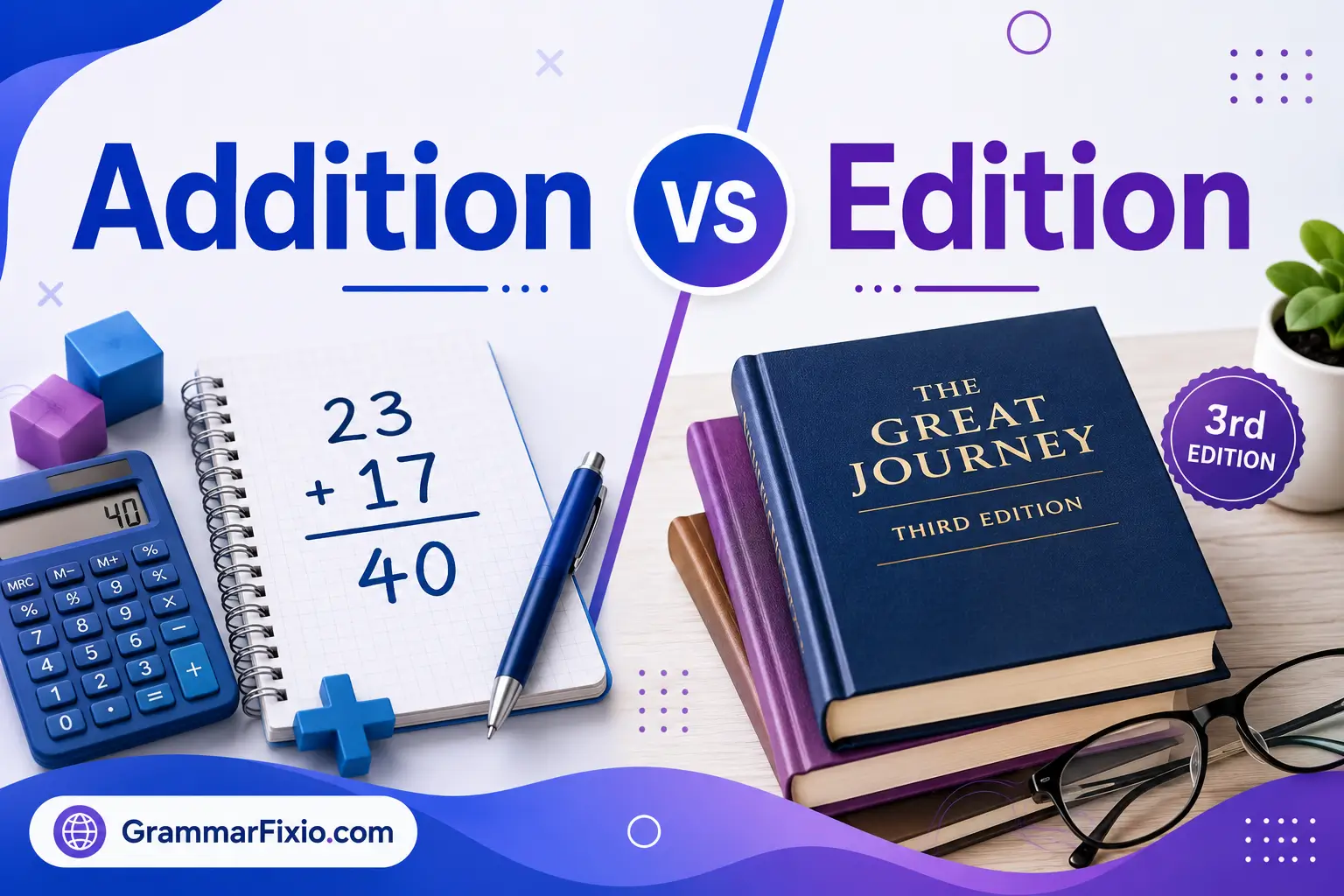
If Addition vs Edition has ever confused you, this guide will clarify the difference in simple English with clear examples for everyday use. Addition meaning is the act of adding, an added sum, or an increase. It is a noun used in mathematical and practical contexts where two or more numbers, quantities, parts, members, items, or sets are joined to form new groups, structures, and features through inclusion in classroom lessons, scenarios, or complex calculations.
Edition meaning refers to a version of a book, software, magazine, or other media. In publishing, production, and broadcasting, every publication, journal, newspaper, online-edition, digital-edition, printed-edition, printed-version, or print-copy follows versioning, release, issue, issue-release, release-date, and schedules. Radio, television, programs, news, broadcasts, editorial, journalistic, and published-material content must maintain an identical number, issue-number, and collection to keep readers informed.
Many writers, students, and professionals search this term because the similar words have related meanings but diverge in context. Knowing the subtle differences helps prevent mistakes in academic citations, workplace communication, updates, and blog content. If you have paused mid-sentence over spelling, remember Charles and the first edition of a history book. That simple example shows how homophones with similar sounds can be spelled differently. Follow the latest, fully updated rules, usage, tips, and insights to write correctly, confidently, and avoid confusion.
Quick Answer: What Is the Difference Between Addition and Edition?
The main difference is simple:
- Addition means something added or the process of adding.
- Edition means a particular version, issue, or published release.
Compare these examples:
- The new conference room is an addition to the office.
- We ordered the newest edition of the training manual.
In the first sentence, a room was added to a building. In the second, edition identifies a specific version of a publication.
Addition connects to add. Edition connects to edit or version.
Addition vs Edition Comparison Table
| Feature | Addition | Edition |
| Main meaning | Something added or the act of adding | A particular version or release |
| Part of speech | Noun | Noun |
| Pronunciation | /əˈdɪʃən/ | /ɪˈdɪʃən/ or /əˈdɪʃən/ in reduced speech |
| Word family | Add, added, additional | Edit, editor, edited |
| Common contexts | Math, buildings, families, teams, features | Books, newspapers, software, broadcasts, products |
| Singular form | addition | edition |
| Plural form | additions | editions |
| Key question | What was added? | Which version or release? |
| Example | The patio is a new addition. | This is the third edition. |
Because the words sound close in everyday speech, meaning and context provide the best guide.
Read this also: Choose vs Chose: Clear Difference, Rules & Easy Examples
What Does Addition Mean?
Addition is a noun connected to the verb add. It can name an action, a result, a new item, a math operation, or a building extension.
Addition as the Act of Adding Something
In its broadest sense, addition means the process of including something new.
- The addition of security cameras improved safety.
- We approved the addition of two questions to the survey.
- The addition of more examples made the lesson clearer.
- Her report improved after the addition of supporting evidence.
A common pattern is:
the addition of + noun
For example:
- the addition of a feature
- the addition of a name
- the addition of a service
- the addition of new data
This structure focuses on the action of adding something.
Addition as Something Newly Added
Addition can also name the person, object, feature, or improvement that has been added.
- Maya is a welcome addition to the team.
- The reading lamp is a useful addition to the room.
- This painting is the latest addition to the collection.
- Their newborn is the newest addition to the family.
In these sentences, the word refers to the new item or person, not the process.
The phrase a welcome addition is especially common. It means that the added person or thing is useful, pleasant, or valuable.
- The new bus route is a welcome addition to the neighborhood.
- Online appointment scheduling is a welcome addition to the clinic’s website.
Addition in Mathematics
In mathematics, addition is the operation of combining numbers or quantities to find a total.
For example:
4 + 3 = 7
In this equation:
- 4 and 3 are numbers being added.
- The plus sign shows addition.
- 7 is the sum or total.
Natural examples include:
- Students learn addition before multiplication.
- Check your addition before submitting the worksheet.
- The calculator can perform basic addition and subtraction.
Here, addition is usually uncountable because it names a general process or school subject.
Addition as a Building Extension
In American English, an addition can be a room or section attached to an existing building.
- The homeowners built an addition behind the kitchen.
- The school’s new science wing is almost finished.
- Our office addition includes three meeting rooms.
- They converted the garage and added a second-story addition.
A building addition remains connected to the original structure. Therefore, a separate shed or detached guesthouse may not be described as an addition.
“In Addition” as a Transition
The phrase in addition means also, furthermore, or besides that. It introduces another related point.
- The plan is affordable. In addition, it is easy to manage.
- The course teaches grammar. In addition, students practice pronunciation.
- The apartment is spacious and, in addition, close to downtown.
When in addition begins a sentence, place a comma after it.
Correct:
- In addition, the company offers free training.
Incorrect:
- In addition the company offers free training.
The comma helps separate the transition from the main sentence.
What Does Edition Mean?
Edition is a noun linked to publishing, releases, and versions. It identifies a specific form of a work or product.
Edition as a Version of a Published Work
A book’s edition is a particular published version. A new edition may contain corrections, new chapters, updated facts, or a redesigned layout.
Common phrases include:
- first edition
- second edition
- revised edition
- updated edition
- anniversary edition
- student edition
Examples:
- I bought the fourth edition of the biology textbook.
- The revised edition corrects several errors.
- Her first edition became valuable to collectors.
- This anniversary edition includes a new introduction.
A later printing isn’t always a new edition. A book can be printed again without major changes. However, publishers usually call it a new edition when the content has been revised or presented as a distinct version.
Edition as a Newspaper or Broadcast Issue
Edition can refer to a version of a newspaper prepared for a specific time, location, or audience.
- The story appeared in the morning edition.
- The Sunday edition includes a travel section.
- The regional edition contains local news.
- The digital edition is available online.
The word can also describe a particular broadcast or program installment.
- Tonight’s edition of the news begins at 6 p.m.
- The holiday edition of the show features former guests.
Edition in Software and Technology
Technology companies often use edition to distinguish product packages designed for different users.
Examples include:
- Standard Edition
- Professional Edition
- Student Edition
- Enterprise Edition
- Developer Edition
Each edition may contain a different set of features.
- The Professional Edition includes advanced reporting tools.
- Our school purchased the Student Edition.
- The Enterprise Edition supports larger organizations.
However, an update isn’t automatically a new edition. A software update may fix bugs or add a feature without changing the product’s official edition.
Special and Limited Editions
Retailers use edition for products released in a distinct form or limited quantity.
Common labels include:
- special edition
- limited edition
- collector’s edition
- deluxe edition
- commemorative edition
Examples:
- The studio released a collector’s edition of the movie.
- Only 500 limited-edition watches were produced.
- The deluxe edition includes bonus material.
- She bought a special-edition cover.
When limited edition appears before a noun, writers often hyphenate it:
- a limited-edition print
- a special-edition package
When the phrase follows the noun, a hyphen is usually unnecessary:
- The print is limited edition.
Addition vs Edition Pronunciation
These words are confusing partly because their pronunciation is very similar.
How to Pronounce Addition
Addition is pronounced /əˈdɪʃən/ in American English.
It has three syllables:
ad-di-tion
The middle syllable receives the stress:
uh-DI-shun
The first vowel is usually weak and sounds like uh.
How to Pronounce Edition
Edition is commonly pronounced /ɪˈdɪʃən/.
It also has three syllables:
e-di-tion
The stress falls on the middle syllable:
ih-DI-shun
In fast speech, the first vowel may become very weak. As a result, addition and edition can sound almost identical.
Why Context Matters More Than Sound
Both words end with the same -dition sound. Their first vowels are unstressed, so speakers may not pronounce them clearly.
Compare these phrases:
- an addition to the house
- an edition of the book
- the latest addition to the team
- the latest edition of the newspaper
The surrounding words usually reveal the meaning.
Use this short pronunciation drill:
- add an addition
- edit an edition
- new addition
- revised edition
- addition to the family
- edition of the textbook
Grammar and Word Forms
Both addition and edition are nouns. However, their related word families help explain their meanings.
Singular and Plural Forms
The plural forms are regular:
- addition → additions
- edition → editions
Examples:
- The renovation includes two new additions.
- The publisher released several editions.
- Recent additions improved the website.
- Older editions may contain outdated information.
Countable and Uncountable Uses of Addition
Addition can be either countable or uncountable.
It is countable when it refers to a specific thing or person:
- The porch is an addition.
- We welcomed three new additions to the staff.
It is often uncountable when it refers to the general process or math operation:
- Addition is easier than division for many beginners.
- The addition of new evidence changed the discussion.
Edition as a Countable Noun
Edition is normally countable because it identifies a specific version.
- an edition
- one edition
- three editions
- the latest edition
- several regional editions
Correct:
- I own two editions of the novel.
Incorrect:
- I own two edition of the novel.
A plural number requires the plural noun editions.
Related Word Families
| Root idea | Noun | Verb | Adjective or adverb |
| Add | addition | add | additional, additionally |
| Edit | edition, editor | edit | edited, editorial |
The add family includes:
- add
- added
- adding
- addition
- additional
- additionally
The edit family includes:
- edit
- edited
- editing
- editor
- editorial
- edition
This family connection provides one of the best ways to choose the right word.
The Key Difference Between Addition and Edition
The fastest way to choose correctly is to ask one question.
Addition Answers “What Was Added?”
Use addition when the sentence refers to something new joining an existing group, place, document, or system.
- A new employee joined the team.
- A room was added to a house.
- A feature was added to an app.
- More evidence was included in a report.
In each case, addition fits because something was added.
Edition Answers “Which Version?”
Use edition when the sentence identifies a particular version, release, or issue.
- Which version of the textbook?
- Which newspaper release?
- Which software package?
- Which collector’s product?
Examples:
- the second edition of a guide
- the evening edition of a newspaper
- the Professional Edition of a program
- a limited edition poster
The Add-or-Edit Test
Try replacing the confusing word with add or version.
- Is it something you add? Use addition.
- Is it a published or released version? Use edition.
Compare:
- The glossary is an addition to the book.
- The revised book is a new edition.
The glossary was added. The book itself was released as a new version.
Latest Addition vs Latest Edition
Both phrases are correct, but they mean different things.
When to Use “Latest Addition”
Latest addition means the newest person or thing added to a group, collection, place, or system.
- Our puppy is the latest addition to the family.
- This painting is the latest addition to the gallery.
- Voice search is the latest addition to the app.
- Jordan is the latest addition to the sales team.
The focus is on joining or being added.
When to Use “Latest Edition”
Latest edition means the newest released or published version.
- I ordered the latest edition of the dictionary.
- The latest edition includes updated statistics.
- She reads the latest edition of the newspaper online.
- The latest software edition offers more security tools.
The focus is on a version or release.
| Phrase | Meaning | Example |
| latest addition | Newest thing or person added | Mia is the latest addition to our team. |
| latest edition | Newest published or released version | This is the latest edition of the manual. |
Addition and Edition in Everyday American English
The two nouns appear in school, work, technology, publishing, and daily conversation.
School and Academic Writing
Students may encounter both words in the same course.
- The class practiced addition and subtraction.
- A new source was a valuable addition to the essay.
- The professor assigned the eighth edition of the textbook.
- The newest edition includes revised exercises.
An academic source may also list an edition number in a citation. That number identifies the exact version used.
Workplace Communication
At work, addition often describes people, requirements, or features.
- Alex is a strong addition to the department.
- The client requested the addition of a payment option.
- This chart is a useful addition to the report.
Meanwhile, edition may identify manuals, software packages, or publications.
- Please use the revised edition of the handbook.
- Our team uses the Enterprise Edition.
- The digital edition is easier to search.
Publishing and Journalism
Publishing creates a clear distinction between these words.
- The author made an addition to Chapter 4.
- The publisher released a new edition.
- A photo was added to the digital edition.
- The morning edition carried the breaking story.
A single project can involve both concepts. Something may be added to a work, and that updated work may then become a new edition.
Technology and Software
In technology, addition names a new feature or capability.
- Dark mode is a useful addition to the app.
- The addition of two-factor authentication improved security.
- A search filter was the latest addition to the website.
Edition, by contrast, identifies a product package or released version.
- The Professional Edition includes automation tools.
- The Student Edition costs less.
- This limited edition device has a special design.
Family, Home, and Daily Life
Everyday examples also make the difference clear.
- Their baby is a new addition to the family.
- The house addition includes a bedroom and bathroom.
- That signed book is a valuable addition to her collection.
- He owns a first edition of the novel.
- They bought the collector’s edition of the game.
Common Phrases With Addition
In Addition
In addition adds another related statement.
- The room is bright. In addition, it has plenty of storage.
- The course is affordable. In addition, it offers flexible scheduling.
Use a comma when the phrase begins a sentence.
In Addition To
In addition to must be followed by a noun, pronoun, or -ing form.
Correct:
- In addition to math, she studies chemistry.
- In addition to the salary, the job offers health benefits.
- In addition to working full time, he attends college.
Incorrect:
- In addition to, the company offers training.
The phrase can’t stand alone with to. It needs an object.
A Welcome Addition
This phrase describes something useful or pleasant that has been added.
- The new playground is a welcome addition to the park.
- Her experience makes her a welcome addition to the team.
The Addition Of
This structure emphasizes the process or result of adding something.
- The addition of captions improved accessibility.
- The addition of a deadline made the request clearer.
An Addition to the Family
This phrase often refers to a baby, adopted child, new spouse, or pet.
- Their adopted dog is a happy addition to the family.
Common Phrases With Edition
First Edition
A first edition is the first published version of a work.
- He collects first-edition novels.
- She owns a first edition of the book.
Revised Edition
A revised edition contains corrections or changes.
- The revised edition has updated examples.
- Please use the revised edition for class.
Special Edition
A special edition is released with distinctive content, features, or design.
- The magazine published a special edition after the election.
- The special-edition package includes bonus items.
Limited Edition
A limited edition is produced in a restricted quantity or for a limited period.
- The artist created 100 limited-edition prints.
- This color is available only as a limited edition.
Digital and Print Editions
These phrases distinguish formats.
- The digital edition includes interactive links.
- The print edition arrived by mail.
Common Addition vs Edition Mistakes
Using Edition for Something Added
Incorrect:
- Maria is a welcome edition to the team.
Correct:
- Maria is a welcome addition to the team.
Maria joined the team. She wasn’t released as a version.
Using Addition for a Book Version
Incorrect:
- I bought the newest addition of the textbook.
Correct:
- I bought the newest edition of the textbook.
A textbook version is an edition.
Confusing a New Chapter With a New Edition
A chapter can be an addition to a book. However, the revised book may become a new edition.
Correct:
- The new chapter is an addition to the third edition.
Both words are correct because they perform different jobs.
Writing “In Edition” Instead of “In Addition”
Incorrect:
- In edition, the office will close early.
Correct:
- In addition, the office will close early.
In addition is the standard transition meaning “also.”
Confusing Additional and Edition
Additional is an adjective meaning extra or added.
- We need additional information.
- The course includes additional exercises.
Edition is a noun meaning version.
- This edition contains additional exercises.
Treating Them as Regional Spellings
Addition and edition aren’t American and British spelling alternatives. Both words exist in both varieties of English.
The difference is meaning, not region:
- Addition = something added
- Edition = a version or release
Correct and Incorrect Examples
| Incorrect sentence | Correct sentence | Explanation |
| Our puppy is the newest edition to the family. | Our puppy is the newest addition to the family. | The puppy was added to the family. |
| I need the latest addition of the textbook. | I need the latest edition of the textbook. | The sentence refers to a published version. |
| The office edition will add two rooms. | The office addition will add two rooms. | A building extension is an addition. |
| In edition, we hired another designer. | In addition, we hired another designer. | The transition phrase is in addition. |
| This is a useful edition to the report. | This is a useful addition to the report. | New report content is an addition. |
| The collector’s addition includes a poster. | The collector’s edition includes a poster. | A special product version is an edition. |
| The morning addition reported the storm. | The morning edition reported the storm. | Newspapers have editions. |
| The software’s newest addition targets businesses. | The software’s newest edition targets businesses. | Use edition when identifying a product package. |
| The feature is in the latest addition of the app. | The feature is in the latest edition of the app. | The app version is an edition; the feature itself is an addition. |
| We practiced edition in math class. | We practiced addition in math class. | Combining numbers is addition. |
How to Choose the Correct Word
Use this simple process:
- Ask whether something was added.
- If yes, choose addition.
- Ask whether the sentence refers to mathematics.
- If yes, choose addition.
- Ask whether it describes a room attached to a building.
- If yes, choose addition.
- Ask whether it refers to a version, issue, package, or release.
- If yes, choose edition.
- Connect addition to add.
- Connect edition to edit or version.
Consider these quick tests:
- New employee? Addition
- New room? Addition
- Math operation? Addition
- New book version? Edition
- Newspaper release? Edition
- Software package? Edition
Easy Memory Tricks for Addition vs Edition
Find “Add” in Addition
The spelling begins with add:
add + ition = addition
Use this memory line:
An addition is something you add.
Connect Edition With Edit
The words edition, edit, and editor belong to the same family.
Use this memory line:
An edition is a version that may have been edited.
Use the Object-or-Version Test
- New object, person, room, feature, or fact = addition
- New version, issue, release, or package = edition
Remember the Family and Book Example
- A new baby is an addition to the family.
- A revised textbook is a new edition.
This pair covers the main difference in two familiar situations.
Synonyms and Related Words
Synonyms can clarify meaning, although no single synonym works in every sentence.
Synonyms for Addition
Depending on context, addition may relate to:
- inclusion
- increase
- supplement
- extension
- extra
- expansion
- contribution
- annex
Examples:
- a building addition = an extension
- an addition to a report = a supplement or inclusion
- a team addition = a new member
- an addition to a collection = a new item
Synonyms and Related Terms for Edition
Possible related words include:
- version
- issue
- release
- printing
- publication
- revision
- format
- installment
Examples:
- a book edition = a published version
- a newspaper edition = an issue or release
- a software edition = a product version
- a collector’s edition = a special release
Addition vs Additional
Addition is a noun. Additional is an adjective.
- The new chart is an addition to the report.
- The report contains additional charts.
In the first sentence, addition names the new item. In the second, additional describes the charts.
Edition vs Version
Version is broader than edition.
A version can refer to almost any form of something:
- a version of a story
- a version of a plan
- a version of an app
- someone’s version of events
An edition is usually a formally identified publication, product package, issue, or release.
- the third edition of a textbook
- the regional edition of a newspaper
- the Enterprise Edition of software
Not every revision becomes a new edition. For example, correcting one typo in an online article creates an updated version, but publishers may not call it a new edition.
Edition vs Issue
Issue and edition overlap in journalism, but they aren’t always identical.
An issue usually refers to one numbered or dated release of a magazine, journal, or newspaper.
- the July issue
- the latest journal issue
An edition may identify a version prepared for a specific time, region, audience, or format.
- the evening edition
- the international edition
- the digital edition
A single publication may have several editions of the same issue.
Formal, Informal, and Professional Usage
Formal and Academic English
Precise word choice matters in academic writing.
Use addition for:
- new evidence
- extra sections
- mathematical processes
- supplementary information
Use edition for:
- textbooks
- reference books
- source versions
- published materials
Examples:
- The addition of recent data strengthens the argument.
- The eighth edition contains revised citation guidance.
- Please identify the edition used in your research.
Professional Communication
Both words appear naturally in workplace writing.
- The addition of live chat improved customer support.
- Simone is a valuable addition to the department.
- Review the updated edition of the employee handbook.
- The Enterprise Edition includes advanced controls.
These examples are formal enough for emails, reports, and presentations.
Casual Conversation
The words also appear in everyday speech.
- Our cat is the newest addition to the family.
- The house addition should be ready next month.
- I bought the latest edition yesterday.
- That’s a limited edition, so it may sell out.
Real-Life Communication Example
Imagine that a manager sends this message:
The latest addition of the employee handbook includes a new remote-work policy.
The intended meaning is clear, but addition is incorrect because the manager is discussing a released version of the handbook.
Correct:
The latest edition of the employee handbook includes a new remote-work policy.
However, the policy itself is an addition to the handbook.
A more detailed sentence can use both words:
The remote-work policy is an important addition to the latest edition of the employee handbook.
This example shows how meaning determines the correct choice. The policy was added, while the handbook is a published version.
Practice: Choose Addition or Edition
Fill in each blank with addition, edition, additional, or in addition.
- The students practiced ________ during math class.
- Our new puppy is a cheerful ________ to the family.
- The house ________ includes a larger kitchen.
- I ordered the latest ________ of the dictionary.
- The Sunday ________ contains extra puzzles.
- The Professional ________ offers advanced tools.
- Dark mode is a useful ________ to the app.
- She bought a collector’s ________ of the game.
- The new appendix is an ________ to the report.
- ________, the hotel offers free parking.
- We need ________ information before deciding.
- The revised ________ contains two new chapters.
Practice Answers and Explanations
- Addition: The sentence refers to the math operation.
- Addition: The puppy joined the family.
- Addition: A building extension is an addition.
- Edition: A dictionary version is an edition.
- Edition: Newspapers release editions.
- Edition: The sentence identifies a software package.
- Addition: A new feature was added.
- Edition: The game is a distinct product release.
- Addition: The appendix was added to the report.
- In addition: The phrase introduces another point.
- Additional: The adjective describes information.
- Edition: The sentence refers to a revised book version.
See this also: Benefited vs Benefitted: Which Spelling Is Correct?
FAQs
Addition means adding something, while edition means a particular version of a published work or product.
Yes. Addition is one of the basic mathematical operations used to find the sum of two or more numbers.
An edition is a specific version of a book that may include updates, corrections, or new content.
They sound very similar but have different meanings, making them a common pair of confusing English words.
Yes. Software often has different editions, such as Home, Professional, or Enterprise editions.
No. Addition can also mean adding a room to a house, a new feature, or another item to a group.
Use edition because it refers to a specific published version of the magazine.
Use addition because it means something new has been added.
Think of addition as adding something and edition as a published version or release of a book, magazine, or software.
They are near-homophones because they sound very similar, but they are not pronounced exactly the same and have completely different meanings.
Conclusion
Choosing between Addition vs Edition becomes simple once you know what each word means. Addition is about adding something, such as numbers, objects, or new parts. Edition refers to a specific version of a book, magazine, newspaper, software, or other published content. Although these words sound similar, they have different meanings and should never be used interchangeably. Remember the context before you write, and you will avoid common spelling mistakes. With regular practice and real-life examples, using the correct word will soon become natural.




1 thought on “Addition vs Edition: Meaning, Grammar, Pronunciation, and Examples”