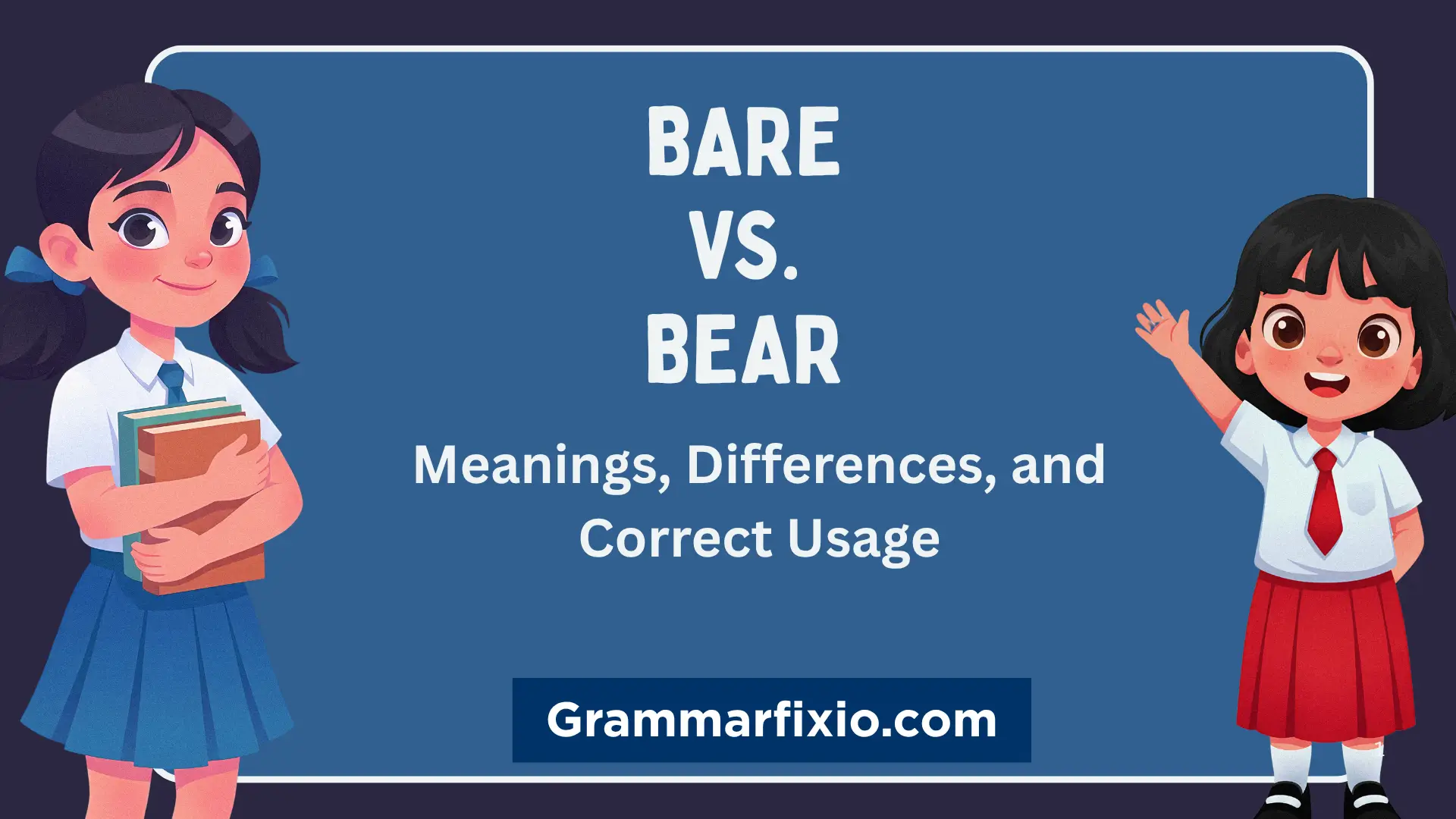
Bare vs. bear is a common spelling problem because both words have the same pronunciation. However, they have different meanings. Bare means uncovered, empty, plain, or exposed. Bear can refer to a large animal or mean to carry, support, tolerate, or produce something.
Knowing this difference helps you avoid mistakes in phrases such as bear with me, bare minimum, bear the burden, and bare feet. The key is to examine the sentence’s meaning before choosing the spelling.
This guide explains the definitions, parts of speech, verb forms, common expressions, and practical memory tricks. You’ll also see clear examples that make these homophones easier to use in conversations, emails, school assignments, and professional writing.
Quick Answer: What Is the Difference Between Bare and Bear?
Use bare when you mean uncovered, empty, plain, or exposed.
- The child ran across the grass in bare feet.
- The apartment had bare walls.
- The investigation bared the truth.
Use bear when you mean carry, support, tolerate, produce, or accept. It’s also the name of an animal.
- I can’t bear this noise.
- These columns bear the roof’s weight.
- Apple trees bear fruit.
- We saw a black bear in the woods.
Quick memory rule: If you mean uncovered, choose bare. If you mean carry or endure, choose bear.
Also read this: What Is It Called? Meaning, Usage & Common Grammar Confusions Explained
Bare vs. Bear at a Glance
| Word | Common grammar role | Main meanings | Example |
| Bare | Adjective | Uncovered, empty, plain, basic | The room had bare walls. |
| Bare | Verb | To uncover or expose | The dog bared its teeth. |
| Bear | Noun | A large mammal | A bear crossed the road. |
| Bear | Verb | To carry, support, endure, produce, or accept | I can’t bear the pressure. |
Both words are pronounced like “bair.” Therefore, pronunciation won’t help you choose the correct spelling. You must look at the word’s meaning and role in the sentence.
Why Are Bare and Bear So Easy to Confuse?
Bare and bear are homophones. Homophones sound alike but have different spellings and meanings. Other examples include their and there, weather and whether, and right and write.
Because bare and bear sound identical, the mistake often appears in texts, emails, essays, and social media posts. A spelling checker may not flag it, either. Both are correctly spelled English words.
Consider these sentences:
- Please bear with me while I find the file.
- Please bare with me while I find the file.
The second sentence contains a real word, so software may accept it. However, bare means uncover. The writer wants the reader to remain patient, so bear is correct.
Context provides the answer. Ask what the word means before deciding how to spell it.
What Does Bare Mean?
Bare most often means uncovered, exposed, empty, plain, or lacking something. It can function as an adjective or a verb.
Bare as an Adjective
As an adjective, bare describes a noun. Its exact meaning depends on what it describes.
Uncovered or Not Clothed
Bare can describe a body part that has no covering.
- He walked along the beach in bare feet.
- Her bare arms became cold.
- Never touch broken glass with your bare hands.
In each sentence, bare means uncovered. The feet have no shoes, the arms have no sleeves, and the hands have no protective covering.
Empty or Without the Usual Contents
The word can also describe a place with very little in it.
- The kitchen shelves were almost bare.
- After the move, the office looked bare.
- By Friday, the refrigerator was bare.
Here, bare doesn’t mean physically uncovered. Instead, it means empty or nearly empty.
Plain or Without Decoration
Something bare may lack decoration, added detail, or comfort.
- The rental had bare white walls.
- His desk contained only the bare essentials.
- The cabin’s interior was simple and bare.
This meaning often appears in descriptions of rooms, designs, and living conditions.
Basic or Only Just Enough
Bare can mean the smallest amount needed.
- The family survived on the bare minimum.
- We packed only the bare necessities.
- The proposal gives the bare facts but no explanation.
The idea is not complete emptiness. Rather, only the most basic amount remains.
Leafless or Without Its Usual Covering
Nature writing often uses bare for trees or land.
- The trees stood bare through the winter.
- Snow covered the bare ground.
- A bird rested on a bare branch.
In these cases, leaves, grass, or another normal covering is missing.
Bare as a Verb
As a verb, bare means to uncover, reveal, or expose something.
- The dog bared its teeth.
- She bared her feelings during the conversation.
- The report bared serious problems in the system.
- He rolled up his sleeve and bared his arm.
The regular verb forms are:
| Verb form | Form of bare | Example |
| Base form | bare | Don’t bare your skin to the cold. |
| Third-person singular | bares | The dog bares its teeth when frightened. |
| Past tense | bared | The article bared the facts. |
| Past participle | bared | The truth was bared during the hearing. |
| Present participle | baring | The wolf was baring its teeth. |
Notice the spelling of baring. It contains one r. Barring, with two r’s, is a different word meaning “except for” or “preventing.”
- Baring his arm, Luis showed us the bruise.
- Barring bad weather, the game will begin at noon.
Bare as an Informal Adverb
In some varieties of informal British English, bare may mean “very” or “a lot of.” For example, someone might say that a party had “bare people.”
However, this use isn’t standard in formal American English. US readers may find it confusing. In American academic or professional writing, choose a clearer term such as many, very, or a lot of.
What Does Bear Mean?
Bear can be a noun or a verb. As a noun, it usually refers to an animal. As a verb, it has several meanings, including carry, support, endure, produce, and accept.
Bear as a Noun
A bear is a large mammal with a heavy body, thick fur, strong legs, and a short tail.
- We saw a black bear near the campsite.
- The park ranger warned us not to feed the bears.
- A mother bear may defend her cubs.
The regular plural is bears.
The noun also appears figuratively. A difficult situation can be “a bear,” especially in casual American English.
- That final exam was a bear.
- Driving through the snow was a bear.
In finance, a bear expects prices to decline. A bear market is a market experiencing a broad, sustained fall in prices. This meaning contrasts with bull, which refers to someone expecting prices to rise.
Bear as a Verb
The verb bear has several related meanings. Most involve carrying, supporting, accepting, or producing something.
To Carry or Support Weight
Use bear when something holds or carries a physical load.
- The bridge can bear heavy traffic.
- These walls bear the weight of the roof.
- The shelf won’t bear another box.
In construction, a load-bearing wall supports weight from above. Removing one without proper support can damage the structure.
To Tolerate or Endure
Bear often means to accept or endure something difficult.
- I can’t bear the heat today.
- She could hardly bear the pain.
- He couldn’t bear to watch the final scene.
- We’ll have to bear the inconvenience for one more week.
This use is common in everyday American English. It can describe physical pain, strong emotions, annoying sounds, delays, or unpleasant situations.
To Accept Responsibility or a Burden
The word can express responsibility for an action, cost, or result.
- The company will bear the repair costs.
- Parents bear responsibility for the decision.
- Each department must bear part of the burden.
- The driver may bear legal responsibility for the crash.
This meaning appears often in professional, legal, and academic writing.
To Produce Something
Plants bear fruit, and actions may bear results.
- The peach tree will bear fruit next summer.
- Their hard work finally bore fruit.
- The research may bear useful results.
- Some plants don’t bear flowers until their second year.
The phrase can be literal or figurative. Literally, a plant produces fruit. Figuratively, an effort produces a result.
To Give Birth
In formal or traditional usage, bear can mean to give birth to a child.
- She bore three children.
- The queen bore an heir.
- He was born in Chicago.
Modern speakers rarely use this sense in casual conversation. However, it still appears in historical, formal, religious, and literary writing.
To Display or Have a Feature
Bear can mean to have, show, or carry a name, mark, or resemblance.
- The document bears her signature.
- The package bore no return address.
- The child bears a strong resemblance to his father.
- The old table bears several scratches.
Although the object may not literally carry something, it displays or possesses the feature.
Forms of the Verb Bear
Unlike bare, bear is an irregular verb. Its past tense isn’t beared.
| Verb form | Form of bear | Example |
| Base form | bear | I can’t bear the noise. |
| Third-person singular | bears | She bears the responsibility. |
| Past tense | bore | He bore the pain quietly. |
| Past participle | borne | The expense was borne by the company. |
| Past participle related to birth | born | She was born in California. |
| Present participle | bearing | The wall is bearing too much weight. |
One frequent mistake is using beared as the past tense.
- Incorrect: She beared the pressure well.
- Correct: She bore the pressure well.
Another mistake involves the present participle. Bearing has one r, while barring has two and carries a different meaning.
Born vs. Borne: Which Past Participle Is Correct?
Both born and borne come from bear, but they serve different purposes.
Use born when discussing birth.
- Maya was born in Boston.
- Three puppies were born last night.
- He is a born leader.
Use borne for other meanings of bear, including carried, supported, endured, or transmitted.
- The cost was borne by the employer.
- Seeds are borne by the wind.
- She had borne many hardships.
- Mosquito-borne illnesses can spread through bites.
The mother has borne a child, but the child was born. This difference focuses on perspective. Borne describes the mother’s act of carrying or giving birth. Born describes the child entering life.
| Meaning | Correct form | Example |
| Entering life | Born | I was born in 2001. |
| Giving birth or carrying a child | Borne | She had borne two children. |
| Carrying a cost | Borne | The fees were borne by the school. |
| Carried through air or water | Borne | The disease is waterborne. |
Key Differences Between Bare and Bear
The simplest difference lies in meaning.
| Intended meaning | Correct word | Example |
| Uncovered | Bare | He stood in bare feet. |
| Empty | Bare | The shelves were bare. |
| Plain or basic | Bare | We learned the bare facts. |
| To reveal | Bare | She decided to bare the truth. |
| An animal | Bear | A bear approached the river. |
| To tolerate | Bear | I can’t bear the smell. |
| To support | Bear | The beam can bear the load. |
| To produce | Bear | These trees bear fruit. |
| To accept responsibility | Bear | You must bear the consequences. |
Try replacing the confusing word with a synonym.
- If uncovered, empty, plain, or expose fits, use bare.
- If carry, endure, support, produce, or accept fits, use bear.
Common Phrases That Use Bare
Several familiar expressions always use bare because they involve exposure, emptiness, or a basic amount.
Bare Minimum
The bare minimum is the smallest acceptable amount.
- He did the bare minimum needed to pass.
- The apartment contains only the bare minimum of furniture.
The expression is never bear minimum. Nothing is being carried or tolerated.
Bare Essentials
The bare essentials are only the most necessary items.
- Pack the bare essentials for the overnight trip.
- After the storm, the family lived with the bare essentials.
Bare Bones
The bare bones are the most basic facts, structure, or framework.
- The outline gives the bare bones of the proposal.
- We have the bare bones of a plan.
Although a bear has bones, the idiom is bare bones because the bones have been stripped of everything else.
Bare Your Soul
To bare your soul means to reveal your private thoughts and feelings.
- She bared her soul to her closest friend.
- You don’t need to bare your soul in a work email.
Here, bare means expose. The phrase can sound sincere, emotional, or dramatic.
Bare Your Teeth
To bare your teeth means to uncover and display them. Animals may do this as a warning. People can also use the phrase figuratively to describe aggression.
- The frightened dog bared its teeth.
- The two political rivals began to bare their teeth.
With Your Bare Hands
Doing something with your bare hands means using no gloves, tools, or protection.
- Don’t pick up broken glass with your bare hands.
- He dug through the soft soil with his bare hands.
Lay Bare
To lay bare means to expose or reveal something clearly.
- The audit laid bare years of financial mismanagement.
- Her testimony laid bare the weaknesses in the policy.
This phrase often appears in news reports, analysis, and formal writing.
Common Phrases That Use Bear
Expressions with bear usually connect to patience, endurance, responsibility, memory, or production.
Bear With Me
Bear with me means “be patient with me.”
- Please bear with me while I restart the computer.
- Bear with us as we update the website.
Writing bare with me accidentally asks someone to uncover themselves with you. That isn’t the intended message.
A Cross to Bear
A cross to bear is a difficult burden or lasting problem that someone must accept.
- Managing the condition became his cross to bear.
- Everyone has a cross to bear.
The phrase uses bear because the person carries a figurative burden.
Bear in Mind
Bear in mind means remember or consider.
- Bear in mind that the store closes at 8 p.m.
- Please bear in mind that prices may change.
This expression works in everyday conversation. However, it’s especially common in instructions, professional emails, and formal explanations.
Bear the Cost
To bear the cost means to pay or accept an expense.
- The landlord agreed to bear the cost of the repairs.
- Customers shouldn’t have to bear additional fees.
Bear Responsibility
To bear responsibility means to accept accountability for something.
- Managers bear responsibility for workplace safety.
- Both parties bear some responsibility for the error.
The phrase commonly appears in business, law, politics, and academic discussion.
Bear Witness
To bear witness means to testify, confirm, or show evidence of something.
- Several residents bore witness to the event.
- The damaged buildings bear witness to the storm’s force.
A person can bear witness by describing what happened. An object can also bear witness figuratively by serving as evidence.
Bear Fruit
To bear fruit means to produce a successful result.
- Months of practice finally bore fruit.
- The negotiations haven’t borne fruit yet.
This expression comes from the literal idea of a tree producing fruit.
Bear a Resemblance
To bear a resemblance means to look or seem similar.
- Ava bears a strong resemblance to her mother.
- The new design bears little resemblance to the original.
Bear Down
Bear down has several meanings. It may mean to apply pressure, focus intensely, or make a strong effort.
- The defense began to bear down on the quarterback.
- We need to bear down and finish the project.
- The storm bore down on the coast.
In childbirth, the phrase may refer to pushing. The intended sense depends on context.
Grin and Bear It
To grin and bear it means to accept an unpleasant situation without complaining.
- The meeting lasted three hours, so we had to grin and bear it.
- I dislike the noise, but I’ll grin and bear it today.
The correct word is bear because the person endures something.
Frequently Confused Bare and Bear Phrases
Some expressions create more confusion than others. This table gives the standard spelling and reason.
| Incorrect form | Correct form | Why |
| Bare with me | Bear with me | Bear means remain patient. |
| Bear minimum | Bare minimum | Bare means only the basic amount. |
| Bear bones | Bare bones | Bare means stripped down or basic. |
| Bear naked | Bare naked | Bare means uncovered. |
| Cross to bare | Cross to bear | Bear means carry a burden. |
| Bare down | Bear down | Bear means press or apply effort. |
| Bare the pain | Bear the pain | Bear means endure. |
| Bear your soul | Bare your soul | Bare means reveal. |
However, some pairs can both be correct because their meanings differ.
Bear Arms vs. Bare Arms
Bear arms means carry weapons.
- The law addresses the right to bear arms.
Bare arms are uncovered arms.
- She wore a sleeveless dress that left her bare arms exposed.
Bear Skin vs. Bare Skin
Bear skin means the skin or hide of a bear.
- The museum displayed an old bear skin.
Bare skin means uncovered human or animal skin.
- Apply sunscreen to any bare skin.
Bear Feet vs. Bare Feet
Bare feet means feet without shoes or socks.
- The children walked through the sand in bare feet.
Bear feet could literally refer to the feet of a bear, but that phrase is uncommon. In almost every everyday context involving a person, bare feet is correct.
Correct and Incorrect Examples
Studying errors in complete sentences makes the distinction easier to remember.
- Incorrect: Please bare with me while I check your order.
- Correct: Please bear with me while I check your order.
Why: The speaker is asking for patience. Therefore, bear is correct.
- Incorrect: She walked across the floor in bear feet.
- Correct: She walked across the floor in bare feet.
Why: Her feet were uncovered, so use bare.
- Incorrect: The apple tree will bare fruit next year.
- Correct: The apple tree will bear fruit next year.
Why: The tree will produce fruit. Bear can mean produce.
- Incorrect: I can’t bare this headache much longer.
- Correct: I can’t bear this headache much longer.
Why: The speaker can’t tolerate the headache.
- Incorrect: The dog bore its teeth at the mail carrier.
- Correct: The dog bared its teeth at the mail carrier.
Why: The dog exposed its teeth. The past tense of bare is bared.
- Incorrect: She beared the loss with courage.
- Correct: She bore the loss with courage.
Why: Bear is irregular. Its past tense is bore, not beared.
- Incorrect: The room looked bear after the furniture was removed.
- Correct: The room looked bare after the furniture was removed.
Why: The room was empty and undecorated.
- Incorrect: The label bares a warning.
- Correct: The label bears a warning.
Why: The label carries or displays the warning.
Bare vs. Bear in Real-Life American English
The correct choice matters in casual and formal situations. A single letter can change the meaning of your message.
Text Messages and Social Media
In casual writing, bear with me is one of the most frequently misspelled phrases.
Suppose you text:
Bear with me I’m stuck in traffic and will be there soon.
You’re asking for patience. If you write bare with me, the message may sound unintentionally funny because bare suggests removing a covering.
School and Academic Writing
Students often use phrases such as bear in mind, bear evidence, and lay bare.
- Bear in mind that the study used a small sample.
- The findings bear evidence of a broader pattern.
- The results lay bare a weakness in the earlier theory.
In academic work, check the precise meaning. Bear often relates to carrying, showing, or supporting evidence. Bare relates to exposing information.
Workplace Emails
Professional messages frequently request patience or discuss responsibility.
- Please bear with us during the system update.
- The supplier will bear the shipping cost.
- The report bears the director’s signature.
- The audit laid bare several accounting errors.
The wrong word may not prevent understanding. Still, correct usage makes the message look more polished and credible.
News and Formal Writing
Journalists and professional writers often use both words figuratively.
- The investigation laid bare failures in the system.
- Taxpayers may bear the cost of the repairs.
- The building still bears the marks of the fire.
- Witnesses described the bare facts of the case.
These expressions pack meaning into a few words. However, each spelling depends on the underlying idea: exposing something calls for bare, while carrying or displaying calls for bear.
Synonyms for Bare and Bear
Synonyms can help you test the intended meaning. However, not every synonym works in every sentence.
Synonyms for Bare
When bare is an adjective, possible alternatives include:
- Uncovered
- Exposed
- Naked
- Empty
- Plain
- Undecorated
- Basic
- Minimal
- Leafless
When bare is a verb, alternatives include:
- Expose
- Reveal
- Uncover
- Disclose
- Show
For example, “She bared the truth” can become “She revealed the truth.”
Synonyms for Bear
The correct synonym depends on the verb’s meaning:
- Carry
- Support
- Hold
- Endure
- Tolerate
- Withstand
- Accept
- Produce
- Display
- Give birth to
For example, “I can’t bear the noise” means “I can’t tolerate the noise.” Meanwhile, “The wall bears the load” means “The wall supports the load.”
Related Words and Forms
Several similar-looking words deserve attention.
| Word | Meaning | Example |
| Bared | Uncovered or revealed | He bared his arm. |
| Baring | Uncovering or revealing | The dog was baring its teeth. |
| Bore | Past tense of bear | She bore the hardship bravely. |
| Born | Brought into life | He was born in Ohio. |
| Borne | Carried, supported, or endured | The cost was borne by taxpayers. |
| Bearing | Carrying, supporting, relating to, or direction | The beam is bearing the load. |
| Barring | Except for or preventing | Barring delays, we’ll arrive at six. |
Pay close attention to baring, bearing, and barring. All three sound similar, but each carries a separate meaning.
- Baring means exposing.
- Bearing comes from bear.
- Barring means excluding or preventing.
Grammar Tips for Choosing the Right Word
A few quick tests can help you make the correct choice.
Check the Meaning
Ask what the sentence communicates.
- Uncovered, empty, or exposed? Choose bare.
- Carry, support, tolerate, or produce? Choose bear.
- A large animal? Choose bear.
Try a Substitute
Replace the word with a simpler synonym.
- “I can’t tolerate it” becomes “I can’t bear it.”
- “She revealed her feelings” becomes “She bared her feelings.”
- “The empty shelves” becomes “The bare shelves.”
If the substitute makes sense, you’ve probably found the correct spelling.
Identify the Part of Speech
If the word describes a noun, bare may be an adjective.
- Bare walls
- Bare feet
- Bare branches
If it names an animal, it’s the noun bear.
If it describes carrying, enduring, producing, or displaying, it’s the verb bear.
Check the Verb Form
Remember the two patterns:
- Bare, bared, bared
- Bear, bore, borne
Using the correct base word with the wrong verb form still creates an error.
A Simple Memory Trick for Bare vs. Bear
Connect bare with bare skin. Both refer to something uncovered.
Then picture a bear carrying a heavy backpack. The animal helps you connect bear with carrying or enduring a burden.
You can also use this short reminder:
Bare exposes; bear carries.
This rule covers many common phrases:
- Bare your soul because you expose your feelings.
- Bear the burden because you carry it.
- Bare walls lack covering.
- Bear the cost means accept the expense.
Bare vs. Bear Practice Exercise
Choose the correct word or form for each sentence.
- Please (bare/bear) with us during the delay.
- The child ran outside in (bare/bear) feet.
- This beam can’t (bare/bear) much weight.
- The trees stood (bare/bear) after the leaves fell.
- She couldn’t (bare/bear) the thought of leaving.
- The investigation (bared/bore) several hidden problems.
- Their efforts finally (bared/bore) fruit.
- He was (born/borne) in New York.
- The expense was (born/borne) by the organization.
- The dog was (baring/bearing) its teeth.
- The package (bares/bears) a warning label.
- We took only the (bare/bear) essentials.
Answers and Explanations
- Bear — It means remain patient.
- Bare — The child’s feet were uncovered.
- Bear — The beam supports weight.
- Bare — The trees had no leaves.
- Bear — She couldn’t tolerate the thought.
- Bared — The investigation exposed the problems.
- Bore — The efforts produced results.
- Born — Use born for someone entering life.
- Borne — The organization carried the expense.
- Baring — The dog was exposing its teeth.
- Bears — The package carries or displays the label.
- Bare — Only the most basic items were taken.
Also read this: Which vs Witch: What’s the Difference? (Meaning, Examples & Easy Rules)
Frequently Asked Questions About Bare vs. Bear
Bare means uncovered, empty, basic, or exposed. Bear names an animal or means to carry, support, endure, produce, or turn.
The correct phrase is bear with me. It means “be patient with me.”
Bare minimum is correct because it means the smallest necessary or acceptable amount.
Write too much to bear when something is difficult to tolerate or endure.
Bare hands means hands without gloves or protection. Bears have paws, so bear hands is normally incorrect.
Both can be correct. Bear arms means carry weapons, while bare arms means uncovered arms.
The correct expression is bare your soul because it means to reveal your private thoughts or feelings.
The simple past tense of bear is bore. Its usual past participle is borne, although born is used for birth.
Yes. Bare and bear are homophones because they sound alike but have different spellings and meanings.
Connect bare with “uncovered.” Connect bear with “burden” because both begin with b and involve carrying or enduring something.
Conclusion
Understanding bare vs. bear becomes easier when you connect each word with its main meaning. Use bare for something uncovered, exposed, empty, plain, or basic. It also works as a verb meaning to reveal, as in bare your soul.
Use bear for the animal or when you mean carry, support, endure, or produce. That’s why the correct expressions are bear with me, bear the burden, and bear fruit.
When you’re unsure, try a quick replacement test. If “uncovered” or “reveal” fits, choose bare. If “carry,” “tolerate,” or “support” fits, choose bear.