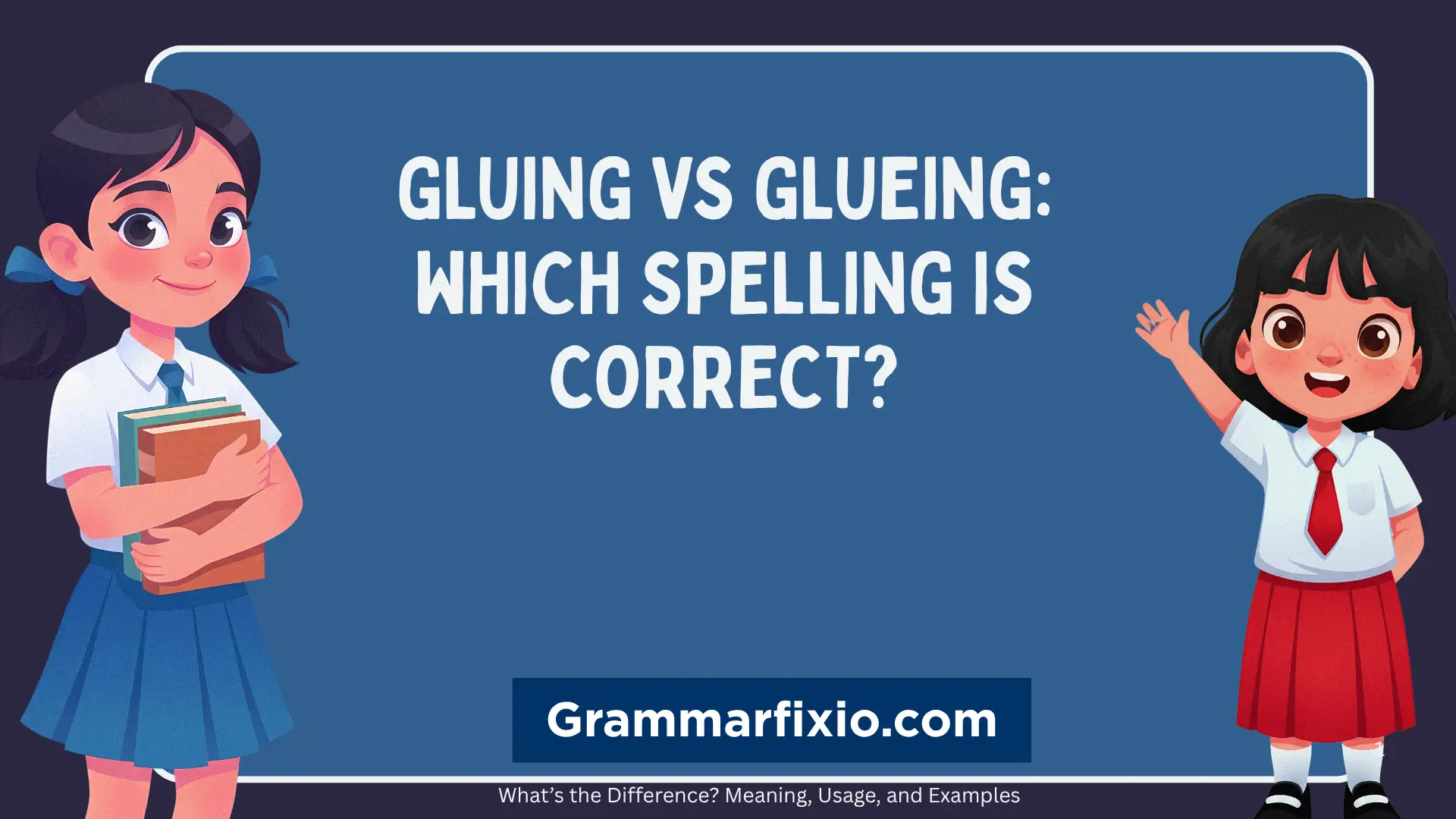
Gluing and glueing are both correct spellings, but gluing is the better choice for most modern writing.
Both words are present-participle forms of the verb glue, meaning to join or stick things together with an adhesive.
If you simply want to know which spelling to use, choose:
Gluing ✅
Glueing ✅ but less commonly used
Gluing vs Glueing: Quick Answer
| Spelling | Is It Correct? | Best Choice? | Meaning |
|---|---|---|---|
| Gluing | Yes | Yes — recommended for most writing | Joining or attaching something with glue |
| Glueing | Yes | Acceptable, but less commonly used | Same meaning as gluing |
The simplest rule
If you are writing an essay, blog post, email, instruction manual, DIY guide, school assignment, or professional document, use “gluing.”
You may encounter “glueing,” and it is not automatically a spelling error. Major dictionaries recognize both forms.
What Is the Difference Between Gluing and Glueing?
There is no difference in meaning between gluing and glueing.
The difference is mainly in spelling and usage preference.
Both describe the action of:
- Applying glue to something
- Sticking two objects together
- Joining materials with adhesive
- Attaching one item to another
- Combining things figuratively
For example:
Gluing:
She is gluing the paper to the cardboard.
Glueing:
She is glueing the paper to the cardboard.
Both sentences communicate the same meaning.
However, gluing is generally the clearer and more familiar spelling, which is why it is the form we recommend for most readers.
Also read this: GFN Meaning in Text: What Does GFN Mean in Texting and Social Media?
Is It Gluing or Glueing?
Both are correct, but gluing is usually preferred.
Cambridge Dictionary lists both glueing and gluing as present-participle forms of the verb glue. Collins Dictionary likewise recognizes both forms.
That means the question is not really:
“Which one is a real word?”
Instead, the better question is:
“Which spelling should I use?”
For most situations, the answer is gluing.
Why Is Gluing Spelled Without the E?
The spelling gluing follows a common English spelling pattern.
Many verbs ending in a silent e drop that final e before -ing is added.
Consider these examples:
| Base Verb | -ing Form |
|---|---|
| Make | Making |
| Write | Writing |
| Drive | Driving |
| Use | Using |
| Move | Moving |
| Glue | Gluing |
Following this pattern:
glue + ing → gluing
This is the easiest way to remember the preferred spelling.
But Why Does “Glueing” Exist?
English spelling contains many exceptions and alternative forms.
Although the usual pattern would give us gluing, the spelling glueing has also been used and is recognized by major dictionaries.
Keeping the e makes the relationship with the base word glue visually obvious:
glue → glueing
Dropping the e follows the more common spelling pattern:
glue → gluing
Because both forms developed in English usage, both can be considered valid.
Still, if consistency and readability are your priorities, gluing is the safer choice.
Gluing vs Glueing: Detailed Comparison
| Feature | Gluing | Glueing |
|---|---|---|
| Correct spelling | Yes | Yes |
| Meaning | Attaching with glue | Attaching with glue |
| Part of speech | Present participle / gerund | Present participle / gerund |
| Base word | Glue | Glue |
| Recommended for general writing | Yes | Less preferred |
| Suitable for academic writing | Yes | Possible, but less conventional |
| Suitable for professional writing | Yes | Possible |
| Meaning difference | None | None |
| Pronunciation difference | None | None |
| Best choice when unsure | Gluing | — |
What Does Gluing Mean?
Gluing means joining, fastening, or attaching something with glue or another adhesive.
It comes from the verb glue.
Examples
- She is gluing the photograph into her scrapbook.
- We are gluing the broken pieces together.
- He spent an hour gluing the wooden parts of the model.
- Always clean the surface before gluing the material.
- The children were gluing decorations onto their cards.
The word can also be used in a broader or figurative sense.
For example:
The editor spent the afternoon gluing several ideas into one coherent story.
Here, no actual adhesive is involved. Gluing means combining separate things into a whole.
Is Glueing a Word?
Yes, glueing is a word.
It is an alternative present-participle spelling of glue.
Therefore, it would be inaccurate to say that glueing is always wrong.
Major dictionaries recognize it.
However, if you are deciding between gluing or glueing, use gluing unless a particular publication, editor, style guide, or organization prefers otherwise.
Gluing or Glueing in American English
For American English writing, gluing is the best default choice.
You might write:
- I am gluing the pieces together.
- She is gluing the label onto the package.
- Avoid touching the material immediately after gluing it.
- He finished gluing the model last night.
Although glueing is recognized, gluing will normally look more natural to readers.
Gluing or Glueing in British English
Both forms can also be found in British English.
British dictionaries such as Cambridge and Collins recognize gluing and glueing.
So this spelling difference should not be treated as a simple rule such as:
American English = gluing
British English = glueing
That would be misleading.
A better rule is:
Use “gluing” as your default in both American and British English unless your style guide says otherwise.
Gluing vs Glued: What Is the Difference?
People searching for gluing vs glueing may also confuse gluing with glued.
The difference is grammatical.
| Word | Grammar | Example |
|---|---|---|
| Glue | Base verb | I will glue the pieces together. |
| Glues | Third-person present | She glues the pieces together. |
| Gluing | Present participle / gerund | She is gluing them together. |
| Glued | Past tense / past participle | She glued them together yesterday. |
Example
Present action:
Sarah is gluing the pieces together.
Past action:
Sarah glued the pieces together yesterday.
Gluing in a Sentence
Here are some natural examples of gluing in different contexts.
Crafts
The students are gluing colored paper onto their posters.
Woodworking
Properly gluing the joint can help create a strong bond.
DIY projects
Before gluing the pieces together, make sure both surfaces are clean.
Repair work
He tried gluing the broken handle back onto the cup.
Model making
She spent the evening cutting and gluing parts of the miniature house.
Packaging
The machine seals the package by gluing the cardboard edges together.
Glueing in a Sentence
Because glueing is an accepted variant, you may also see sentences such as:
- She is glueing the pieces together.
- He spent the afternoon glueing the model.
- They are glueing fabric onto the wooden frame.
These sentences are understandable and grammatically acceptable.
However, for most modern readers, we would write:
- She is gluing the pieces together.
- He spent the afternoon gluing the model.
- They are gluing fabric onto the wooden frame.
When Should You Use “Gluing”?
Use gluing when you want the most straightforward spelling for general English.
It is especially suitable for:
- Academic writing
- School assignments
- Blog articles
- Business communication
- DIY instructions
- Craft tutorials
- Woodworking content
- Product instructions
- Technical documentation
- General website content
If you are unsure, simply choose gluing.
When Can You Use “Glueing”?
You can use glueing because it is a recognized spelling variant.
It may appear in:
- Published writing
- Dictionary entries
- Regional usage
- Older texts
- Individual house styles
- Content where the writer prefers to retain the e from glue
However, consistency matters.
If you choose glueing, do not alternate randomly between gluing and glueing throughout the same document.
Common Mistakes With Gluing and Glueing
1. Saying that “glueing” is not a word
This is incorrect.
Glueing is recognized as an alternative spelling.
2. Assuming they have different meanings
They do not.
Gluing and glueing mean the same thing.
3. Assuming one is automatically British and the other American
The distinction is not that simple.
Both spellings can be recognized in English dictionaries.
4. Using both spellings inconsistently
Even when two spellings are acceptable, consistency improves readability.
Pick one spelling and stick with it.
5. Confusing “gluing” with “glued”
Gluing describes an ongoing action or the activity itself.
Glued normally refers to a completed or past action.
How to Remember Gluing vs Glueing
Here is an easy three-step trick.
- Start with glue.
- Drop the final e.
- Add -ing.
So:
GLUE → GLU + ING → GLUING
You can connect it with similar words:
- make → making
- move → moving
- use → using
- write → writing
- glue → gluing
Memory tip
When in doubt, drop the E and write “gluing.”
Gluing Together or Glueing Together?
Both phrases can be grammatically acceptable, but gluing together is the better default.
Recommended
We are gluing together the broken pieces.
Alternative
We are glueing together the broken pieces.
The meaning is identical.
Is It “Glueing Wood” or “Gluing Wood”?
Use gluing wood in most writing.
Example:
Properly gluing wood requires clean surfaces and suitable adhesive.
Similarly:
- gluing plastic
- gluing paper
- gluing fabric
- gluing metal
- gluing cardboard
Is It “Gluing Something” or “Glueing Something”?
Both can be correct.
However, gluing something is our recommended wording.
Example:
Make sure the surface is dry before gluing something onto it.
Is It “Gluing Together” or “Glueing Together”?
Gluing together is the preferred choice for general writing.
For example:
She is gluing together several pieces of cardboard.
The alternative spelling, glueing together, has the same meaning.
Quick Examples: Which Form Should You Choose?
| Sentence | Recommended Version |
|---|---|
| I am ___ the paper together. | gluing |
| She is ___ wood onto the frame. | gluing |
| They spent an hour ___ the model. | gluing |
| He finished ___ the decorations. | gluing |
| We are ___ two pieces together. | gluing |
Gluing vs Glueing: Final Verdict
Here are the five points worth remembering:
- Gluing is correct.
- Glueing is also recognized as a valid spelling.
- Both words have the same meaning.
- Gluing is the recommended choice for most modern writing.
- If you are unsure which spelling to use, choose gluing.
Final answer
Gluing vs glueing: both are correct, but “gluing” is the better spelling to use in most situations.
Also read this: BWC Meaning in Text: What Does BWC Mean in Texting and Social Media?
Frequently Asked Questions About Gluing vs Glueing
Both gluing and glueing are recognized spellings of the present participle of glue. Gluing is the better default for most writing.
Yes. Glueing is recognized by major English dictionaries as an alternative spelling of gluing.
Yes. Gluing is the present participle and gerund form of the verb glue.
Example:
She is gluing the pieces together.
For most school, professional, academic, online, and general writing, use gluing.
English commonly drops the final silent e before adding -ing. This gives us glue → gluing, similar to make → making and write → writing.
No. Glueing and gluing have the same meaning. The difference is spelling, not definition.
It can occur in British English, but it is misleading to say that glueing is exclusively British. Major British dictionaries recognize both gluing and glueing.
Gluing is commonly used in American English, but it is not exclusive to American English.
The recommended spelling is:
G-L-U-I-N-G
Gluing wood is the recommended phrase.
Example:
Clamping is often useful after gluing wood together.
Use gluing paper in most contexts.
Example:
The children were gluing paper onto the cardboard.
The recommended expression is gluing things together.
The past tense of glue is glued.
Example:
She glued the photograph to the card.
The most commonly recommended -ing form is gluing, although glueing is also recognized.
Use gluing unless your teacher, editor, or required style guide specifically prefers another form.
Remember this pattern:
glue → drop e → add ing → gluing
Related Words
Readers looking up gluing vs glueing may also find these terms useful:
- Glue
- Glued
- Glues
- Adhesive
- Adhere
- Attach
- Bond
- Cement
- Fasten
- Stick
- Join
- Paste
Sources and Editorial Note
Major dictionaries including Cambridge Dictionary and Collins English Dictionary recognize gluing and glueing as forms of the verb glue. For consistency and readability, this guide recommends gluing as the default spelling for general writing.