Ever struggled to remember someone’s name, even though it’s right on the tip of your tongue? You think harder, replay old conversations, and search your memory. Still, nothing comes to mind.
That’s exactly when you might say, “I’m racking my brain.”
But here’s where things get confusing. Should you write “racking” or “wracking”? Both spellings appear in English, leaving many people unsure which one to choose.
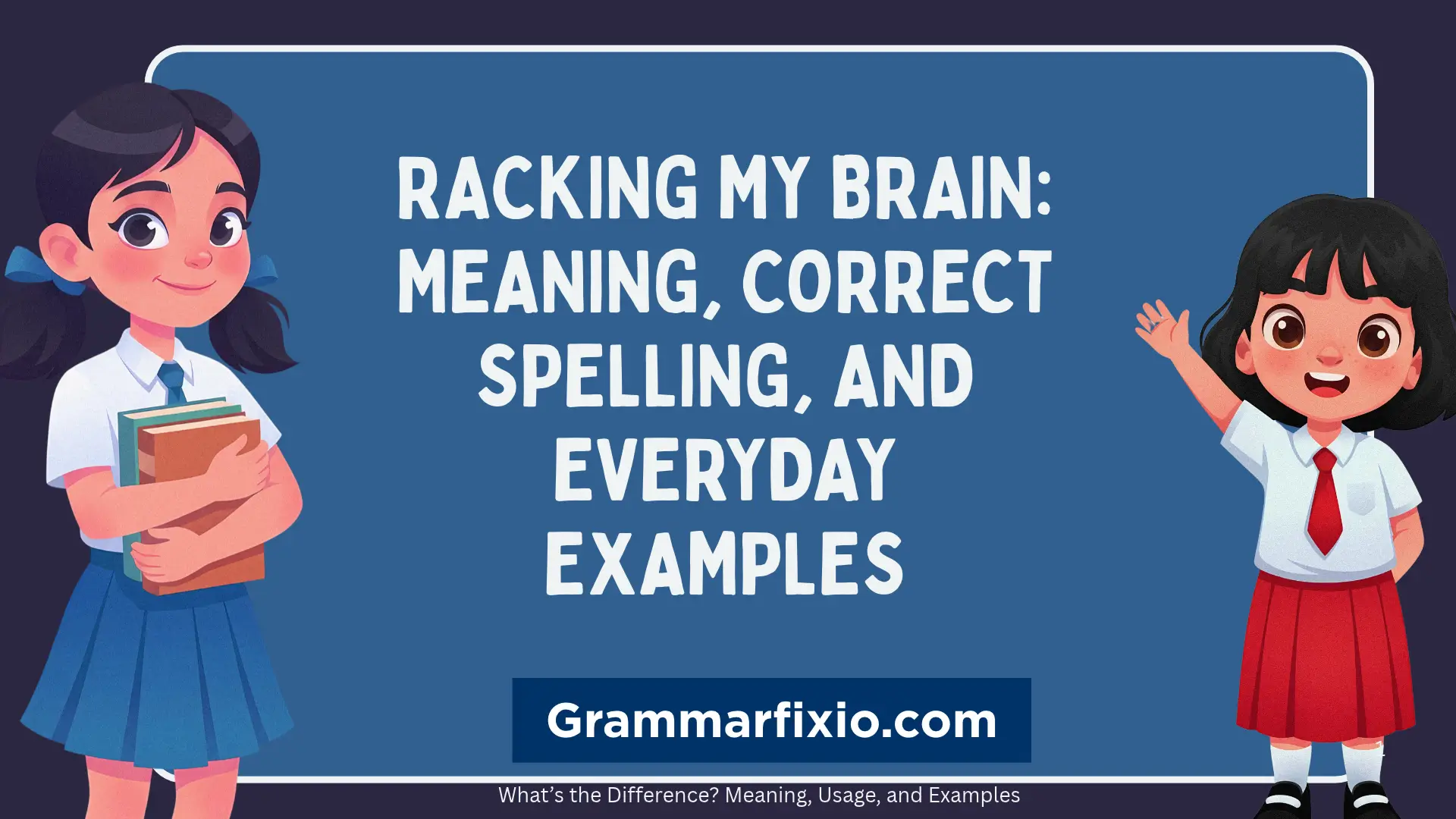
The expression describes intense mental effort, especially when you’re trying to remember something or solve a difficult problem. Understanding its meaning, spelling, and usage can make your English sound more natural.
What Does Racking My Brain Mean?
Racking my brain means thinking extremely hard to remember something, solve a problem, or develop an idea.
It’s an English idiom that emphasizes mental effort, frustration, or intense concentration.
For example:
“I’ve been racking my brain all morning trying to remember where I put my keys.”
The speaker isn’t experiencing physical harm. They’re simply struggling to recall something important.
People commonly use this expression in three situations.
Trying to Remember Something
When information seems just beyond reach, the idiom describes your effort to recall it.
Example: “I’m racking my brain trying to remember our teacher’s name.”
Solving a Difficult Problem
The expression also works when you’re searching for an answer.
Example: “We spent hours racking our brains over that math problem.”
Coming Up With an Idea
Creative challenges often demand intense thinking.
Example: “She’s racking her brain for a unique birthday surprise.”
In each situation, the expression suggests that finding an answer requires considerable effort.
Also read this: WTM Meaning in Text: What WTM Means and How to Use It
Is It Racking My Brain or Wracking My Brain?
The conventional spelling is “racking my brain.” However, “wracking my brain” also exists as a recognized variant.
Both expressions communicate essentially the same meaning.
| Feature | Racking My Brain | Wracking My Brain |
|---|---|---|
| Meaning | Thinking intensely | Thinking intensely |
| Status | Preferred spelling | Accepted variation |
| Pronunciation | Identical | Identical |
| Recommended use | General English writing | Less conventional alternative |
For school assignments, workplace communication, and general writing, choose racking.
Is Wracking My Brain Wrong?
Not necessarily.
English dictionaries document “wracking” as an alternative in this expression. However, many usage guides prefer “racking” because of the idiom’s historical connection with the verb “rack.”
Therefore, choosing “racking” avoids unnecessary spelling disputes.
Rack vs. Wrack: What’s the Difference?
Although these verbs sound identical, their traditional meanings differ.
Rack can mean to cause severe strain, suffering, or distress.
Wrack commonly relates to destruction, damage, or ruin.
Consider these examples:
| Word | Meaning | Example |
|---|---|---|
| Rack | Cause intense strain or suffering | “Guilt racked his mind.” |
| Wrack | Damage or devastate | “The storm-wracked coastline needed repairs.” |
| Rack | Make an intense mental effort | “She racked her brain for answers.” |
English usage also shows overlap between these spellings, particularly in expressions involving suffering.
That’s one reason people confuse them.
Where Did the Expression Come From?
The idiom connects with the historical word “rack,” which referred to a device that stretched the human body during torture.
Over time, the verb developed figurative meanings involving extreme physical or emotional strain.
People eventually applied that imagery to difficult mental effort.
When someone says they’re “racking their brain,” they’re figuratively describing the strain of searching for an answer.
The alternative spelling “wracking” developed through overlapping meanings and pronunciation. It isn’t merely a modern internet error.
Also read this: OTG Meaning in Text: What Does OTG Mean in Messages and Chat?
How to Use Racking My Brain in a Sentence
The expression changes according to the speaker and situation.
Its basic structure is:
Subject + form of rack + possessive word + brain
You can also add “for” or “trying to” when explaining the purpose.
Everyday Conversation Examples
- “I’m racking my brain trying to remember that movie.”
- “He racked his brain for the missing password.”
- “She’s racking her brain about where she left her wallet.”
- “We’ve been racking our brains for a suitable gift.”
- “They racked their brains over the mysterious clue.”
Workplace and School Examples
The expression works naturally in professional conversations and educational settings.
- “I’m racking my brain for a better marketing idea.”
- “Our team racked its collective brain for a solution.”
- “She spent the afternoon racking her brain over the assignment.”
- “I’ve been racking my brain about improving our presentation.”
These examples emphasize genuine difficulty rather than ordinary thought.
Racking My Brain vs. Racking My Brains
Both singular and plural versions are correct idiomatic expressions.
American English commonly favors “rack your brain,” while British English often uses “rack your brains.”
For example:
American English: “I’ve been racking my brain for an answer.”
British English: “I’ve been racking my brains for an answer.”
The plural doesn’t literally suggest multiple brains. It’s simply an established variation.
Both forms communicate intense thinking and speakers generally understand either version.
Racking My Brain in Different Verb Tenses
You can use the idiom in several tenses depending on when the mental effort happens.
| Tense | Example |
|---|---|
| Simple present | “I rack my brain whenever I forget something.” |
| Present continuous | “I’m racking my brain right now.” |
| Simple past | “I racked my brain yesterday.” |
| Present perfect | “I’ve racked my brain for answers.” |
| Present perfect continuous | “I’ve been racking my brain all day.” |
| Future | “I’ll rack my brain for a solution.” |
Use racked for the simple past and past participle.
When Should You Use This Expression?
Use this idiom when thinking requires considerable concentration or effort.
It works especially well when you’re:
- Struggling to recall forgotten information
- Searching for a creative idea
- Working through a difficult problem
- Trying to understand something confusing
In formal academic writing, simpler alternatives such as “carefully considered” or “analyzed thoroughly” may sound more appropriate.
Similar Expressions and Their Meanings
Several English expressions describe mental activity but their meanings aren’t identical.
| Expression | Meaning |
|---|---|
| Think hard | Concentrate deeply |
| Ponder | Consider something carefully |
| Scratch your head | Feel puzzled or confused |
| Jog your memory | Help yourself remember |
| Pick someone’s brain | Ask someone for ideas or knowledge |
| Rack your brain | Make an intense mental effort |
For example, picking someone’s brain means seeking their knowledge. Racking your own brain means trying to find the answer yourself.
Common Mistakes to Avoid
Even familiar idioms can cause grammatical confusion.
Using the Wrong Verb Form
Incorrect: “I’m rack my brain.”
Correct: “I’m racking my brain.”
The present continuous requires “am,” “is,” or “are” followed by the -ing form.
Using the Wrong Possessive
Incorrect: “She’s racking my brain for an answer.”
Correct: “She’s racking her brain for an answer.”
The possessive should identify whose mental effort you’re describing.
Assuming the Expression Is Literal
The idiom doesn’t describe physical brain damage. It’s figurative language for intense thinking.
Using It for Effortless Decisions
Saying you racked your brain over an obvious answer may sound exaggerated unless you’re joking.
Easy Trick to Remember the Correct Spelling
Think of the historical rack, a device associated with extreme strain.
The idiom compares difficult thinking to that kind of pressure.
Remember:
Rack = strain. Racking your brain = straining to think.
This connection makes the conventional spelling easier to remember.
Real-Life Example: A Forgotten Movie Title
Imagine watching a movie with friends when someone mentions an actor you recognize.
You remember the actor’s face but can’t recall the movie’s title.
You describe several scenes, search your memory, and repeat the actor’s name.
Eventually, you say:
“I’ve been racking my brain for twenty minutes, and I still can’t remember that movie!”
The expression fits because you’ve made a sustained mental effort without finding the answer.
Also read this: WTV Meaning in Text: What Does WTV Mean?
Frequently Asked Questions
Yes. It’s the conventional spelling of an established English idiom describing intense mental effort.
Yes. Dictionaries recognize it as a variant, although “racking” remains the preferred choice in general writing.
The past tense is “racked my brain.” For example, “I racked my brain trying to remember her address.”
Absolutely. The present perfect continuous form emphasizes mental effort that began earlier and continued over a period of time.
Yes. Its meaning is figurative rather than literal. It describes serious effort to remember, understand, or solve something.
Conclusion
Racking my brain means thinking intensely to remember information, solve problems, or discover ideas.
While “wracking my brain” is an accepted alternative, “racking” is the conventional spelling and the safest choice for everyday writing.
Both “brain” and “brains” work, with regional preferences influencing usage.
Next time a forgotten name or tricky question keeps you thinking, you’ll know exactly how to describe the effort.
Sometimes the answer is sitting in your memory. You just have to rack your brain to find it.