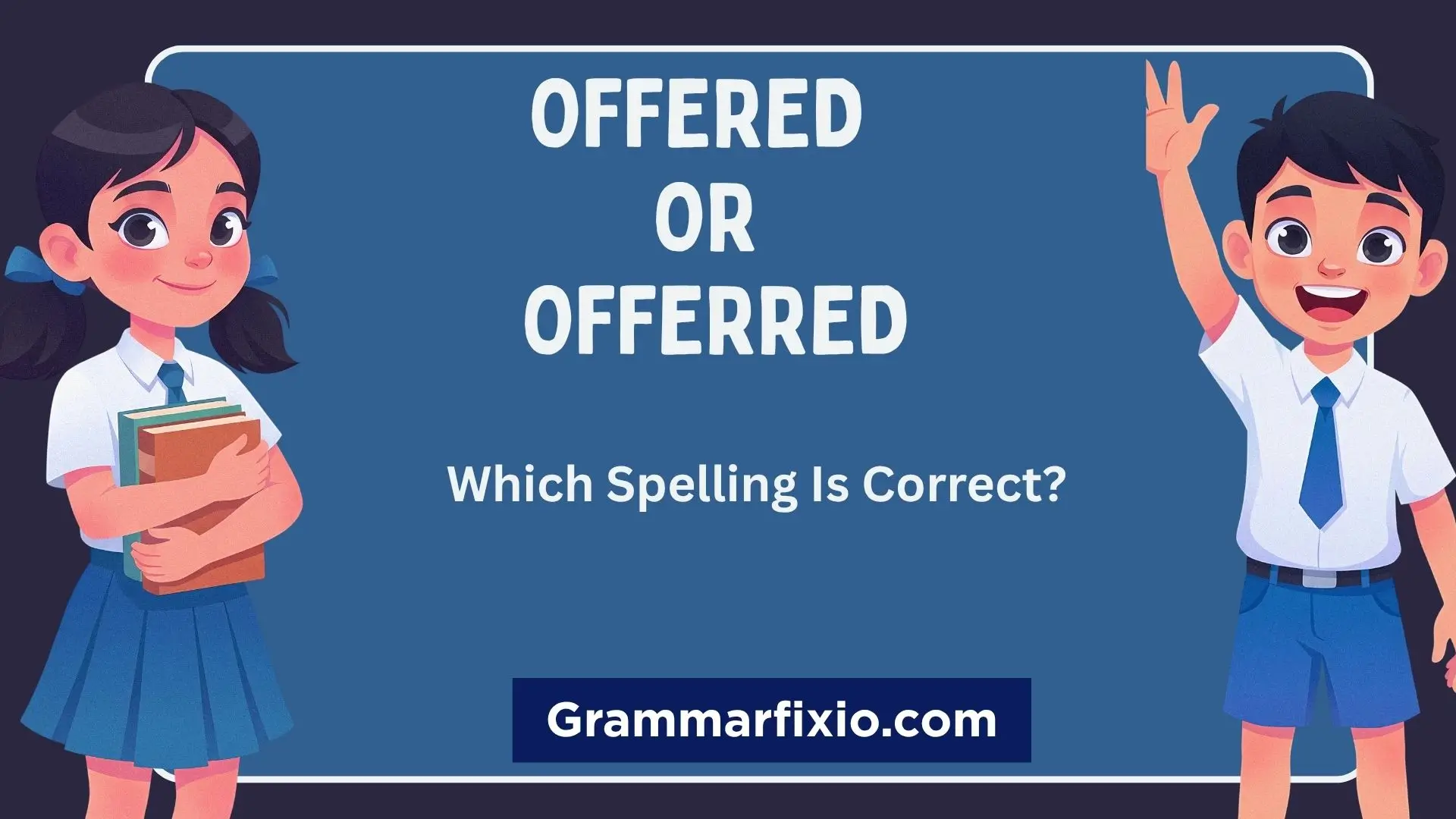
If you’re stuck between offered or offerred, the correct spelling is offered. The word offerred is incorrect in standard English. Offered is the past tense and past participle of offer, which means to give, provide, suggest, or make something available.
Here’s the clean version:
Correct: She offered to help.
Incorrect: She offerred to help.
That extra r may look harmless, but it turns a normal word into a spelling mistake. In school writing, business emails, resumes, blog posts, and product pages, that little typo can make the whole sentence look rushed.
The confusion makes sense, though. English doubles final consonants in some words, such as preferred, referred, and occurred. So why not offerred? The answer comes down to stress. In offer, the stress falls on the first syllable: OFF-er. Because the final syllable is not stressed, the final r does not double.
So, the rule is simple:
Offer + ed = offered. One r is enough.
Quick Answer: Offered Is Correct
The correct spelling is offered. It means someone gave, suggested, provided, presented, or made something available. Offerred is a spelling error. Use offered in casual writing, academic writing, business writing, formal documents, emails, and everyday English.
Examples:
- The company offered a discount.
- He offered me a seat.
- She offered to explain the problem.
- The school offered new classes.
- The report offered useful evidence.
The wrong version looks like this:
- The company offerred a discount.
- He offerred me a seat.
- She offerred to explain the problem.
Those sentences still make sense to the reader, but they don’t look correct. A spelling mistake doesn’t always hide the meaning. Sometimes it simply makes the writer look less careful.
That’s why this word matters. You’re not only spelling a verb. You’re protecting the trust your sentence needs to carry.
Offered vs Offerred: The Simple Difference
The difference between offered and offerred is not about meaning. It’s about correct spelling.
Offered is the correct word.
Offerred is the incorrect spelling.
There isn’t a special British version, American version, business version, or academic version where offerred suddenly becomes right. The correct form stays the same across standard English.
Offered Is the Correct Spelling
Offered is the past tense and past participle form of offer.
The base verb offer means to give, suggest, provide, present, or make something available.
Examples:
- The waiter offered water.
- The manager offered a solution.
- The teacher offered extra help.
- The company offered free shipping.
- The speaker offered a clear explanation.
In each sentence, offered shows that the action already happened.
You can use offered in many contexts:
- A person can offer help.
- A business can offer a service.
- A school can offer courses.
- A report can offer evidence.
- A friend can offer advice.
- A store can offer a refund.
- A company can offer a job.
The word is flexible, clean, and common. More importantly, it has only one r before ed.
Offerred Is Incorrect
Offerred is not the standard spelling. It happens when writers double the r by mistake.
Wrong:
The teacher offerred extra credit.
Correct:
The teacher offered extra credit.
Wrong:
The brand offerred a free trial.
Correct:
The brand offered a free trial.
Wrong:
He offerred to drive us home.
Correct:
He offered to drive us home.
Most spell checkers will flag offerred, but don’t rely on tools alone. Spell check can miss errors in headings, images, captions, forms, and copied text. Your own proofreading still matters.
What Does Offered Mean?
Offered means that someone gave, provided, suggested, proposed, volunteered, or made something available in the past.
It comes from the verb offer.
Offer = to give or present something for someone to accept or reject.
Offered = gave or presented something in the past.
That sounds simple, but the word has several useful shades of meaning.
Offered Means Gave or Provided
The most basic meaning of offered is “gave” or “provided.”
Examples:
- The hotel offered free breakfast.
- The store offered a refund.
- The company offered health benefits.
- The school offered after-class support.
- The app offered a free trial.
In these examples, something was made available to someone.
A hotel can offer breakfast.
A store can offer a refund.
A company can offer benefits.
The word does not always mean someone accepted the thing. It only means the thing was made available.
For example:
The company offered him a job.
That sentence tells you the company gave him the chance. It does not tell you whether he accepted it.
Offered Means Suggested or Proposed
Offered can also mean someone suggested an idea, plan, explanation, or solution.
Examples:
- He offered a better way to solve the problem.
- The lawyer offered a different interpretation.
- The student offered a new answer.
- The report offered three possible solutions.
- The committee offered a plan for next year.
This meaning is common in academic, professional, and formal writing.
For example:
The author offered several reasons for the character’s decision.
Here, offered means “presented” or “gave for consideration.” The author did not physically hand someone the reasons. The author introduced them through writing.
Offered Means Volunteered to Do Something
Offered often shows willingness.
When someone offered to help, they volunteered. They made themselves available.
Examples:
- She offered to carry the bags.
- He offered to stay late.
- My neighbor offered to water the plants.
- The student offered to read first.
- The employee offered to train the new hire.
This use feels personal because it often shows kindness, support, or responsibility.
Notice the pattern:
offered + to + verb
Examples:
- offered to help
- offered to pay
- offered to drive
- offered to explain
- offered to listen
That structure is very common in everyday English.
Offered Means Made Available
Businesses, schools, websites, services, and organizations often offer products, programs, or options.
Examples:
- The course offered flexible payment options.
- The website offered free templates.
- The gym offered personal training.
- The bank offered lower interest rates.
- The restaurant offered vegetarian meals.
This meaning matters for product pages, sales copy, service descriptions, and ads.
For example:
The software offered a simple dashboard for beginners.
That sentence means the software included or made available that feature.
Why Isn’t Offered Spelled Offerred?
The spelling looks confusing because some English verbs double the final consonant before adding -ed.
Examples:
- refer → referred
- prefer → preferred
- occur → occurred
- admit → admitted
- permit → permitted
So, it’s fair to wonder why offer doesn’t become offerred.
The answer sits in the sound pattern.
The Final R Does Not Double
The verb offer becomes offered by adding -ed.
Here is the pattern:
| Base Verb | Ending Added | Correct Form |
| offer | -ed | offered |
You do not add another r.
The word already has one final r, and that one r stays enough.
Simple spelling breakdown:
offer + ed = offered
Not:
offer + red = offerred
That mistake usually happens because writers think -ed requires a doubled letter. It doesn’t. Some words double. Many don’t.
The Stress Falls on the First Syllable
The most useful rule involves syllable stress.
Offer has two syllables:
OFF-er
The stress falls on the first syllable: OFF.
Because the final syllable is not stressed, the final r does not double when you add -ed.
That gives you:
offer → offered
Now compare it with prefer:
pre-FER
The stress falls on the second syllable. Because the final syllable is stressed, the r doubles:
prefer → preferred
The same thing happens with refer:
re-FER → referred
This is the heart of the spelling rule.
Compare Offered With Referred and Preferred
This table makes the pattern clear:
| Base Verb | Pronunciation Stress | Correct Past Form | Why |
| offer | OFF-er | offered | Stress is not on the final syllable |
| prefer | pre-FER | preferred | Stress is on the final syllable |
| refer | re-FER | referred | Stress is on the final syllable |
| occur | oc-CUR | occurred | Stress is on the final syllable |
| open | O-pen | opened | Stress is not on the final syllable |
This is why offered looks like opened, not preferred.
Both offer and open stress the first syllable.
OFF-er → offered
O-pen → opened
That’s the spelling pattern you need.
Offered or Offerred Comparison Table
Here’s the difference in one clean view:
| Word | Correct? | Meaning | Example |
| Offered | Yes | Gave, suggested, provided, volunteered, or made available | She offered me a seat. |
| Offerred | No | Misspelling of offered | Avoid this spelling. |
| Offer | Yes | To give, suggest, provide, or make available | They offer free delivery. |
| Offering | Yes | Giving, providing, or making available | The store is offering a discount. |
The key takeaway:
Offered is correct. Offerred is wrong.
Grammar Breakdown of Offered
Understanding the grammar makes the spelling easier to remember.
The word offered can work as a past tense verb or as a past participle. It depends on the sentence.
Base Verb: Offer
Offer is the base verb.
Examples:
- They offer help.
- We offer free delivery.
- The school offers music classes.
- She offers good advice.
- The app offers useful tools.
Use offer for present simple sentences or after words like can, will, should, and may.
Examples:
- I can offer help.
- They will offer support.
- The company may offer refunds.
Past Tense: Offered
Offered describes a completed action in the past.
Examples:
- They offered help yesterday.
- The company offered a discount last week.
- She offered me a ride home.
- The teacher offered extra credit.
- The hotel offered breakfast during our stay.
This is the most common use.
The action happened already.
Past Participle: Offered
Offered also works as a past participle.
That means it can appear with helping verbs such as has, have, had, was, were, or been.
Examples:
- She has offered support.
- They have offered a refund.
- The company had offered better terms.
- Free training was offered to new employees.
- Several options were offered during the meeting.
In these sentences, offered still keeps one r.
Do not write has offerred, had offerred, or was offerred.
Present Participle: Offering
Offering means the action is happening now or continuing.
Examples:
- The store is offering free shipping.
- She is offering online classes.
- The company is offering discounts this month.
- He is offering help to new students.
- The website is offering a free guide.
This word also keeps one r.
Correct:
offering
Incorrect:
offerring
The same spelling logic applies. Don’t double the r.
When to Use Offered
Use offered when someone gave, suggested, provided, volunteered, or made something available in the past.
The word fits many real-life situations.
Use Offered in Everyday Conversation
In daily speech, offered often sounds natural and friendly.
Examples:
- He offered me coffee.
- She offered to help with dinner.
- My friend offered me a ride.
- They offered us a place to sit.
- The neighbor offered to fix the gate.
This use often shows kindness or courtesy.
Someone didn’t have to help. They chose to.
Use Offered in Emails
Emails need correct spelling because they often represent you professionally.
Examples:
- Thank you for the support you offered.
- The client offered helpful feedback.
- Our team offered a solution during the call.
- You offered excellent advice yesterday.
- The supplier offered revised pricing.
A word like offerred in an email may look careless. One typo can distract from an otherwise strong message.
Better to keep it clean.
Use Offered in School Writing
In school writing, offered can mean “gave,” “presented,” or “provided.”
Examples:
- The author offered several reasons for the decision.
- The study offered strong evidence.
- The speaker offered a clear explanation.
- The poem offered a different view of grief.
- The article offered useful background information.
This word works well in essays because it sounds clear without sounding stiff.
Instead of writing the author gave, you can write the author offered. It sounds a little more polished.
Use Offered in Business Writing
Business writing uses offered all the time.
Examples:
- The company offered a better price.
- The manager offered a flexible schedule.
- The brand offered free delivery.
- The vendor offered a replacement product.
- The employer offered health insurance.
Businesses can offer:
- Jobs
- Discounts
- Services
- Refunds
- Consultations
- Payment plans
- Support
- Training
- Free trials
- Shipping options
This word appears often in sales, customer service, hiring, marketing, and internal communication.
Use Offered in News or Formal Writing
In news and formal writing, offered often means “gave” or “provided.”
Examples:
- Officials offered an update after the meeting.
- The mayor offered a statement to reporters.
- The agency offered support to affected families.
- The report offered new details about the case.
- Witnesses offered different accounts of the event.
This use sounds clean and neutral. It works well when the writer wants to report what someone said, gave, or provided.
Common Mistakes With Offered and Offerred
Most mistakes happen because writers overapply a spelling rule. They see double letters in other verbs and assume offer should work the same way.
It doesn’t.
Mistake: Adding an Extra R
The most common mistake is simple: adding one extra r.
Wrong:
She offerred her help.
Correct:
She offered her help.
More examples:
| Wrong | Correct |
| The shop offerred free delivery. | The shop offered free delivery. |
| He offerred me a job. | He offered me a job. |
| They offerred a refund. | They offered a refund. |
| She offerred good advice. | She offered good advice. |
| The app offerred a free trial. | The app offered a free trial. |
The correction never changes. Remove the extra r.
Mistake: Thinking Every Final Consonant Doubles
Some writers think final consonants always double before -ed or -ing.
That is not true.
These words do not double the final consonant:
- open → opened
- happen → happened
- listen → listened
- answer → answered
- offer → offered
These words keep the final consonant single because the stress pattern does not require doubling.
Compare:
open → opened
offer → offered
Both sound natural with one final consonant before -ed.
Mistake: Confusing Offered With Preferred or Referred
This is the most understandable mistake.
Words like preferred and referred do double the final r.
Examples:
- prefer → preferred
- refer → referred
So, writers assume:
- offer → offerred
But that is wrong.
Why?
Because prefer and refer stress the last syllable:
pre-FER
re-FER
Offer stresses the first syllable:
OFF-er
That stress difference changes the spelling pattern.
Mistake: Copying Incorrect Spellings Online
Online writing spreads errors quickly.
A typo in one social post can show up in captions, comments, product pages, and blog drafts. If someone sees offerred often enough, it may start to look normal.
That’s the danger.
A word can look familiar without being correct.
Before publishing, check words that feel slightly off. The eye gets tired. Typos sneak in through the side door.
Mistake: Trusting Pronunciation Alone
Pronunciation can help, but it can also mislead you.
The word offered may sound like it could have a double r. Still, spelling follows rules and patterns, not only sound.
A useful habit is to break the word into parts:
offer + ed
That structure keeps the spelling clear.
Offered vs Preferred vs Referred
This comparison solves the biggest confusion.
All three words end in r before adding -ed. Yet only two double the r.
Why Offered Has One R
Offer sounds like this:
OFF-er
The first syllable receives the stress. Since the final syllable is not stressed, the r stays single.
Correct:
offer → offered
Examples:
- The store offered a discount.
- She offered to help.
- They offered support.
Why Preferred Has Double R
Prefer sounds like this:
pre-FER
The final syllable receives the stress. That is why the final r doubles.
Correct:
prefer → preferred
Examples:
- She preferred tea over coffee.
- He preferred the second option.
- They preferred a later meeting time.
Why Referred Has Double R
Refer sounds like this:
re-FER
Again, the stress falls on the final syllable. So the r doubles.
Correct:
refer → referred
Examples:
- The doctor referred her to a specialist.
- The teacher referred to the textbook.
- He referred a client to the agency.
Side-by-Side Spelling Table
| Base Verb | Stress Pattern | Correct Past Form | Incorrect Form |
| offer | OFF-er | offered | offerred |
| prefer | pre-FER | preferred | prefered |
| refer | re-FER | referred | refered |
| occur | oc-CUR | occurred | occured |
| open | O-pen | opened | openned |
This table gives you the practical rule:
If the final syllable carries the stress, the final consonant often doubles. If the first syllable carries the stress, it usually does not.
British English vs American English: Is There a Difference?
Some spelling questions depend on region. This one does not.
Offered in American English
In American English, the correct spelling is offered.
Examples:
- The school offered new classes.
- The company offered a refund.
- She offered to help.
American English does not use offerred as the standard form.
Offered in British English
In British English, the correct spelling is also offered.
Examples:
- The university offered several courses.
- The shop offered a discount.
- He offered his opinion.
This is not like color and colour or center and centre. The spelling does not change.
Global and International Use
For international readers, offered is still the safest and correct spelling.
Use it in:
- Academic writing
- Business emails
- Website copy
- Product pages
- Job applications
- News articles
- Social media captions
- Customer support replies
- Professional documents
No matter where your readers live, offered with one r is the right choice.
Real-Life Examples of Offered
Seeing the word in context makes the spelling easier to remember.
Offered in Emails
- Thank you for the solution you offered.
- The client offered helpful feedback.
- You offered a useful suggestion during the meeting.
- The supplier offered a lower price.
- She offered to send the files again.
Emails often move fast, so spelling mistakes slip in easily. Still, a clean email creates a stronger impression.
Offered in Business
- The company offered a discount to new customers.
- The manager offered a flexible schedule.
- The employer offered a full-time position.
- The brand offered a free trial.
- The store offered same-day delivery.
Business writing should feel sharp and trustworthy. Offered helps keep it that way.
Offered in School or Academic Writing
- The study offered strong evidence.
- The writer offered a clear explanation.
- The article offered several examples.
- The speaker offered a new perspective.
- The research offered useful insight.
In academic writing, offered can sound more precise than gave.
For example:
The author gave several reasons is fine.
The author offered several reasons sounds more polished.
Offered in Daily Conversation
- She offered me a ride home.
- He offered to help with dinner.
- They offered us coffee.
- My friend offered good advice.
- The neighbor offered to watch the dog.
Everyday use keeps the word simple. You don’t need a fancy sentence.
Offered in News Style Sentences
- The mayor offered a statement after the meeting.
- Officials offered support to affected families.
- The agency offered an update on the case.
- The spokesperson offered no further details.
- The report offered new information about the issue.
News writing often uses offered to show that someone gave a statement, explanation, or update.
Offered in Social Media
- She offered great advice in the comments.
- The brand offered a free trial for one week.
- He offered a simple tip that helped everyone.
- The creator offered a behind-the-scenes look.
- The coach offered quick feedback during the live session.
Social media may feel casual, but spelling still matters. A typo in a caption can get more attention than the message itself.
Incorrect Examples Using Offerred
The spelling offerred looks wrong because the extra r does not belong there.
Offerred in a Sentence: Why It Looks Wrong
Wrong:
The shop offerred free delivery.
Correct:
The shop offered free delivery.
The mistake happens because the writer doubles the r. The base verb is offer, and the correct past form is offered.
More Wrong vs Correct Examples
| Wrong | Correct |
| He offerred me a job. | He offered me a job. |
| They offerred a refund. | They offered a refund. |
| She offerred good advice. | She offered good advice. |
| The app offerred a free trial. | The app offered a free trial. |
| The school offerred music classes. | The school offered music classes. |
| My boss offerred a raise. | My boss offered a raise. |
| The hotel offerred free breakfast. | The hotel offered free breakfast. |
| The report offerred useful facts. | The report offered useful facts. |
The fix is always the same:
Delete the extra r.
How to Remember the Correct Spelling of Offered
Spelling sticks better when you attach it to a simple pattern.
The Offer + Ed Trick
This is the easiest memory trick:
Offer + ed = offered
That’s it.
You do not need to change the base word. You do not need to double the final r. You only add ed.
Examples:
- offer + ed = offered
- offer + ing = offering
- offer + s = offers
The base stays clean.
The Open and Offer Trick
Compare offer with open.
| Base Verb | Past Form |
| open | opened |
| offer | offered |
Both words stress the first syllable:
O-pen
OFF-er
Because of that, neither word doubles the final consonant.
You don’t write openned.
You don’t write offerred.
Write:
opened
offered
The One R Is Enough Trick
Use this memory line:
Offer already has one r. One r is enough for offered.
It’s short and practical.
When you see offerred, the double r should look suspicious. It’s carrying extra baggage.
Visual Memory Method
Look at the correct form:
offer + ed
offered
Now look at the wrong form:
offer + red
offerred
That second version adds too much. The past tense ending is -ed, not -red.
This visual trick helps because you can see the mistake instead of only hearing it.
Why Correct Spelling Matters
Some people say spelling doesn’t matter if the meaning is clear. That sounds nice, but it’s not how readers judge writing.
Readers notice errors. Sometimes they notice them quickly.
A spelling mistake can make strong content look sloppy.
Offered in Professional Writing
In professional writing, offerred can weaken trust.
Weak:
Our company offerred support during the transition.
Better:
Our company offered support during the transition.
The second sentence looks cleaner and more credible.
Professional writing includes:
- Emails
- Proposals
- Reports
- Client updates
- Service pages
- Presentations
- Contracts
- Job applications
Small mistakes can make readers question attention to detail.
Offered in Academic Writing
Teachers and examiners expect standard spelling.
Correct:
The author offered several examples to support the claim.
Incorrect:
The author offerred several examples to support the claim.
In academic writing, errors can distract from the idea. The argument may be good, but the typo makes the sentence look weaker.
Offered in Digital Marketing and SEO Content
Digital content needs trust.
A product page that says offerred free shipping looks less polished. A blog post with repeated spelling errors may feel less reliable. An ad with a typo can make users hesitate.
Correct spelling helps in:
- Product descriptions
- Landing pages
- Blog posts
- Email campaigns
- Sales pages
- Social captions
- Ad copy
- Service pages
Example:
The brand offered free delivery on first orders.
That sentence looks clean and commercial.
Offered in Resumes and Job Applications
Resume spelling matters because employers scan fast.
Strong resume line:
Offered customer support to 50+ clients daily.
Weak resume line:
Offerred customer support to 50+ clients daily.
The number 50+ adds value, but the spelling mistake hurts the line. A resume should make the hiring manager trust your accuracy. Don’t give them a reason to doubt it.
Case Study: How Offerred Can Hurt Credibility
Imagine a small business writes this on its website:
We offerred premium support to every customer.
The service may be excellent. The team may care deeply. The business may actually provide great support.
Still, the spelling mistake creates doubt.
A reader may think:
- Did they proofread this page?
- Is the business careful with details?
- Will they be careful with my order?
- Is the website professionally managed?
Now compare the clean version:
We offered premium support to every customer.
The second sentence says the same thing, but it feels more trustworthy.
This is the real cost of spelling mistakes. They don’t just affect grammar. They affect perception.
Another Case Study: Resume Example
A job applicant writes:
Offerred product recommendations to customers and increased sales by 18%.
The achievement is strong. An 18% increase is worth noticing. But the spelling error distracts from the result.
Better:
Offered product recommendations to customers and increased sales by 18%.
Now the achievement can shine without a typo standing in the way.
That’s why spelling matters most when the stakes are high.
Similar Words That Follow the Same Pattern
English spelling becomes easier when you group similar words.
Words That Do Not Double the Final Letter
These words keep the final consonant single before -ed:
| Base Verb | Past Form |
| open | opened |
| happen | happened |
| listen | listened |
| answer | answered |
| offer | offered |
| visit | visited |
| limit | limited |
| cover | covered |
These words usually stress the first syllable or do not follow the final-stress doubling pattern.
Examples:
- The door opened slowly.
- The accident happened yesterday.
- She listened carefully.
- He answered the question.
- The company offered a refund.
Words That Do Double the Final Letter
These words double the final consonant before -ed:
| Base Verb | Past Form |
| refer | referred |
| prefer | preferred |
| occur | occurred |
| admit | admitted |
| permit | permitted |
| stop | stopped |
| plan | planned |
| rub | rubbed |
Many of these words have final-syllable stress or a short vowel sound before the final consonant.
Examples:
- The doctor referred her to a specialist.
- She preferred the blue dress.
- The error occurred twice.
- He admitted the mistake.
- They planned the event.
Why These Patterns Matter
These patterns stop you from guessing.
Without the pattern, offered, preferred, and referred seem inconsistent. With the pattern, they make more sense.
The key difference is stress:
OFF-er → offered
pre-FER → preferred
re-FER → referred
Once you hear that difference, the spelling becomes easier.
Quick Practice: Offered or Offerred?
Choose the correct spelling for each sentence.
Fill in the Blank
- She ______ to help.
- The store ______ a refund.
- The teacher ______ extra credit.
- The company ______ free shipping.
- He ______ me a seat.
- The report ______ useful advice.
- The hotel ______ free breakfast.
- The app ______ a free trial.
- The speaker ______ a clear explanation.
- The manager ______ a flexible schedule.
Answer Key
- She offered to help.
- The store offered a refund.
- The teacher offered extra credit.
- The company offered free shipping.
- He offered me a seat.
- The report offered useful advice.
- The hotel offered free breakfast.
- The app offered a free trial.
- The speaker offered a clear explanation.
- The manager offered a flexible schedule.
The answer stays the same every time. Offered has one r.
FAQs About Offered or Offerred
Q1:Is offerred ever correct?
No. Offerred is not correct in standard English. The correct spelling is offered.
Q2:What is the correct spelling: offered or offerred?
The correct spelling is offered. It is the past tense and past participle of offer.
Example:
She offered to help.
Q3:Why doesn’t offered have double r?
Offered does not have double r because the stress in offer falls on the first syllable: OFF-er. Since the final syllable is not stressed, the final r does not double when you add -ed.
Q4:Is offered past tense?
Yes. Offered is the past tense of offer.
Example:
The company offered a discount yesterday.
Q5:Is offered a past participle?
Yes. Offered also works as a past participle.
Example:
She has offered help several times.
Q6:Is offerred British spelling?
No. Offerred is not standard British spelling. Both American and British English use offered.
Q7:Why do people write offerred?
People often write offerred because they confuse it with words like preferred and referred, which do double the final r. The difference comes from syllable stress.
Q8:Can spell check catch offerred?
Most spell checkers should catch offerred, but writers should still proofread. Spell check can miss errors in titles, captions, graphics, forms, and copied text.
Q9:How can I remember the correct spelling?
Use this simple trick:
Offer + ed = offered. One r is enough.
Q10:What is the difference between offered and offering?
Offered describes a past action.
Example:
The store offered free shipping last week.
Offering describes a current or ongoing action.
Example:
The store is offering free shipping today.
Final Takeaway: Offered or Offerred
The correct spelling is offered. The spelling offerred is incorrect.
Use offered when you mean someone gave, suggested, provided, volunteered, or made something available in the past.
Remember the simple spelling pattern:
Offer + ed = offered. One r is enough.
That rule works in school essays, business emails, resumes, product pages, service descriptions, social media captions, and everyday writing.
A single letter can change how polished your work feels. Keep the spelling clean. Write offered, not offerred.