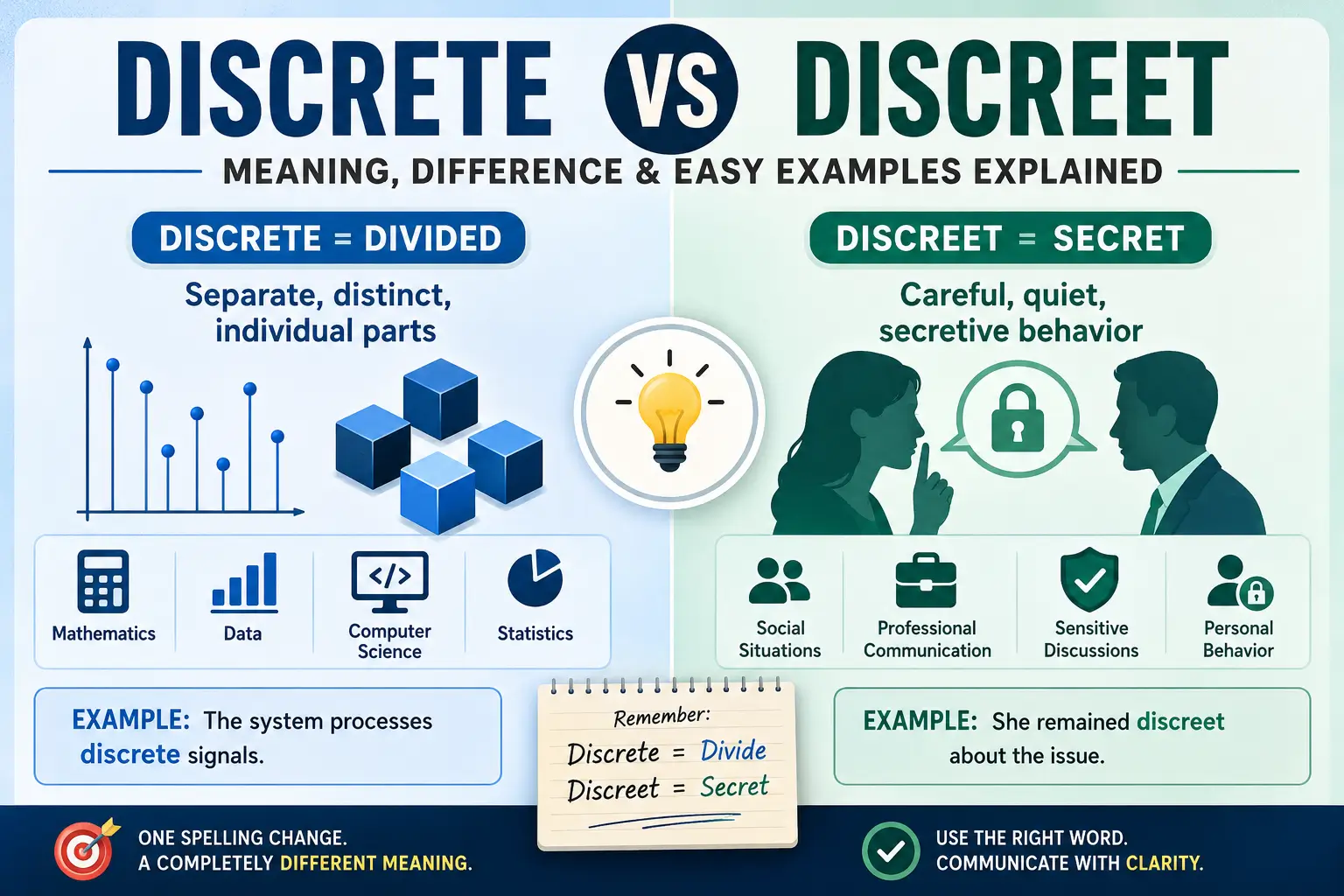
English has plenty of words that look similar, sound identical, and still mean completely different things. Few examples confuse writers as often as discrete vs discreet.
At first glance, the two words appear almost identical. The difference is only a single letter. Yet that tiny spelling change creates a completely different meaning. Using the wrong word can make your writing appear careless, especially in academic papers, professional emails, business reports, and everyday communication.
Many people understand what they want to say but hesitate before typing one of these words. Should you write discrete data or discreet data? Is a person discrete or discreet? Which spelling belongs in a mathematics textbook, and which one belongs in a conversation about privacy?
The good news is that once you understand the meanings, the confusion becomes much easier to avoid.
This guide breaks down everything you need to know about discrete vs discreet, including definitions, examples, memory tricks, business usage, data science applications, common mistakes, and practical tips that help you choose the correct word every time.
Discrete vs Discreet: Quick Answer
If you’re looking for the fastest explanation, here it is:
- Discrete means separate, distinct, or individually separate.
- Discreet means careful, tactful, private, or cautious.
The Simple Difference in One Sentence
A discrete item stands apart from others.
A discreet person knows how to keep things private.
Side-by-Side Example
- The survey divided customers into discrete groups.
- The manager handled the complaint in a discreet manner.
Both sentences are correct because each word serves a different purpose.
Why Do People Confuse Discrete and Discreet?
The confusion isn’t surprising.
These words belong to a category known as homophones. Homophones are words that sound alike but carry different meanings and spellings.
When spoken aloud, discrete and discreet sound virtually identical.
Because of this, many people rely on pronunciation rather than spelling. That habit often leads to mistakes.
Identical Pronunciation, Different Meanings
Consider these examples:
- Flour and flower
- Their, there, and they’re
- Principal and principle
- Discrete and discreet
Your ears hear the same sound, but your brain must determine the correct spelling based on context.
Why This Commonly Confused Word Pair Causes Mistakes
Several factors contribute to the problem:
| Reason | Explanation |
| Similar spelling | Only one letter differs |
| Same pronunciation | Both sound alike |
| Similar appearance | Easy to overlook while proofreading |
| Rare usage | Many people encounter them infrequently |
| Context dependence | Meaning changes completely based on situation |
Because both words appear in professional writing, selecting the correct form matters.
What Does Discrete Mean?
The word discrete refers to something separate, distinct, individual, or disconnected from other things.
Think of separate building blocks sitting on a table. Each block exists independently from the others.
That’s the core idea behind discrete.
Definition of Discrete
Discrete means:
Individually separate and distinct from other things.
The word emphasizes separation rather than privacy.
The Core Meaning: Separate and Distinct
Imagine a classroom containing 30 students.
Each student is a separate individual.
In this context, the students are discrete entities.
Likewise:
- Separate categories are discrete.
- Independent units are discrete.
- Distinct groups are discrete.
- Individual numbers can be discrete.
The key concept remains separation.
Common Uses of Discrete
You will often encounter discrete in:
- Mathematics
- Statistics
- Data analysis
- Computer science
- Scientific research
- Engineering
- Academic writing
In these fields, precision matters. Therefore, discrete appears frequently.
Everyday Examples of Discrete
Consider these examples:
- The company organized products into discrete categories.
- Each department functions as a discrete unit.
- Researchers examined discrete groups of participants.
- The project contains several discrete phases.
Notice that privacy isn’t involved.
Instead, the focus remains on separation and distinction.
Discrete in Mathematics
Mathematics provides one of the most common uses of discrete.
A discrete value can take specific individual values.
For example:
- 1
- 2
- 3
- 4
You cannot have 2.5 children in a family count.
You either have two children or three.
Therefore, family size is considered discrete.
Discrete Data Explained
Data analysts frequently divide information into two categories:
- Discrete data
- Continuous data
Let’s compare them.
| Discrete Data | Continuous Data |
| Countable | Measurable |
| Whole values | Infinite possible values |
| Number of cars | Height |
| Number of students | Weight |
| Number of purchases | Temperature |
If something can only exist in specific countable amounts, it is usually discrete.
Common Collocations with Discrete
Writers frequently pair discrete with words such as:
- Discrete variables
- Discrete values
- Discrete categories
- Discrete units
- Discrete groups
- Discrete components
- Discrete elements
- Discrete stages
- Discrete system
- Discrete data
Learning these combinations helps reinforce proper usage.
Examples of Discrete in Sentences
Everyday Examples
- The museum divided exhibits into discrete sections.
- Each team operated as a discrete department.
- The project contains several discrete milestones.
- Researchers evaluated discrete customer groups.
Academic Examples
- The study examined discrete variables.
- Discrete mathematics focuses on countable structures.
- The sample consisted of discrete population segments.
- Scientists analyzed discrete observations.
Business and Technical Examples
- Engineers tested discrete components separately.
- The software organizes files into discrete folders.
- Analysts measured discrete events throughout the quarter.
- The database stores information in discrete records.
What Does Discreet Mean?
Unlike discrete, discreet focuses on behavior rather than separation.
A discreet person exercises caution, tact, and good judgment.
Definition of Discreet
Discreet means:
Careful not to attract attention or reveal private information.
Privacy lies at the heart of the word.
The Core Meaning: Careful and Tactful
Imagine a friend sharing sensitive news.
You don’t spread it to everyone.
Instead, you keep the information private.
That behavior is discreet.
Similarly:
- A discreet employee protects confidential information.
- A discreet doctor respects patient privacy.
- A discreet advisor handles sensitive matters carefully.
The emphasis remains on wisdom and restraint.
How Discreet Is Used in Everyday Communication
Many professional environments value discretion.
For example:
- Human resources departments handle employee matters discreetly.
- Lawyers discuss client information discreetly.
- Financial advisors maintain discreet communication.
- Healthcare professionals protect private records.
In each situation, trust depends on confidentiality.
Common Situations Where Someone Is Described as Discreet
People often describe someone as discreet when they:
- Keep secrets
- Protect privacy
- Avoid unnecessary attention
- Handle sensitive matters professionally
- Show good judgment
- Speak tactfully
These qualities make discreet individuals highly trusted.
Common Collocations with Discreet
You’ll often see discreet paired with:
- Discreet service
- Discreet inquiry
- Discreet conversation
- Discreet location
- Discreet assistance
- Discreet investigation
- Discreet approach
- Discreet handling
- Discreet communication
- Discreet manner
These combinations appear regularly in business and professional writing.
Examples of Discreet in Sentences
Personal Communication Examples
- She remained discreet about her friend’s situation.
- He gave a discreet response during the discussion.
- They handled the issue discreetly.
- She asked a discreet question.
Professional Workplace Examples
- The manager conducted a discreet investigation.
- The company provided discreet support.
- Human resources handled complaints discreetly.
- The executive preferred discreet communication.
Customer Service and Business Examples
- The hotel offers discreet service for guests.
- Financial consultants maintain discreet relationships.
- The firm conducted a discreet review.
- Customer concerns received discreet attention.
Discrete vs Discreet: Side-by-Side Comparison Table
Understanding the differences becomes easier when viewed side by side.
| Feature | Discrete | Discreet |
| Meaning | Separate, distinct | Careful, private |
| Focus | Separation | Privacy |
| Common Fields | Math, science, data | Communication, business |
| Describes | Things | People, actions |
| Example | Discrete categories | Discreet conversation |
| Opposite | Continuous, connected | Open, indiscreet |
This table alone solves most confusion surrounding discrete vs discreet.
When Should You Use Discrete?
A simple way to choose discrete is to ask yourself one question:
Am I talking about things that are separate or distinct?
If the answer is yes, discrete is probably the correct word.
The word almost always describes objects, categories, units, values, systems, groups, or elements that exist independently.
Signs That Discrete Is the Correct Choice
Use discrete when discussing:
- Separate categories
- Independent components
- Distinct stages
- Countable values
- Individual units
- Mathematical concepts
- Data analysis
- Scientific research
For example:
- The software stores data in discrete records.
- The report divides customers into discrete groups.
- The machine consists of discrete components.
In each example, the focus is on separation.
Questions to Ask Yourself Before Using Discrete
Before writing the word, ask:
- Does this refer to separate parts?
- Can these items be counted individually?
- Am I discussing mathematics, statistics, or data?
- Does the sentence focus on distinction rather than privacy?
If you answer yes, use discrete.
Quick Rule
Think of the word discrete as meaning:
Separate pieces that stand on their own.
That single idea will help you avoid many mistakes.
When Should You Use Discreet?
Now consider a different question:
Am I talking about privacy, tact, or careful behavior?
If yes, choose discreet.
Unlike discrete, discreet usually describes people, actions, conversations, services, or behavior.
Signs That Discreet Is the Correct Choice
Use discreet when discussing:
- Confidential matters
- Private information
- Professional conduct
- Careful communication
- Sensitive situations
- Good judgment
- Tactful behavior
Examples include:
- The lawyer remained discreet.
- The company handled the issue discreetly.
- She gave a discreet answer.
The focus is privacy rather than separation.
Questions to Ask Yourself Before Using Discreet
Ask these questions:
- Am I describing someone’s behavior?
- Does the situation involve privacy?
- Is discretion important?
- Am I referring to tact or caution?
If yes, use discreet.
Quick Rule
Think of discreet as meaning:
Careful enough to keep things private.
This shortcut works surprisingly well.
Discrete vs Discreet in Mathematics and Data Science
One major reason people search for discrete vs discreet is because they encounter the word discrete in math classes, statistics courses, and data science discussions.
Interestingly, you will almost never use discreet in mathematics.
What Is Discrete Data?
Discrete data consists of countable values.
These values cannot fall between fixed numbers.
Examples include:
| Discrete Data Examples | Why They Are Discrete |
| Number of students | Countable |
| Number of cars sold | Countable |
| Number of goals scored | Countable |
| Number of employees | Countable |
| Number of purchases | Countable |
You can count them one by one.
What Is Continuous Data?
Continuous data works differently.
It can take virtually any value within a range.
Examples include:
| Continuous Data Examples |
| Height |
| Weight |
| Temperature |
| Distance |
| Time |
A person’s height could be:
- 170 cm
- 170.5 cm
- 170.53 cm
- 170.531 cm
The values continue indefinitely.
Discrete Variables vs Continuous Variables
Understanding this distinction is essential in statistics.
| Feature | Discrete Variable | Continuous Variable |
| Values | Countable | Infinite possibilities |
| Examples | Number of books | Weight |
| Measurement | Counting | Measuring |
| Typical Data | Whole numbers | Decimals allowed |
Real-World Case Study: School Enrollment
Imagine a school administrator analyzing enrollment data.
The administrator counts:
- 500 students
- 40 teachers
- 20 classrooms
These are discrete values.
However, when measuring:
- Student height
- Classroom temperature
- Travel distance
The data becomes continuous.
This simple example explains why discrete plays such an important role in analytics and research.
Discrete vs Discreet in Business Communication
Business writing frequently uses both words.
However, they appear in very different contexts.
Using Discreet in Professional Emails
Privacy matters in professional communication.
A manager might write:
“Please handle this matter in a discreet manner.”
A human resources department might request:
“Keep employee information discreet and confidential.”
Customer service teams often emphasize discretion when handling sensitive issues.
Using Discrete in Reports and Technical Documents
Business analysts regularly use discrete.
Examples include:
- Discrete customer segments
- Discrete revenue streams
- Discrete product categories
- Discrete project phases
Notice how the word describes separate units rather than private behavior.
Business Example Comparison
| Sentence | Correct Word |
| The consultant handled the issue carefully. | Discreet |
| The report divided customers into groups. | Discrete |
| The manager protected confidential data. | Discreet |
| The system contains separate modules. | Discrete |
This distinction becomes important in professional writing.
Common Mistakes People Make
Even experienced writers sometimes confuse these words.
Understanding common errors can prevent future mistakes.
Using Discrete Instead of Discreet
Incorrect:
Please be discrete about the merger.
Correct:
Please be discreet about the merger.
Why?
The sentence concerns privacy, not separation.
Using Discreet Instead of Discrete
Incorrect:
The survey measured discreet variables.
Correct:
The survey measured discrete variables.
Why?
Variables are separate units. They are not behaving cautiously.
Assuming They Are Interchangeable
Many writers assume the words mean the same thing because they sound alike.
They don’t.
Replacing one with the other changes the meaning entirely.
Misunderstanding Context
Sometimes people memorize definitions but fail to recognize context.
For example:
- Data analysis → discrete
- Confidential conversation → discreet
- Mathematical values → discrete
- Private handling → discreet
Context always determines the correct choice.
Easy Memory Tricks to Remember the Difference
Memory tricks can eliminate confusion in seconds.
The Double “EE” Memory Trick
Look at the word:
discrEEt
The double EE can remind you of:
- kEEp secrets
- bEE private
Both relate to discretion.
The Separate Parts Memory Trick
Look at:
discrete
The ending resembles the word:
separate
Both involve distinct pieces.
This makes discrete easier to remember.
Fast Recall Method for Exams and Writing
Use this two-step process:
- Privacy or caution? → Discreet
- Separate parts or categories? → Discrete
This method works in nearly every situation.
Synonyms of Discrete
Sometimes another word communicates your meaning more clearly.
Best Alternatives for Discrete
Common synonyms include:
| Synonym | Meaning |
| Separate | Not connected |
| Distinct | Clearly different |
| Independent | Operating alone |
| Individual | Single entity |
| Detached | Not attached |
| Isolated | Set apart |
| Distinguishable | Recognizably different |
When a Synonym Works Better
Instead of:
The company has discrete divisions.
You could write:
The company has separate divisions.
Sometimes simplicity improves readability.
Synonyms of Discreet
Several alternatives carry a similar meaning.
Best Alternatives for Discreet
| Synonym | Meaning |
| Tactful | Sensitive and thoughtful |
| Careful | Acting cautiously |
| Diplomatic | Skilled in communication |
| Prudent | Showing good judgment |
| Circumspect | Avoiding risk |
| Confidential | Kept private |
| Judicious | Wise and sensible |
When a Synonym Works Better
Instead of:
She gave a discreet response.
You could write:
She gave a tactful response.
Both sentences work, though the nuance differs slightly.
Discrete and Discreet: Common Phrases and Expressions
Learning common word pairings improves accuracy.
Frequently Used Phrases with Discrete
- Discrete data
- Discrete mathematics
- Discrete variables
- Discrete categories
- Discrete systems
- Discrete units
- Discrete components
- Discrete stages
- Discrete values
- Discrete groups
Frequently Used Phrases with Discreet
- Discreet service
- Discreet inquiry
- Discreet assistance
- Discreet handling
- Discreet communication
- Discreet conversation
- Discreet location
- Discreet investigation
- Discreet approach
- Discreet behavior
Recognizing these common combinations makes correct usage much easier.
Discrete vs Discreet in American and British English
Many commonly confused words have different spellings in American and British English. Examples include:
| American English | British English |
| Color | Colour |
| Favor | Favour |
| Center | Centre |
| Organize | Organise |
However, discrete and discreet are different.
Are There Any Spelling Differences?
No.
Both American English and British English use the same spellings:
- Discrete
- Discreet
There are no regional spelling variations.
Usage Trends Across English Variants
Whether you’re reading a business report in New York, a research paper in London, or a university textbook in Australia, the meanings remain consistent.
- Discrete always relates to separate or distinct things.
- Discreet always relates to privacy, caution, and tact.
This consistency makes them easier to learn than many other confusing word pairs.
Real-Life Examples: Discrete vs Discreet
Learning definitions helps, but real-world situations make the distinction easier to remember.
Workplace Scenario
Imagine a company launching a new product.
The marketing team divides customers into discrete audience groups based on age, interests, and buying behavior.
At the same time, executives keep launch details discreet until the official announcement.
Notice the difference:
- Discrete describes separate customer segments.
- Discreet describes careful handling of information.
Academic Scenario
A university researcher studies student performance.
The researcher places students into discrete categories based on test scores.
When discussing individual results, the researcher remains discreet to protect student privacy.
Again:
- Categories are discrete.
- Behavior is discreet.
Healthcare Scenario
A hospital tracks:
- Number of patients
- Number of surgeries
- Number of appointments
These are discrete data points because they can be counted.
Hospital staff must also remain discreet when handling patient records and medical information.
Everyday Conversation Scenario
Consider these two sentences:
“The event was divided into discrete sessions.”
“The organizer was discreet about the guest list.”
The first discusses separation.
The second discusses confidentiality.
Case Study: How One Wrong Letter Changed the Meaning
A consulting company once prepared a report that included the sentence:
“Our staff remain discrete when handling client information.”
Although readers understood the intended meaning, the sentence was technically incorrect.
The correct version should have been:
“Our staff remain discreet when handling client information.”
Why?
Because the company wanted to emphasize confidentiality, not separation.
This example highlights an important lesson:
A single misplaced letter can change the entire meaning of a sentence.
Quick Quiz: Can You Choose the Correct Word?
Test your understanding before moving to the answer section.
Practice Sentences
Choose either discrete or discreet.
- The hotel offers ______ service for high-profile guests.
- Researchers analyzed several ______ variables.
- The lawyer remained ______ during the investigation.
- The machine contains multiple ______ components.
- Human resources handled the complaint in a ______ manner.
- The survey divided participants into ______ groups.
- The executive requested a ______ meeting.
- The database stores information in ______ records.
- The doctor was ______ when discussing patient concerns.
- The study focused on ______ data points.
Answer Key and Explanations
| Sentence | Correct Answer | Reason |
| 1 | Discreet | Privacy and confidentiality |
| 2 | Discrete | Separate variables |
| 3 | Discreet | Careful behavior |
| 4 | Discrete | Separate components |
| 5 | Discreet | Tactful handling |
| 6 | Discrete | Separate groups |
| 7 | Discreet | Private meeting |
| 8 | Discrete | Individual records |
| 9 | Discreet | Professional confidentiality |
| 10 | Discrete | Countable data points |
If you answered most of these correctly, you’ve already mastered the difference.
Advanced Usage Tips
Writers who understand context rarely confuse these words.
The challenge usually appears when proofreading quickly.
These tips can help.
Focus on the Subject
Ask yourself:
What is the sentence describing?
If it describes:
- A person
- A conversation
- A service
- A response
- A behavior
The answer is often discreet.
If it describes:
- Data
- Categories
- Units
- Elements
- Components
- Variables
The answer is usually discrete.
Watch for Industry Context
Certain industries strongly favor one word over the other.
| Industry | Common Word |
| Mathematics | Discrete |
| Statistics | Discrete |
| Data Science | Discrete |
| Engineering | Discrete |
| Customer Service | Discreet |
| Hospitality | Discreet |
| Healthcare | Discreet |
| Legal Services | Discreet |
Understanding industry language improves accuracy.
Use Collocations as Clues
Many words naturally pair with one form.
For example:
Discrete
- Data
- Variables
- Categories
- Components
- Systems
Discreet
- Service
- Communication
- Inquiry
- Assistance
- Handling
These pairings often reveal the correct choice instantly.
Frequently Asked Questions
What is the difference between discrete and discreet?
Discrete means separate, distinct, or individual. Discreet means careful, private, tactful, or cautious.
Can discrete and discreet be used interchangeably?
No.
Although they sound the same, they have different meanings and cannot replace one another without changing the sentence.
Why are discrete and discreet pronounced the same way?
English contains many homophones—words that share pronunciation but differ in meaning and spelling. Discrete and discreet belong to this category.
Is discrete used in mathematics?
Yes.
Discrete is widely used in mathematics, statistics, computer science, data science, and engineering.
Examples include:
- Discrete mathematics
- Discrete variables
- Discrete values
- Discrete data
What does discreet mean in communication?
Discreet communication involves sensitivity, confidentiality, tact, and professionalism.
A discreet person knows what information should remain private.
What are examples of discrete data?
Examples include:
- Number of students
- Number of customers
- Number of sales
- Number of vehicles
- Number of products sold
These values are countable.
How can I remember the difference quickly?
Use this shortcut:
- DiscrEEt → kEEp secrets
- Discrete → separate pieces
This memory trick works for most people.
Is discreet positive or negative?
Usually positive.
Being discreet often suggests professionalism, maturity, wisdom, and good judgment.
What is the opposite of discrete?
Depending on context:
- Continuous
- Connected
- Unified
- Integrated
What is the opposite of discreet?
Common opposites include:
- Indiscreet
- Careless
- Reckless
- Thoughtless
- Open
Final Verdict: Discrete vs Discreet
The confusion surrounding discrete vs discreet is understandable because both words look similar and sound exactly alike. However, their meanings are completely different.
Remember the core distinction:
| Word | Meaning |
| Discrete | Separate, distinct, individual |
| Discreet | Careful, private, tactful |
Whenever you encounter these words, focus on the context.
If you’re discussing:
- Data
- Mathematics
- Categories
- Variables
- Components
- Independent units
Choose discrete.
If you’re discussing:
- Privacy
- Confidentiality
- Professional behavior
- Sensitive information
- Careful communication
Choose discreet.
Key Takeaways at a Glance
- Discrete means separate or distinct.
- Discreet means careful or private.
- Both words are pronounced the same way.
- They are not interchangeable.
- Discrete is common in mathematics and data analysis.
- Discreet is common in business and professional communication.
- Memory trick: DiscrEEt = kEEp secrets.
- Memory trick: Discrete = separate pieces.
Master this distinction once, and you’ll never struggle with discrete vs discreet again.







2 thoughts on “Discrete vs Discreet: What’s the Difference and Which Word Should You Use?”