Have you ever paused while writing and wondered whether to use Manuel or manual? You’re not alone. The confusion between Manuel vs Manual is surprisingly common because the two words differ by only one letter. Yet their meanings are completely different. One is a widely used English word found in instruction guides, user manuals, technical documentation, employee handbooks, workplace training materials, manual labor, software documentation, and operating instructions. The other is a personal name used by millions of people around the world.
This spelling confusion often appears in emails, academic papers, blog posts, business reports, and professional communications. A simple typo can change the meaning of an entire sentence and make your writing look less credible. For example, writing “employee Manuel” instead of “employee manual” can instantly confuse readers and distract them from your message.
In this guide, you’ll learn the exact difference between Manuel vs Manual, their definitions, pronunciation, parts of speech, real-world examples, common spelling mistakes, and practical memory tricks. By the end, you’ll know when to use each word confidently and avoid one of the most common English writing errors.
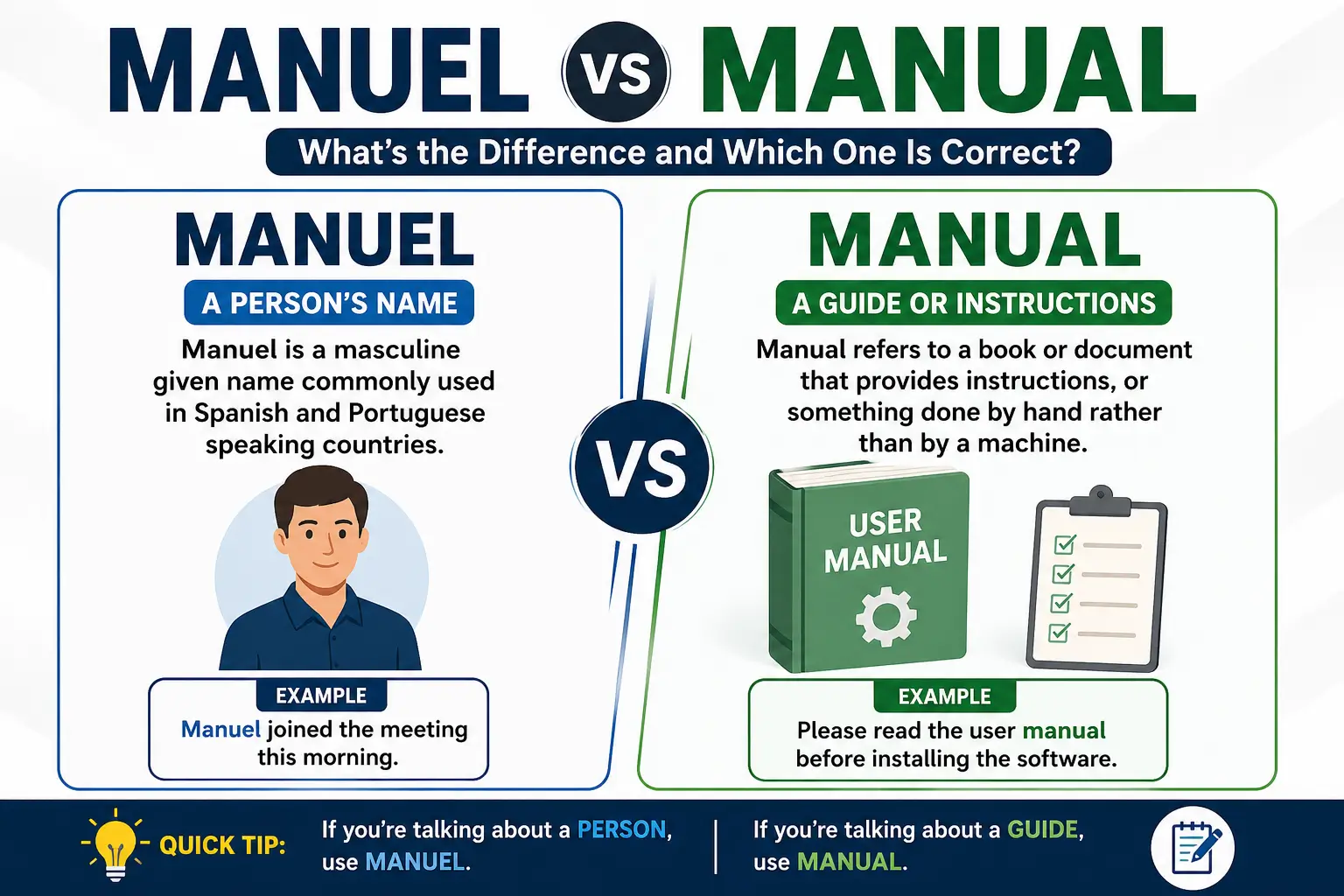
Manuel vs Manual: Quick Comparison Table
| Word | Meaning | Part of Speech | Example |
| Manual | A handbook, guide, or something done by hand | Noun, Adjective | Please read the manual before installing the software. |
| Manuel | A male given name | Proper Noun | Manuel joined the meeting this morning. |
What Is the Difference Between Manuel and Manual?
The difference is simple.
Manual is a standard English word. It refers to instructions, guides, or work performed by hand rather than by machines.
Manuel is primarily a personal name used in many Spanish- and Portuguese-speaking countries.
If you’re writing about instructions, equipment, training documents, or physical labor, you almost always need manual.
If you’re referring to a person named Manuel, then Manuel is correct.
What Does Manual Mean?
The word manual comes from the Latin word manus, meaning “hand.” Over time, it developed several meanings in English.
Read this also: Sale vs Sail: Meaning, Differences, Examples, and Easy Ways to Never Confuse Them Again
Manual as a Noun
As a noun, manual refers to a book or document that provides instructions.
Examples include:
- Employee training manual
- User manual
- Safety manual
- Vehicle owner’s manual
- Software installation manual
Examples of Manual as a Noun
- The technician followed the manual to repair the machine.
- Every employee receives a training manual during orientation.
- I downloaded the user manual from the manufacturer’s website.
Manual as an Adjective
As an adjective, manual describes work done by human hands rather than machines or automation.
Examples:
- Manual labor
- Manual testing
- Manual entry
- Manual transmission
Examples of Manual as an Adjective
- The company still relies on manual record keeping.
- Farmers often perform manual tasks during harvest season.
- Manual inspections help identify quality issues.
What Does Manuel Mean?
Unlike manual, Manuel is not typically used as a standard English vocabulary word.
It is a masculine given name that originated from the Hebrew name Emmanuel, which means “God is with us.”
The name remains popular in countries such as:
- Spain
- Portugal
- Mexico
- Brazil
- Argentina
- Chile
Examples of Manuel in Sentences
- Manuel submitted the project before the deadline.
- I met Manuel at a business conference.
- Manuel enjoys reading historical novels.
Is Manuel a Real English Word?
Yes, but only as a proper name.
Many people mistakenly use Manuel when they actually mean manual. In professional writing, academic papers, business reports, and online content, this error can reduce credibility.
Correct Example
- Please read the instruction manual carefully.
Incorrect Example
- Please read the instruction Manuel carefully.
The second sentence is incorrect because it refers to a guidebook rather than a person.
Why People Confuse Manuel and Manual
Several factors contribute to the confusion.
Similar Spelling
Only one letter separates the two words. When typing quickly, mistakes happen easily.
Autocorrect Problems
Some spell-check programs may not flag Manuel because it is a valid name.
Fast Typing
Writers often swap letters unintentionally, especially when working under deadlines.
Lack of Context Review
Many people focus on grammar while overlooking word choice.
When Should You Use Manual?
You should use manual whenever you’re talking about instructions, physical work, procedures, or non-automated processes.
Technology and Software
Technology companies frequently provide manuals.
Examples:
- Installation manual
- User manual
- Configuration manual
- Troubleshooting manual
Workplace Documentation
Businesses use manuals to standardize procedures.
Examples:
- Employee handbook
- Safety manual
- Operations manual
- Training manual
Automotive Industry
Vehicle owners regularly encounter manuals.
Examples:
- Owner’s manual
- Repair manual
- Maintenance manual
Manual Labor
The adjective form often describes physical work.
Examples:
- Construction work
- Farming activities
- Warehouse tasks
When Should You Use Manuel?
Use Manuel only when referring to someone’s name.
Examples:
- Manuel called the customer support team.
- Manuel received an award for outstanding performance.
- Manuel attended the annual conference.
Manual vs Automatic
Another common comparison involves manual and automatic systems.
| Manual | Automatic |
| Requires human control | Operates with minimal human input |
| Often slower | Usually faster |
| More hands-on | More technology-driven |
| Greater human involvement | Greater automation |
Example
A manual transmission requires the driver to change gears. An automatic transmission changes gears automatically.
Common Mistakes Writers Make
Here are mistakes frequently seen in emails, blog posts, and reports.
| Incorrect | Correct |
| User Manuel | User Manual |
| Safety Manuel | Safety Manual |
| Training Manuel | Training Manual |
| Employee Manuel | Employee Manual |
Even a small spelling error can make professional content look careless.
Synonyms of Manual
Depending on context, manual can have several alternatives.
As a Noun
- Guide
- Handbook
- Instruction book
- Reference guide
- Documentation
As an Adjective
- Hands-on
- Physical
- Non-automated
- Human-operated
Easy Tricks to Remember the Difference
Trick One
Manual contains the word “hand” in its origin.
Since manuals often explain how to perform tasks, think of hands and instructions together.
Trick Two
Manuel ends with “el.”
Many male names end with similar sounds, making it easier to remember that Manuel is usually a person’s name.
Trick Three
Ask yourself one simple question:
“Am I talking about a person or instructions?”
If it’s instructions, use manual. If it’s a person, use Manuel.
Why Correct Spelling Matters
Correct spelling affects more than grammar.
Professional Credibility
Clients and employers notice errors.
Academic Performance
Teachers often deduct marks for spelling mistakes.
Business Communication
Clear writing prevents misunderstandings.
SEO Benefits
Search engines prefer high-quality content with accurate spelling and language usage.
“Good writing isn’t just about grammar. It’s about making sure readers understand exactly what you mean.”
Real-World Examples
Business Example
The HR department distributed an employee manual outlining workplace policies.
Education Example
Students received a laboratory manual before conducting experiments.
Technology Example
The software manual explained how to configure advanced settings.
Personal Name Example
Manuel was responsible for presenting the quarterly report.
Practice Quiz
Choose the correct word.
- Please read the user _____ before installation.
- _____ attended the meeting yesterday.
- The company updated its safety _____.
- _____ works in the marketing department.
Answers
- Manual
- Manuel
- Manual
- Manuel
Frequently Asked Questions
Q1:What is the difference between Manuel and Manual?
The main difference is that manual is an English word that refers to a user guide, instruction book, training handbook, or work done by hand, while Manuel is a male personal name commonly used in Spanish- and Portuguese-speaking countries.
Q2:Is Manuel a correct English word?
Yes, Manuel is a valid name and can appear in English writing when referring to a person. However, it should not replace manual when discussing technical documentation, instruction manuals, or workplace procedures.
Q3:Why do people confuse Manuel vs Manual?
People often confuse Manuel vs Manual because the words differ by only one letter. Similar pronunciation, typing mistakes, autocorrect issues, and unfamiliarity with the correct spelling can all contribute to the confusion.
Q4:Is manual a noun or an adjective?
Manual can function as both. As a noun, it means an instruction manual, user handbook, or reference guide. As an adjective, it describes manual work, manual labor, or tasks completed by hand rather than through automation.
Q5:How can I remember the correct spelling of Manuel vs Manual?
A simple memory trick is to connect manual with instruction guides, training documents, and operating manuals. If you’re talking about a person, use Manuel. If you’re talking about documentation, procedures, or work done by hand, use manual.
Conclusion
Understanding the difference between Manuel vs Manual is essential for clear and professional communication. Although these words look similar, they serve completely different purposes. Manual refers to an instruction book, user guide, training manual, reference handbook, or work performed through manual processes, while Manuel is typically a male given name.
Many writers make this mistake because the words share nearly identical spelling and pronunciation. However, remembering the context makes the choice easy. If you’re discussing technical manuals, employee manuals, operating procedures, instructional materials, manual tasks, workplace documentation, written instructions, or equipment guides, the correct word is manual. If you’re referring to a person named Manuel, then Manuel is the right choice.
Small spelling errors can have a big impact on readability, professionalism, credibility, and reader trust. Taking a few seconds to review your word choice can help you communicate more effectively and present polished, error-free content. Whenever you’re unsure, remember this simple rule: manual is for instructions, Manuel is for people.