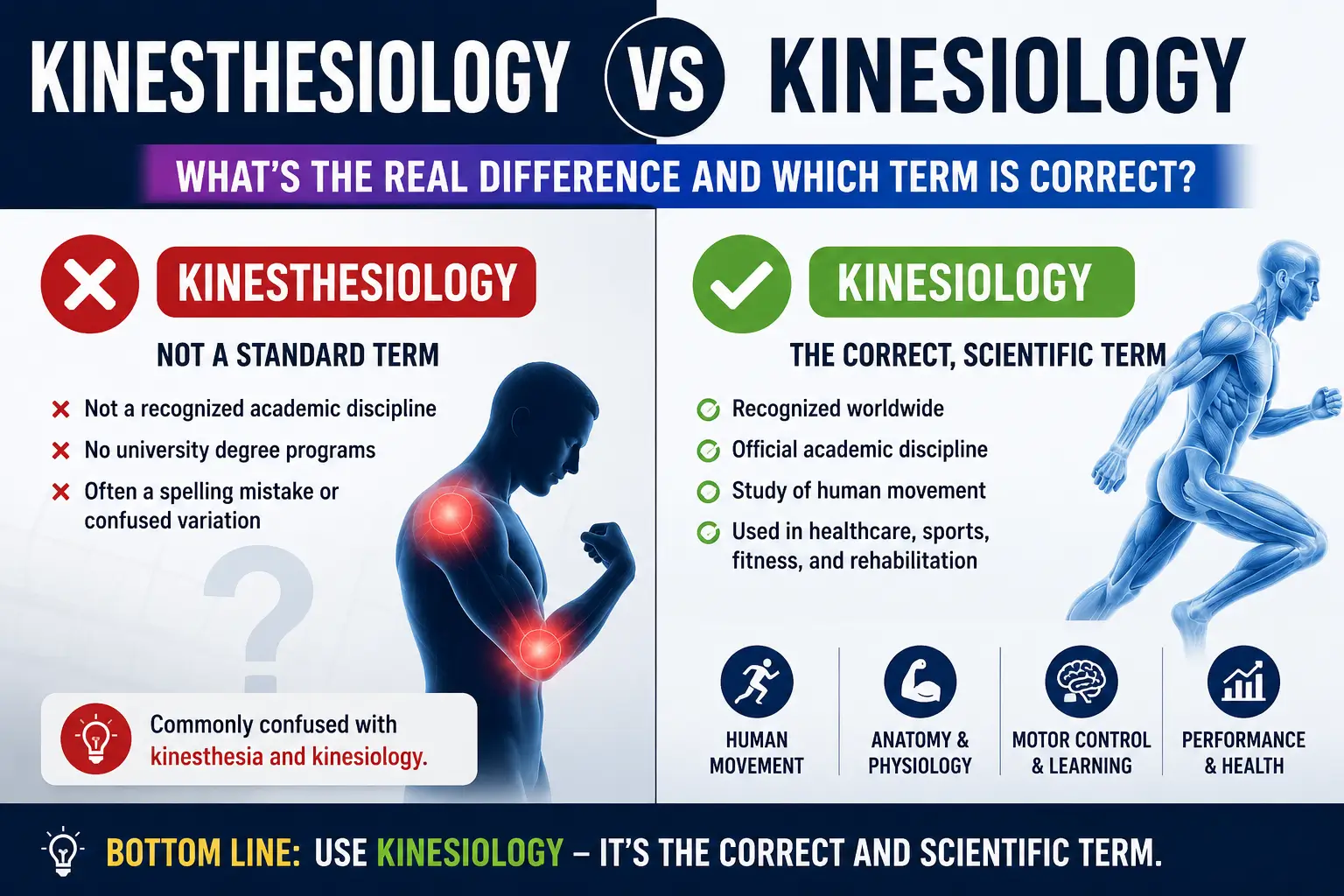
When you first encounter Kinesthesiology vs Kinesiology, the confusion usually starts in the search bar. The terms look almost identical, sound similar, and often create a mistaken variation in spelling that leads people to assume they mean the same thing. In reality, only kinesiology is the correct scientific term used in universities, healthcare, and sports science. It focuses on human movement, study of movement, physiology, anatomy, mechanics, and physical activity. On the other hand, kinesthesiology is not the standard term and usually appears due to spelling confusion or misunderstanding.
This mix-up often affects beginners in academic and fitness fields who are trying to build accuracy in their academic use and professional fields like fitness education and research training. Because both words relate to movement ideas, people often confuse movement awareness, kinesthetic perception, and body perception, which reduces clarity and credibility in writing.
Understanding the difference helps you use the correct term with confidence. Once you know that kinesiology is the scientific study of movement and kinesthesiology is commonly a misused form, the confusion disappears. This clarity improves your communication clarity, writing accuracy, and overall understanding in both academic and professional contexts.
Quick Answer: Kinesthesiology vs Kinesiology
If you just want the straight truth, here it is:
- Kinesiology is the correct, widely accepted scientific term
- Kinesthesiology is not a standard academic discipline
That’s it. Simple but important.
Which Term Is Correct Today?
Modern universities, healthcare systems, and sports science programs all use kinesiology. You’ll find thousands of degree programs in this field across the US, Canada, Australia, and Europe.
In contrast, kinesthesiology rarely appears in formal education or research. When it does, it usually comes from:
- Miswriting
- Confusion with kinesthesia
- Informal or outdated usage
What Is Kinesiology?
Kinesiology is the scientific study of human movement. It explores how muscles, bones, joints, and the nervous system work together.
Think of it like this:
If your body were a machine, kinesiology studies how every moving part interacts.
Kinesiology Definition
In simple terms:
Kinesiology is the science that studies how humans move and how movement affects health, performance, and recovery.
The Science of Human Movement
Kinesiology pulls knowledge from several core sciences:
- Anatomy (body structure)
- Physiology (how the body functions)
- Biomechanics (movement mechanics)
- Neuroscience (brain and muscle control)
This combination makes it a strong evidence-based discipline, not just theory.
Main Areas of Study in Kinesiology
Here are the core branches:
| Area | What It Studies | Real-Life Example |
| Biomechanics | Movement mechanics | How a sprinter improves stride |
| Exercise Physiology | Body response to exercise | Heart rate during running |
| Motor Learning | Skill development | Learning to ride a bike |
| Motor Control | Brain-body coordination | Balance while walking |
| Sport Psychology | Mental performance | Focus before competition |
Each area connects directly to sports, rehab, fitness, and healthcare.
What Is Kinesthesiology?
Now here’s where confusion begins.
Kinesthesiology is not a standard scientific field. Most academic institutions do not recognize it as a separate discipline.
Kinesthesiology Definition
When used, it usually gets described as:
A mistaken or informal term related to the study of movement or body awareness.
But scientifically, it does not stand alone.
Historical Use of the Term
The word appears occasionally in older texts or informal writing, often due to confusion with:
- Kinesiology
- Kinesthesia
However, it never developed into an official academic field.
Why the Word Appears Online
You might still see it because:
- People assume it sounds more “medical”
- It spreads through blogs or social media
- It gets mixed up in search queries
But in real academic or professional settings, it is not used.
Is Kinesthesiology an Academic Discipline?
No. Universities do not offer degrees in kinesthesiology. Accreditation bodies do not list it as a recognized field.
If you see it in content, treat it carefully. It’s usually inaccurate.
Kinesthesiology vs Kinesiology: Key Differences
Now let’s break it down clearly.
Side-by-Side Comparison
| Feature | Kinesiology | Kinesthesiology |
| Status | Official science | Non-standard term |
| Usage | Universities, healthcare | Rare, informal |
| Field | Human movement science | Misused or mistaken |
| Recognition | Global academic field | Not recognized |
| Application | Sports, rehab, health | No formal application |
Terminology Differences
The difference often comes down to language structure. “Kinesiology” comes from Greek:
- kinesis = movement
- logia = study of
“Kinesthesiology” blends incorrect assumptions about kinesthesia and physiology.
Academic Usage
Only kinesiology appears in:
- University syllabi
- Medical rehabilitation programs
- Sports science degrees
Scientific Recognition
Organizations like:
- American Kinesiology Association
- National Academy of Kinesiology
recognize only kinesiology, not kinesthesiology.
Professional Applications
Kinesiology is used in:
- Sports training
- Physical therapy support
- Rehabilitation programs
- Workplace ergonomics
Kinesthesiology has no formal professional framework.
Why People Confuse Kinesthesiology and Kinesiology
This confusion is more common than you might think.
Nearly Identical Spellings
One extra syllable creates the mix-up. Visually, they look almost identical.
Connection to Human Movement
Both seem related to movement science, so people assume they are interchangeable.
Confusion With Kinesthesia
This is a big reason.
Kinesthesia means:
Awareness of body movement and position
People mistakenly combine:
- kinesiology + kinesthesia → kinesthesiology
Influence of Alternative Medicine
Some alternative health content uses similar-sounding terms, which adds more confusion.
Internet Misinformation
Blogs and social media often repeat incorrect terms without verification.
What Is Kinesthesia?
To understand the confusion fully, you need kinesthesia.
Kinesthesia Definition
Kinesthesia is your body’s ability to sense movement.
For example:
- Knowing your arm position without looking
- Balancing while walking in the dark
How Kinesthesia Relates to Movement
It is part of your sensory system. It works with:
- vision
- balance system
- muscle feedback
Kinesthesia vs Kinesiology
| Kinesthesia | Kinesiology |
| Sensory ability | Scientific study |
| Internal awareness | External analysis |
| Personal experience | Academic discipline |
Everyday Examples
- Catching a ball without watching your hands
- Typing without looking at keys
- Walking without focusing on each step
Which Term Should You Use?
This is where clarity matters most.
Academic Writing
Always use kinesiology
University Programs
Search only for:
- Kinesiology degree
- Exercise science
Healthcare Settings
Professionals use kinesiology in:
- rehab clinics
- sports medicine
- physiotherapy support
Fitness and Sports Settings
Coaches and trainers rely on kinesiology principles daily.
Is Kinesiology a Real Science?
Yes, and it is well-established.
Scientific Foundations
Kinesiology uses:
- peer-reviewed research
- biomechanics testing
- physiological data
Research-Based Evidence
Studies in kinesiology often measure:
- muscle activation levels
- movement efficiency
- injury prevention strategies
Healthcare Impact
It plays a major role in:
- stroke recovery
- athletic rehabilitation
- mobility improvement programs
What Does a Kinesiologist Do?
A kinesiologist studies movement and helps improve physical performance.
Role and Responsibilities
They often:
- assess movement patterns
- design exercise programs
- support injury recovery
Injury Prevention
They help reduce strain on joints and muscles.
Exercise Prescription
They build safe fitness routines for patients.
Rehabilitation Support
They assist recovery after injuries or surgeries.
Is a Kinesiologist a Doctor?
No.
Education Requirements
Most kinesiologists hold:
- Bachelor’s degree in kinesiology
- Sometimes a master’s degree
What They Are Not
They are not medical doctors.
What They Can Do
They can:
- support therapy plans
- work with physiotherapists
- improve movement outcomes
But they cannot diagnose diseases.
Kinesiology vs Applied Kinesiology
This is another common confusion point.
What Is Applied Kinesiology?
It is an alternative practice claiming muscle testing reveals health issues.
Scientific Standing
Mainstream science does not fully support it.
Key Difference
| Kinesiology | Applied Kinesiology |
| Evidence-based | Controversial |
| Academic field | Alternative therapy |
| Research supported | Limited validation |
Kinesiology vs Physical Therapy
Similarities
- Both help recovery
- Both improve movement
Differences
- Physical therapy treats injuries clinically
- Kinesiology focuses on movement science and prevention
Kinesiology vs Exercise Science vs Sports Science
These fields overlap but differ slightly:
- Kinesiology → broad human movement science
- Exercise science → fitness and body response
- Sports science → athletic performance focus
Kinesiology Degree Overview
Subjects You Study
- Anatomy
- Physiology
- Biomechanics
- Nutrition basics
Degrees Available
- Bachelor of Science (BSc)
- Master’s programs
- PhD research tracks
Careers in Kinesiology
Common roles include:
- Athletic trainer
- Exercise physiologist
- Rehab specialist
- Sports performance coach
- Ergonomics consultant
Salary Overview
In the US (2025 estimates):
- Entry level: $45,000–$60,000
- Mid level: $60,000–$85,000
- Senior roles: $90,000+
How Kinesiology Is Used in Real Life
You’ll see it in:
- sports training programs
- hospital rehab units
- workplace safety systems
- fitness coaching
Common Mistakes to Avoid
- Using “kinesthesiology” instead of kinesiology
- Mixing kinesthesia with kinesiology
- Treating applied kinesiology as mainstream science
Easy Way to Remember
- Kinesiology = science of movement
- Kinesthesia = feeling movement
- Kinesthesiology = incorrect term
Kinesthesiology vs Kinesiology Examples
Correct:
- “She studied kinesiology at university.”
Incorrect:
- “She studied kinesthesiology.”
Key Takeaways
- Kinesiology is the correct scientific term
- Kinesthesiology is not academically recognized
- Confusion comes from spelling and kinesthesia overlap
- The field plays a major role in health and sports science
FAQs
Q.1 What is the difference between kinesthesiology and kinesiology?
Kinesiology is a real scientific field. Kinesthesiology is not a standard academic term.
Q.2 Is kinesthesiology a real word?
It exists in informal use but is not recognized in science or universities.
Q.3 What does kinesiology study?
It studies human movement, including muscles, bones, and motor control.
Q.4 Is kinesiology a medical field?
It supports healthcare but is not a medical doctor field.
Q.5 What jobs can you get with kinesiology?
You can work in fitness, sports training, rehab, and ergonomics.
Conclusion
Understanding Kinesthesiology vs Kinesiology clears up a lot of confusion in science and everyday writing. Once you know the difference, you stop mixing up a non-standard term with a well-established scientific field. Kinesiology gives you a real, research-backed understanding of human movement, while kinesthesiology simply fades away as a common mistake.