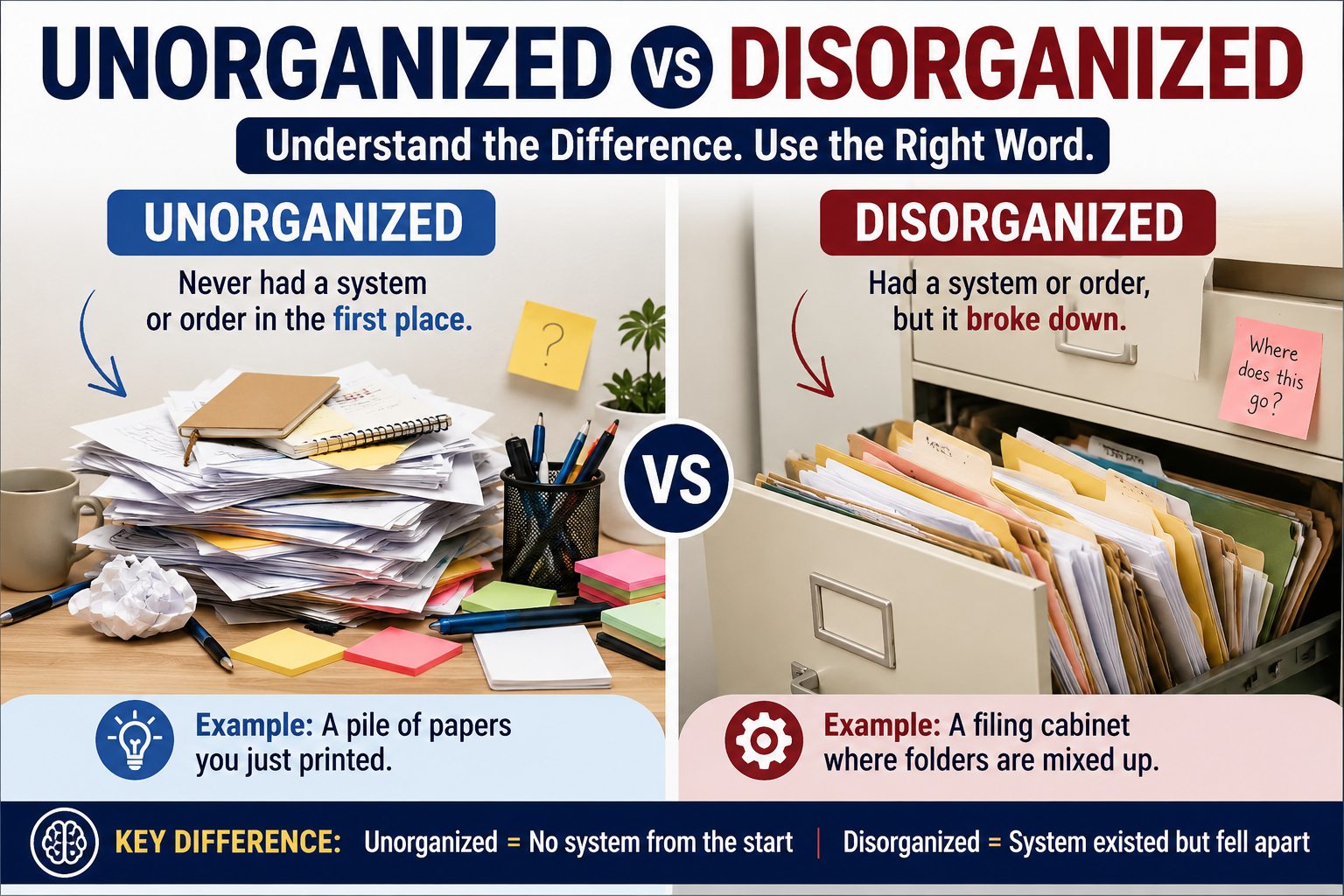
Unorganized vs Disorganized becomes easier when you check whether something lacks a system or has a system that now works badly in daily life. Both describe a lack of order, but the meaning distinction and subtle difference guide better word choice and correct usage.
Unorganized meaning is close to not organized: a pile of papers or printed papers may lack order because no one created an organization method. Disorganized meaning points more toward disorder, such as an existing system that became a broken system after a system breakdown. Picture a filing cabinet with folders mixed up.
Choose the correct term by checking the context and sentence context. A good problem diagnosis leads to the right solution. For an English learner or native speaker, studying the prefixes un- and dis- explains their negative meaning. This improves language precision, sentence accuracy, message clarity, workplace communication, clarity, and confidence, while preventing a common mistake.
Unorganized vs Disorganized: Quick Answer
Unorganized generally means not arranged, sorted, classified, or formally structured.
Disorganized usually means confused, disorderly, poorly planned, or badly managed.
For example:
- A folder of photos that nobody has sorted is unorganized.
- A filing system with duplicate labels and missing documents is disorganized.
- A group without formal leadership may be unorganized.
- A team that misses deadlines and gives conflicting instructions is disorganized.
The words sometimes describe the same situation. Still, the emphasis changes.
Use “unorganized” when order or structure is missing. Use “disorganized” when confusion or ineffective organization creates a problem.
Quick comparison table
| Feature | Unorganized | Disorganized |
| Basic meaning | Not arranged or structured | Lacking order or effective planning |
| Main emphasis | Missing organization | Poor or confusing organization |
| Common tone | Neutral or mildly critical | More clearly negative |
| Often describes | Files, notes, data, collections, groups | People, meetings, offices, plans, systems |
| Typical example | Unorganized research notes | A disorganized research project |
| Suggests confusion | Not always | Usually |
| Suggests poor performance | Not necessarily | Often |
| British spelling | Unorganised | Disorganised |
Read this also: Shute vs Chute: Meaning, Difference, and Correct Usage Explained
What Does Unorganized Mean?
Unorganized is an adjective. It describes something that hasn’t been arranged into a clear, systematic, or formal structure.
The word often focuses on the absence of organization rather than the presence of chaos.
Imagine a box filled with printed photographs. The pictures aren’t damaged. They aren’t necessarily thrown around carelessly. However, nobody has sorted them by date, person, location, or event.
Those photographs are unorganized.
The main meaning of unorganized
Something may be unorganized when it lacks:
- Categories
- Labels
- A fixed arrangement
- Formal leadership
- A clear system
- Group coordination
- Classification
- A logical sequence
The word can describe physical objects, information, activities, groups, or institutions.
Common examples of unorganized things
Natural combinations include:
- Unorganized files
- Unorganized notes
- Unorganized photographs
- Unorganized records
- Unorganized research
- Unorganized data
- Unorganized activities
- Unorganized groups
- Unorganized labor
- An unorganized collection
In these examples, the main problem isn’t always disorder. Instead, the material or group lacks a defined arrangement.
Unorganized doesn’t always mean messy
An unorganized collection may look neat.
For instance, imagine 200 books placed carefully on shelves. Every book stands upright. Nothing lies on the floor. Yet the owner hasn’t arranged the books by author, subject, title, or genre.
The shelves look tidy, but the collection remains unorganized.
This example reveals an important distinction:
- Tidy describes physical neatness.
- Organized describes a useful arrangement or system.
Something can look tidy without being organized. Likewise, something can look slightly messy while following a system its owner understands.
Does unorganized mean “never organized”?
Writers often claim that unorganized means something has never been organized. That explanation can work as a memory shortcut, but it isn’t a strict rule.
The word mainly describes the current state.
If someone says, “The files are unorganized,” the sentence doesn’t prove that the files were never sorted before. Perhaps they were organized last month. Perhaps someone mixed them up yesterday. The speaker simply tells us that the files lack organization now.
Therefore, avoid treating “never organized” as part of the formal definition.
Specialized meaning: unorganized labor
The phrase unorganized labor has a specific meaning in employment and industrial relations.
It can refer to workers who don’t belong to a labor union or haven’t formed an organized bargaining group.
In this context, unorganized doesn’t mean lazy, careless, or confused. It refers to the absence of formal union organization.
Compare:
- Unorganized workers may lack union representation.
- Disorganized workers may struggle to coordinate tasks or manage responsibilities.
The two phrases communicate completely different ideas.
Examples of unorganized in sentences
- Her interview notes remained unorganized after the research phase.
- The folder contains hundreds of unorganized family photographs.
- The company collected useful information, but the data stayed unorganized.
- At first, the residents formed an unorganized group without formal leadership.
- The teacher gave students several unorganized activities to complete freely.
- The archive includes decades of unorganized correspondence.
- Most workers in the sector remained unorganized and had no union representation.
- His ideas were valuable, although his notes were still unorganized.
What Does Disorganized Mean?
Disorganized is also an adjective. It describes something that lacks order, coordination, clear planning, or an effective system.
Unlike unorganized, this word often suggests that the lack of order causes confusion, delays, mistakes, or frustration.
A disorganized meeting, for example, may have no clear agenda. Speakers interrupt one another. Participants don’t know what they need to decide. The meeting runs late without producing useful results.
The problem goes beyond missing categories. The entire process works poorly.
The main meaning of disorganized
Something may be disorganized when it shows:
- Poor planning
- Conflicting instructions
- Weak coordination
- Scattered thinking
- Inconsistent methods
- Missing information
- Unclear priorities
- Repeated delays
- Confusing arrangements
- Ineffective leadership
Common examples of disorganized people and systems
Natural combinations include:
- A disorganized person
- A disorganized manager
- A disorganized office
- A disorganized meeting
- A disorganized schedule
- A disorganized team
- A disorganized presentation
- A disorganized filing system
- Disorganized thinking
- Disorganized work habits
In these phrases, disorganized suggests that the lack of order affects performance or understanding.
Disorganized often carries a negative tone
Calling a file unorganized may sound factual. Calling a person disorganized sounds more personal and critical.
Consider these sentences:
- “Your notes are unorganized.”
- “You’re disorganized.”
The first sentence comments on the condition of the notes. The second judges the person’s habits or abilities.
For that reason, use the word carefully when talking about people. A more specific description often sounds fairer and more useful.
Instead of saying:
You’re disorganized.
You might say:
Your appointments, task lists, and deadlines are stored in several different places.
The second version explains the actual problem without attaching a broad label to the person.
Examples of disorganized in sentences
- The meeting felt disorganized because nobody had prepared an agenda.
- His desk looked disorganized, with papers covering every available surface.
- The team became disorganized after its project manager resigned.
- She’s talented and creative, but her work habits can be disorganized.
- The application process was slow, confusing, and badly disorganized.
- His presentation sounded disorganized because he jumped between unrelated points.
- A disorganized schedule caused her to miss two important appointments.
- The event appeared disorganized despite months of preparation.
What Is the Difference Between Unorganized and Disorganized?
The central difference lies in what each word emphasizes.
Unorganized points toward missing arrangement, classification, or formal structure.
Disorganized points toward confusion, disorder, weak coordination, or ineffective planning.
That distinction isn’t absolute. English words rarely stay inside perfectly separated boxes. Context still determines which term sounds more natural.
Missing structure versus ineffective structure
Suppose a company receives 500 customer comments.
If nobody has sorted the comments by topic, department, or urgency, the feedback is unorganized.
Now suppose the company has a sorting system. However, employees use conflicting categories, duplicate entries, and lose urgent complaints. The system is disorganized.
In the first case, a clear structure is missing.
In the second, the process creates confusion.
Neutral description versus negative evaluation
Unorganized can sound relatively neutral.
A collection may remain unorganized simply because nobody has had time to classify it. The word doesn’t always suggest carelessness.
Disorganized usually sounds more critical.
It often implies that someone planned poorly, failed to coordinate details, or created an ineffective system.
Compare:
- The documents are unorganized.
- The records department is disorganized.
The first sentence describes the documents’ condition. The second criticizes how an entire department operates.
Materials versus people and processes
Although both words can modify many nouns, they have different natural partners.
Unorganized often sounds natural with:
- Information
- Notes
- Data
- Files
- Photos
- Collections
- Groups without formal structure
Disorganized often sounds natural with:
- People
- Meetings
- Offices
- Schedules
- Projects
- Presentations
- Work habits
- Management systems
These patterns aren’t grammar laws. They reflect common English usage.
Side-by-Side Meaning Comparison
| Context | Better choice | Reason |
| Photos that haven’t been sorted | Unorganized | They lack classification |
| A confusing photo archive | Disorganized | The system works poorly |
| A manager who misses deadlines | Disorganized | The word describes ineffective habits |
| A group without formal leadership | Unorganized | The group lacks structure |
| A team with conflicting roles | Disorganized | Poor coordination creates confusion |
| Raw research notes | Unorganized | The material hasn’t been arranged |
| A presentation with no logical flow | Disorganized | The ideas appear confused |
| Workers without union membership | Unorganized | The word has a specialized labor meaning |
| A chaotic office | Disorganized | The environment lacks workable order |
| Books not sorted by category | Unorganized | No classification system exists |
Can Both Words Describe the Same Thing?
Yes. In some situations, either word can work.
A desk can be unorganized or disorganized. A room can also receive either description.
However, the speaker’s focus changes.
An unorganized desk
This phrase suggests that the items haven’t been arranged systematically.
Perhaps the owner hasn’t created separate places for documents, stationery, receipts, and equipment.
A disorganized desk
This phrase suggests visible disorder or practical difficulty.
Important papers may be buried under old receipts. Pens disappear. Deadlines get missed because documents can’t be found.
The first phrase focuses on missing arrangement. The second highlights the consequences of disorder.
An unorganized room
The room may lack storage zones or a clear layout. Items don’t have assigned places.
A disorganized room
The room feels chaotic, cluttered, or difficult to use.
In casual conversation, many people won’t notice a major difference. In careful writing, though, the distinction can sharpen your meaning.
How the Prefixes Change the Meaning
The prefixes un- and dis- provide a useful clue.
However, prefixes don’t always create strict definitions. Usage and context still matter.
What “un-” suggests
The prefix un- often means “not” or “lacking.”
Examples include:
- Unclear
- Unfinished
- Uncertain
- Unavailable
- Unprepared
Following this pattern, unorganized can mean “not organized.”
The word often describes a missing condition rather than an active breakdown.
What “dis-” suggests
The prefix dis- can express separation, reversal, absence, or a negative condition.
Examples include:
- Disconnect
- Disagree
- Distrust
- Disorder
- Disapprove
In disorganized, the prefix helps create the sense of disorder or disrupted organization.
Still, don’t assume that something must have been organized before becoming disorganized. A badly planned event can feel disorganized from the moment it begins.
When Should You Use Unorganized?
Choose unorganized when you want to emphasize that something hasn’t been sorted, classified, arranged, or formally structured.
The word works especially well when you’re talking about raw material or a collection waiting for organization.
Use unorganized for unsorted information
Examples include:
- Unorganized survey results
- Unorganized research notes
- Unorganized receipts
- Unorganized digital files
- Unorganized customer records
In each case, the information exists. However, it hasn’t been placed into useful categories.
Use unorganized for groups without formal structure
An unorganized group may lack:
- Elected leaders
- Defined roles
- Written rules
- A membership system
- A shared decision-making process
The group may still achieve useful results. It simply hasn’t developed a formal structure.
Use unorganized in labor contexts
As mentioned earlier, unorganized workers may refer to employees who don’t belong to a union.
Because the phrase carries a specific meaning, replacing it with disorganized workers would change the message.
When Should You Use Disorganized?
Choose disorganized when confusion, poor planning, or ineffective systems create problems.
The word often works best for people, behavior, events, workplaces, and processes.
Use disorganized for people and habits
A disorganized person may:
- Forget appointments
- Misplace important items
- Miss deadlines
- Start tasks without finishing them
- Store information in several places
- Struggle to set priorities
However, avoid using the label too broadly. Someone may manage one area poorly while handling other responsibilities well.
Use disorganized for meetings and events
A disorganized event may involve:
- Unclear schedules
- Late starts
- Missing supplies
- Conflicting instructions
- Poor communication
- Undefined responsibilities
- Last-minute changes
The word fits because the problem affects how the event operates.
Use disorganized for systems
A disorganized system may technically exist, but it fails to create clarity.
For example, a company may have folders for every department. Yet if employees use different naming rules and store documents in random locations, the system remains disorganized.
Real-Life Sentence Pairs
The following pairs show how a small word change can alter the meaning.
| Situation | Unorganized | Disorganized |
| Notes | Her notes were unorganized and hadn’t been sorted by topic. | Her notes were disorganized, so the argument became hard to follow. |
| Office | The new office remained unorganized during the move. | The office was disorganized, with missing records and conflicting schedules. |
| Team | The volunteers began as an unorganized group. | The team became disorganized after its leader left. |
| Event | The gathering started as an unorganized neighborhood activity. | The conference felt disorganized and began two hours late. |
| Files | The files were unorganized because nobody had labeled them. | The filing system was disorganized because it used duplicate categories. |
| Ideas | His ideas were unorganized and needed a clear outline. | His explanation was disorganized and difficult to understand. |
Grammar and Usage Tips
Both terms function mainly as adjectives.
They describe nouns:
- Unorganized documents
- Disorganized thinking
- An unorganized group
- A disorganized employee
Adverb forms
The related adverb disorganizedly exists, but it sounds awkward in most everyday writing.
Instead of writing:
She worked disorganizedly.
Write:
She worked without a clear system.
Or:
Her approach to the task was disorganized.
English speakers rarely use unorganizedly. A clearer phrase usually works better.
Read this also: Comming vs Coming: Correct Spelling, Meaning, and Real Usage Explained
Noun forms
The common noun related to both words is organization.
Depending on context, you may also use:
- Disorder
- Disorganization
- Lack of structure
- Confusion
- Poor coordination
Disorganization is a standard and natural noun.
Example:
Poor communication caused widespread disorganization.
The word unorganization exists in limited use, but it sounds uncommon and awkward. Most writers should choose lack of organization instead.
Comparative forms
Grammatically, you can say:
- More unorganized
- Less unorganized
- More disorganized
- Less disorganized
However, more disorganized sounds far more natural in everyday English.
Example:
The office became more disorganized as the company grew.
For unorganized, writers often improve clarity by describing the exact condition:
The second folder contains more unsorted files.
American and British English Spellings
American English usually uses:
- Unorganized
- Disorganized
- Organization
British English commonly uses:
- Unorganised
- Disorganised
- Organisation
However, British spelling isn’t completely uniform. Some British publishers and academic institutions use -ize endings rather than -ise endings.
That means you may encounter:
- Organize
- Organized
- Disorganized
in British publications.
The best rule is simple: follow the spelling style required by your school, employer, client, or publication. Then use that style consistently.
Spelling comparison
| American English | Common British English |
| Unorganized | Unorganised |
| Disorganized | Disorganised |
| Organized | Organised |
| Organization | Organisation |
Common Mistakes to Avoid
These words look simple, but several common mistakes can blur your meaning.
Treating them as perfect synonyms
The terms overlap, but they aren’t always interchangeable.
“Unorganized labor” and “disorganized labor” don’t mean the same thing. Likewise, “unorganized data” often sounds more precise than “disorganized data” when the information simply hasn’t been sorted.
Believing the history rule too literally
A popular explanation says:
- Unorganized means never organized.
- Disorganized means organized before and later disturbed.
That distinction can help beginners remember the words. Still, real English usage doesn’t always follow it.
A meeting may be disorganized even if nobody planned it properly in the first place.
Using unorganized for every messy person
“An unorganized person” isn’t necessarily incorrect. However, a disorganized person sounds more natural when you mean someone who struggles with planning, deadlines, or belongings.
Using disorganized when you mean unsorted
If raw data hasn’t been categorized, call it unorganized or unsorted.
Calling it disorganized may suggest that the data follows a confusing system rather than no system at all.
Ignoring the tone
Disorganized can sound judgmental when applied to a person.
Instead of attaching a label, describe the behavior when tact matters.
Less helpful:
Jenna is disorganized.
More useful:
Jenna keeps project notes in several apps, which makes deadlines harder to track.
Mixing US and UK spelling
Avoid switching between organized and organised in the same article.
Neither style is universally better. Consistency makes the writing look professional.
Mini Case Study: An Unorganized Team and a Disorganized Team
Consider two small marketing teams preparing product launches.
Team A: Unorganized
Team A includes six skilled freelancers. They communicate through email, chat, and shared documents.
However, the team has:
- No formal leader
- No standard project template
- No fixed meeting schedule
- No official process for approving content
The members cooperate well. They simply haven’t created a formal structure.
Calling Team A unorganized makes sense because the group lacks an established arrangement.
Team B: Disorganized
Team B has a manager, weekly meetings, project software, deadlines, and written procedures.
Still, the manager changes priorities every few days. Employees receive conflicting instructions. Designers create duplicate files, while writers miss approval deadlines.
The team has a structure, but it doesn’t work effectively.
Calling Team B disorganized communicates the real problem: confusion and poor coordination.
What the case study shows
Team A lacks organization.
Team B has organizational tools but still operates badly.
That contrast captures the practical difference better than the oversimplified “never organized” rule.
Synonyms for Unorganized
No synonym fits every context. Choose one that reflects the exact problem.
| Synonym | Best use |
| Unsorted | Files, photos, data, mail |
| Unclassified | Research, records, specimens |
| Unarranged | Objects, materials, ideas |
| Unstructured | Meetings, activities, learning |
| Informal | Groups, agreements, gatherings |
| Unsystematic | Methods, research, procedures |
| Haphazard | Random arrangements or actions |
| Nonunion | Workers outside a labor union |
Example distinctions
Unsorted works well when items haven’t been placed into categories.
The folder contains unsorted receipts.
Unstructured may describe something intentionally flexible.
The workshop uses an unstructured discussion format.
Haphazard suggests randomness and weak planning.
The documents were stored in a haphazard way.
Synonyms for Disorganized
Useful alternatives include:
| Synonym | Best use |
| Chaotic | Severe disorder |
| Disorderly | Messy behavior or spaces |
| Scattered | Thoughts, attention, efforts |
| Muddled | Ideas, explanations, plans |
| Confused | Thinking, instructions, arrangements |
| Inefficient | Systems and workflows |
| Jumbled | Words, objects, information |
| Poorly planned | Meetings, projects, events |
| Cluttered | Rooms, desks, visual layouts |
Choosing the right synonym
Use chaotic when the disorder feels extreme.
Use cluttered when too many physical or visual items occupy a space.
Use scattered for thoughts, attention, or effort.
Use inefficient when a system wastes time or resources.
Use poorly planned when you want a clear, neutral description of the cause.
Related Words and Their Differences
Several related words appear similar, but they focus on different conditions.
Messy
Messy usually describes physical untidiness.
A messy desk may contain scattered papers and food wrappers. However, the owner might still know where everything is.
Cluttered
Cluttered means crowded with too many objects or details.
A webpage can look cluttered even when its content follows a clear structure.
Chaotic
Chaotic suggests severe confusion and unpredictability.
The word is stronger than disorganized.
Unstructured
Unstructured means something lacks a fixed format.
Unlike disorganized, it can carry a positive or neutral meaning.
An unstructured interview, for example, allows a flexible conversation. That doesn’t automatically make it poorly managed.
Unsystematic
Unsystematic describes an approach that doesn’t follow a consistent method.
It often appears in academic, scientific, and professional writing.
Disorderly
Disorderly can describe untidy places, unruly behavior, or a lack of control.
The word sometimes sounds stronger and more formal than messy.
A Simple Memory Trick
Use this two-part reminder:
- Unorganized = not yet arranged
- Disorganized = difficult to manage
Another useful shortcut focuses on nouns:
- Choose unorganized for raw material.
- Choose disorganized for confused behavior or broken processes.
For example:
- Raw interview notes are unorganized.
- A confusing interview process is disorganized.
Remember, this trick guides your choice. It doesn’t create an inflexible grammar rule.
Practice Examples
Choose unorganized or disorganized for each sentence.
- The vacation photos remained ______ after the family returned home.
- The conference was ______, with long delays and missing speakers.
- Her ______ schedule caused her to miss the appointment.
- Most workers in the industry were ______ and lacked union representation.
- The researchers stored the raw data in an ______ folder.
- The company’s filing system was ______ and full of duplicate records.
- The residents formed an ______ group without elected leaders.
- His presentation sounded ______ because the ideas lacked a logical sequence.
Answer key
- Unorganized: The photos haven’t been sorted.
- Disorganized: The conference suffered from poor coordination.
- Disorganized: The schedule caused practical problems.
- Unorganized: The workers lacked union organization.
- Unorganized: The raw data hadn’t been classified.
- Disorganized: The filing system existed but worked badly.
- Unorganized: The group lacked formal structure.
- Disorganized: The presentation felt confusing.
Frequently Asked Questions
Q1. What is the main difference between unorganized and disorganized?
Unorganized usually means something has no clear arrangement or system. Disorganized means something is confusing, poorly managed, or no longer working in an orderly way.
Q2. Can unorganized and disorganized mean the same thing?
Sometimes, yes. Both can describe a lack of order. However, unorganized often focuses on missing structure, while disorganized usually points to confusion or poor control.
Q3. Is it correct to say an unorganized person?
Yes, but a disorganized person sounds more natural in everyday English. It usually describes someone who often loses things, misses deadlines, or struggles with planning.
Q4. Which word should I use for files or papers?
Use unorganized when the files or papers have not been sorted. Use disorganized when a filing system exists but is confusing, inconsistent, or difficult to use.
Q5. Does disorganized mean something was organized before?
Not always. A system may become disorganized after losing order, but a meeting or project can also be disorganized from the beginning because of poor planning.
Conclusion
The difference between unorganized and disorganized depends on the type of problem you want to describe. Use unorganized when something lacks sorting, structure, or a clear system. Choose disorganized when confusion, weak planning, or poor management creates disorder.
A pile of unsorted papers may be unorganized, while a filing cabinet with mixed labels and missing folders is disorganized. Checking the context will help you choose the right word and make your writing clearer.