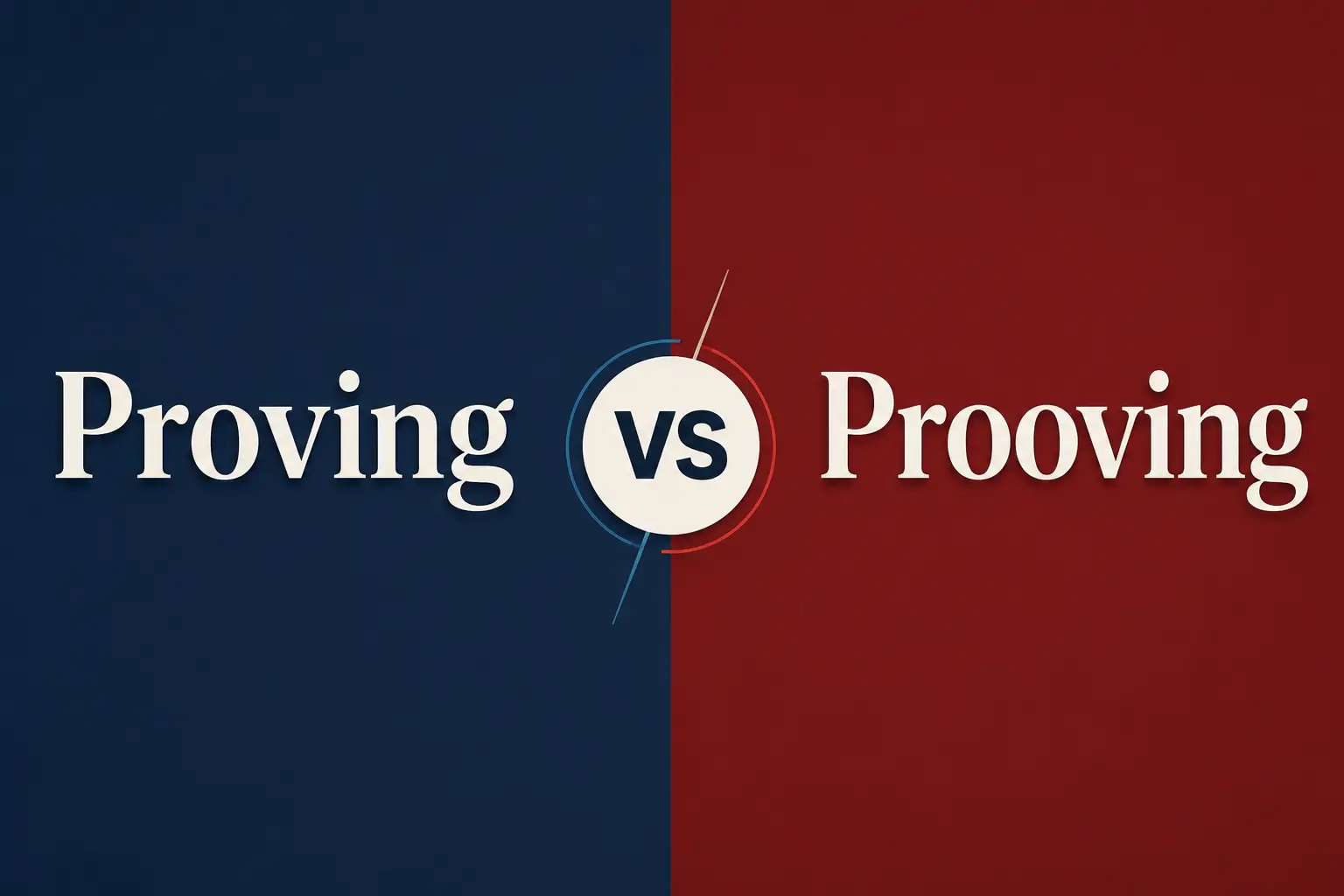
Proving or Prooving creates common spelling confusion because English spelling changes when a verb form becomes a present participle. Many writers become paused while writing when they see proof with a double o and assume the same pattern applies.
In reality, proving is the correct version and the accepted version in standard English, while prooving is an incorrect spelling. Although these similar words may look alike, they serve different purposes in language usage. Building understanding the difference helps improve writing in an email, on social media, and in academic content. A trusted guide can explain the real meaning, apply grammar rules, clarify proving meaning, improve word usage, and reduce common mistakes through practical examples used every day.
Trusted dictionaries such as Merriam-Webster and Wiktionary support accurate writing and written communication. They help writers avoid a spelling mistake, catch a common typo, and strengthen proofreading habits. The verb prove means to demonstrate truth through evidence and factual proof. In academic writing, a school assignment, and formal essays, proper word usage matters.
Proving vs Prooving: The Quick Answer
If you’ve ever wondered whether to write proving or prooving, the answer is simple: proving is the correct spelling. Prooving is a common spelling mistake that appears because many people assume the double “o” from the word prove should remain when adding -ing.
However, English spelling rules work differently. When forming the present participle of prove, the silent e is removed before adding -ing, resulting in proving.
Correct: proving
Incorrect: prooving
Although the mistake looks minor, it can affect credibility in academic writing, business communication, professional documents, and online content.
What Does “Proving” Mean?
Definition of Proving
The word proving is the present participle and gerund form of the verb prove. It refers to the act of demonstrating that something is true, valid, accurate, or effective.
Examples include:
- Proving a scientific theory
- Proving a legal claim
- Proving a business strategy works
- Proving someone’s identity
At its core, proving involves presenting evidence, facts, or results that support a conclusion.
Proving as the Present Participle of Prove
The verb family looks like this:
| Form | Word |
| Base Verb | Prove |
| Present Participle | Proving |
| Past Tense | Proved |
| Past Participle | Proven / Proved |
This pattern follows standard English grammar rules and appears in both American and British English.
Common Meanings of Proving
Depending on context, proving may mean:
- Demonstrating truth
- Establishing facts
- Confirming evidence
- Testing effectiveness
- Validating claims
- Showing capability
For example:
“The company is proving that sustainable practices can also increase profits.”
In this sentence, proving means demonstrating through evidence and results.
Proving in Modern English Usage
Today, proving appears across many fields:
- Education
- Science
- Law
- Business
- Marketing
- Technology
- Everyday conversation
Whether you’re writing a research paper or sending an email, proving remains the accepted and correct form.
Is “Prooving” a Real Word?
Why “Prooving” Looks Correct
Many spelling mistakes happen because writers rely on sound rather than spelling rules.
When people hear the word “prove,” they often assume the double vowel should remain when adding -ing. That assumption creates the incorrect form prooving.
The mistake seems logical because English contains words like:
- moon → moonlight
- food → foodie
- room → roomy
Because these words keep the double “o,” writers sometimes expect prove to behave similarly.
Read this also: Present vs Presant: Meaning, Spelling Rules, and Real Usage Explained
Why English Grammar Rejects “Prooving”
English grammar follows a specific rule for many verbs ending with a silent e.
When adding -ing, the final silent e is usually removed.
Examples:
| Base Word | Correct Form |
| Make | Making |
| Take | Taking |
| Drive | Driving |
| Move | Moving |
| Prove | Proving |
Following this rule, prooving becomes grammatically incorrect.
Dictionary Status of Prooving
Major dictionaries do not recognize prooving as a standard English word.
Instead, they list proving as the correct form derived from the verb prove.
If you encounter prooving online, it is almost always a typographical or spelling error.
Is Prooving Ever Acceptable?
In standard English writing, the answer is no.
There are no recognized grammar rules, style guides, or dictionaries that treat prooving as a correct alternative spelling.
Whether you’re writing professionally or casually, proving should always be your choice.
The Grammar Rule Behind Proving
How Verbs Change When Adding -ing
English verbs follow predictable patterns when transformed into present participles.
One common pattern involves verbs ending in silent e.
The process is straightforward:
- Start with the base verb.
- Remove the silent e.
- Add -ing.
For example:
| Base Verb | Present Participle |
| Bake | Baking |
| Write | Writing |
| Drive | Driving |
| Smile | Smiling |
| Prove | Proving |
Why the Silent “E” Disappears
The silent e serves a purpose in the base word. Once -ing is added, that function is no longer needed.
Removing the silent letter creates smoother spelling and follows long-established English conventions.
Without this rule, many words would become unnecessarily awkward.
Why the Double “O” Is Incorrect
The mistake often comes from focusing on pronunciation instead of spelling structure.
Although prove contains the letters o and v, English spelling rules do not require preserving every letter arrangement when adding suffixes.
The correct transformation is:
prove → proving
Not:
prove → prooving
Similar Word Patterns
Consider these examples:
| Correct Pattern | Incorrect Pattern |
| Move → Moving | Move → Mooving |
| Drive → Driving | Drive → Driiving |
| Make → Making | Make → Maaking |
| Prove → Proving | Prove → Prooving |
Once you recognize the pattern, the correct spelling becomes much easier to remember.
Prove, Proving, Proved, and Proven
Understanding the Complete Word Family
Many learners confuse not only proving and prooving but also other forms of the verb.
Here’s a simple breakdown:
| Form | Purpose |
| Prove | Base verb |
| Proving | Ongoing action |
| Proved | Past tense |
| Proven | Past participle |
Examples:
- I prove my point with data.
- I am proving my point with data.
- I proved my point yesterday.
- I have proven my point repeatedly.
Difference Between Proved and Proven
Both forms exist, but their usage differs.
Proved commonly serves as the simple past tense.
Example:
The scientist proved the theory.
Proven commonly functions as a past participle.
Example:
The theory has been proven correct.
When to Use Each Form Correctly
Use:
- Prove for present actions.
- Proving for ongoing actions.
- Proved for completed past actions.
- Proven after helping verbs such as has, have, or had.
Understanding these distinctions improves grammar accuracy and writing clarity.
Proving vs Prooving: Side-by-Side Comparison
| Feature | Proving | Prooving |
| Correct English Spelling | Yes | No |
| Found in Dictionaries | Yes | No |
| Accepted in Professional Writing | Yes | No |
| Used in Academic Writing | Yes | No |
| Grammatically Correct | Yes | No |
| Present Participle of Prove | Yes | No |
The comparison makes the choice easy. Every major grammar authority supports proving, while prooving remains a spelling error.
How to Use Proving Correctly in Sentences
Everyday Conversation Examples
People use proving regularly in daily communication.
Examples:
- She is proving her skills through hard work.
- They are proving that teamwork produces better results.
- He keeps proving his critics wrong.
Academic Writing Examples
Academic writing often relies on evidence and analysis.
Examples:
- The experiment is proving the hypothesis.
- Researchers are proving the effectiveness of the treatment.
- The data is proving the model accurate.
Business Writing Examples
Business professionals frequently use proving when discussing performance.
Examples:
- The campaign is proving successful.
- Customer feedback is proving valuable.
- The strategy is proving effective across markets.
Professional Communication Examples
Strong professional writing values precision.
Examples:
- The report is proving the need for additional investment.
- Recent results are proving the project’s viability.
- Market trends are proving our forecasts accurate.
Common Situations Where People Use Proving
Demonstrating Evidence
One of the most common uses of proving involves presenting evidence. Whether in a classroom, courtroom, or workplace, people often need facts to support their claims.
Examples include:
- Proving ownership of property
- Proving eligibility for a program
- Proving a statement with evidence
- Proving research findings
Evidence turns opinions into supported conclusions. That is why proving plays such a central role in communication.
Showing Results
Results often speak louder than promises.
Businesses frequently focus on proving success through measurable outcomes rather than making claims without support.
For example:
A company may claim its product saves time, but customer data is what proves it.
Establishing Facts
Scientists, researchers, and analysts spend much of their time proving facts through observation and testing.
Examples:
- Proving a scientific hypothesis
- Proving statistical relationships
- Proving mathematical concepts
- Proving engineering principles
Without proof, ideas remain assumptions.
Supporting Arguments
Strong arguments depend on evidence.
Whether writing an essay or participating in a debate, proving your position strengthens credibility and persuasion.
Validating Claims
Modern consumers expect proof before trusting products, services, and brands.
Organizations regularly use data, testimonials, studies, and case results for proving claims made in advertisements and marketing materials.
Why People Misspell Proving as Prooving
Pronunciation-Based Errors
Many spelling mistakes originate from pronunciation.
Because people hear the long “oo” sound in prove, they assume an additional “o” belongs in the present participle.
However, English spelling often separates pronunciation from spelling patterns.
Typing Habits and Muscle Memory
Fast typing can create mistakes.
Writers who frequently use words containing double vowels sometimes unconsciously type prooving without noticing the error.
Influence of Similar-Looking Words
English contains many words with repeated vowels.
Examples include:
- Moon
- School
- Food
- Room
- Pool
These familiar patterns can make prooving appear visually correct even when it isn’t.
Autocorrect and Spellcheck Issues
Modern spellcheck tools catch many mistakes, but they are not perfect.
Sometimes writers ignore correction suggestions. Other times, they draft content in environments without grammar assistance.
Lack of Grammar Awareness
Many learners simply haven’t encountered the grammar rule involving silent-e removal.
Once they learn the rule, the confusion usually disappears.
Proving in Different Contexts
Proving in Education
Teachers regularly ask students to prove ideas, support arguments, and demonstrate understanding.
Examples include:
- Proving a mathematical theorem
- Proving a literary interpretation
- Proving comprehension through assessment
Academic success often depends on evidence-based reasoning.
Proving in Science and Research
Scientific progress relies heavily on proving hypotheses through testing.
Researchers must:
- Develop a hypothesis.
- Gather evidence.
- Analyze results.
- Draw conclusions.
Only after rigorous testing can a claim gain scientific acceptance.
Proving in Mathematics
Mathematics may be the discipline most associated with proving.
Mathematical proofs establish certainty through logical reasoning.
Common examples include:
- Geometry proofs
- Algebraic proofs
- Theorem verification
- Logical deductions
In mathematics, proving is not optional. It is fundamental.
Proving in Law
Legal systems depend on evidence.
Attorneys must prove:
- Liability
- Ownership
- Intent
- Damages
- Contract validity
The burden of proof often determines case outcomes.
Proving in Business and Marketing
Modern businesses rely heavily on proving value.
Examples include:
| Business Goal | Method of Proof |
| Increase sales | Revenue reports |
| Improve customer satisfaction | Survey data |
| Boost efficiency | Performance metrics |
| Grow market share | Industry statistics |
Companies that provide evidence often gain greater customer trust.
Common Spelling Mistakes Related to Proving
Prooving vs Proving
This remains the most common mistake.
Correct:
She is proving her capability.
Incorrect:
She is prooving her capability.
Proveing vs Proving
Some writers incorrectly add -ing without removing the silent e.
Incorrect:
Proveing
Correct:
Proving
Proven vs Proving
These words serve different purposes.
Incorrect:
She is proven her point.
Correct:
She is proving her point.
Proofing vs Proving
Although similar, these words have different meanings.
Proofing often refers to reviewing content or testing products.
Proving refers to demonstrating truth or validity.
Proved vs Proven vs Proving
A quick guide:
| Word | Function |
| Proved | Past tense |
| Proven | Past participle |
| Proving | Present participle |
Knowing the distinction improves grammar accuracy significantly.
Real Examples of Correct and Incorrect Usage
Sentence Correction Examples
Incorrect:
The report is prooving the effectiveness of the strategy.
Correct:
The report is proving the effectiveness of the strategy.
Incorrect:
Scientists are prooving the theory.
Correct:
Scientists are proving the theory.
Before-and-After Examples
Before:
The presentation was prooving difficult to follow.
After:
The presentation was proving difficult to follow.
Before:
Market data is prooving our assumptions.
After:
Market data is proving our assumptions.
Frequently Seen Online Mistakes
Search engines process thousands of misspelled queries every day.
Common versions include:
- Prooving
- Proveing
- Provin
- Provingg
Most arise from typing habits rather than misunderstanding.
Professional Writing Examples
Professional documents require precision.
Correct examples:
- The audit is proving compliance.
- Customer feedback is proving valuable.
- The new process is proving effective.
- Research findings are proving significant.
Proving vs Proofing: Understanding Another Common Confusion
What Proofing Means
Proofing typically means reviewing content for errors.
Examples:
- Proofing a manuscript
- Proofing a report
- Proofing website content
Editors frequently perform proofing tasks.
What Proving Means
Proving involves demonstrating truth, effectiveness, or validity.
Examples:
- Proving a claim
- Proving a theory
- Proving competence
Key Differences
| Proofing | Proving |
| Reviewing | Demonstrating |
| Editing | Validating |
| Correcting errors | Establishing truth |
| Publishing process | Evidence process |
Understanding this distinction prevents another common writing mistake.
Does Correct Spelling Matter for SEO and Professional Writing?
Impact on Search Visibility
Search engines continue improving their understanding of language, but spelling still matters.
Correct spelling helps:
- Improve readability
- Increase user trust
- Reduce bounce rates
- Enhance content quality
User Trust and Credibility
Readers notice mistakes.
A single spelling error may not destroy credibility, but repeated mistakes can create doubts about expertise.
Academic and Workplace Implications
Universities and employers often expect polished writing.
Accurate spelling demonstrates:
- Attention to detail
- Professionalism
- Communication skills
- Language proficiency
Brand Reputation and Content Quality
Businesses invest heavily in content quality because trust influences purchasing decisions.
Well-written content creates a stronger impression than content filled with avoidable mistakes.
Historical Development of the Word Prove
Origins of Prove
The word prove traces its origins to Latin and Old French influences that eventually entered Middle English.
Historically, it carried meanings related to testing, examining, and demonstrating truth.
Evolution Into Proving
As English grammar evolved, the present participle form became proving according to established verb formation patterns.
The silent-e removal rule gradually became standardized.
Historical Grammar Patterns
Many English verbs followed the same transformation:
- Love → Loving
- Move → Moving
- Drive → Driving
- Prove → Proving
These patterns remain consistent today.
How Modern Usage Became Standard
Dictionaries, educational systems, publishers, and style guides all reinforced the spelling proving, making it the accepted standard worldwide.
Easy Tricks to Remember the Correct Spelling
The Silent-E Removal Trick
Remember:
Remove the silent “e” before adding “-ing.”
Prove → Proving
The Root Word Method
Focus on the base word first.
If the base word ends with a silent e, the pattern becomes easier to recognize.
Visual Memory Technique
Picture this:
❌ Prooving
✅ Proving
The shorter version is the correct version.
Common Pattern Recognition
Compare:
- Move → Moving
- Love → Loving
- Drive → Driving
- Prove → Proving
The pattern repeats consistently.
Quick Reference Table
| Question | Answer |
| Correct spelling? | Proving |
| Incorrect spelling? | Prooving |
| Base word? | Prove |
| Part of speech? | Present participle |
| Accepted in formal writing? | Yes |
| Accepted in dictionaries? | Yes |
Practice Exercises
Fill in the Blank
- She is ______ her argument with evidence.
- The experiment is ______ the hypothesis.
- They are ______ their commitment through action.
Choose the Correct Spelling
- Proving / Prooving
- Proving / Proveing
- Proving / Provving
Sentence Correction Exercise
Correct the following:
- The report is prooving effective.
- Researchers are proveing the theory.
- Data is prooving the prediction accurate.
Context-Based Practice
Choose the correct word based on context and explain why.
- The lawyer is ______ the client’s innocence.
- Market research is ______ customer demand.
- The study is ______ a long-held assumption.
Answers and Explanations
Exercise Solutions
Fill in the Blank:
- proving
- proving
- proving
Choose the Correct Spelling:
- proving
- proving
- proving
Sentence Corrections:
- The report is proving effective.
- Researchers are proving the theory.
- Data is proving the prediction accurate.
Grammar Breakdown
All correct answers follow the silent-e removal rule.
Prove + ing = Proving
Not prooving.
Key Takeaways
- Proving is the correct spelling.
- Prooving is a common spelling mistake.
- Remove the silent e before adding -ing.
- The rule also applies to words like move, drive, and love.
- Correct spelling improves clarity, credibility, and professionalism.
- Proving commonly appears in academic, legal, business, and everyday writing.
- Consistent proofreading helps eliminate errors before publication.
Practical Examples of Proving in Different Contexts
Understanding how proving works in real writing makes the rule easier to remember. The word appears across many fields and situations.
Read this also: Icycle vs Icicle: Meaning, Difference, Usage, and Common Confusion Explained
Academic Writing
Students often use proving when presenting evidence or supporting an argument.
Examples:
- The researcher is proving the hypothesis through extensive testing.
- Scientists spent years proving the relationship between the variables.
- The experiment is proving more successful than expected.
Business Communication
In business, proving often relates to performance, value, or credibility.
Examples:
- The company is proving its ability to adapt to market changes.
- Customer reviews are proving the effectiveness of the product.
- The sales team is proving that the strategy works.
Legal Writing
Legal professionals frequently use proving when discussing evidence.
Examples:
- The attorney focused on proving the defendant’s involvement.
- Witness testimony helped in proving the claim.
- The documents played a key role in proving ownership.
Everyday Conversations
People also use proving in casual speech.
Examples:
- You’re proving my point.
- She keeps proving everyone wrong.
- The new routine is proving helpful.
Common Mistakes Writers Make With Proving
Many spelling errors follow predictable patterns.
Keeping the Double “O”
This is the most frequent mistake.
❌ Prooving
✅ Proving
Writers often assume that because the root word contains “oo,” the participle should keep both letters. English spelling rules disagree.
Mixing Up Proof and Prove
People sometimes blend the spelling of proof and prove.
| Word | Correct Form |
| Proof | Noun |
| Prove | Verb |
| Proving | Present participle |
| Proven | Past participle (common) |
Ignoring Spellcheck Warnings
Modern writing tools often catch “prooving” immediately. However, writers who skip proofreading may overlook the error.
Relying on Pronunciation
Since spoken English does not strongly emphasize spelling differences, many writers trust sound rather than grammar rules.
Why Correct Spelling Matters
A single spelling mistake may seem insignificant. However, readers often judge credibility based on writing quality.
Professional Reputation
Correct spelling:
- Builds trust
- Demonstrates attention to detail
- Enhances professionalism
- Improves readability
Academic Success
Teachers and professors notice spelling accuracy.
Repeated errors can:
- Lower grades
- Reduce clarity
- Distract readers
- Weaken arguments
Business Communication
Clients expect polished communication.
A document filled with errors may appear:
- Rushed
- Unprofessional
- Unreliable
Digital Content
Search engines understand language better than ever. While one typo won’t destroy rankings, consistently accurate content improves user experience.
Related Forms of the Word Prove
Understanding the entire word family helps reinforce the correct spelling.
| Form | Part of Speech | Example |
| Prove | Verb | I will prove it. |
| Proves | Verb | She proves her point. |
| Proved | Past tense | He proved the claim. |
| Proven | Past participle | The method has proven effective. |
| Proving | Present participle | They are proving the theory. |
| Proof | Noun | We need proof. |
Notice that none of these forms use prooving.
Quick Comparison Checklist
Before publishing your writing, ask yourself:
Use Proving If:
✅ You are using the verb prove in a continuous form.
✅ You mean demonstrating evidence.
✅ You mean establishing truth.
✅ You are writing formal English.
Avoid Prooving If:
❌ You are keeping the double “o” from prove.
❌ You think pronunciation determines spelling.
❌ You assume all verbs retain their original letters.
Case Study: Student Essay Correction
Original Draft
The student spent three pages prooving that climate change affects agriculture.
Corrected Draft
The student spent three pages proving that climate change affects agriculture.
Result
The correction:
- Improved grammatical accuracy
- Increased credibility
- Enhanced readability
- Removed a distracting error
One small change created a noticeably stronger sentence.
Case Study: Job Application
A hiring manager reviews hundreds of applications.
Consider these examples:
Version A
I am prooving my leadership abilities through volunteer work.
Version B
I am proving my leadership abilities through volunteer work.
Most readers instantly recognize Version B as the professional choice.
Memory Tricks to Remember the Correct Spelling
Remove the Silent E
Think of the transformation:
Prove → Proving
Simply drop the final e.
Follow Similar Patterns
Compare:
- Move → Moving
- Drive → Driving
- Improve → Improving
- Prove → Proving
The pattern remains consistent.
Remember the Rule
Drop the silent “e” before adding “-ing.”
This rule solves the problem instantly.
Visual Reminder
| Base Word | Add -ing | Result |
| Prove | Remove e | Proving |
| Move | Remove e | Moving |
| Drive | Remove e | Driving |
| Improve | Remove e | Improving |
Practical Editing Exercise
Choose the correct spelling.
- She is (proving / prooving) her point.
- The evidence is (proving / prooving) useful.
- They are (proving / prooving) the theory.
Answers
- Proving
- Proving
- Proving
If you selected proving every time, you’ve mastered the rule.
FAQs
Q1: Is “prooving” a real word in English?
In standard English, prooving is not recognized as a correct spelling. The accepted form is proving, which comes from the verb prove.
Q2: Why is it “proving” and not “prooving”?
English spelling rules often drop the silent e before adding -ing. As a result, prove becomes proving, not prooving.
Q3: What does “proving” mean?
Proving means demonstrating the truth, validity, or existence of something through evidence, facts, reasoning, or practical results.
Q4: Where is the word “proving” commonly used?
The word proving appears in academic writing, business communication, legal discussions, research papers, emails, reports, and everyday conversations.
Q5: How can I remember the correct spelling of proving?
A simple trick is to remember the base word prove. Remove the silent e and add -ing. This creates proving, which is the correct spelling every time.
Conclusion
The debate over Proving or Prooving becomes simple once you understand the spelling rule behind the word. Proving is the correct form recognized in standard English, while prooving is generally considered a misspelling in everyday writing, academic work, business communication, and professional content. The confusion often comes from the word proof, which contains a double “o,” leading many writers to assume that the same pattern should continue when adding -ing.
Understanding how English verbs change form improves spelling accuracy and strengthens overall writing quality. Whether you are drafting an email, completing a school assignment, creating a blog post, or posting on social media, using proving correctly helps your writing appear clearer, more professional, and more credible. A small spelling adjustment can make a significant difference in how your message is understood.