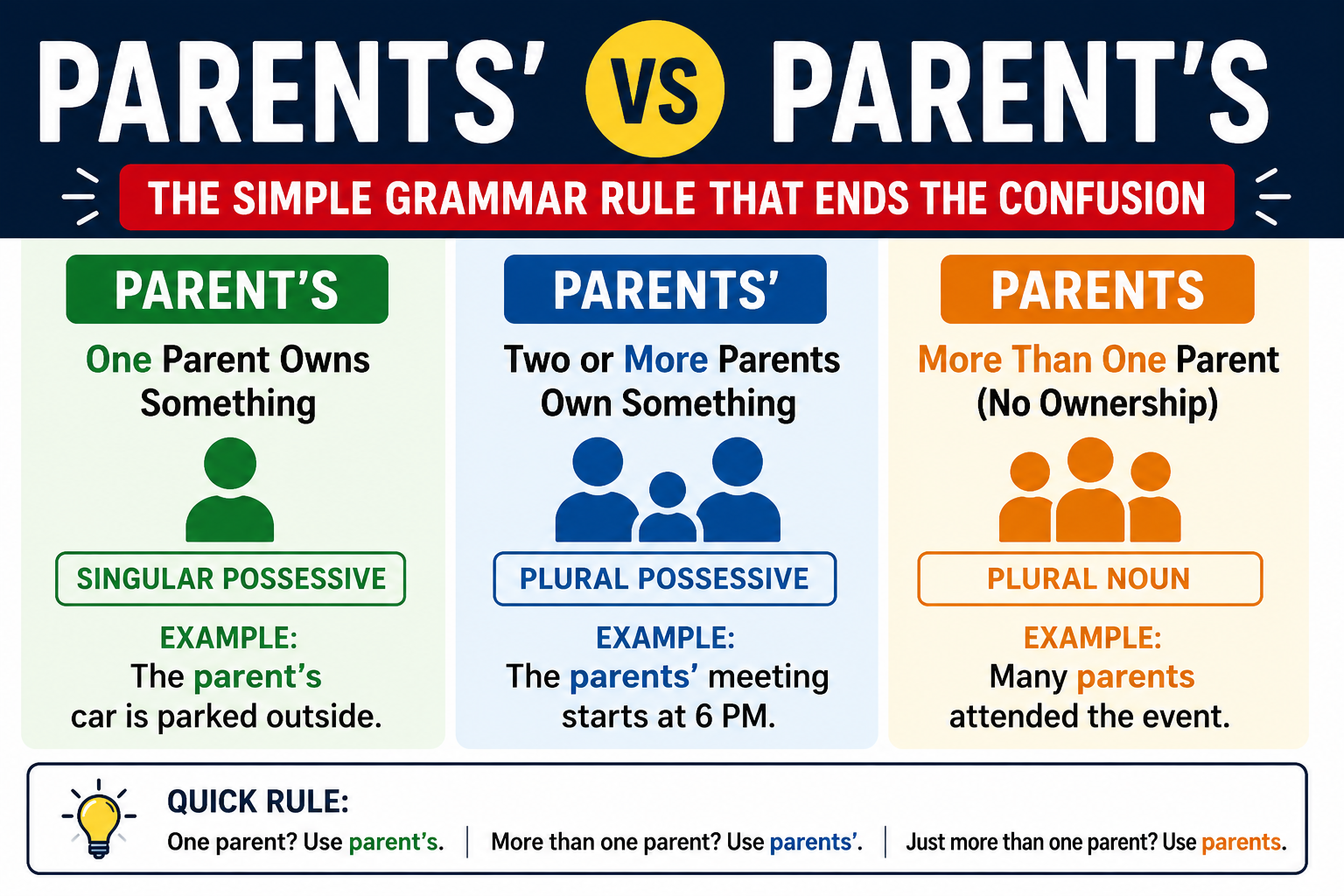
[Parents’ vs Parent’s] is simple: parent’s means one parent owns something, while parents’ means more than one parent owns it. Apostrophe is the clue.
Use parent’s for singular possessive ownership. It shows one parent owns or is associated with something, like a parent’s decision. Use parents’ for plural possessive ownership. It shows multiple parents collectively own or share something, like parents’ decision. This core difference is about numerical ownership, not style.
The rule is clear: singular nouns use apostrophe + s, while plural nouns ending in s use only an apostrophe. This small mark gives the reader the clue, removes confusion, and keeps school writing, email, social media post, or business document clear and professional. In editing work, I ask one simple question: does it belong to one parent or both parents? That quick check helps you choose the correct form confidently.
Quick Answer: Parents’ vs Parent’s in Simple English
Here’s the fastest way to understand Parents’ vs Parent’s without overthinking it:
- Parent’s = one parent owns something
- Parents’ = two or more parents own something
- Parents = just plural, no ownership
Simple examples:
- The parent’s car is parked outside. (one parent)
- The parents’ meeting starts at 6 PM. (both parents)
That’s it. One letter changes everything.
Why Parents’ vs Parent’s Confuses So Many People
This confusion doesn’t come from lack of intelligence. It comes from how English behaves in real life.
Most people:
- Type quickly on phones
- Rely on how words sound
- Skip proofreading
- Mix spoken English with written English
So instead of thinking about grammar, they write what feels right. That’s where mistakes begin.
For example, in casual texting, no one pauses to check apostrophes. But in formal writing, that small mark matters a lot.
Another reason is simple: English uses apostrophes in two different ways:
- To show possession (ownership)
- To show missing letters (like don’t = do not)
So the brain gets overloaded. And Parents’ vs Parent’s becomes a common confusion point.
The Core Rule Behind Parent’s, Parents, and Parents’
Let’s make it crystal clear.
Step 1: Start with “parent”
- Singular = one parent
- Plural = more than one parent
Step 2: Add possession
- Add ’s for singular ownership
- Add ’ after plural ending in s
Final structure:
| Form | Meaning | Example |
| parent | one person | a parent came to school |
| parents | more than one | parents arrived early |
| parent’s | one owns something | parent’s phone |
| parents’ | both own something | parents’ house |
A simple rule helps:
If you can count more than one owner, the apostrophe moves to the end.
Parent’s (Singular Possessive) Explained Clearly
When you see parent’s, think of one person.
It shows ownership by a single parent.
Real examples:
- The parent’s advice helped the child
- I borrowed my parent’s car
- The parent’s signature is required
This form is used when only one parent is involved in the situation.
Everyday situation:
Imagine a school form asking for permission. If only one guardian signs it, it becomes:
- parent’s signature
Simple. Direct. No confusion.
Parents’ (Plural Possessive) Explained Clearly
Now let’s move to parents’.
This is where most mistakes happen.
It shows that two or more parents own something together.
Real examples:
- The parents’ meeting is scheduled for Monday
- The parents’ decision was final
- The parents’ house is very large
School context example:
Schools almost always use this form because they talk about both guardians:
- parents’ evening
- parents’ committee
Real-life scenario:
A child says:
“My parents’ rules are strict.”
That means both mother and father together created the rules.
Parents (No Apostrophe) — The Most Common Mistake Area
Here’s where people go wrong.
When you write parents without an apostrophe, it simply means more than one parent.
It does NOT show ownership.
Examples:
- Parents attended the event (just people, no ownership)
- Many parents arrived early
Common mistake:
❌ Parents meeting was held
✔ Parents’ meeting was held
That missing apostrophe completely changes meaning and correctness.
Side-by-Side Comparison of Parents’ vs Parent’s vs Parents
| Form | Type | Meaning | Example |
| parent’s | singular possessive | one parent owns something | parent’s car |
| parents’ | plural possessive | multiple parents own something | parents’ meeting |
| parents | plural noun | more than one parent | parents arrived |
This table alone clears 90% of confusion around Parents’ vs Parent’s.
Real-Life Usage You See Every Day
Let’s connect grammar to real life so it sticks.
School environment
- parents’ evening
- parents’ teacher meeting
- parent’s signature on forms
Home life
- parent’s advice
- parents’ rules
- parents watching TV
Professional writing
- HR emails mention “parents’ leave policy”
- Forms ask for “parent’s contact information”
Social media
People often write incorrectly:
❌ my parents party was fun
✔ my parents’ party was fun
Small error. Big grammar difference.
Common Mistakes and Easy Fixes
Mistake 1: Using apostrophe for plural
❌ parents’ = plural only
✔ parents = correct plural
Mistake 2: Missing apostrophe in possession
❌ parents house
✔ parents’ house
Mistake 3: Mixing singular and plural
❌ parent’ meeting
✔ parent’s meeting
Mistake 4: Guessing spelling
People often type based on sound instead of rule.
Quick fix method:
Before writing, ask:
- One parent or more than one?
- Ownership or just description?
That’s enough to fix 90% of errors.
Easy Memory Tricks You Can Actually Use
Here are simple ways to never forget:
- One owner → parent’s
- Two owners → parents’
- No ownership → parents
- Think: “Where does the apostrophe sit?”
Visual trick:
Imagine the apostrophe as a hand pointing to the owner:
- parent’s → pointing to one person
- parents’ → pointing to group
It sounds silly, but it works.
Why Apostrophe Placement Matters So Much
A small punctuation mark can change meaning completely.
Compare:
- parents’ meeting = meeting for all parents
- parent’s meeting = meeting for one parent
Same words. Different meaning.
That’s why schools, offices, and formal writing take apostrophes seriously.
Misplacing them can cause confusion in:
- official documents
- academic writing
- workplace communication
Quick Practice Examples (Test Yourself)
Try filling the blanks mentally:
- The ___ car is outside (parent’s / parents’)
- The ___ meeting starts at 5 PM (parents’)
- My ___ advice helped me (parent’s)
- Many ___ attended the event (parents)
Answers:
- parent’s
- parents’
- parent’s
- parents
If you got them right, you’re already mastering it.
FAQs About Parents’ vs Parent’s
Is “parents” ever possessive without an apostrophe?
No. Without an apostrophe, it only means plural, not ownership.
Can “parent’s” refer to both parents?
No. It refers to only one parent. For both, use parents’.
Why do schools use “parents’ evening”?
Because the event involves all guardians, not just one.
What is the easiest way to remember the rule?
Think:
- One = parent’s
- Many = parents’
- None = parents
What happens if I use the wrong form?
In casual writing, people may still understand you. But in formal writing, it looks like a grammar error and reduces clarity.
FAQs
1. What is the main difference between parent’s and parents’?
Parent’s means something belongs to one parent. Parents’ means something belongs to more than one parent.
2. Is parent’s singular or plural?
Parent’s is singular possessive. It talks about one parent owning or being connected to something.
3. Is parents’ singular or plural?
Parents’ is plural possessive. It talks about two or more parents owning or sharing something.
4. Which is correct: parent’s decision or parents’ decision?
Both can be correct. Use parent’s decision when one parent made the decision. Use parents’ decision when both parents or multiple parents made the decision.
5. How can I remember parent’s vs parents’ easily?
Ask yourself, “How many parents?” If it is one parent, write parent’s. If it is more than one parent, write parents’.
Conclusion
Parents’ vs Parent’s becomes easy when you check how many parents you mean. Use parent’s when something belongs to one parent. Use parents’ when something belongs to more than one parent. The apostrophe may look small, but it changes the meaning of the sentence. When writing for school, work, emails, or social media, this simple rule helps your writing stay clear, correct, and professional.