The licence vs license issue becomes simple when you check your reader, region, and grammar use before choosing the spelling. In English, both words can be correct, but the right choice depends on audience, location, and usage context.
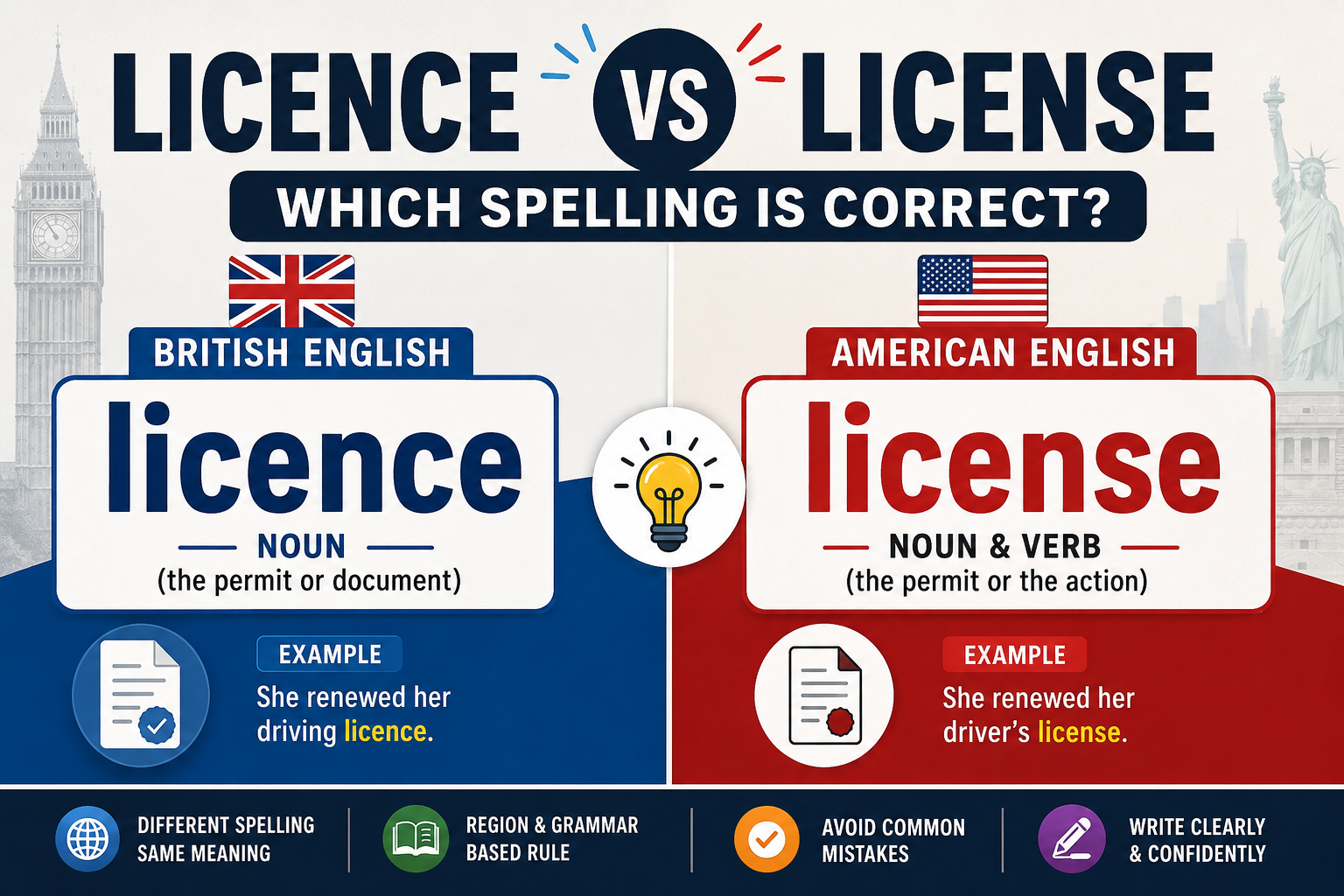
In American English, license works as the standard word form for the noun and verb. In British English, licence is the noun, while license is the verb. This small difference creates a clear regional difference for writers who live in one place but write for another.
In real document writing, this spelling confusion often appears on an application, application form, official document, or permit. Don’t make the incorrect assumption that one spelling is always wrong. Follow this clear rule to avoid a common writing mistake, improve writing accuracy, and keep your official wording and careful wording clean.
Quick Answer: Licence vs License
Here’s the fastest way to remember the difference.
American English:
Use license as both a noun and a verb.
British English:
Use licence as a noun.
Use license as a verb.
That means the correct spelling depends on two things:
- Your audience
- The way the word works in the sentence
If you write for US readers, keep it simple and use license every time. If you write for UK readers, check whether you mean the thing itself or the act of giving permission.
Quick Comparison Table
| English Style | Noun Form | Verb Form | Example |
| American English | license | license | She renewed her driver’s license. |
| British English | licence | license | She renewed her driving licence. |
| British English Verb | license | license | The council will license the business. |
Quick Examples
| Sentence | Correct Version |
| US English | I lost my driver’s license. |
| UK English | I lost my driving licence. |
| Verb Use | The state will license new contractors. |
| Wrong Spelling | I need a new lisense. |
Quick rule:
If you write in American English, choose license. If you write in British English, use licence for the noun and license for the verb.
Read this also: Parents’ vs Parent’s — The Simple Grammar Rule That Finally Ends the Confusion
What Does License Mean?
The word license means official permission to do something. It can refer to a document, legal approval, professional permission, software usage rights, or formal authority.
In American English, license works as both a noun and a verb.
As a noun, it means the permit or permission itself.
Example:
She received her driver’s license last month.
As a verb, it means to give official permission.
Example:
The city will license the new business after inspection.
This word appears in many parts of daily life. You may need a license to drive, open a business, use software, practice medicine, sell certain products, or operate equipment.
Common Definitions of License
| Use | Meaning | Example |
| Driving | Permission to drive legally | driver’s license |
| Business | Permission to operate | business license |
| Software | Permission to use a program | software license |
| Professional | Permission to work in a regulated field | medical license |
| Legal | Formal right granted by an authority | license agreement |
A license often comes from an official body. That may be a government agency, professional board, software company, business owner, or rights holder.
In simple words, a license says, “You’re allowed to do this under certain rules.”
What Does Licence Mean?
The word licence is the British English noun form. It means the same thing as the American noun license. It refers to official permission, a permit, or a document that proves someone has approval.
For example, in the UK, people usually say driving licence, not driver’s license.
Examples:
- He renewed his driving licence.
- The shop applied for a trade licence.
- Her TV licence expires next month.
- The restaurant needs a premises licence.
However, British English does not usually use licence as a verb. When you talk about giving permission, use license.
Correct British English:
The council will license the venue.
Incorrect British English:
The council will licence the venue.
That difference can feel tricky at first. Still, it follows a familiar British English pattern.
Think of advice and advise.
- Advice is a noun.
- Advise is a verb.
The same idea helps with this word pair.
- Licence is the noun.
- License is the verb.
Main Difference Between Licence and License
The main difference comes down to region and grammar.
In American English, there’s no split. Writers use license for everything. That makes the rule easy for US blogs, school papers, legal pages, resumes, business websites, and product descriptions.
In British English, the spelling changes based on grammar. Use licence when you mean the permit, document, or permission. Use license when you mean the action of granting permission.
Region-Based Difference
| Region | Correct Spelling | Usage |
| United States | license | Noun and verb |
| United Kingdom | licence | Noun |
| United Kingdom | license | Verb |
| Australia | licence | Usually noun |
| Canada | licence/license | Usage may vary by context, but British spelling often appears in official contexts |
For most writers, the safest move is simple. Match the spelling style your audience expects.
If your website targets US readers, use license. If your website targets UK readers, use licence as the noun. If your audience is global, choose one style guide and stay consistent.
Grammar-Based Difference
| Word | Grammar Role | Meaning | Example |
| license | US noun | official permission | She has a license. |
| license | US verb | to give permission | They license contractors. |
| licence | UK noun | official permission | She has a licence. |
| license | UK verb | to give permission | They license contractors. |
Consistency matters. Mixing both styles in one article can make your writing look rushed.
License as a Noun in American English
In American English, license as a noun means a permit, document, or legal approval.
You’ll see it in phrases like:
- driver’s license
- business license
- marriage license
- fishing license
- hunting license
- software license
- medical license
- professional license
Examples in Sentences
- She passed the test and got her driver’s license.
- The bakery needs a business license before opening.
- The software license allows five users.
- His medical license must be renewed every two years.
- The couple applied for a marriage license.
Each example talks about a thing. That thing may be a physical card, a digital record, a legal document, or a formal right.
In US writing, you don’t need to think about noun versus verb spelling. Just use license.
License as a Verb in American English
As a verb, license means to grant permission. The subject gives someone the legal or official right to do something.
Examples
- The state will license new drivers after they pass the test.
- The company can license its software to schools.
- The board may license qualified doctors.
- The city plans to license food trucks.
- The brand will license its logo to selected partners.
This verb often appears in business, law, technology, education, medicine, and entertainment.
For example, a film studio may license a character for toys. A software company may license its app to businesses. A professional board may license nurses after they meet education and exam requirements.
The word always carries one idea: permission under rules.
Licence as a Noun in British English
In British English, licence works as the noun. It refers to the official permission itself.
Common British English Phrases
| Phrase | Meaning |
| driving licence | document that allows someone to drive |
| TV licence | required permission for watching live TV in the UK |
| trade licence | permission for certain business activities |
| premises licence | permission linked to a business location |
| fishing licence | permission to fish in regulated waters |
| licence holder | person who holds official permission |
Sentence Examples
- He forgot to renew his driving licence.
- The pub applied for a premises licence.
- She carried her fishing licence in her bag.
- The licence holder must follow local rules.
- The company lost its trade licence after repeated violations.
British English keeps this noun spelling because it follows a wider spelling pattern. It separates some noun and verb pairs by using c for the noun and s for the verb.
That’s why licence and license work like practice and practise in traditional British usage.
License as a Verb in British English
British English uses license when the word acts as a verb.
That may feel odd if you expect British English to use licence all the time. However, the rule stays clear once you focus on the action.
Correct British English Verb Examples
- The council will license the restaurant.
- The authority can license taxi drivers.
- The publisher may license the content.
- The government will license approved operators.
- The board decided to license qualified applicants.
In these sentences, someone gives permission. That action needs the verb form license.
Helpful Grammar Test
Ask yourself this question:
Is someone giving permission?
If yes, use license as the verb.
Ask another question:
Does the word name the permit or document?
If yes, British English uses licence.
That quick test can save you from most mistakes.
Driver’s Licence or Driver’s License?
This is one of the most common questions because driving documents appear everywhere: forms, travel records, ID checks, insurance papers, job applications, and official websites.
In American English
Use driver’s license.
Examples:
- Please show your driver’s license.
- His driver’s license expired last week.
- You need a valid driver’s license to rent a car.
- She passed the road test and received her driver’s license.
In British English
Use driving licence.
Examples:
- He renewed his driving licence online.
- She lost her driving licence during the trip.
- You must carry a valid driving licence.
- His driving licence shows his current address.
Quick Regional Table
| Region | Natural Phrase |
| United States | driver’s license |
| United Kingdom | driving licence |
| Australia | driver licence or driving licence, depending on local usage |
| Canada | driver’s licence or driver’s license, depending on province and style |
For SEO writing, match the country you target. A US blog should use driver’s license. A UK guide should use driving licence.
Business Licence or Business License?
A business document often needs the right regional spelling because it appears on forms, service pages, legal pages, and compliance content.
American English
Use business license.
Examples:
- The salon needs a business license.
- A business license proves that a company can operate legally.
- Some cities require a separate business license for each location.
British English
Use business licence, though British official language often uses more specific terms such as trade licence, premises licence, or operator licence.
Examples:
- The shop applied for a business licence.
- The restaurant needs a premises licence.
- The company renewed its trade licence.
Why This Matters
Spelling affects trust. A small error on a legal or business page can make readers pause. They may still understand the meaning, but the page feels less polished.
For business websites, choose the spelling your customers expect. Then use it everywhere: homepage, service pages, FAQs, invoices, forms, and email templates.
Professional Licence or Professional License?
Professional licensing helps protect the public. It sets rules for jobs where mistakes can cause harm, financial loss, legal trouble, or safety risks.
Common Licensed Professions
- Doctors
- Nurses
- Lawyers
- Teachers
- Accountants
- Engineers
- Real estate agents
- Electricians
- Plumbers
- Therapists
American English
Use professional license.
Examples:
- A nurse must keep her professional license active.
- The board suspended his medical license.
- A real estate license allows agents to represent buyers and sellers.
British English
Use professional licence as the noun.
Examples:
- The regulator issued a professional licence.
- Her professional licence allows her to work in a regulated role.
- The licence holder must follow the code of conduct.
In both styles, the idea stays the same. A professional license or licence proves that someone meets required standards.
Software License or Software Licence?
Software writing adds another layer because technology companies often sell products across regions. You may see both spellings depending on the company’s location and style guide.
American English
Use software license.
Example:
The software license covers one user and two devices.
British English
Use software licence as the noun.
Example:
The software licence allows installation on three computers.
Common Software Licensing Terms
| Term | Meaning |
| software license/licence | permission to use software |
| license agreement | contract that explains usage rules |
| end-user license agreement | terms accepted by the user |
| open-source license | permission to use, edit, or share code under rules |
| commercial license | paid permission for business use |
| site license | permission for many users in one organization |
Software licensing protects ownership, sets usage limits, and explains what users can or can’t do. For example, a license may allow personal use but block resale. Another may allow editing but require attribution.
In short, software licensing tells users where the fence is. You can play inside it, but you can’t move it.
Legal and Professional Contexts
Legal writing needs sharp spelling because every detail affects credibility. The spelling choice may not always change the legal meaning, but it does affect clarity and professionalism.
Common Legal Phrases
| Phrase | Use |
| license agreement | contract that grants permission |
| licensing authority | body that grants approval |
| licence holder | person or company with permission |
| licensed premises | place approved for certain activities |
| license fee | payment for permission |
| licence renewal | process of renewing permission |
Practical Rule for Legal Writing
Use the spelling of the legal system you’re writing for.
- US contract: license
- UK contract: licence as noun and license as verb
- Global contract: follow the chosen governing law and style guide
For example, a US software contract should usually say license agreement. A UK document may say software licence, but the verb still appears as license.
That’s why consistency matters so much. If a document jumps between spellings without reason, it looks messy.
Common Phrases with License and Licence
Some phrases belong strongly to one region. Others shift based on context.
American English Phrases
| Phrase | Example |
| driver’s license | She showed her driver’s license. |
| license plate | The license plate was damaged. |
| marriage license | They applied for a marriage license. |
| business license | The city issued a business license. |
| software license | The software license expires soon. |
| professional license | He renewed his professional license. |
| license renewal | License renewal takes five minutes online. |
British English Phrases
| Phrase | Example |
| driving licence | He renewed his driving licence. |
| TV licence | They paid the TV licence fee. |
| premises licence | The pub needs a premises licence. |
| trade licence | The trader applied for a trade licence. |
| fishing licence | She bought a fishing licence. |
| licence holder | The licence holder must follow the rules. |
| licensed premises | Alcohol can be sold on licensed premises. |
Notice one useful pattern. In British English, even when the noun uses licence, the adjective often uses licensed.
Example:
A licensed restaurant has a valid licence.
That sentence looks strange at first, but it follows the rule.
Common Mistakes With Licence and License
Even strong writers slip on this word. The mistake usually happens because the writer mixes regions or forgets the noun-verb split.
Mistake: Using Licence in American English
Incorrect for US writing:
She renewed her driving licence.
Correct for US writing:
She renewed her driver’s license.
American readers expect license. Using licence on a US page may look like a typo unless the text clearly discusses British usage.
Mistake: Using License as a British Noun
Less preferred in UK writing:
He renewed his driving license.
Better in UK writing:
He renewed his driving licence.
Many people will understand either spelling. Still, British English normally prefers licence for the noun.
Mistake: Using Licence as a Verb
Incorrect:
The council will licence the venue.
Correct:
The council will license the venue.
This mistake happens because people remember the British spelling but apply it too widely.
Mistake: Mixing Styles
Inconsistent:
The company renewed its business license and updated its trade licence.
Better:
The company renewed its business license and updated its trade license.
Or:
The company renewed its business licence and updated its trade licence.
Choose one style unless the context demands both.
Why “Lisense” Is Incorrect
Lisense is not a correct English spelling. It’s a common misspelling of license or licence.
People often write lisense because the word sounds like it has an s in the middle. Spoken English can trick the ear. The spelling also feels less predictable than words like “table” or “paper.”
Common Wrong Forms
| Wrong Spelling | Correct Form |
| lisense | license |
| lisence | licence or license |
| licencee | licensee |
| lisenced | licensed |
| lisencing | licensing |
Correct Examples
- I need to renew my license.
- He lost his driving licence.
- The company is fully licensed.
- The software uses a commercial license.
The best fix is simple. If you write for US readers, use license. If you write for UK readers and need the noun, use licence.
Word Forms: Licensed, Licensing, Licensee, and Licensor
Related forms can confuse people too. These words appear often in legal, business, and software writing.
| Word | Meaning | Example |
| licensed | approved or officially permitted | She is a licensed therapist. |
| licensing | the process of granting permission | Licensing rules vary by state. |
| licensee | person or company receiving permission | The licensee must follow the contract. |
| licensor | person or company granting permission | The licensor owns the brand. |
| unlicensed | not officially permitted | The shop was unlicensed. |
Licensed
Licensed works as an adjective or past-tense verb.
Examples:
- He is a licensed electrician.
- The board licensed the clinic.
- Only licensed drivers may rent the vehicle.
Licensing
Licensing means the process of giving, managing, or controlling permission.
Examples:
- Music licensing protects artists.
- Business licensing rules differ by city.
- Software licensing affects how many users can access a tool.
Licensee and Licensor
A licensee receives permission. A licensor gives permission.
For example, if a toy company gets permission to use a movie character, the toy company is the licensee. The film studio is the licensor.
That relationship appears in entertainment, software, publishing, franchising, sports merchandise, and brand partnerships.
Memory Tricks That Actually Work
Spelling rules feel easier when they stick in your mind. These tricks can help.
For American English
Think: America uses one spelling.
One country. One spelling.
Use license for the noun and the verb.
Examples:
- driver’s license
- business license
- license a product
- licensed professional
For British English
Think of advice and advise.
- Advice = noun
- Advise = verb
Now apply the same pattern.
- Licence = noun
- License = verb
The c belongs to the noun. The s belongs to the action.
The “Thing or Action” Test
Ask yourself:
Is it a thing?
In British English, use licence.
Is it an action?
Use license.
Example:
- The licence arrived yesterday.
- The council will license the company.
The Audience Test
Ask yourself:
Who will read this?
- US readers: license
- UK readers: licence as noun, license as verb
- Global readers: choose one style and stay consistent
That one question solves most real-world spelling problems.
Synonyms and Related Words
The words license and licence don’t always have perfect synonyms. Their meaning depends on context. Still, several related words can help you understand the idea.
Related Words
| Word | Meaning |
| permit | official permission |
| approval | acceptance or authorization |
| authorization | formal power to do something |
| certification | proof of meeting a standard |
| registration | official listing or record |
| clearance | permission after review |
| consent | agreement or permission |
| accreditation | official recognition of standards |
Example Differences
A permit often gives permission for a specific activity, such as parking or building.
A certification proves that someone has completed training or met a standard.
A license often gives legal permission to do regulated work or use protected rights.
These words overlap sometimes, but they don’t always mean the same thing. A person can have a certification without having a license. For example, someone may complete a training course, but they may still need a state license to work legally.
Real-Life Case Study: A Website Targeting the Wrong Audience
Imagine a driving school in Texas publishes a service page titled “How to Get Your Driving Licence.”
The content may still make sense. However, US readers expect “driver’s license.” Searchers in Texas usually type phrases like “how to get a driver’s license,” “Texas driver’s license test,” or “renew driver’s license.”
That one spelling choice can create three problems.
First, the page may feel less local. Readers may wonder whether the website understands US driving rules.
Second, the wording may not match search intent. A person in Texas probably won’t search for “driving licence” unless they follow British English.
Third, the page may look less professional. Small language details often shape trust before readers even notice the design.
Now flip the example. A UK driving school that writes “driver’s license” may sound too American. British readers usually expect “driving licence.”
The lesson is clear. Grammar matters, but audience matters more.
Practice Section
Try these quick blanks. Choose license or licence based on the context.
Fill in the Blanks
| Sentence | Region | Answer |
| She renewed her driver’s ____ in California. | US | license |
| He renewed his driving ____ in London. | UK | licence |
| The city will ____ the new food truck. | US/UK verb | license |
| The software ____ allows three users. | US | license |
| The software ____ allows three users. | UK | licence |
| The bar has a premises ____. | UK | licence |
| The board ____ qualified doctors. | US/UK verb | license |
| His professional ____ expires next month. | US | license |
Quick Self-Check
If you can place a or the before the word, it’s probably a noun.
- a license
- the licence
- a software license
- the driving licence
If the word shows an action, it’s a verb.
- to license
- will license
- licensed
- licensing
FAQs
Q1: Is it licence or license?
Both spellings can be correct. In American English, use license for both noun and verb. In British English, use licence as the noun and license as the verb.
Q2: What is the main difference between licence and license?
The main difference is regional and grammatical. License is the standard spelling in the US. In the UK, licence means the permit or document, while license means to give official permission.
Q3: Is driver’s licence or driver’s license correct?
Driver’s license is correct in American English. In British English, the more common phrase is driving licence.
Q4: When should I use licence?
Use licence when you write in British English and talk about a noun, such as a permit, document, or official permission.
Q5: When should I use license?
Use license in American English for every meaning. Also use license as a verb in British English, such as “The authority will license the company.”
Conclusion
The difference between Licence vs License becomes much easier once you know the region and grammar rule. In American English, license is the correct spelling for both the noun and the verb. You can write driver’s license, business license, software license, and license a company without changing the word.
In British English, the rule works differently. Use licence when you mean the noun, such as a driving licence, TV licence, or trade licence. Use license when you mean the verb, as in “the council will license the business.” This simple difference helps you avoid spelling confusion and keeps your writing clear.
The safest approach is to think about your audience first. If you write for US readers, use license. If you write for UK readers, use licence for the document or permission and license for the action. Once you follow this rule, your writing looks cleaner, more accurate, and more professional.