The Receive vs Recieve issue looks small, but it creates real confusion when writers want clean, professional English.
At first glance, both versions seem believable. Your brain follows a familiar pattern, your fingers type quickly, and a quick typing error enters the sentence. The correct spelling is receive, while recieve is a spelling mistake.
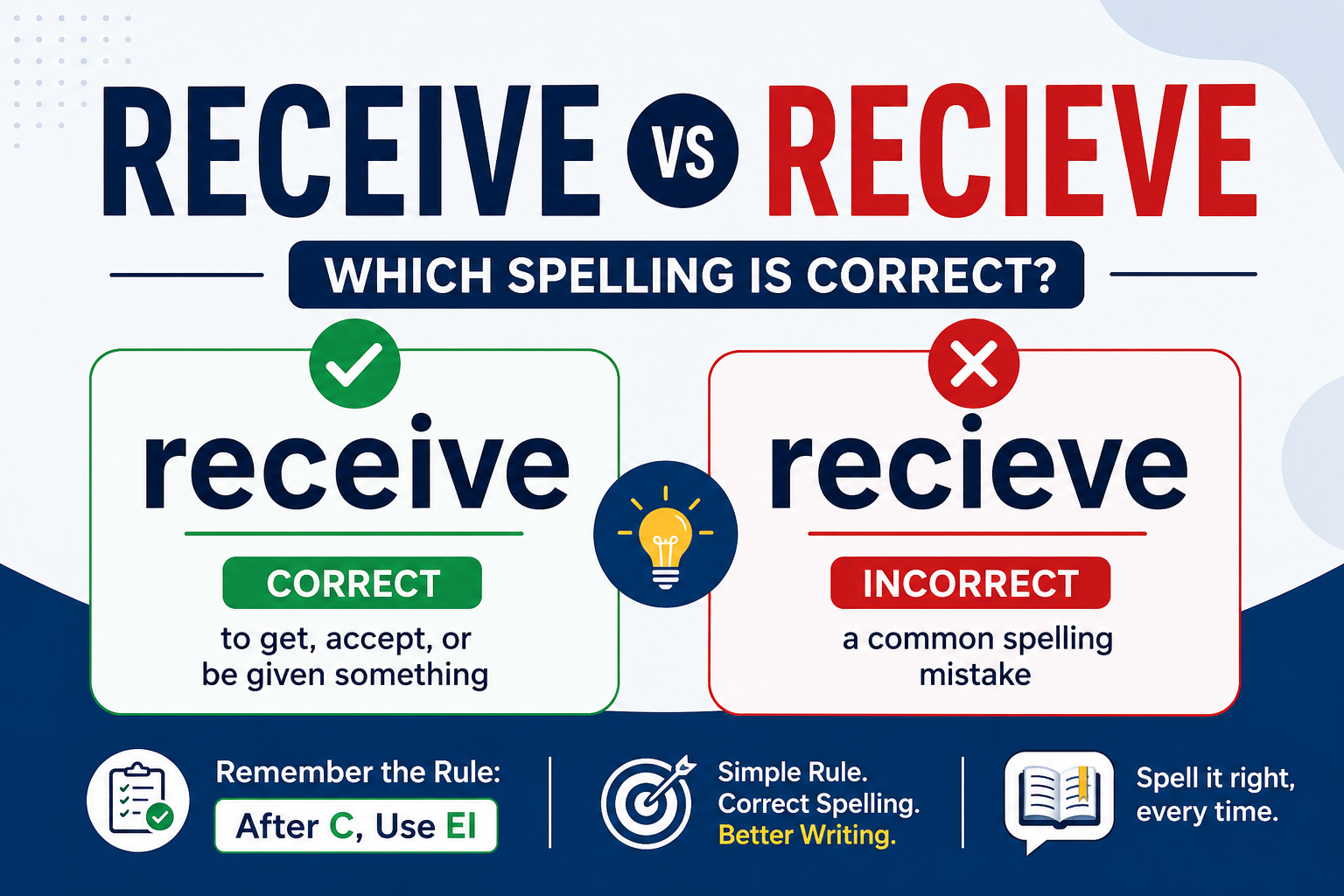
This spelling confusion often shows up in formal writing, student drafts, and emails. The good news is that it’s easy to fix. Use this spelling guide: after c, write ei. This clear English pattern helps you spell receive correctly, avoid mistake, improve writing accuracy, and stop overthinking every word.
Quick Answer: Receive vs Recieve
Receive is correct.
Recieve is incorrect.
Use receive when you mean to get something, accept something, or be given something.
Quick Examples
| Incorrect | Correct |
| I did not recieve your email. | I did not receive your email. |
| She will recieve the package today. | She will receive the package today. |
| Did you recieve my message? | Did you receive my message? |
| We recieved your payment. | We received your payment. |
Simple Rule
If you mean “get,” “be given,” or “accept,” write receive.
Example:
I will receive the documents tomorrow.
That’s the whole rule in plain English. No fancy grammar needed.
Read this also: Useable vs Usable: Which Spelling Is Correct in English (Complete 2026 Guide)
What Does Receive Mean?
Receive means to get something, be given something, or accept something that comes to you. The word can describe physical items, messages, payments, awards, help, feedback, news, or treatment.
You can receive a package.
You can receive an email.
You can receive advice.
You can receive a payment.
You can receive medical care.
The word sounds formal enough for business writing, but it also works in everyday English. That makes it useful in many types of writing.
Common Meanings of Receive
| Context | Meaning | Example |
| to get a message | I received your email. | |
| Delivery | to get an item | She received the package. |
| Money | to be paid | He received his salary. |
| Award | to be given recognition | They received first prize. |
| Help | to get support | The family received assistance. |
| Medical care | to get treatment | The patient received care. |
| Information | to get news or details | We received the update. |
In simple words, receive means something comes to you.
Receive Meaning in Everyday English
In daily English, people often use receive when they want to sound clear, polite, or professional. It feels more polished than “get,” especially in formal messages.
For example, compare these two sentences:
Casual:
I got your email.
More professional:
I received your email.
Both sentences mean almost the same thing. However, the second one sounds better in a workplace email, school message, or customer support reply.
Everyday Examples
- I received your call, but I couldn’t answer.
- She received a gift from her friend.
- We received the final report this morning.
- The teacher received all assignments on time.
- The customer received a refund.
- He received helpful feedback after the interview.
Notice how the word fits smoothly in many situations. It works for objects, messages, money, and information.
Receive vs Recieve Meaning Explained
The difference is simple: receive is a real word, and recieve is not a correct spelling.
Receive has meaning.
Recieve is only a misspelling.
That means you should never use recieve in emails, articles, schoolwork, resumes, official forms, or business communication. A reader may still understand what you mean, but the error can make your writing look rushed.
Main Difference Table
| Word | Correct? | Meaning | Use It? |
| receive | Yes | to get, accept, or be given something | Yes |
| recieve | No | no standard meaning | No |
Correct Sentence
I will receive the file today.
Incorrect Sentence
I will recieve the file today.
The incorrect version looks believable because the letters are close. Still, English spelling treats it as an error.
Why People Confuse Receive and Recieve
This mistake happens for a few clear reasons. Most people don’t misspell receive because they don’t know the meaning. They misspell it because the letter order feels slippery.
The “I Before E” Rule Confuses Writers
Many learners remember this rule:
“I before E except after C.”
The problem? People often remember only the first part. They write ie because they think that pattern should appear in most words.
However, receive has the letter pair after c, so it follows the exception. After c, use ei.
That gives you:
r-e-c-e-i-v-e
Not:
r-e-c-i-e-v-e
Fast Typing Causes Letter Reversal
Typing quickly can flip letters before your brain catches the mistake. This often happens in:
- emails
- comments
- messages
- forms
- job applications
- school assignments
- customer support chats
The word may look close enough that your eyes skip over it.
Pronunciation Doesn’t Help Much
Both spellings would sound the same when spoken. You can’t hear whether someone means receive or recieve. The difference only shows in writing.
That’s why memorizing the spelling pattern matters.
The Grammar Rule Behind Receive
The spelling of receive follows a common English spelling pattern. When ei comes after c, the word often uses cei.
You can see the same pattern in related words.
| Word | Correct Spelling | Pattern |
| receive | r-e-c-e-i-v-e | cei |
| deceive | d-e-c-e-i-v-e | cei |
| perceive | p-e-r-c-e-i-v-e | cei |
| conceive | c-o-n-c-e-i-v-e | cei |
These words share the same -ceive ending. Once you learn that ending, you can spell several words correctly.
The Key Pattern
The tricky part is not the whole word. It’s the ending:
ceive
So think of the word like this:
re + ceive
That makes it easier to remember. You don’t need to rebuild the spelling from sound every time.
Why “Recieve” Is Incorrect
Recieve is incorrect because standard English does not recognize it as the proper spelling. It is a common spelling mistake, not a second version of the word.
Some spelling errors become common because they look natural. Recieve is one of them. It has the same letters as receive, but the i and e appear in the wrong order.
Wrong and Right Forms
| Wrong Form | Correct Form |
| recieve | receive |
| recieved | received |
| recieving | receiving |
| reciever | receiver |
| recieveing | receiving |
The misspelling can spread into other word forms too. That’s why learning the base word helps you fix several mistakes at once.
Correct Forms
- receive
- receives
- received
- receiving
- receiver
- reception
Once you spell the base word correctly, the rest becomes easier.
British English vs American English Spelling
Some English words change depending on region. For example, American English uses “color,” while British English uses “colour.” American English uses “license,” while British English often uses “licence” as a noun.
However, receive does not change.
Both American English and British English use receive.
US and UK Comparison
| English Type | Correct Spelling | Example |
| American English | receive | I received your message. |
| British English | receive | I received your message. |
| Incorrect in both | recieve | I recieved your message. |
This point matters because some writers assume every spelling difference comes from region. Not here. Receive stays the same everywhere standard English is used.
Receive Pronunciation
Receive is pronounced like ri-SEEV. The stress falls on the second part of the word.
You don’t strongly hear the first vowel. That’s why some people spell the beginning as “re,” “ri,” or “ree” in their minds. However, the standard spelling remains receive.
Simple Pronunciation Guide
| Word | Pronunciation | Stress |
| receive | ri-SEEV | second syllable |
| received | ri-SEEVD | second syllable |
| receiving | ri-SEE-ving | second syllable |
| receiver | ri-SEE-ver | second syllable |
The spelling may feel odd at first, but the sound is simple. Say it naturally: ri-SEEV.
Receive Examples in Everyday Sentences
Examples make spelling easier because they show the word in real situations. Here are clear examples you can copy and learn from.
Email Examples
- I did not receive your email.
- Did you receive my reply?
- We received the attachment.
- She receives many emails every morning.
- Please confirm that you received the form.
Delivery Examples
- I received the package yesterday.
- They will receive the order next week.
- She received a damaged item.
- The customer received a replacement product.
- We haven’t received the shipment yet.
School and Work Examples
- The student received feedback from the teacher.
- He received a promotion at work.
- The team received clear instructions.
- Applicants will receive a response within seven days.
- She received praise for her presentation.
Money and Payment Examples
- I received my payment today.
- Employees receive their salaries every month.
- The charity received a large donation.
- He received a refund after returning the item.
- The business received its first invoice.
These examples show how flexible the word is. It fits daily life, professional writing, schoolwork, and online communication.
Common Mistakes with Receive
The most common mistakes involve spelling the word based on sound or using the wrong word form.
Mistake: Writing Recieve
Incorrect:
I will recieve the file.
Correct:
I will receive the file.
This is the most common error. Fix the letter order: ei, not ie.
Mistake: Writing Recieved
Incorrect:
She recieved the letter.
Correct:
She received the letter.
The past tense adds -d to receive, but the spelling pattern stays the same.
Mistake: Writing Recieving
Incorrect:
We are recieving complaints.
Correct:
We are receiving complaints.
When you add -ing, drop the final e in receive. That gives you receiving.
Mistake: Using Receive Instead of Accept
Sometimes the spelling is right, but the word choice is weak. Receive means something reaches you. Accept means you agree to take it.
Example:
I received the job offer.
I accepted the job offer.
The first sentence means the offer came to you. The second means you said yes.
Receive vs Accept vs Get
These three words are related, but they don’t always mean the same thing.
Receive
Receive means something comes to you. It sounds neutral or professional.
Example:
I received your message.
Accept
Accept means you agree to take something. It shows approval or agreement.
Example:
She accepted the invitation.
Get
Get is casual. It works well in everyday speech, but it may sound too informal in business writing.
Example:
I got your text.
Comparison Table
| Word | Meaning | Tone | Example |
| receive | to get or be given something | formal or neutral | I received your email. |
| accept | to agree to take something | specific | I accepted the offer. |
| get | to receive or obtain | casual | I got your message. |
| obtain | to get through effort | formal | He obtained approval. |
| collect | to pick up or gather | practical | She collected the package. |
Easy Difference
You can receive an offer without accepting it.
You can get a message casually.
You can accept an invitation when you agree.
That small difference can make your writing more accurate.
Correct Word Forms of Receive
Knowing the word forms helps you avoid related spelling mistakes.
| Word Form | Use | Example |
| receive | base verb | I receive updates daily. |
| receives | present tense | She receives many calls. |
| received | past tense | We received the report. |
| receiving | continuous form | They are receiving help. |
| receiver | person or device | The receiver picked up the signal. |
| reception | act or place of receiving | The reception was friendly. |
| receptive | willing to receive ideas | The manager was receptive to feedback. |
Received
Received is the past tense of receive.
Examples:
- I received your email.
- She received a gift.
- They received the final payment.
Receiving
Receiving shows an action that is happening now or over time.
Examples:
- We are receiving many questions.
- The hospital is receiving new patients.
- The company is receiving applications.
Receiver
A receiver can be a person or device that receives something.
Examples:
- The receiver answered the call.
- The radio receiver picked up the signal.
- The package receiver signed the form.
Easy Tricks to Remember Receive Spelling
Spelling becomes easier when you attach it to a simple memory hook.
Trick: Remember “E After C”
In receive, the letter e comes right after c.
Think:
rec-ei-ve
That little chunk helps you remember the correct order.
Trick: Learn the “Ceive” Family
Group receive with similar words:
- receive
- deceive
- perceive
- conceive
All of them contain ceive.
Once you learn that pattern, you’re not memorizing one word. You’re learning a family.
Trick: Break the Word Apart
Try this:
re + ceive
The second part, ceive, is the key. Don’t spell it “cieve.”
Trick: Use a Memory Sentence
After c, use ei in receive.
That sentence is short, clear, and easy to remember.
Why Correct Spelling Matters
Spelling may seem small, but readers notice it. A single mistake can change how polished your writing feels.
In Professional Writing
Emails, proposals, reports, and resumes need clean spelling. If you write “I did not recieve your message,” the reader will probably understand you. However, the mistake may still make the email feel rushed.
In Academic Writing
Teachers and examiners often notice repeated spelling errors. One typo may not hurt much. Several errors can make a paper look less careful.
In Business Communication
Customers trust clear writing. A misspelled word on a contact form, invoice, product page, or support email can make a business look less professional.
In Online Content
Correct spelling improves readability. It also helps readers feel confident that the content gives accurate information.
Good spelling doesn’t make writing brilliant by itself, but it keeps distractions out of the way.
Receive in Digital Communication
The receive mistake appears often online because people type fast. Digital writing rewards speed, but speed can invite errors.
Where the Mistake Often Appears
- email replies
- text messages
- customer support chats
- contact forms
- job applications
- online assignments
- social media captions
- payment confirmations
Why It Happens Online
People often focus on the message, not the spelling. That makes sense. When you’re trying to send a quick reply, your fingers may run ahead of your brain.
Autocorrect can help, but it doesn’t catch everything. Some tools may miss errors inside names, subject lines, forms, or pasted text.
Quick Editing Tip
Before sending an important message, search for these wrong forms:
- recieve
- recieved
- recieving
- reciever
Then replace them with:
- receive
- received
- receiving
- receiver
This takes less than a minute, but it can save your writing from an easy mistake.
Word Origin of Receive
The word receive comes from older French and Latin roots connected to the idea of taking back, accepting, or getting something. That history explains why the spelling may not feel fully natural to modern English learners.
English borrowed many words from French and Latin. Because of that, spelling doesn’t always match sound perfectly. Words like receive, deceive, perceive, and conceive kept a similar spelling pattern.
That’s why learning word families helps. You start to see English as a set of patterns instead of a pile of random spellings.
Real-Life Case Study: A Job Application Mistake
Imagine a job applicant writes this sentence in a cover letter:
“I would be happy to recieve your response.”
The message is polite, and the meaning is clear. Still, the misspelling stands out. A hiring manager may not reject someone for one typo, but the mistake can make the application feel less polished.
Now compare it with the corrected sentence:
“I would be happy to receive your response.”
That version looks cleaner and more professional. It sends the same message, but it removes the distraction.
This is why spelling matters most in high-trust situations. Job applications, school essays, client emails, business proposals, and official forms all deserve one extra check.
Practice Section
Test yourself with these quick blanks.
Fill in the Blanks
| Sentence | Correct Answer |
| Did you ____ my email? | receive |
| She ____ an award yesterday. | received |
| We are ____ many calls today. | receiving |
| I have not ____ the package yet. | received |
| The radio ____ picked up the signal. | receiver |
| The school will ____ applications this week. | receive |
| He ____ his salary on Friday. | received |
Answers in Sentences
- Did you receive my email?
- She received an award yesterday.
- We are receiving many calls today.
- I have not received the package yet.
- The radio receiver picked up the signal.
- The school will receive applications this week.
- He received his salary on Friday.
Quick Recap Table
| Question | Answer |
| Correct spelling | receive |
| Incorrect spelling | recieve |
| Past tense | received |
| Continuous form | receiving |
| Person or device form | receiver |
| Same in US and UK English? | Yes |
| Meaning | to get, accept, or be given something |
| Best memory trick | after c, use ei |
Synonyms and Related Words
Sometimes you may want another word for receive, especially if you’ve used it too many times in one paragraph. The best synonym depends on context.
Synonyms of Receive
| Word | Best Use | Example |
| get | casual writing | I got your message. |
| accept | agreeing to take something | She accepted the offer. |
| obtain | formal or effort-based | He obtained permission. |
| collect | picking something up | I collected the parcel. |
| acquire | gaining something | The company acquired new data. |
| take | simple action | Please take the documents. |
| be given | simple explanation | She was given an award. |
Related Words
- received
- receiving
- receiver
- reception
- receptive
- receipt
- receivable
Usage Tip
Don’t replace receive with a synonym unless the meaning still fits. For example, “I accepted your email” sounds odd because you don’t usually accept an email. You receive it.
FAQs
Q1: Which is correct: receive or recieve?
Receive is correct. Recieve is incorrect and should not be used in standard English writing.
Q2: Is recieve a real word?
No, recieve is not a real English word. It is only a common misspelling of receive.
Q3: Why is receive spelled with ei?
Receive uses ei because the letters come after c. A simple memory rule is: after c, write ei in receive.
Q4: Is received spelled correctly?
Yes, received is correct. It is the past tense of receive. For example: “I received your email yesterday.”
Q5: Is receive the same in American and British English?
Yes, receive is spelled the same in American English and British English. The spelling recieve is wrong in both.
Conclusion
The difference between Receive vs Recieve is simple once you know the spelling rule. Receive is the correct spelling in English, while recieve is always a spelling mistake. Both words may look close at first, but only receive belongs in proper writing.
You can use receive when you mean to get, accept, or be given something. For example, you can receive an email, a package, a message, a payment, or helpful feedback. The spelling stays the same in both American English and British English, so you don’t need to change it based on region.
The easiest way to remember it is this: after c, write ei. That gives you receive, not recieve. Once you remember this small rule, you can avoid a common spelling mistake and make your writing look cleaner, sharper, and more professional.