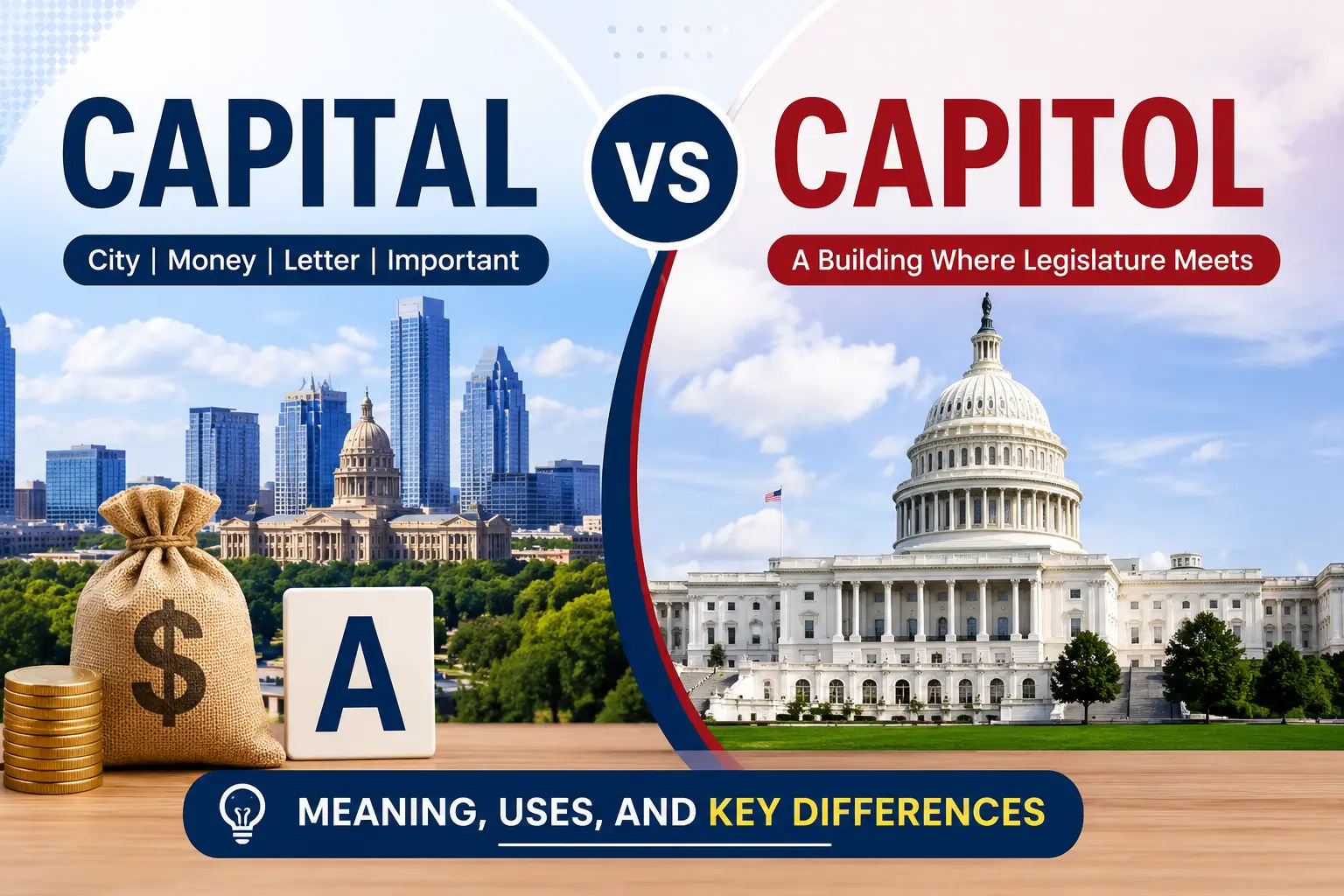
Capital vs capitol becomes simple when you focus on meaning. Capital has several uses, while capitol names a building where lawmakers meet.
As a noun, capital can mean a capital city, money, financial assets, or an uppercase letter. It can also work as an adjective. For example, a capital offense is a serious crime that may be punishable by death. A business may raise capital, while a writer uses capital letters at the beginning of a sentence.
Capitol has a narrower meaning. It refers to a legislative building where a congress, parliament, or state legislature meets. For example, Washington, D.C., is the capital of the United States, but the United States Capitol is the building where Congress works. Since both words are homophones, they sound alike. Remember the difference by connecting the “o” in capitol with the round dome of a government building.
What Is the Difference Between Capital and Capitol?
The main difference is simple:
- Capital has several meanings. It can refer to a government city, money, an important resource, or an uppercase letter.
- Capitol has a narrow meaning. It names a building where a legislative body meets.
Consider this sentence:
Austin is the capital of Texas, and the Texas State Capitol is located there.
In this example, capital identifies the city that serves as the center of state government. Capitol identifies the government building inside that city.
Quick Answer: Capital vs. Capitol
Use capital when referring to:
- A city that serves as a seat of government
- Money invested in a company
- Financial or other valuable resources
- An uppercase letter
- Something important, serious, or excellent
Use capitol when referring to:
- A building where a state legislature meets
- The U.S. Capitol in Washington, D.C.
- An officially named capitol building or complex
Capital vs. Capitol Comparison Table
| Word | Main meaning | Part of speech | Example |
| Capital | A city where a government is based | Noun | Albany is the capital of New York. |
| Capital | Money or assets used to create value | Noun | The company needs more capital. |
| Capital | An uppercase letter | Noun | Begin the sentence with a capital. |
| Capital | Uppercase, important, or extremely serious | Adjective | Write your name in capital letters. |
| Capitol | A building where a legislature meets | Noun | The lawmakers returned to the capitol. |
| Capitol | The building where the U.S. Congress meets | Proper noun when used in its official name | Visitors toured the U.S. Capitol. |
What Does Capital Mean?
Capital is the more common and flexible word. It functions as both a noun and an adjective, and its meaning changes with context.
The word often relates to government, finance, writing, importance, or severity. Therefore, you need to look at the surrounding sentence before choosing a definition.
Capital as a City or Seat of Government
As a noun, capital can mean a city that serves as the official center of a country, state, province, or region. Government leaders and major administrative offices are usually based there.
Examples include:
- Washington, D.C., is the capital of the United States.
- Sacramento is the capital of California.
- Boston is the capital of Massachusetts.
- Canberra is the capital of Australia.
- Ottawa is the capital of Canada.
A capital doesn’t have to be the largest or most populated city in an area. For example, New York City has a much larger population than Albany. However, Albany is the capital of New York State.
Similarly, Los Angeles is larger than Sacramento, but Sacramento remains California’s state capital. The word describes a city’s government role, not its size or popularity.
You may also see the phrase seat of government. It refers to the location from which a government carries out its work. In many cases, that location is the capital.
Capital as Money, Wealth, or Business Assets
In finance and business, capital means money or other assets available for investment. A company may use capital to buy equipment, hire employees, develop products, or expand its operations.
For example:
- The founders raised enough capital to launch the company.
- The business invested its capital in new equipment.
- Several investors provided startup capital.
- The owner lacked the working capital needed to pay short-term expenses.
Capital doesn’t always mean cash. Depending on the context, it can include property, equipment, investments, or other resources that help produce economic value.
Several related terms appear in business writing:
| Financial term | Meaning |
| Startup capital | Money used to establish a new business |
| Working capital | Resources available for daily operations |
| Venture capital | Private investment in businesses with strong growth potential |
| Capital gain | Profit earned from selling an asset for more than its purchase price |
| Capital loss | Loss created by selling an asset for less than its purchase price |
| Human capital | The skills, knowledge, and experience people contribute |
Although human capital doesn’t refer directly to money, it describes valuable abilities that support an organization or economy.
Capital as an Uppercase Letter
A capital can also mean an uppercase letter. In this sense, A is the capital form of a, while M is the capital form of m.
Examples include:
- Begin every sentence with a capital letter.
- Write your initials in capitals.
- The password requires at least one capital.
- Proper nouns usually begin with a capital letter.
In American English, both capital letter and uppercase letter are correct. However, uppercase is especially common in computing, online forms, and password instructions.
The phrase capital letters is more widely used than capital characters in everyday writing.
Capital as an Adjective
As an adjective, capital can describe letters, cities, financial assets, serious offenses, or matters of great importance.
Common combinations include:
- Capital city
- Capital letter
- Capital investment
- Capital expenditure
- Capital offense
- Capital punishment
For example:
- Boise is Idaho’s capital city.
- The editor corrected several missing capital letters.
- The factory requires a large capital investment.
- The defendant faced charges for a capital offense.
In capital punishment, the adjective refers to punishment by death. A capital offense is a crime that may carry the death penalty in a legal system that permits it.
You might also encounter capital meaning excellent or first-rate, as in “That’s a capital idea.” However, that use sounds old-fashioned to many American English speakers. It appears more often in older writing or traditional British English than in modern US conversation.
Other Meanings of Capital
The word appears in several specialized expressions.
In architecture, a capital is the top section of a column. It sits between the column’s shaft and the structure above it.
In economics, capital goods are items that businesses use to produce other goods or services. Machinery, tools, and commercial equipment are common examples.
The phrase social capital refers to the value created through relationships, trust, and social networks. Meanwhile, political capital means the influence or public support that a political leader can use to achieve a goal.
These meanings differ, but none refers to a legislative building. Therefore, they all use capital with an “a.”
What Does Capitol Mean?
Capitol is a noun that refers to a building where lawmakers meet and conduct legislative business. Unlike capital, it doesn’t normally function as an adjective and has few meanings.
In the United States, the term most often refers to the U.S. Capitol or a state capitol.
Examples include:
- Congress meets in the U.S. Capitol.
- Protesters gathered outside the state capitol.
- The class toured the Colorado State Capitol.
- Renovations began inside the capitol building.
The context should involve a physical government building. If the sentence refers to a city, money, or uppercase writing, use capital instead.
Capitol as a Government Building
A capitol houses a legislative body. At the federal level, the U.S. Capitol contains the chambers used by the Senate and the House of Representatives.
At the state level, a capitol commonly houses the state legislature. The governor and other state officials may work in the same building or in nearby government offices.
For example:
The state capital contains the capitol where lawmakers debate new legislation.
Here, state capital refers to the city. The capitol is the building located within it.
People sometimes use capitol building, even though capitol already means a legislative building. The phrase remains common and acceptable because it makes the physical meaning especially clear.
Capitol as a Government Complex
Depending on local naming practices, capitol may refer not only to one building but also to the surrounding government complex. However, you shouldn’t assume that every government office near a legislature is part of a capitol.
Official names vary. Therefore, follow the name used by the relevant government or institution when discussing a particular site.
The broader term capitol grounds refers to the land around a capitol. Meanwhile, a capitol complex may contain legislative offices, administrative buildings, public spaces, and related facilities.
When Capitol Should Be Capitalized
Capitalize Capitol when it forms part of an official proper name:
- U.S. Capitol
- United States Capitol
- Colorado State Capitol
- Texas State Capitol
- Capitol Hill
You may also capitalize the Capitol when it clearly refers to the U.S. Capitol. In that context, the shortened form stands in place of the building’s full official name.
Use lowercase when speaking generically:
- The state plans to repair its capitol.
- Several visitors entered the capitol building.
- Each state capitol has its own history.
Official naming and editorial style can affect capitalization. When accuracy matters, check the government body’s preferred name.
Capital City vs. Capitol Building
The contrast between capital city and capitol building explains the spelling difference better than almost any rule.
A capital city is a place. A capitol is a building.
| If you mean… | Correct word | Example |
| The city where a government is based | Capital | Phoenix is Arizona’s capital. |
| The building where lawmakers meet | Capitol | The Arizona State Capitol is in Phoenix. |
| Money used for investment | Capital | The firm raised capital. |
| An uppercase character | Capital | Use a capital B. |
Why “Capital City” Is Correct
The correct phrase is capital city, never capitol city. A city can serve as the political or administrative center of a territory, but the city itself isn’t a legislative building.
Correct:
- Nashville is the capital city of Tennessee.
- We visited the state capital during our road trip.
- What is the capital of Oregon?
Incorrect:
- Nashville is the capitol city of Tennessee.
- What is the capitol of Oregon?
In the incorrect examples, capitol wrongly labels an entire city as a government building.
Why “Capitol Building” Is Correct
Use capitol for a legislative building.
Correct:
- The committee met inside the capitol building.
- Tourists photographed the U.S. Capitol.
- The state capitol has a large dome.
Incorrect:
- The committee met inside the capital building.
- Tourists photographed the U.S. Capital.
However, capital building can be grammatically possible in an unrelated context. For example, a business might use Capital in a building’s official name. Without such a special name, the legislative sense requires capitol.
The U.S. Capitol, Washington, D.C., and State Capitols
The distinction becomes especially important when writing about American government.
Washington, D.C., is the capital of the United States. The U.S. Capitol is a specific building in Washington where Congress meets.
The city and building are related, but they aren’t the same thing.
The Difference Between the Capitol and the Capital
Compare these sentences:
- The president traveled back to the capital.
- Members of Congress returned to the Capitol.
The first sentence refers to Washington, D.C., as a city. The second refers to the U.S. Capitol building.
In political reporting, the Capitol can sometimes represent Congress or the legislative branch through a figure of speech known as metonymy. Metonymy uses the name of a closely related place or object to represent an institution.
For example:
Tensions increased between the White House and the Capitol.
The sentence may represent a disagreement between the executive and legislative branches. However, the literal locations are the White House and the U.S. Capitol.
How to Write State Capital and State Capitol Correctly
A state capital is the city that serves as the center of a state government. A state capitol is the building associated with that state’s legislature.
Examples include:
- Denver is the capital of Colorado.
- The Colorado State Capitol is in Denver.
- Madison is Wisconsin’s capital.
- Wisconsin lawmakers meet at the state capitol in Madison.
Many state capitals contain capitol buildings, but the terms remain separate. One names the city; the other names the building.
Capitol Hill and Related Proper Names
Capitol Hill is the neighborhood surrounding the U.S. Capitol in Washington, D.C. The name is capitalized because it identifies a specific place.
In news and political writing, Capitol Hill can also refer broadly to Congress or the American legislative community.
For example:
- She works on Capitol Hill.
- The proposal received strong support on Capitol Hill.
The first sentence may describe someone’s work location. The second uses the place name to represent lawmakers or congressional activity.
Don’t confuse Capitol Hill with every hill containing a capitol. It is an established proper name associated with Washington, D.C., although some other cities may use the same name for local districts.
How to Use Capital and Capitol in Sentences
The best way to master these words is to see them in context. First, identify what the sentence describes. Then decide whether you need the broad word capital or the building-specific word capitol.
Example Sentences Using Capital
The following examples show the main meanings of capital:
- Atlanta is the capital of Georgia.
- The startup needs additional capital before it can expand.
- Please write the heading in capital letters.
- Buying new machinery requires a major capital investment.
- Knowledge can become valuable intellectual capital.
- The jury considered evidence in a capital case.
- Investors reported a capital gain after selling their shares.
- A sentence should normally begin with a capital.
Notice how the surrounding words reveal the intended meaning. Cities, money, investments, and uppercase letters all require capital.
Example Sentences Using Capitol
These examples refer to legislative buildings:
- The governor addressed lawmakers at the state capitol.
- Congress assembled in the U.S. Capitol.
- Our class took a guided tour of the capitol building.
- Security increased around the capitol grounds.
- Reporters waited outside the Texas State Capitol.
- The bill passed after a long debate at the capitol.
Each sentence involves a physical building or the legislative institution closely connected with it.
Examples Using Both Words in One Sentence
Using both words together makes their difference especially clear:
- We drove through the capital to visit the capitol.
- The state raised capital for repairs to its historic capitol.
- Madison is Wisconsin’s capital, and its capitol stands near the center of the city.
- During our trip to the nation’s capital, we toured the U.S. Capitol.
- The report used a capital C when spelling Capitol Hill.
- Investors visiting the state capital walked past the capitol before their meeting.
A useful question is: Am I describing a city, resource, or letter—or a legislative building? Your answer determines the spelling.
Capital vs. Capitol: Spelling and Pronunciation
Capital and capitol are homophones, which means they have the same pronunciation but different spellings and meanings.
Both words are generally pronounced KAP-ih-tuhl in American English. Because you can’t hear the spelling difference, confusion usually occurs in writing rather than speech.
Do Capital and Capitol Sound the Same?
Yes. In standard American pronunciation, the final unstressed vowels often sound alike. As a result, listening alone usually won’t tell you which word a speaker intends.
Context supplies the answer:
- “The company needs more KAP-ih-tuhl” means capital.
- “We toured the KAP-ih-tuhl” means capitol.
- “What is the KAP-ih-tuhl of Maine?” means capital.
When writing, focus on meaning rather than sound.
Why Their Final Syllables Have Different Spellings
Both words ultimately have roots connected with the Latin word for “head.” However, capitol developed its specialized spelling through its association with the Capitoline Hill and the Roman Capitol.
Modern English preserves that distinction:
- Capital became the broad form used for cities, finances, letters, and importance.
- Capitol became the specialized form for certain legislative buildings.
You don’t need to memorize the full word history to spell them correctly. Still, the historical link helps explain why two similar-sounding words developed different uses.
How to Remember Capital vs. Capitol
A strong memory trick connects the spelling directly to the meaning.
The “O” in Capitol Memory Trick
The “o” in capitol can remind you of the dome on many capitol buildings. Imagine the letter o as a round dome.
You can also connect the “o” with these words:
- Office: Lawmakers have offices in or near a capitol.
- Official building: A capitol is an official government building.
- One building: Capitol usually points to a particular building.
For capital, remember that the letter “a” appears in several related words:
- Area: A capital is a city or geographic area.
- Assets: Capital can mean financial assets.
- ABC: Capital can describe uppercase letters.
These associations aren’t grammar rules. However, they can help you recall the correct spelling quickly.
A Quick Context Check Before Choosing
Ask these questions in order:
- Am I referring to a legislative building?
If yes, use capitol. - Am I referring to a city where a government is based?
If yes, use capital. - Does the sentence involve money, assets, or investment?
Use capital. - Does it involve an uppercase letter?
Again, use capital. - Is it an official building name?
Use and capitalize Capitol as required by that name.
This short check works in school essays, professional documents, emails, and social media posts.
Common Capital and Capitol Mistakes
Most errors occur because writers remember the government connection but forget the city-building distinction.
Writing “Capitol City” Instead of “Capital City”
Incorrect:
Jefferson City is the capitol of Missouri.
Correct:
Jefferson City is the capital of Missouri.
A city is a capital. A building is a capitol.
Using “Capital Building” for a Government Building
Incorrect:
The senators met in the capital building.
Correct:
The senators met in the capitol building.
The sentence describes the structure where lawmakers meet. Therefore, capitol is the correct noun.
Confusing a State Capital with a State Capitol
Incorrect:
We explored the state capitol before visiting its legislative building.
Correct:
We explored the state capital before visiting its legislative building.
The first location is a city. The second is a building inside that city.
A more precise version would be:
We explored the state capital before touring the capitol.
Capitalizing Capitol When It Is Not a Proper Name
Incorrect in ordinary generic use:
Every state Capitol has a unique design.
Correct:
Every state capitol has a unique design.
Here, capitol refers to capitol buildings as a general category. It isn’t part of a specific official name.
However, capitalization is correct in a name such as Iowa State Capitol.
Using Capitol for Money or Uppercase Letters
Incorrect:
- The business raised enough capitol to open a second store.
- Type one capitol letter in the password field.
Correct:
- The business raised enough capital to open a second store.
- Type one capital letter in the password field.
Capitol never carries the standard financial or uppercase-letter meanings.
Correct and Incorrect Examples
Realistic examples can help you catch mistakes during editing.
Examples from School and Academic Writing
| Incorrect | Correct | Why? |
| Juneau is Alaska’s capitol. | Juneau is Alaska’s capital. | Juneau is a city. |
| Congress meets in the U.S. Capital. | Congress meets in the U.S. Capitol. | The sentence names the legislative building. |
| Start the title with a capitol letter. | Start the title with a capital letter. | An uppercase letter is a capital. |
| The state capital has a famous dome. | The state capitol has a famous dome. | A dome is part of a building. |
The final pair depends on meaning. If the writer means the city has a famous dome somewhere, capital might be possible. However, the intended reference is almost certainly the capitol building.
Examples from News and Professional Writing
Correct:
- Lawmakers returned to the Capitol for a late vote.
- The company secured enough capital to fund the project.
- Officials met at the state capitol on Monday.
- The agency opened a new office in the state capital.
In professional writing, precision matters. Using the wrong spelling can change the subject from a city to a building or make a financial sentence appear careless.
Examples from Emails, Texts, and Social Media
Even informal writing benefits from the correct word:
- “We’re touring the capitol at 2 p.m.”
- “Which city is the capital of Vermont?”
- “Don’t forget the capital letter in the access code.”
- “They need more capital before opening the café.”
Texting may be casual, but the meanings don’t change. Use capitol only when the message concerns a legislative building.
Capitalization Rules for Capital and Capitol
Spelling and capitalization are separate issues. First, choose the correct word. Then decide whether the context requires an uppercase first letter.
When to Capitalize Capitol
Capitalize Capitol when it appears in a complete official name:
- United States Capitol
- U.S. Capitol
- Utah State Capitol
- Capitol Hill
In American political writing, the Capitol usually takes a capital letter when it specifically means the U.S. Capitol.
Example:
The committee members walked from their offices to the Capitol.
However, generic references normally remain lowercase:
The state’s capitol will close for repairs.
When Capital Remains Lowercase
Use lowercase capital for general meanings:
- The country moved its capital.
- Our firm needs more capital.
- Begin with a capital letter.
- The project involves capital spending.
Capitalize it only when normal title or proper-name rules require capitalization. For example, Capital may appear uppercase in a company name, publication title, or official heading.
Capitalization in Official Building Names and Titles
Official titles don’t always follow one universal pattern. Some institutions use State Capitol in a formal name, while general descriptions may use lowercase.
Compare:
- We toured the California State Capitol.
- We toured the state capitol in California.
The first sentence uses an official building name. The second uses a general description.
When editing formal material, verify the institution’s exact name. Don’t capitalize common nouns simply because they refer to government.
Synonyms and Related Words
Capital and capitol don’t share the same synonyms because they have different meanings.
| Target word or meaning | Possible related terms |
| Capital as a government city | Seat of government, administrative center |
| Capital as money | Funds, assets, financing, wealth, investment |
| Capital as an uppercase letter | Uppercase, uppercase letter, majuscule |
| Capital as important | Major, serious, primary |
| Capitol as a building | Statehouse, legislative building |
| U.S. Capitol | Congress’s meeting place, Capitol building |
These terms aren’t always exact replacements. For instance, statehouse often refers to a state capitol, but local naming practices differ. Likewise, funds may replace capital in some financial sentences, yet the two words can carry different technical meanings.
Other useful related terms include:
- Capitalization: The use of uppercase letters
- Capitalize: To write a letter in uppercase or provide financial resources
- Capitalism: An economic system based largely on private ownership
- Capitol grounds: The land surrounding a capitol
- Capitol complex: A group of government buildings connected with a capitol
- Capital city: A city serving as a government center
- Capitol building: A building where a legislature meets
Capital vs. Capitol Practice Quiz
Choose capital or capitol for each sentence.
- The class traveled to the state ___ to observe a legislative session.
- What is the ___ of South Dakota?
- The company raised additional ___ from private investors.
- Congress meets inside the U.S. ___.
- Please begin the name with a ___ letter.
- We spent two days exploring the state ___.
- Reporters gathered outside the ___ building.
- The firm made a major ___ investment.
- Helena is Montana’s ___.
- The tour included the historic state ___ and its grounds.
Answers with Explanations
- Capitol: The class visited a legislative building.
- Capital: The question asks for a city. Pierre is South Dakota’s capital.
- Capital: The sentence refers to investment funds.
- Capitol: The official name of the building requires this spelling and capitalization.
- Capital: An uppercase character is a capital letter.
- Capital: The sentence describes exploring a city.
- Capitol: The reporters stood outside a legislative building.
- Capital: Capital investment is the standard financial phrase.
- Capital: Helena is a city and government center.
- Capitol: The sentence refers to a building and its surrounding land.
Frequently Asked Questions About Capital vs. Capitol
Q1: What is the main difference between capital and capitol?
Capital can mean a government city, money, an uppercase letter, or something important. Capitol means a building where a legislature meets.
Q2: Is a city a capital or a capitol?
A city is a capital when it serves as the official seat of government. A capitol is a legislative building located within a city.
Q3: Is Washington, D.C., a capital or capitol?
Washington, D.C., is the capital of the United States. The U.S. Capitol is the building in Washington where the Senate and House of Representatives meet.
Q4: Is it state capital or state capitol?
Both phrases are correct, but they have different meanings. A state capital is the city where the state government operates. A state capitol is the building where the state legislature meets.
Q5: Is it Capitol Building or Capital Building?
Use capitol building for a building where lawmakers meet. However, official names may simply use Capitol, as in the United States Capitol.
Q6: Are capital and capitol pronounced differently?
No. In American English, both words are usually pronounced “KAP-ih-tuhl.” They are homophones, which means they sound alike but have different spellings and meanings.
Q7: Can capital refer to money?
Yes. In business and finance, capital means money, assets, or other resources used to operate or grow a company. For example, a startup may raise capital from investors.
Q8: What does capital mean in writing?
In writing, a capital is an uppercase letter. For example, A is the capital form of a. Sentences and proper nouns normally begin with capital letters.
Q9: Should capitol always be capitalized?
No. Use lowercase capitol for a general reference, such as “the state capitol.” Capitalize it when it forms part of an official name, such as the Texas State Capitol or U.S. Capitol.
Q10: What is the easiest way to remember capital vs. capitol?
Connect the “o” in capitol with the round dome on many capitol buildings. Use capitol for a legislative building and capital for cities, money, uppercase letters, and other meanings.
Conclusion
The capital vs. capitol difference depends on meaning. Use capital when discussing a capital city, financial assets, an uppercase letter, or something highly important. Use capitol when naming a legislative building where lawmakers meet.
Remember that a capital is usually a city, while a capitol is a building inside that city. For instance, Washington, D.C., is the nation’s capital, but Congress meets in the U.S. Capitol.
A simple memory trick can prevent mistakes: connect the “o” in capitol with the round dome of a government building. If your sentence doesn’t refer to a legislative building, capital is probably the correct spelling.