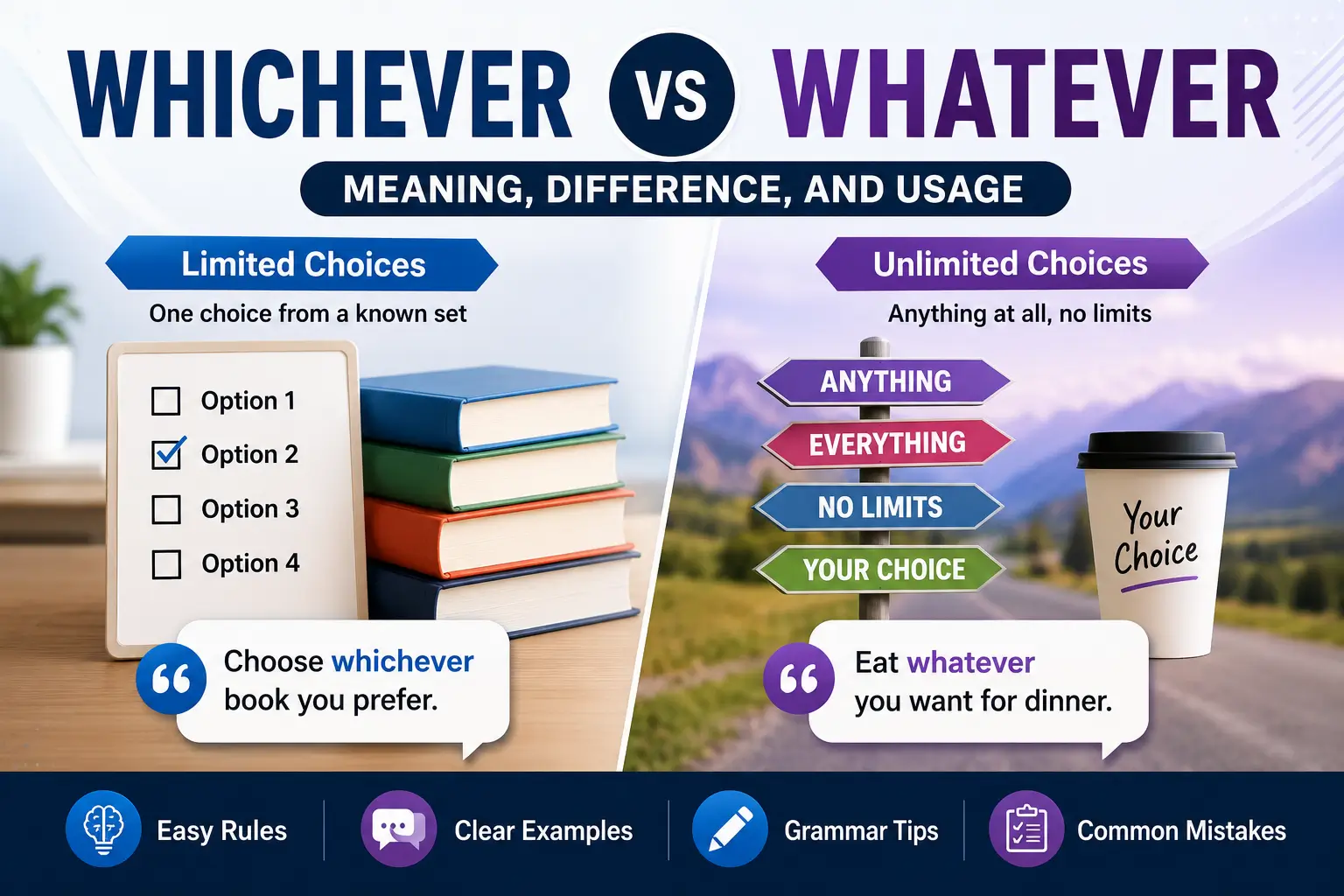
Whichever vs whatever becomes easy to understand when you focus on the available choices. Use whichever when choosing one item from a known or limited set. Use whatever when the possibilities are unlimited, unknown, or unrestricted.
For example, “Choose whichever book you prefer” refers to specific books. “Read whatever you enjoy” allows any reading choice. This simple difference helps you select the correct word in everyday conversation and writing.
Both words can function as pronouns or determiners, but their meanings depend on context. This guide explains their grammar rules, common uses, sentence patterns, and mistakes through clear American English examples.
Quick Answer: Whichever vs. Whatever
The main difference between whichever and whatever is the number of choices involved.
- Whichever refers to one choice from a known or limited group of options.
- Whatever refers to anything at all, without limiting the possibilities.
Quick examples
✅ You can choose whichever seat is available.
(There are only certain seats.)
✅ Eat whatever you want for dinner.
(There are no specific limits.)
A simple way to remember it is this:
Whichever = Which one? (Limited choices)
Whatever = Anything at all (Unlimited choices)
What Does Whichever Mean?
Whichever is used when you’re choosing one option from a specific or limited group. The exact number of choices may not be stated, but the options are understood to exist.
In American English, whichever often introduces a choice between two or more possible things. It tells the reader or listener that the selection comes from an identifiable set.
Simple definition
Whichever means “any one that you choose from a limited group.”
Examples
- Choose whichever color you prefer.
- Sit in whichever chair is empty.
- Buy whichever phone fits your budget.
- Take whichever route is faster.
Each sentence involves choosing from available options rather than from everything imaginable.
How Whichever Works in a Sentence
Depending on the sentence, whichever can perform different grammar functions.
| Grammar Role | Example |
| Pronoun | Whichever works best is fine with me. |
| Determiner | Choose whichever book you want. |
| Relative pronoun | I’ll support whichever candidate wins. |
Although the grammar labels sound technical, the meaning stays almost the same. Whichever always points to one choice among known possibilities.
Common Situations Where You Use Whichever
Choosing between available options
This is the most common use.
Examples
- Pick whichever dress you like best.
- Order whichever meal sounds good.
- Use whichever computer is available.
Giving someone freedom to choose
Instead of selecting for someone else, you allow them to decide.
Examples
- You may sit in whichever seat you prefer.
- Borrow whichever pen you need.
- Select whichever package fits your budget.
Referring to limited possibilities
Sometimes the options aren’t listed, but they’re still limited.
Examples
- Whichever answer is correct will receive full credit.
- Follow whichever instructions your teacher gives.
- We’ll visit whichever location is open today.
Even without naming every option, the listener understands there’s a specific group being considered.
Everyday American English Examples
At school
- Choose whichever topic interests you most.
- Submit whichever project you completed.
At work
- Use whichever software your company recommends.
- Contact whichever manager is available.
Shopping
- Buy whichever brand offers the best value.
- Pick whichever size fits you.
Family conversation
- Watch whichever movie everyone agrees on.
- Eat whichever dessert you’d like.
These examples reflect how native English speakers naturally use whichever in daily life.
Grammar Tip
A useful question to ask yourself is:
Am I choosing from known options?
If the answer is yes, whichever is often the correct word.
For example:
✅ Choose whichever laptop you prefer.
The available laptops represent a limited group.
What Does Whatever Mean?
Unlike whichever, whatever removes limits. It refers to anything, everything, or no particular choice.
The word suggests that the specific option doesn’t matter or that there are no restrictions.
Simple definition
Whatever means “anything that,” “no matter what,” or “it doesn’t matter what.”
How Whatever Functions in English
Like whichever, whatever can serve several grammar roles.
| Grammar Role | Example |
| Pronoun | Whatever happens, stay calm. |
| Determiner | Eat whatever food you like. |
| Relative pronoun | Take whatever you need. |
Although the grammar changes slightly, the basic meaning remains the same: there are no specific limits.
Common Situations Where You Use Whatever
Talking about unlimited possibilities
This is the most common use.
Examples
- Wear whatever makes you comfortable.
- Cook whatever you feel like eating.
- Buy whatever you need.
Nothing limits the possible choices.
Saying something doesn’t matter
Sometimes whatever shows that the specific choice isn’t important.
Examples
- Choose whatever works best.
- Call me whatever time you arrive.
- We can meet whatever day is convenient.
The focus is flexibility rather than selecting from fixed options.
Showing “no matter what”
In many sentences, whatever means regardless of what happens.
Examples
- Whatever happens, don’t panic.
- Whatever you decide, I’ll support you.
- Whatever the weather, we’ll continue.
This use is especially common in spoken and written American English.
Expressing indifference in conversation
Native speakers also use whatever as a one-word response.
For example:
Person A: I don’t agree with you.
Person B: Whatever.
Here, whatever doesn’t mean “anything.” Instead, it expresses indifference, frustration, or a desire to end the conversation.
Because of its tone, this use can sound dismissive or even rude, depending on the situation.
Everyday American English Examples
School
- Study whatever subjects interest you.
- Bring whatever materials you need.
Workplace
- Wear whatever is appropriate for the meeting.
- Use whatever method gets the job done.
Shopping
- Buy whatever you can afford.
- Order whatever sounds delicious.
Family life
- We’ll cook whatever everyone wants.
- Watch whatever is on TV tonight.
These examples show that whatever often gives complete freedom rather than limiting the choice.
Grammar Tip
Ask yourself this question:
Could the answer be almost anything?
If the answer is yes, whatever is usually the right choice.
For example:
✅ Eat whatever you want.
The possibilities are unlimited, so whatever fits naturally.
A Quick Comparison Before Moving On
Although these two words look alike, they express different ideas.
- Whichever focuses on choosing from specific options.
- Whatever focuses on anything without restrictions.
That small difference affects the meaning of your sentence more than many learners realize.
Whichever vs. Whatever: The Key Difference
Although whichever and whatever both end in “-ever,” they are not interchangeable in every situation. The key difference is simple:
- Whichever refers to a choice from a limited or known set of options.
- Whatever refers to anything at all, with no specific limit on the choices.
Understanding this distinction will help you choose the correct word in conversations, emails, academic writing, and everyday American English.
Limited Choices vs. Unlimited Possibilities
Think about whether the options are limited or unlimited.
Use whichever when someone is choosing from available options.
Examples
- Choose whichever cookie you want from the plate.
- Sit in whichever seat is empty.
- Pick whichever shirt fits best.
In each sentence, the choices are limited to what is available.
Now compare that with whatever.
Examples
- Eat whatever you want.
- Watch whatever makes you happy.
- Buy whatever you need.
Here, there is no defined list of options. The possibilities are open-ended.
Easy rule:
Whichever = Which one from these?
Whatever = Anything at all.
Which Word Fits Your Sentence?
Before choosing between these words, ask yourself one simple question:
Are there specific options to choose from?
If yes, use whichever.
✔ Choose whichever laptop you prefer.
If no, use whatever.
✔ Buy whatever you need.
This quick question helps you avoid one of the most common grammar mistakes.
Side-by-Side Comparison Table
| Feature | Whichever | Whatever |
| Basic meaning | Any one from a limited group | Anything at all |
| Number of choices | Limited or known | Unlimited or unspecified |
| Main idea | Selection | No restriction |
| Common question | Which one? | What? Anything? |
| Typical use | Choosing between options | Expressing freedom or no limits |
| Formal writing | Very common | Also common, depending on context |
| Informal speech | Common | Very common |
| Example | Choose whichever book you like. | Read whatever interests you. |
Grammar Rules for Using Whichever and Whatever
Both words belong to a group called compound relative pronouns. While that grammatical term sounds complicated, their job is actually straightforward. They introduce clauses while referring to people or things without naming them directly.
Fortunately, you don’t need to memorize the grammar label. You simply need to know how each word functions in real sentences.
As Pronouns
A pronoun replaces a noun.
Whichever as a pronoun
- Whichever is cheaper will be fine.
- Take whichever you prefer.
- Whichever arrives first gets the prize.
Here, whichever stands for one item chosen from several possibilities.
Whatever as a pronoun
- Whatever happens, stay calm.
- Take whatever you need.
- Whatever works is acceptable.
Instead of referring to limited choices, whatever allows any possibility.
As Determiners
A determiner comes before a noun.
Whichever
- Choose whichever restaurant you like.
- Buy whichever computer fits your needs.
- Pick whichever route is faster.
Whatever
- Eat whatever food you enjoy.
- Use whatever method works.
- Wear whatever clothes feel comfortable.
In these examples, both words describe a noun, but the meaning changes depending on whether the choices are limited.
In Noun Clauses
A noun clause acts as a noun within the sentence.
Examples with whichever
- We’ll buy whichever is on sale.
- She selected whichever looked newest.
Examples with whatever
- Do whatever makes you happy.
- Say whatever you believe is true.
These clauses function as the object of the sentence while expressing different ideas of choice.
In Relative Clauses
Relative clauses provide additional information.
Examples
- I’ll accept whichever solution you recommend.
- Keep whatever documents you receive.
- We’ll support whichever team wins.
- Record whatever information you find.
Notice how whichever points to one option from a known group, while whatever leaves the possibilities open.
Sentence Examples in Everyday American English
Learning grammar becomes much easier when you see how native speakers naturally use these words.
School and College Examples
Whichever
- Choose whichever topic interests you most.
- Submit whichever assignment is complete.
- Read whichever chapter your teacher recommends.
Whatever
- Study whatever helps you understand the lesson.
- Ask whatever questions you have.
- Bring whatever supplies you need.
Workplace and Business Examples
Whichever
- Contact whichever department handles billing.
- Use whichever software the company provides.
- Attend whichever meeting fits your schedule.
Whatever
- Do whatever is necessary to meet the deadline.
- Use whatever resources are available.
- Share whatever information you have.
Everyday Conversations
Whichever
- Take whichever slice of pizza you want.
- Sit in whichever chair is free.
- Buy whichever cake looks freshest.
Whatever
- Eat whatever you feel like.
- Wear whatever makes you comfortable.
- Watch whatever you want tonight.
Emails, Text Messages, and Social Media
Professional Email
✔ Please select whichever appointment time works best for you.
✔ Attach whatever documents are required.
Text Message
✔ Meet me at whichever entrance is closest.
✔ Bring whatever you need for the trip.
Social Media
✔ Watch whatever makes you smile today.
✔ Vote for whichever design you like best.
These examples reflect natural American English rather than textbook-only grammar.
Can You Use Whichever and Whatever Interchangeably?
Sometimes yes—but not always.
In certain situations, both words are grammatically correct. However, they often communicate slightly different meanings.
Understanding those differences makes your writing more precise.
Cases Where Either Word Can Work
Sometimes both words fit, although the emphasis changes.
Example
Choose whichever you like.
This suggests there are specific choices available.
Choose whatever you like.
This sounds broader and gives complete freedom.
Both sentences are correct.
However, the first implies a limited selection, while the second feels less restricted.
Cases Where Only One Word Is Correct
Some situations clearly require one word.
Correct
✔ Pick whichever movie is showing first.
There are only a few movies playing.
Incorrect
✘ Pick whatever movie is showing first.
This sounds awkward because the choices are already limited.
Another example:
✔ Eat whatever you want for dinner.
This sentence has unlimited possibilities.
✘ Eat whichever you want for dinner.
Without mentioning a limited set of foods, whichever doesn’t fit naturally.
How the Meaning Changes
Look at these similar sentences.
Sentence 1
Take whichever notebook you prefer.
Meaning:
There are several notebooks, and you may choose one.
Sentence 2
Take whatever notebook you need.
Meaning:
Take any notebook that suits your purpose. The focus isn’t on selecting from listed options but on meeting your needs.
The difference is subtle but important.
Common Patterns You’ll Hear in American English
Native speakers often use these expressions:
With Whichever
- Whichever is easier
- Whichever comes first
- Whichever works best
- Whichever one you choose
- Whichever option you prefer
With Whatever
- Whatever happens
- Whatever you decide
- Whatever you need
- Whatever it takes
- Whatever works
Learning these common phrases helps your English sound more natural and fluent.
Quick Grammar Checklist
Before you use whichever or whatever, ask yourself these questions:
| Question | Use |
| Are there specific options? | Whichever |
| Can the answer be almost anything? | Whatever |
| Am I choosing one item from a known group? | Whichever |
| Am I talking without limits? | Whatever |
| Does the exact choice not matter? | Whatever |
This simple checklist can help you make the right choice in seconds.
Common Mistakes and How to Fix Them
Even advanced English learners sometimes confuse whichever and whatever because both words seem interchangeable. In reality, choosing the wrong one can make your sentence sound unnatural or change its meaning.
Here are the mistakes people make most often.
Using Whatever When the Choices Are Limited
This is probably the most common mistake.
❌ Incorrect
Choose whatever shirt is in your closet.
This sentence isn’t always wrong, but it sounds less precise if you’re choosing from a specific collection of shirts.
✅ Correct
Choose whichever shirt you like.
The shirts represent a known, limited group.
Another example
❌ Pick whatever seat is available.
✅ Pick whichever seat is available.
Since there are only a certain number of seats, whichever is the better choice.
Using Whichever Without Specific Options
Sometimes writers use whichever even though no limited set of choices exists.
❌ Incorrect
Eat whichever you want.
The sentence doesn’t mention any specific options.
✅ Correct
Eat whatever you want.
Now the meaning is clear because there are no restrictions.
Confusing Meaning with Tone
Many learners think whatever always means “anything.”
That’s true in many sentences, but not in every situation.
For example:
Person A: I tried to help.
Person B: Whatever.
Here, whatever doesn’t mean “anything.” Instead, it expresses annoyance, boredom, or indifference.
Because of that, this response may sound rude in professional or formal conversations.
Forgetting the Context
Always look at the context instead of focusing only on the words.
Ask yourself:
- Are there several known choices?
- Or are the possibilities unlimited?
That single question usually gives you the correct answer.
Formal vs. Informal Usage
Both whichever and whatever appear in formal and informal English. However, the way people use them depends on the situation.
In Business Writing
Both words are perfectly acceptable.
Examples:
- Please select whichever appointment time is most convenient.
- Submit whatever documents are required.
These sentences sound professional and natural.
In Academic Writing
Students and researchers frequently use both words.
Examples:
- Choose whichever method best supports your argument.
- Analyze whatever evidence is available.
The emphasis remains the same:
- Whichever = limited selection
- Whatever = unrestricted possibility
In Everyday Conversation
Native speakers use both words constantly.
Examples:
- Sit whichever side you like.
- Bring whatever you need.
- Watch whichever movie starts first.
- Eat whatever you feel like.
When “Whatever” Sounds Rude
The one-word reply “Whatever.” deserves special attention.
Its meaning depends entirely on tone.
Neutral
Do whatever you think is best.
Polite
Whatever works for you is fine.
Dismissive
Whatever.
The final example often sounds disrespectful because it suggests the speaker no longer cares about the discussion.
Similar “-Ever” Words You Should Know
English contains several “-ever” words that work in similar ways.
Learning them together makes the pattern easier to remember.
| Word | Meaning | Example |
| Whoever | Any person | Whoever arrives first can start. |
| Whomever | Any person (object form, mostly formal) | Invite whomever you choose. |
| Wherever | Any place | Sit wherever you like. |
| Whenever | Any time | Visit whenever you’re free. |
| However | In any way or regardless of how | Finish it however you can. |
Notice the pattern:
Each word means “any…” followed by the question word.
- Who → Whoever
- Where → Wherever
- When → Whenever
- Which → Whichever
- What → Whatever
Quick Memory Tricks
Simple memory tricks can help you remember the difference instantly.
Trick 1: Look for the Word “Which”
The word whichever starts with which.
Ask yourself:
Which one?
If you can answer that question, use whichever.
Example:
There are five cookies.
Choose whichever you want.
Trick 2: Think “Anything”
The word whatever often means anything at all.
Example:
Eat whatever you want.
No limits exist.
Trick 3: Remember This Formula
Whichever = Limited choices
Whatever = Unlimited choices
Most grammar questions about these words can be solved with this simple rule.
Synonyms and Similar Expressions
Neither word has a perfect synonym, but these alternatives sometimes work depending on the sentence.
Synonyms for Whichever
- Any one
- Either (when there are two choices)
- Any of the available options
- The one you choose
Synonyms for Whatever
- Anything
- No matter what
- Anything at all
- Regardless of what
Always check the context before replacing either word.
Practice: Choose the Correct Word
Test your understanding by filling in the blanks.
Questions
- Choose __________ book you like best.
- Eat __________ you’d like for dinner.
- We’ll support __________ plan the team approves.
- Bring __________ supplies you think you’ll need.
- Sit in __________ seat is available.
Answer Key
1.
✅ Whichever
A limited group of books.
2.
✅ Whatever
No restrictions on the food.
3.
✅ Whichever
The team will approve one plan from several options.
4.
✅ Whatever
Any supplies are acceptable.
5.
✅ Whichever
Only certain seats are available.
Frequently Asked Questions
1. What is the difference between whichever and whatever?
Whichever means any one from a limited or known set of options. Whatever means anything at all, usually without restrictions.
2. When should I use whichever?
Use whichever when someone must choose one option from a specific group. For example: “Take whichever seat is available.”
3. When should I use whatever?
Use whatever when the possibilities are open or unrestricted. For example: “Eat whatever you want.”
4. Can whichever and whatever be used interchangeably?
Sometimes both words are grammatically correct, but they create different meanings. Whichever suggests limited options, while whatever suggests broader freedom.
5. Is “whichever you prefer” grammatically correct?
Yes. Whichever you prefer is correct when a person is choosing from available or understood options.
6. Is “whatever you prefer” also correct?
Yes. Whatever you prefer is correct when the choice is open-ended or when the exact selection does not matter.
7. Can whichever and whatever function as pronouns?
Yes. Both may act as pronouns. Examples include “Whichever works is fine” and “Whatever happens, remain calm.”
8. Can whichever and whatever come before nouns?
Yes. Both can function as determiners. For example: “Choose whichever route is shorter” and “Use whatever method works.”
9. Is saying “whatever” rude?
Not usually. However, saying “Whatever” as a one-word response may sound dismissive, impatient, or disrespectful because of the speaker’s tone.
10. What is the easiest way to remember whichever vs whatever?
Remember this quick grammar rule: whichever = which one from these options, while whatever = anything at all.
Conclusion
Understanding whichever vs whatever depends on one simple distinction: limited choices vs unlimited possibilities. Use whichever when selecting one option from a known group. Use whatever when anything is acceptable or no clear limits exist.
Context remains important because both words can fit some sentences while creating different meanings. “Choose whichever you like” suggests an available selection, while “Choose whatever you like” offers broader freedom.
Whenever you feel uncertain, ask whether you could point to the available options. If you can, whichever will usually fit. If the answer could be almost anything, choose whatever.