Many writers, students, and learners search for Forward vs Forwards because these similar words sound similar and have identical meanings. Both describe movement, direction, or moving toward the front, but the correct use depends on regional usage, grammar structure, and style. Choosing the right form improves writing, adds clarity, and helps you avoid an inconsistent or regionally awkward style.
This guide explains the grammatical difference and real-world usage in simple words. In American English, forward is the preferred spelling for formal writing and many formal situations. In British English, forwards is a less common spelling often heard in casual speech and some informal situations. Both forms work as an adverb showing progress, advancement, movement ahead, or a destination.
Learning through advanced examples, practice exercises, and correct sentences makes the confusion easier to understand. This article explains the meaning, different contexts, and when both forms can be used interchangeably. Regular practice helps bloggers, professionals, native speakers, and anyone typing with more confidence.
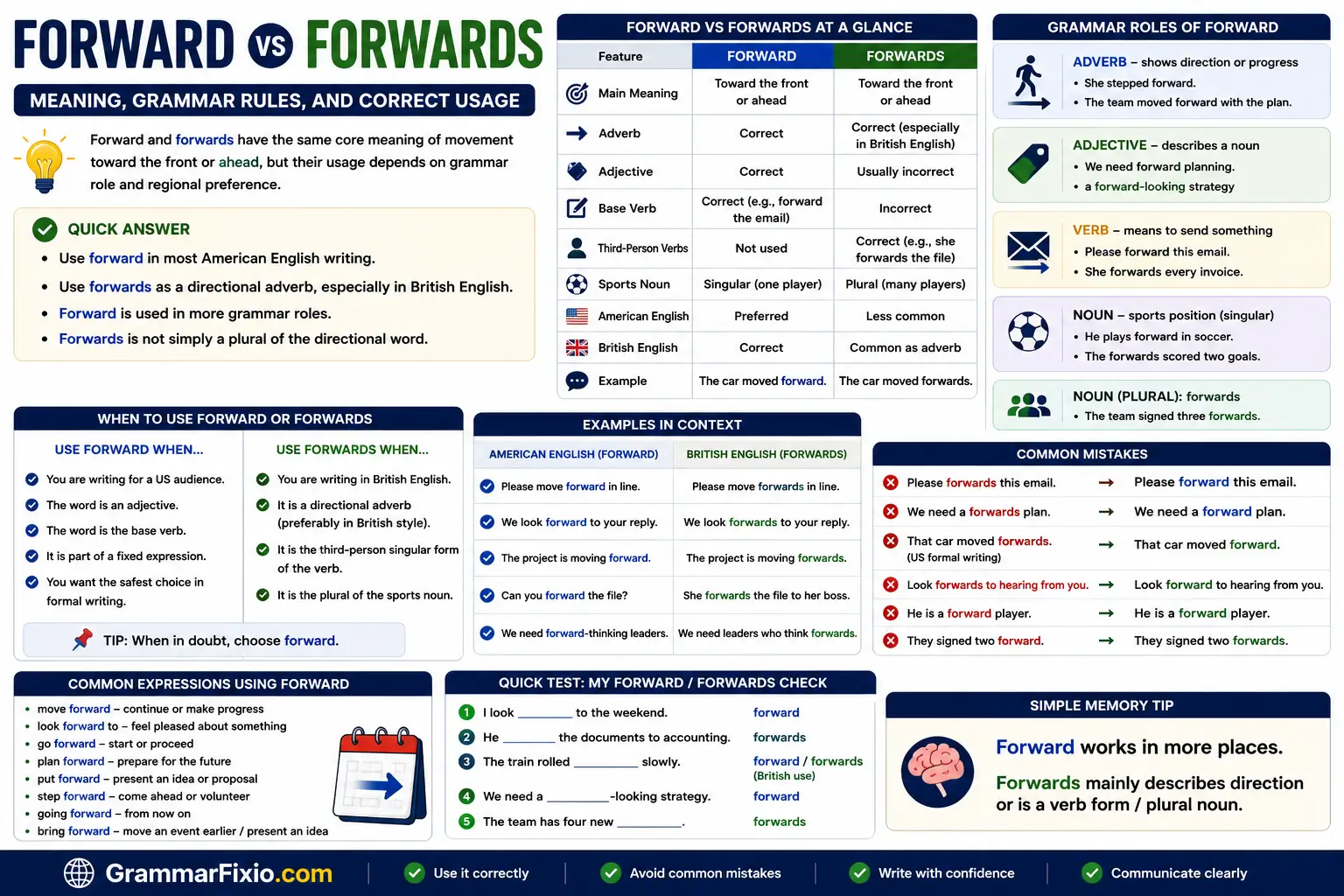
Quick Answer: Should You Use Forward or Forwards?
Use forward in most American English writing.
Use forwards when it functions as a directional adverb, especially in British English.
Compare these examples:
- American English: She took one step forward.
- British English: She took one step forwards.
- Correct: Please forward the email.
- Correct: We need a forward-looking plan.
- Correct: The team signed two new forwards.
- Incorrect: Please forwards the email.
The simplest rule is:
Forward works in more grammatical roles. Forwards mainly describes direction.
Therefore, forward is usually the best choice for a US audience.
Forward vs Forwards at a Glance
| Feature | Forward | Forwards |
| Main meaning | Toward the front or ahead | Toward the front or ahead |
| Adverb | Correct | Correct, especially in British English |
| Adjective | Correct | Usually incorrect |
| Base verb | Correct | Incorrect |
| Third-person verb | No | Correct in “she forwards” |
| Sports noun | Singular | Plural |
| American English | Strongly preferred | Less common |
| British English | Correct | Common as a directional adverb |
| Formal writing | Preferred | More regionally marked |
| Example | The car moved forward. | The car moved forwards. |
Notice that forwards is not simply a plural version of the directional word forward. Its grammatical role depends on the sentence.
Read this also: SM Meaning in Text: What Does SM Mean in Texting and Social Media?
What Does Forward Mean?
Forward generally means toward the front, ahead, or in the direction someone is facing. It can also describe progress, future planning, sending information, or a player’s position in sports.
Unlike many direction words, forward can serve several parts of speech:
- Adverb
- Adjective
- Verb
- Noun
Its meaning changes slightly with each role.
Forward as an Adverb
As an adverb, forward describes the direction of an action. It often modifies verbs such as move, walk, step, lean, push, look, and go.
Examples:
- She stepped forward.
- Please move the chair forward.
- The line moved forward slowly.
- He leaned forward to hear the speaker.
- The project is moving forward.
In American English, this is the normal adverbial form. You don’t need to add an s.
Forward for Physical Direction
The most basic use refers to movement toward the front.
- Take two steps forward.
- The bus rolled forward.
- She reached forward and opened the door.
- The crowd moved forward when the gate opened.
Each sentence describes literal movement.
The direction usually depends on the person or object involved. For example, when a driver moves forward, the vehicle travels toward its front.
Forward for Progress
Forward can also describe figurative movement. In this sense, it means making progress or continuing with a plan.
- The team moved forward with the project.
- We can’t move forward without approval.
- The agreement helped the talks move forward.
- She is ready to move forward in her career.
Nothing physically moves in these examples. Instead, an idea, process, or person develops.
This use is common in business, education, politics, and personal development.
Forward for Future Time
Sometimes, forward refers to movement toward a later time.
- Turn the clock forward one hour.
- The schedule extends forward into next year.
- We need to plan forward carefully.
However, phrases such as move the meeting forward can be unclear. Some speakers understand this as moving the meeting to an earlier time. Others think it means moving it later.
For professional communication, use an exact date or time:
- Ambiguous: We moved the meeting forward.
- Clear: We moved the meeting from Friday to Wednesday.
- Clear: We postponed the meeting until next Monday.
Specific wording prevents scheduling mistakes.
What Does Forwards Mean?
Forwards is an adverb meaning toward the front or in an onward direction. It is grammatically correct, especially in British English.
Examples:
- She stepped forwards.
- The train moved forwards slowly.
- He fell forwards onto the grass.
- The child leaned forwards to see the screen.
In these sentences, forwards describes how or where the movement happens.
For a US audience, forward usually sounds more natural:
- She stepped forward.
- He fell forward.
- The train moved forward.
The meaning remains the same.
When Forwards Sounds Natural
Forwards often sounds natural in British conversation and informal writing, particularly when describing physical direction.
For example:
- Take one step forwards.
- Bend forwards at the waist.
- The car rolled forwards.
British speakers may also use forward in these sentences. Therefore, the difference is a preference rather than a strict national rule.
When Forwards Does Not Work
You normally cannot replace every use of forward with forwards.
Incorrect:
- a forwards plan
- a forwards-looking company
- Please forwards this document.
- the forwards cabin
Correct:
- a forward plan
- a forward-looking company
- Please forward this document.
- the forward cabin
The reason is grammatical. In those sentences, the word is an adjective or base verb, not a directional adverb.
The Main Difference Between Forward and Forwards
The main distinction involves part of speech, regional usage, and flexibility.
Difference in Grammar
| Grammatical Role | Forward | Forwards |
| Directional adverb | The car moved forward. | The car moved forwards. |
| Adjective | We need forward planning. | Not normally correct |
| Base verb | Please forward the email. | Incorrect |
| Third-person verb | Not used | She forwards the email. |
| Singular sports noun | He plays forward. | Not singular |
| Plural sports noun | Not plural | The team has three forwards. |
As the table shows, forward works in more situations.
Difference in Regional Usage
American English generally prefers adverbs without a final s:
- forward
- backward
- toward
- upward
- downward
British English more often accepts or favors forms ending in -s:
- forwards
- backwards
- towards
- upwards
- downwards
However, this is a broad pattern, not an absolute rule. Both varieties use several forms, and fixed expressions may follow their own conventions.
Difference in Formality
Forward is the safer option in formal, academic, professional, and international writing. It is widely understood and doesn’t strongly signal a regional dialect.
Forwards is not informal or ungrammatical. Still, it may sound distinctly British to American readers.
Difference in Flexibility
The word forward can describe direction, modify a noun, name a sports position, or mean sending something.
By contrast, forwards usually has one of three roles:
- A directional adverb
- The third-person singular form of the verb forward
- The plural of the sports noun forward
Context determines which meaning applies.
Forward as an Adjective
As an adjective, forward describes a noun. It may mean located at the front, directed ahead, progressive, or unusually bold.
Forwards cannot normally replace it.
Forward Meaning at the Front
- the forward section of the plane
- the forward cabin
- the forward wheels
- the forward position
Here, forward identifies something near or toward the front.
Forward Meaning Future-Oriented
The adjective can also describe planning, progress, or preparation for the future.
- forward planning
- a forward-looking strategy
- forward thinking
- a forward-thinking company
Use a hyphen in a compound adjective before a noun:
- a forward-looking policy
- a forward-thinking manager
When the phrase comes after the noun, style may vary:
- The company is forward-looking.
- The company’s approach is forward looking.
Keeping the hyphen is common and often improves clarity.
Forward Meaning Bold
Forward can describe behavior that seems unusually direct, familiar, or presumptuous.
- His question seemed too forward.
- She apologized for being so forward.
- That was a surprisingly forward comment.
This meaning is correct, though it may sound somewhat formal or old-fashioned in casual American conversation.
Forward as a Verb
As a verb, forward means to send something to another person, place, or destination.
It is common in email, postal services, offices, customer support, and phone systems.
Forward in Email
- Please forward the message to your manager.
- I forwarded the attachment yesterday.
- She forwards all requests to the support team.
- We are forwarding your complaint to the correct department.
The verb forms are:
| Form | Example |
| Base form | I forward the message. |
| Third-person singular | She forwards the message. |
| Past tense | He forwarded the message. |
| Present participle | They are forwarding the message. |
This explains why forwards may be correct as a verb:
- Correct: She forwards every invoice to accounting.
- Incorrect: Please forwards every invoice to accounting.
The first sentence has a third-person singular subject, she. The second uses an imperative, so it needs the base form forward.
Forward Mail and Packages
- The postal service forwarded the package.
- Please forward my mail to my new address.
- The office will forward the letter to the director.
Forward Calls and Requests
- The receptionist forwarded the call.
- Your request has been forwarded to management.
- The assistant forwards urgent messages to the supervisor.
Forward as a Noun
In sports, a forward is an attacking player positioned toward the front.
Examples:
- She plays forward on the soccer team.
- The club signed a new forward.
- He is a power forward in basketball.
- The hockey team needs another forward.
The plural is forwards:
- one forward
- two forwards
- several forwards
This plural noun is different from the directional adverb forwards.
Compare:
- The forwards moved forward.
- The team’s forwards attacked quickly.
- Both players stepped forwards.
The first forwards names players. The second directional word explains movement.
American English vs British English
Regional preference is the main reason both forms appear in edited writing.
American English Usage
American speakers strongly prefer forward as the directional adverb.
Natural American examples include:
- Walk forward.
- Lean forward.
- The car moved forward.
- We’re moving forward with the proposal.
- Please step forward.
For US readers, forwards may sound British, though its directional use remains understandable.
British English Usage
British speakers commonly use forwards for physical direction:
- She walked forwards.
- He leaned forwards.
- The vehicle moved forwards.
However, British English also uses forward, especially in established phrases and non-adverbial roles:
- look forward to
- forward planning
- forward the email
- the forward section
Therefore, British English does not simply add an s in every situation.
Is One Form More Correct?
Neither form is universally wrong. The correct choice depends on:
- Grammatical role
- Regional style
- Fixed expression
- Intended audience
- Publication guidelines
For a US audience, choose forward unless the sentence specifically needs forwards as a verb form or plural sports noun.
Fixed Expressions That Use Forward
Certain phrases strongly favor forward, even where forwards is possible in other adverbial uses.
Look Forward To
The standard phrase is look forward to.
- I look forward to meeting you.
- We look forward to your reply.
- She is looking forward to the trip.
- They looked forward to graduation.
In this expression, to is a preposition. Therefore, it must be followed by a noun, pronoun, or -ing form.
Correct:
- I look forward to the meeting.
- I look forward to hearing from you.
- We look forward to working together.
Incorrect:
- I look forward to hear from you.
- We look forward to work together.
Although look forwards to may occasionally appear in British usage, look forward to is the established and widely preferred form.
Move Forward
Move forward can describe literal direction or figurative progress.
- Please move forward in line.
- The company will move forward with the plan.
- We need more information before moving forward.
- The talks moved forward after the compromise.
In British English, move forwards may sound natural for physical movement. However, move forward remains the best choice in American business writing.
Going Forward
Going forward means from now on or in the future.
- Going forward, employees must submit reports online.
- We will use the new system going forward.
This phrase is common in business English. However, it can sound vague or repetitive.
Clearer alternatives include:
- from now on
- beginning Monday
- in future reports
- after July 1
- during the next phase
Instead of writing, “Going forward, meetings will start earlier,” you might write:
- Beginning Monday, meetings will start at 8:30 a.m.
The exact version gives readers more useful information.
Path Forward
A path forward is a plan or method for making progress.
- The committee agreed on a path forward.
- We need a practical path forward.
- The report outlines a path forward for the project.
This phrase is common in business, politics, and public policy.
Step Forward
Step forward can be literal or figurative.
- Please step forward.
- Two witnesses stepped forward.
- Several volunteers stepped forward to help.
In the figurative examples, people make themselves known or offer support.
Put Forward
Put forward means to propose an idea, candidate, or argument.
- She put forward a new proposal.
- The committee put his name forward.
- The lawyer put forward a strong argument.
Bring Forward
Bring forward may mean presenting an idea or moving an event to an earlier time.
- The board brought forward several recommendations.
- The appointment was brought forward from Friday to Tuesday.
Because scheduling language can vary, include the exact dates whenever possible.
Forward or Forwards in Real-Life Contexts
The correct choice often becomes clear once you identify the sentence’s purpose.
Use forward as the verb for sending an email:
- Please forward this message to HR.
- I forwarded the file this morning.
- She forwards customer complaints to the manager.
Use look forward to in a polite closing:
- I look forward to your response.
- We look forward to working with you.
Business Writing
Common business expressions include:
- move forward
- path forward
- forward planning
- forward-looking strategy
- forward the report
Examples:
- The company will move forward with the merger.
- Management approved a forward-looking investment plan.
- Please forward the final report to the legal team.
For clearer professional writing, avoid repeating moving forward in every paragraph.
Everyday Movement
American English:
- Take one step forward.
- Move the table forward.
- He fell forward.
British English may use:
- Take one step forwards.
- Move the table forwards.
- He fell forwards.
Both sets describe the same direction.
News and Formal Writing
Formal American writing generally favors forward:
- The negotiations moved forward.
- Officials put forward a proposal.
- The vehicle rolled forward.
- The investigation took a major step forward.
Sports
In sports, the word may refer to direction or a player.
- The player moved forward.
- The forward scored twice.
- The team selected three forwards.
- The coach told the forwards to press higher.
Readers identify the meaning through grammar and context.
Technology
Technology instructions usually use forward.
- Tap the forward button.
- Forward the message.
- Use the back and forward controls.
- The browser moved forward to the next page.
A forwards button would sound unnatural in standard American English.
Common Mistakes and Corrections
Understanding the grammatical role prevents most errors.
Using Forwards as an Adjective
Incorrect:
- We need a forwards plan.
- She has a forwards-looking approach.
Correct:
- We need a forward plan.
- She has a forward-looking approach.
The word modifies a noun, so you need the adjective forward.
Using Forwards as the Base Verb
Incorrect:
- Please forwards the message.
- Can you forwards the attachment?
Correct:
- Please forward the message.
- Can you forward the attachment?
However, forwards is correct with a third-person singular subject:
- She forwards the message.
- The system forwards each request automatically.
Forgetting the Plural Sports Noun
Incorrect:
- The team signed two forward.
Correct:
- The team signed two forwards.
Here, the word is a countable sports noun. Therefore, it takes a normal plural ending.
Writing Look Forwards To
Less suitable for American English:
- I look forwards to your response.
Preferred:
- I look forward to your response.
The established phrase in edited American English uses forward.
Confusing Forward with Foward
Foward is a misspelling.
Incorrect:
- Please move foward.
- I will foward the email.
Correct:
- Please move forward.
- I will forward the email.
A simple spelling reminder is:
For + ward = forward
The first r must remain.
Adding an Unnecessary Apostrophe
Incorrect plural:
- The team has three forward’s.
Correct plural:
- The team has three forwards.
Use forward’s only for singular possession:
- The forward’s injury affected the team.
Treating the Forms as Fully Interchangeable
Forward and forwards overlap only in some adverbial uses.
Both may work:
- The vehicle moved forward.
- The vehicle moved forwards.
Only forward works:
- a forward movement
- forward the email
- a forward-looking policy
Why People Confuse Forward and Forwards
The confusion comes from regional differences and English word patterns.
Regional Variation
American and British media expose learners to both forms. As a result, a student may hear move forwards in one program and move forward in another.
Both can be correct as adverbs.
Similar Meaning
When describing physical direction, the two forms often mean the same thing.
- She stepped forward.
- She stepped forwards.
Because this overlap is real, learners may assume the words are interchangeable everywhere. However, they are not.
Similar Directional Adverbs
The same regional pattern appears in related words:
| American Preference | British Alternative |
| forward | forwards |
| backward | backwards |
| toward | towards |
| upward | upwards |
| downward | downwards |
Again, these are tendencies rather than absolute rules.
Multiple Parts of Speech
Forward has several grammatical roles. That flexibility can make its forms harder to recognize.
For example:
- Adverb: Move forward.
- Adjective: The forward section is closed.
- Verb: Forward the email.
- Noun: She plays forward.
The directional forwards does not have all those uses.
Forward Compared with Related Words
Several similar words overlap with forward, but their meanings are not identical.
Forward vs Ahead
Forward often describes movement or direction. Ahead often describes position, future time, or what comes next.
- Move forward.
- The car ahead stopped suddenly.
- We have a difficult week ahead.
- The team moved ahead in the rankings.
You can move forward toward something that lies ahead.
Forward vs Onward
Onward emphasizes continued movement or progress from a point.
- The group moved onward after lunch.
- From that day onward, the policy changed.
- The project continued onward despite delays.
Forward focuses more directly on direction or progress.
Forward vs Toward
Forward gives a general direction. Toward introduces a target or destination.
- She moved forward.
- She moved toward the door.
The second sentence tells you where she was going.
Forward vs Foreword
These words sound alike but have different meanings.
Forward relates to direction, progress, sending, or sports.
Foreword is an introductory section in a book, usually written by someone other than the author.
- Please forward the manuscript.
- The professor wrote the book’s foreword.
- I read the foreword before Chapter 1.
Forward vs Forth
Forth appears in expressions involving movement outward or onward.
Common phrases include:
- back and forth
- bring forth
- go forth
- from this day forth
However, forth cannot normally replace forward.
Natural:
- Move forward.
- The chair rocked back and forth.
Unnatural:
- Move forth two steps.
Synonyms for Forward
The best synonym depends on the meaning.
Synonyms for Direction
- ahead
- onward
- toward the front
- in front
Example:
- The line moved ahead.
Synonyms for Progress
- advance
- proceed
- progress
- develop
- continue
Example:
- The project can now proceed.
Synonyms for Sending
- send
- transfer
- redirect
- pass along
- transmit
Example:
- Please send the message to your supervisor.
Synonyms for Bold Behavior
- bold
- direct
- presumptuous
- overly familiar
These alternatives differ in tone. Direct may be neutral, while presumptuous is strongly negative.
A Simple Decision Guide
Use these questions when choosing between forward and forwards.
Does It Describe Direction?
Use forward for American English.
Forwards is also possible as an adverb, especially in British English.
Does It Modify a Noun?
Use forward:
- forward movement
- forward planning
- forward section
- forward-looking strategy
Does It Mean Send?
Use the verb forward:
- forward an email
- forward a call
- forward a package
Use forwards only when the subject requires a third-person singular verb:
- She forwards the email.
Does It Name a Sports Player?
Use forward for one player and forwards for more than one:
- one forward
- three forwards
Is It Part of a Fixed Expression?
Use the established phrase:
- look forward to
- move forward
- going forward
- path forward
- put forward
Easy Memory Tips
Forward Works in More Places
Forward can be an adverb, adjective, verb, or noun. Therefore, it is the safest default.
Remember:
When unsure, move forward without the s.
The S Often Signals British Direction
The final s in forwards often appears in British directional language.
However, don’t apply this shortcut to adjectives, base verbs, or fixed expressions.
Check What Comes Next
If a noun follows directly, you probably need the adjective forward:
- forward motion
- forward planning
- forward progress
If the word describes movement, either adverb may be possible depending on the regional style.
Formal, Informal, and Professional Usage
Formal American English
Use forward for direction and progress.
- The negotiations moved forward.
- The report presents a path forward.
- The vehicle moved forward slowly.
Reserve forwards for grammatical cases where it is required, such as she forwards or three forwards.
Informal Conversation
Regional dialect matters more than formality.
An American speaker may say:
- Move forward a little.
A British speaker may say:
- Move forwards a little.
Neither sentence is careless or uneducated.
Academic Writing
Use forward for broad readability.
Also, replace vague business phrases when a more exact word is available.
Vague:
- Going forward, this issue requires more study.
Clearer:
- Future studies should examine this issue.
Professional Communication
Standard choices include:
- Please forward the document.
- I look forward to your reply.
- We can move forward after approval.
- The team agreed on a path forward.
These forms work well for American and international audiences.
Creative Writing
In dialogue, forwards can help reflect British speech naturally.
For example:
“Take another step forwards,” the officer said.
Narrative language should remain consistent with the character, setting, and chosen dialect.
Practice Exercise: Choose Forward or Forwards
Choose the correct form for each sentence. In some directional sentences, both may be possible depending on regional style.
- Please ______ the invoice to the finance department.
- The crowd moved ______ when the doors opened.
- We need a ______-looking plan for the next five years.
- I look ______ to hearing from you.
- She ______ every customer complaint to her manager.
- The basketball team signed two new ______.
- Take one step ______ and raise your hand.
- The project cannot move ______ without funding.
- The ______ section of the aircraft is reserved.
- In British English, “The car rolled ______” is acceptable.
- The committee put ______ a new proposal.
- The coach told the ______ to stay near the goal.
Answer Key
- Forward — The sentence requires the base form of the verb.
- Forward — Preferred in American English; forwards is also possible in British English.
- Forward — The compound adjective is forward-looking.
- Forward — The fixed phrase is look forward to.
- Forwards — The subject she requires the third-person singular verb.
- Forwards — The word is a plural sports noun.
- Forward — Preferred in American English; forwards may be used in British English.
- Forward — The figurative expression is move forward.
- Forward — The word functions as an adjective.
- Forwards — This is a correct British directional adverb.
- Forward — The fixed phrase is put forward.
- Forwards — The sentence refers to several attacking players.
See this also: GLHF Meaning in Text: What Does GLHF Mean?
Frequently Asked Questions
The main difference is regional usage. Forward is more common in American English, while forwards is more common in British English.
Yes, in many situations they have the same meaning. However, the preferred form depends on the style and regional variety of English.
Both are correct. Forward is usually preferred in American English, while forwards is more common in British English.
Yes. Forward can be used as an adverb to describe movement ahead or toward a destination. It can also be used as an adjective, verb, and noun in different contexts.
It is understood in American English, but forward is much more common in everyday writing and speech.
Yes. Forward is the preferred choice for formal writing, especially in American English.
People confuse them because both words have the same meaning and are used differently depending on regional English.
Example: She stepped forward to answer the question.
Example: The children ran forwards across the playground. This form is more common in British English.
Remember that forward is the standard choice in American English, while forwards is more common in British English. If you’re unsure, forward is usually the safer option in formal writing.
Conclusion
Understanding Forward vs Forwards is easier when you know that the meaning stays the same, but the preferred form depends on the type of English you use. Forward is more common in American English and formal writing, while forwards is used more often in British English and casual speech. Both words describe movement or progress, and neither is wrong when used in the right context. By learning the regional differences and practicing with real examples, you can write more naturally, avoid inconsistency, and communicate with confidence.

2 thoughts on “Forward vs Forwards: Meaning, Grammar Rules, and Correct Usage”