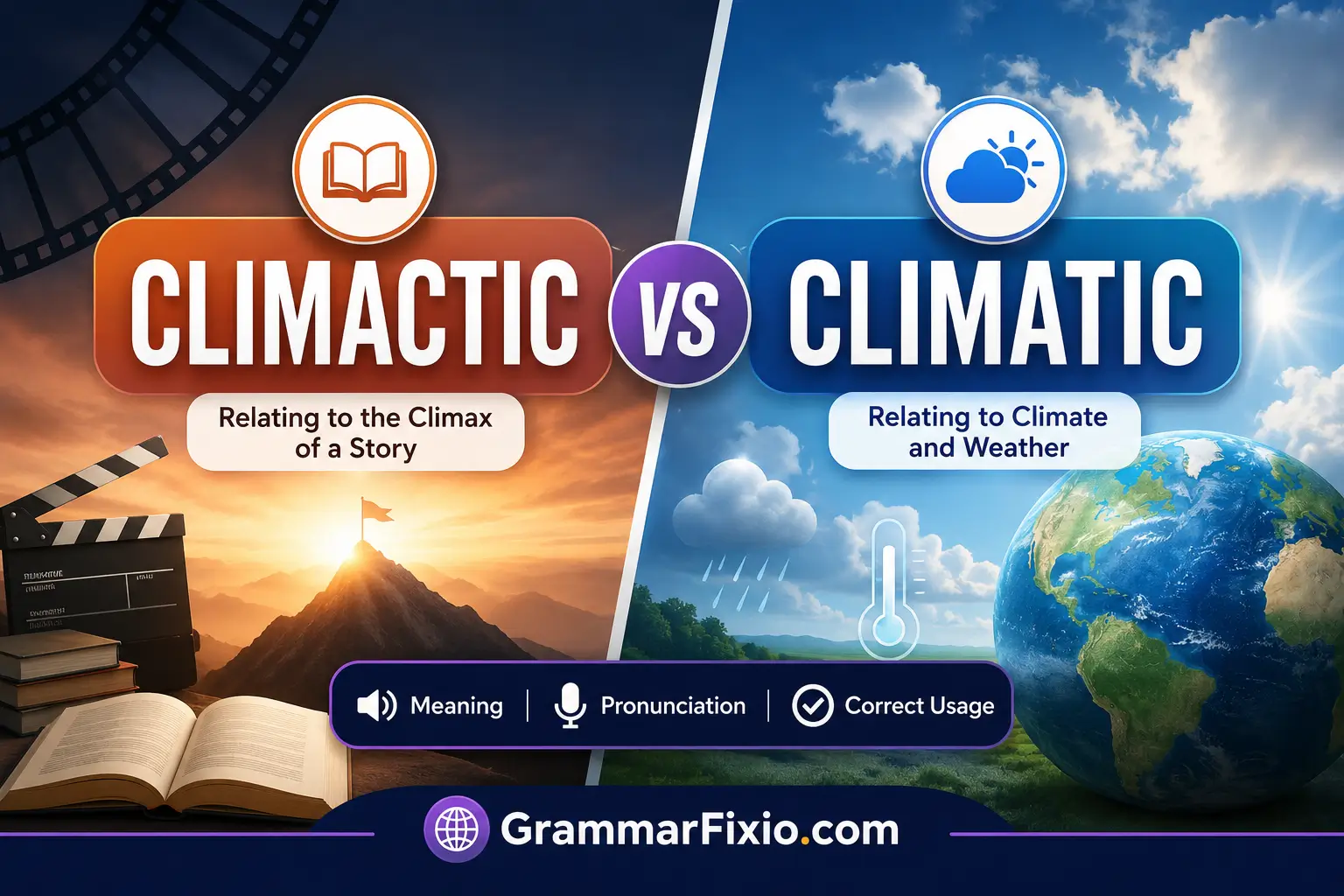
Many English learners confuse Climactic vs Climatic because both words look similar and have a similar sound, but their meanings are different. This common mistake can affect your writing, grammar, and vocabulary. Climactic is an adjective used for the high point, most intense part, ultimate, final, or peak moment in a movie, song, play, or other creative work. Climatic connects with climate and describes weather-related topics. Using the correct word in a sentence helps improve your communication skills.
In research and storytelling, researchers need accurate words to share the right intended message. A well-written article or blog should clearly express ideas, thoughts, and emotions. This pair of words has specific meanings, and understanding their distinction creates a better impact in every writing realm. Real examples help you focus on the correct usage instead of confusing rules.
The simple answer is that climactic means a dramatic peak, while climatic refers to climate. You should learn how to pronounce both words and remember they are not homophones. These similar words cannot be used interchangeably, but with regular practice, you can easily choose the correct word and avoid mistakes.
Quick Answer: Climactic or Climatic?
Use climactic when describing the most dramatic, important, intense, or decisive point of an event.
Use climatic when describing climate or long-term atmospheric conditions.
Climax → climactic
Climate → climatic
Compare these examples:
- The movie builds toward a climactic confrontation.
- The plant cannot survive the region’s dry climatic conditions.
- The championship reached a climactic final minute.
- Researchers studied long-term climatic changes.
The extra c in climactic is an important clue. It separates a high point from anything related to climate.
Climactic vs Climatic at a Glance
| Feature | Climactic | Climatic |
| Basic meaning | Relating to a climax or high point | Relating to climate |
| Root word | Climax | Climate |
| Part of speech | Adjective | Adjective |
| US pronunciation | kly-MAK-tik | kly-MAT-ik |
| Common contexts | Movies, books, sports, debates, events | Science, geography, farming, ecology |
| Typical nouns | Scene, battle, moment, ending, confrontation | Conditions, patterns, zones, factors, changes |
| Tone | Often dramatic or intense | Usually neutral or technical |
| Example | The story ends with a climactic battle. | The crop needs warm climatic conditions. |
The fastest test is to identify the root word.
If you mean climax, choose climactic. If you mean climate, choose climatic.
Read this also: Forward vs Forwards: Meaning, Grammar Rules, and Correct Usage
How to Pronounce Climactic and Climatic
The words look almost identical, but they don’t sound exactly the same. Climactic contains an extra consonant sound.
How to Pronounce Climactic
Climactic is pronounced kly-MAK-tik.
The standard American English pronunciation is:
/klaɪˈmæk.tɪk/
The stress falls on the second syllable, mak. You should also pronounce the k sound before the final syllable.
Break it into three parts:
- kly
- MAK
- tik
Examples:
- a climactic scene
- a climactic battle
- a climactic moment
Because the word comes from climax, the k sound remains present.
How to Pronounce Climatic
Climatic is pronounced kly-MAT-ik.
Its American English pronunciation is commonly shown as:
/klaɪˈmæt̬.ɪk/
The stress falls on mat. In natural American speech, the middle t may sound softer, almost like a quick d sound.
Break it into three parts:
- kly
- MAT
- ik
Examples:
- climatic conditions
- climatic patterns
- climatic variation
Are Climactic and Climatic Homophones?
No. Climactic and climatic are not homophones because their pronunciations differ.
Compare:
- Climactic: kly-MAK-tik
- Climatic: kly-MAT-ik
The extra k sound in climactic makes the distinction clearer. However, fast speech may hide that sound, which is one reason people confuse the words.
What Does Climactic Mean?
Climactic is an adjective meaning related to a climax. A climax is the highest, most intense, most exciting, or most important point in a story, event, conflict, or process.
The word often appears in discussions of:
- Movies
- Novels
- Plays
- Video games
- Sports
- Political campaigns
- Court cases
- Negotiations
- Public events
A climactic moment usually feels decisive. It often resolves a major conflict or determines what happens next.
Climactic in Stories, Movies, and Books
In storytelling, the climax is the point of greatest tension or importance. Therefore, a climactic scene is the scene in which that high point occurs.
Examples:
- The hero faces the villain in a climactic battle.
- The novel’s climactic scene reveals the murderer.
- The play builds toward a climactic confrontation between the brothers.
- The final episode contains a climactic sequence that resolves the central conflict.
A climax often appears near the end of a story. However, the climax and the ending aren’t always the same.
For example, a detective novel may reveal the criminal during its climactic scene. The remaining pages may then explain what happens to each character. Those later pages form the ending, but they aren’t necessarily climactic.
Climactic vs Final
Final simply means last. Climactic means connected to the high point.
As a result, a final moment isn’t automatically climactic.
Compare:
- The final scene shows the family leaving town.
- The climactic scene shows the family escaping the fire.
The first sentence only identifies the last scene. The second describes the story’s most intense moment.
Sometimes, a scene can be both final and climactic:
- The film ends with a climactic final battle.
Still, the two adjectives communicate different information.
Climactic in Sports
Sports writers and commentators use climactic for dramatic or decisive moments.
Examples:
- The game reached a climactic final minute.
- The striker scored during the match’s climactic sequence.
- The runners entered a climactic sprint toward the finish line.
- The tournament ended with a climactic championship game.
However, not every final game is climactic. A one-sided contest with little tension may be final without feeling like a climax.
For greater precision, ask whether the moment represents the event’s emotional or competitive peak.
Climactic in Work and Public Events
Although climactic is common in entertainment, it can also describe real-life events.
Examples:
- Negotiations entered a climactic stage.
- The trial ended with a climactic exchange between the attorneys.
- The campaign reached a climactic final week.
- The meeting concluded with a climactic vote on the proposal.
These uses are correct, but the word can sound dramatic. In routine professional writing, another adjective may be more precise.
Possible alternatives include:
- Decisive
- Critical
- Final
- Pivotal
- Concluding
- Most important
For example, decisive vote may sound more natural than climactic vote in a formal business report.
Common Phrases with Climactic
Writers often use climactic with nouns that describe dramatic points or events.
Common combinations include:
- Climactic moment
- Climactic scene
- Climactic battle
- Climactic confrontation
- Climactic sequence
- Climactic ending
- Climactic event
- Climactic point
- Climactic speech
- Climactic finish
These word combinations are called collocations. A collocation is a group of words that commonly appear together in natural English.
Word Forms Related to Climactic
| Word | Part of Speech | Meaning | Example |
| Climax | Noun | The highest or most intense point | The battle is the story’s climax. |
| Climax | Verb | To reach the highest point | The film climaxes with a chase. |
| Climactic | Adjective | Related to a climax | The chase is the climactic scene. |
| Climactically | Adverb | In a climactic way | The story ends climactically. |
Climactically is grammatically correct, but it is uncommon. Most writers choose a clearer phrase.
Less natural:
- The film ended climactically.
More natural:
- The film ended with a climactic battle.
What Does Climatic Mean?
Climatic is an adjective meaning related to climate. Climate refers to the usual or long-term weather patterns of a place.
These patterns may involve:
- Temperature
- Rainfall
- Snowfall
- Humidity
- Wind
- Seasonal changes
- Atmospheric pressure
- Drought frequency
You will often see climatic in scientific, geographic, agricultural, and environmental writing.
Climatic Conditions and Patterns
Climatic conditions are the climate-related features of a location or period.
Examples:
- Cacti can survive harsh climatic conditions.
- The region’s climatic patterns support year-round farming.
- Mountain elevation creates major climatic differences.
- The species has adapted to changing climatic conditions.
In these examples, climatic doesn’t describe one hot day or one rainstorm. Instead, it refers to broader patterns.
Climate vs Weather
Understanding the difference between climate and weather will help you use climatic correctly.
Weather refers to short-term atmospheric conditions. It may change within hours or days.
Examples of weather include:
- Today’s rain
- Tomorrow’s temperature
- This afternoon’s wind
- A storm passing through town
Climate refers to typical weather patterns over a much longer period.
Examples of climate include:
- A region’s dry summers
- Regular winter snowfall
- Long-term rainfall patterns
- Average seasonal temperatures
Therefore, one rainy day is usually a weather event, not a climatic pattern.
Compare:
- Today’s bad weather delayed the flight.
- The region’s severe climatic conditions limit air travel during winter.
The first sentence describes a short-term event. The second describes recurring conditions.
Climatic in Science and Environmental Writing
Scientists use climatic when discussing the effects, patterns, or features of climate.
Examples:
- Researchers examined long-term climatic variation.
- Rising temperatures may alter regional climatic patterns.
- The report identifies several climatic factors affecting migration.
- Ocean currents influence coastal climatic conditions.
The word often appears before technical nouns such as data, variables, records, zones, and trends.
However, modern writers frequently use climate directly as a noun modifier.
For example:
- Climate change is more common than climatic change.
- Climate data is often more natural than climatic data.
- Climate patterns may be simpler than climatic patterns.
Both structures can be grammatical. The best choice depends on common usage and the tone of the sentence.
Climatic in Agriculture
Farmers, researchers, and agricultural planners use climatic to explain how climate affects crops and livestock.
Examples:
- Wheat grows well under these climatic conditions.
- Farmers must choose varieties suited to local climatic zones.
- Changing rainfall has created new climatic challenges.
- Temperature is an important climatic factor in crop development.
This word is useful because agricultural success often depends on long-term patterns, not one day’s weather.
However, daily weather still matters. A sudden frost can damage a crop even when the wider climate is suitable.
Climatic in Geography and Ecology
Geographers use climatic to describe regions and environmental patterns. Ecologists may use it when explaining the distribution of plants and animals.
Examples:
- The mountain has several distinct climatic zones.
- The bird’s range depends partly on climatic factors.
- Coastal and inland areas show clear climatic differences.
- The forest developed under warm, humid climatic conditions.
In each case, the word connects the noun to climate.
Common Phrases with Climatic
Common collocations include:
- Climatic conditions
- Climatic patterns
- Climatic factors
- Climatic variation
- Climatic zone
- Climatic region
- Climatic differences
- Climatic influences
- Climatic effects
- Climatic changes
These phrases sound natural in academic and technical writing. In casual conversation, people often use simpler forms such as climate conditions or weather patterns.
Word Forms Related to Climatic
| Word | Part of Speech | Meaning | Example |
| Climate | Noun | Long-term weather patterns | The region has a dry climate. |
| Climatic | Adjective | Related to climate | The region has dry climatic conditions. |
| Climatology | Noun | The scientific study of climate | She studies climatology. |
| Climatologist | Noun | A scientist who studies climate | The climatologist analyzed rainfall records. |
| Climatological | Adjective | Related to climatology | The report includes climatological data. |
Climatic and climatological overlap in some contexts. However, climatological often refers more specifically to climate science, records, or analysis.
Key Differences Between Climactic and Climatic
The difference comes from meaning, root word, context, and tone.
Difference in Meaning
Climactic means related to a climax.
Climatic means related to climate.
Compare:
- The story ends with a climactic confrontation.
- The animals have adapted to cold climatic conditions.
The confrontation is a dramatic high point. The conditions relate to climate.
Difference in Root Words
The root-word method is the most reliable way to choose.
| Root Word | Adjective | Meaning |
| Climax | Climactic | Related to a high point |
| Climate | Climatic | Related to climate |
Notice that climactic contains an extra c. That spelling comes from its connection to climax.
Difference in Context
| Use Climactic For | Use Climatic For |
| A movie’s high point | Long-term weather patterns |
| A dramatic ending | Regional climate |
| A decisive sports moment | Temperature and rainfall |
| A major confrontation | Agricultural conditions |
| A story’s peak | Environmental zones |
| An intense final stage | Climate-related factors |
Difference in Tone
Climactic often has an emotional or dramatic tone.
It suggests:
- Excitement
- Tension
- Importance
- Intensity
- Resolution
In contrast, climatic is usually neutral and descriptive.
It often appears in:
- Scientific reports
- Research papers
- Environmental discussions
- Geographic descriptions
- Agricultural guidance
Correct Examples of Climactic
These sentences use climactic because they describe a climax or high point.
Entertainment Examples
- The film ends with a climactic battle between the hero and the villain.
- The novel’s climactic scene takes place in an abandoned hotel.
- A surprising confession creates the play’s climactic moment.
- The final level includes a climactic confrontation with the main enemy.
Each sentence describes the most intense or important part of a narrative.
Sports Examples
- The match reached a climactic final minute.
- The race ended with a climactic sprint to the finish line.
- A late goal created a climactic finish.
- The championship provided a climactic end to the season.
The word works because each moment represents a peak in excitement or competition.
Professional and Public Examples
- The court case reached a climactic stage during closing arguments.
- The negotiations ended with a climactic meeting between both leaders.
- The election campaign entered its climactic final days.
- The debate concluded with a climactic exchange over taxes.
These examples are grammatically correct. Still, formal writers should avoid making an ordinary event sound more dramatic than it was.
Correct Examples of Climatic
These sentences use climatic because they relate to climate.
Science and Geography Examples
- Elevation causes significant climatic differences across the state.
- Researchers compared rainfall and other climatic factors.
- The island’s climatic conditions support tropical forests.
- Several climatic zones exist within the mountain range.
Environmental Examples
- The species may struggle under changing climatic conditions.
- Long-term climatic variation affects water supplies.
- The report examines the ecological effects of climatic changes.
- Coastal cities face unique climatic risks.
Agriculture Examples
- Farmers choose crops based on local climatic conditions.
- The variety performs well across different climatic zones.
- Rainfall is a major climatic factor in crop production.
- New planting methods may help farmers respond to climatic challenges.
Common Mistakes with Climactic and Climatic
Both words are correctly spelled. Therefore, a spelling checker may accept the wrong one.
Mistake: Using Climatic for a Story’s High Point
Incorrect: The movie ends with a climatic battle.
Correct: The movie ends with a climactic battle.
A battle at the high point of a movie relates to its climax, not its climate.
Mistake: Using Climactic for Climate Conditions
Incorrect: The crop cannot survive these climactic conditions.
Correct: The crop cannot survive these climatic conditions.
The sentence describes climate-related conditions. Therefore, climatic is correct.
Mistake: Calling Every Ending Climactic
Weak: The report has a climactic ending that lists the references.
Better: The report ends with a list of references.
A list of references is final, but it isn’t a dramatic high point. Climactic should describe genuine intensity or importance.
Mistake: Using Climatic for One Day’s Weather
Imprecise: Today’s climatic conditions caused traffic delays.
Better: Today’s weather conditions caused traffic delays.
One day’s rain, snow, or wind is normally weather. Climatic conditions usually refers to broader or recurring patterns.
However, the word may be appropriate if the sentence connects a daily event to a larger climate pattern:
- The region’s harsh climatic conditions regularly cause winter travel problems.
Mistake: Assuming the Words Are Regional Variants
Climactic and climatic aren’t American and British spellings of the same word. They are separate words with different meanings in all major forms of English.
The distinction applies in:
- American English
- British English
- Canadian English
- Australian English
Why People Confuse Climactic and Climatic
Several features make this pair difficult.
The Spellings Are Almost Identical
Compare:
- climactic
- climatic
The extra c is easy to overlook, especially when reading quickly.
The Root Words Look Similar
Climax and climate both begin with clima-. However, they have unrelated meanings.
- Climax means a high point.
- Climate means long-term weather patterns.
Their visual similarity can mislead writers.
Both Words Are Adjectives
Because both are adjectives, they can appear in the same sentence position.
Compare:
- a climactic event
- a climatic event
Both phrases are grammatically possible. However, their meanings differ.
A climactic event is a dramatic high point. A climatic event is an event related to climate.
Grammar Tools May Not Catch the Error
Software may recognize both spellings as valid. It may also struggle to understand your intended meaning.
For example:
- The novel ends with a climatic scene.
The sentence has a correctly spelled adjective before a noun. Still, climactic is almost certainly the intended word.
A Simple Decision Guide
Use these steps whenever you’re unsure.
Ask Whether You Mean Climax
Does the sentence describe:
- A high point?
- A dramatic moment?
- A decisive event?
- The peak of a story?
- An intense final stage?
If so, use climactic.
Ask Whether You Mean Climate
Does the sentence describe:
- Long-term weather patterns?
- Temperature?
- Rainfall?
- Humidity?
- Climate zones?
- Environmental conditions?
If so, use climatic.
Replace the Word
Try replacing climactic with:
- Dramatic
- Decisive
- Peak
- Pivotal
- High-point
Try replacing climatic with:
- Climate-related
- Environmental
- Atmospheric
Example:
- The film has a dramatic ending.
Because dramatic fits, climactic may be correct.
Another example:
- The plant needs specific climate-related conditions.
Because climate-related fits, use climatic.
Easy Memory Tricks
The Extra C Stands for Climax
Climactic contains an extra c.
Remember:
Climactic has an extra c for climax.
This memory trick helps you connect the longer spelling with a story’s high point.
Climate Becomes Climatic
To form climatic, remove the final e from climate and add -ic:
- climate
- climat + ic
- climatic
This spelling pattern makes the relationship easy to see.
Use the Story or Science Test
Ask what kind of context you’re reading.
- Story, film, game, battle, debate → climactic
- Climate, weather patterns, farming, geography → climatic
This test won’t cover every possible sentence, but it works well in most cases.
Synonyms and Related Words
Synonyms for Climactic
Possible alternatives include:
- Dramatic
- Decisive
- Pivotal
- Critical
- Intense
- Culminating
- Peak
- Most important
These words aren’t perfect substitutes in every sentence.
For example, pivotal means highly important, but it doesn’t always suggest an emotional high point. Culminating refers to something that completes or results from earlier developments.
Synonyms for Climatic
Possible alternatives include:
- Climate-related
- Atmospheric
- Environmental
- Meteorological
- Weather-related
However, meteorological may refer to weather as well as climate. Likewise, environmental has a broader meaning and can include pollution, land, water, and ecosystems.
Therefore, climatic remains the most precise adjective when you specifically mean climate-related.
Climactic vs Climatic vs Climate
These related-looking terms play different grammatical roles.
| Word | Part of Speech | Meaning | Example |
| Climactic | Adjective | Related to a climax | The climactic scene reveals the truth. |
| Climatic | Adjective | Related to climate | The plant needs warm climatic conditions. |
| Climate | Noun | Long-term weather patterns | The region has a warm climate. |
Compare:
- The movie’s ending is climactic.
- The region’s conditions are climatic.
- The region has a dry climate.
Climactic vs Anticlimactic
Anticlimactic describes something that is less exciting, important, or impressive than expected after a buildup.
Compare:
- The final battle was climactic.
- The final battle felt anticlimactic because it ended in seconds.
Both words relate to climax, not climate.
Common examples include:
- an anticlimactic ending
- an anticlimactic reveal
- an anticlimactic conclusion
- an anticlimactic finish
A scene may be intended as climactic but feel anticlimactic to the audience.
What Does Climacteric Mean?
Climacteric is another similar-looking word, but it has specialized meanings.
Traditionally, it can refer to a critical period or turning point. In medical contexts, it may describe a stage involving age-related reproductive changes, especially around menopause.
Examples:
- The nation entered a climacteric period in its history.
- The medical discussion focused on the climacteric stage.
The word is far less common than climactic or climatic. In most general writing, critical period, turning point, or another familiar phrase will be clearer.
Formal, Informal, and Professional Usage
Everyday American English
In casual speech, climactic may appear when people discuss movies, games, sports, or dramatic events.
Examples:
- The show’s climactic episode was amazing.
- The game had a climactic finish.
Climatic is less common in casual conversation. People often say climate-related or simply weather conditions instead.
Academic and Scientific Writing
Use climatic when you mean long-term climate conditions or variables.
Examples:
- The study measured climatic variation.
- Researchers identified three key climatic factors.
However, avoid using climatic for isolated daily weather unless the larger context justifies it.
Professional Writing
In business or government writing, use climactic carefully. It can sound emotional or dramatic.
For example:
- The negotiations reached a decisive stage.
This may sound more objective than:
- The negotiations reached a climactic stage.
Both can be correct, but they create different tones.
Reviews and Entertainment Writing
Climactic is especially useful in reviews of movies, books, plays, and games.
Writers may discuss:
- A climactic battle
- A climactic reveal
- A climactic episode
- A climactic confrontation
- An anticlimactic ending
The word allows reviewers to discuss story structure without revealing every plot detail.
Real-Life Usage Case Studies
Movie Review
A reviewer writes:
The climatic battle delivers the excitement promised by the trailer.
The battle is a story’s dramatic high point. It isn’t related to weather patterns.
Corrected version:
The climactic battle delivers the excitement promised by the trailer.
Science Report
A student writes:
The researchers studied climactic differences between coastal and inland regions.
The sentence refers to differences in climate.
Corrected version:
The researchers studied climatic differences between coastal and inland regions.
Workplace Email
An employee writes:
The project reached a climatic stage before the final presentation.
The writer means the project reached an important or decisive point.
Better version:
The project reached a climactic stage before the final presentation.
However, a more neutral professional choice may be:
The project reached a critical stage before the final presentation.
Weather Report
A writer states:
Today’s climatic conditions include heavy rain and strong winds.
Because the sentence describes one day, weather conditions is more precise.
Better version:
Today’s weather conditions include heavy rain and strong winds.
Practice Exercise: Choose Climactic or Climatic
Choose the correct word for each sentence.
- The movie ends with a ______ confrontation between the two main characters.
- The plant grows best under warm and humid ______ conditions.
- The championship reached a ______ moment during the final seconds.
- The report examines long-term ______ variation across the region.
- The novel’s ______ scene reveals the narrator’s secret.
- Farmers must consider local ______ factors before selecting a crop.
- The trial ended with a ______ exchange between the lawyers.
- Mountain elevation produces several distinct ______ zones.
- The game’s ______ battle was exciting but surprisingly short.
- Researchers analyzed temperature, rainfall, and other ______ data.
Answer Key
- Climactic — The confrontation is the story’s dramatic high point.
- Climatic — The conditions relate to climate.
- Climactic — The sentence describes a decisive sports moment.
- Climatic — The variation involves long-term climate patterns.
- Climactic — The scene represents the novel’s climax.
- Climatic — The factors include climate-related conditions.
- Climactic — The exchange is the trial’s most intense point.
- Climatic — The zones are based on climate.
- Climactic — The battle is the game’s major high point.
- Climatic — The data concerns climate variables.
See this also: Thats vs That’s: Meaning, Apostrophe Rule, and Correct Usage
FAQs
Climactic refers to the highest or most dramatic point of something, while climatic relates to climate, weather, or environmental conditions.
Yes, climactic is an adjective used to describe a peak moment or the most intense part of an event, story, or creative work.
Climatic means connected to climate, weather patterns, or conditions related to the environment.
No, climactic and climatic are not homophones because their pronunciation is similar but not exactly the same.
No, these words have different meanings and should not replace each other in sentences.
Example: The final scene of the movie was the most climactic moment of the entire story.
Example: The region has unique climatic conditions throughout the year.
People confuse them because they have similar spelling, similar pronunciation, and only a small difference in letters.
Remember climactic contains “act,” which can remind you of action and dramatic moments, while climatic relates to climate.
Yes, using climactic and climatic correctly makes your writing clearer, more accurate, and more professional.
Conclusion
Understanding Climactic vs Climatic becomes simple when you remember their different meanings. Climactic describes the highest or most exciting point of a story, movie, song, or event, while climatic relates to climate, weather, or environmental conditions. Although these words have a similar appearance and sound, they cannot be used interchangeably. Learning this difference improves your grammar, vocabulary, and writing accuracy. With regular practice and real examples, you can confidently choose the correct word and avoid common mistakes in your writing.