How to Choose the Correct Form
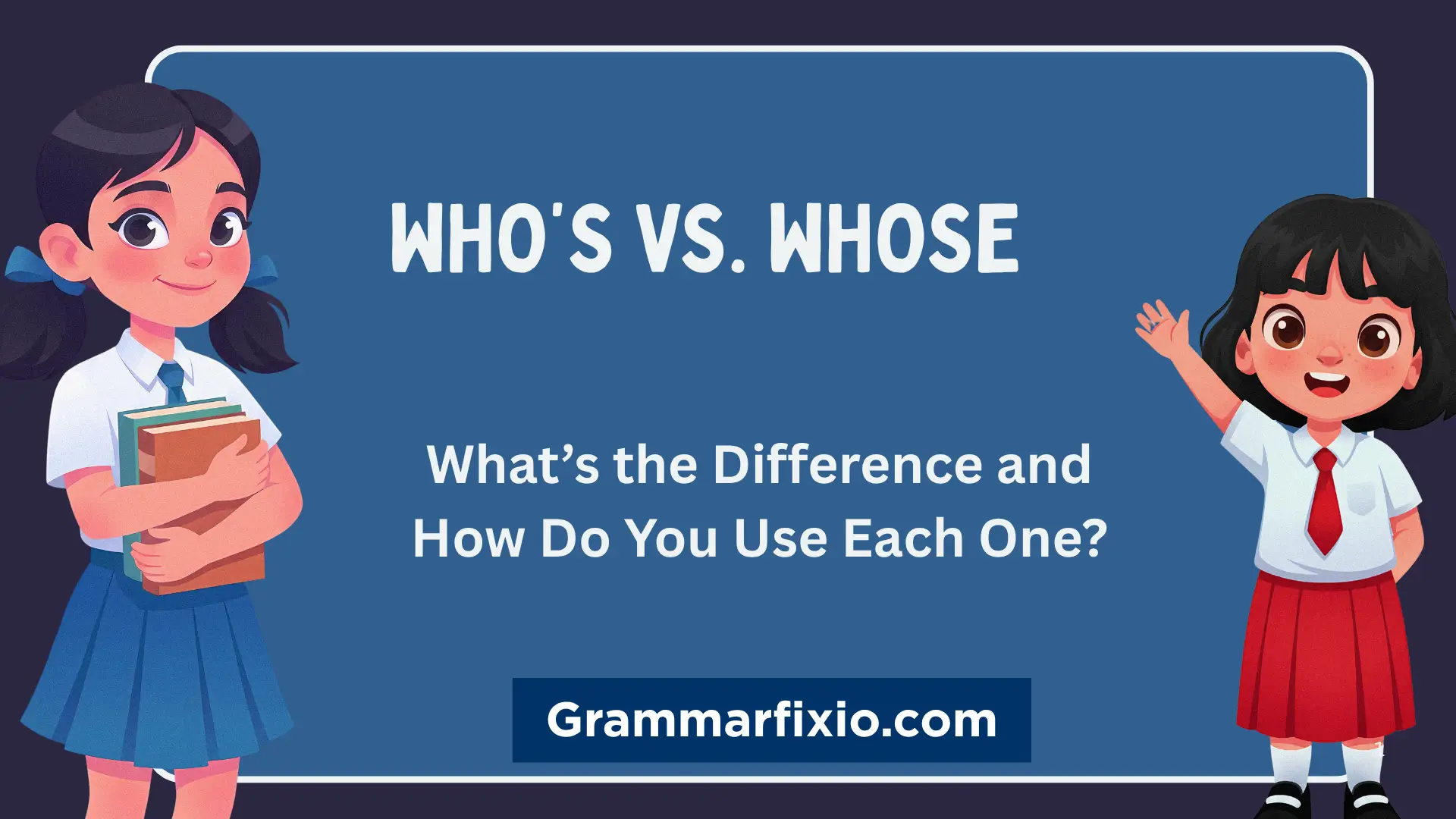
Who’s vs whose is easy to understand once you know the rule: who’s means who is or who has, while whose shows ownership or connection in a sentence.
Use the replacement test whenever you feel unsure. Replace who’s with who is or who has. If the sentence still makes sense, the contraction is correct. For example, “Who’s calling?” becomes “Who is calling?” However, “Who’s phone is this?” fails the test, so write “Whose phone is this?”
These words are homophones, which means they have the same pronunciation but different spellings and meanings. Don’t choose by sound. Instead, check the sentence structure and ask whether the idea shows possession. This simple habit helps students, writers, bloggers, and English learners avoid common grammar mistakes in schoolwork, emails, texts, and professional writing. It also makes your meaning clearer and improves your confidence when choosing the correct word.
Quick Answer: Who’s or Whose?
Use who’s when you mean who is or who has.
- Who’s at the door?
- Who’s finished the assignment?
Use whose when you ask about ownership or describe something connected to a person, animal, group, or thing.
- Whose jacket is this?
- The student whose project won received an award.
Here is the main rule:
Who’s = who is or who has. Whose = belonging to whom.
Read this also: Altar vs Alter: Meaning, Differences, Examples, and How to Use Each Word Correctly
Who’s vs. Whose Comparison Table
| Feature | Who’s | Whose |
| Meaning | Who is or who has | Belonging to whom |
| Grammar role | Contraction | Possessive determiner or pronoun |
| Uses an apostrophe | Yes | No |
| Shows possession | No | Yes |
| Common question | Who’s coming? | Whose car is this? |
| Expanded form | Who is coming? | Cannot be expanded |
| Pronunciation | /hooz/ | /hooz/ |
Because the pronunciation is the same, you cannot choose the correct spelling by listening. Instead, you must look at the sentence’s meaning.
What Does “Who’s” Mean?
Who’s is a contraction. A contraction combines two words and replaces missing letters with an apostrophe.
The word who’s can mean:
- who is
- who has
It does not show ownership.
“Who’s” as a Contraction of “Who Is”
In most sentences, who’s means who is.
- Who’s coming to dinner?
- Who’s your new manager?
- Do you know who’s responsible for the report?
- She’s the student who’s presenting first.
You can test each sentence by expanding the contraction.
- Who is coming to dinner?
- Who is your new manager?
- Do you know who is responsible for the report?
Each sentence remains correct. Therefore, who’s is the right choice.
“Who’s” in Direct Questions
A direct question asks something clearly and usually ends with a question mark.
- Who’s at the front desk?
- Who’s using the conference room?
- Who’s your favorite teacher?
- Who’s ready to leave?
In these examples, who’s means who is.
“Who’s” in Indirect Questions
An indirect question appears inside a statement or another question. It does not always use the same word order as a direct question.
- I wonder who’s attending the meeting.
- Do you know who’s in charge?
- Please tell me who’s available tomorrow.
- We need to find out who’s using this account.
These sentences sound natural in both spoken and written American English.
“Who’s” in Relative Clauses
A relative clause gives more information about a person or group.
- The employee who’s sitting near the window can help you.
- She’s the designer who’s leading the project.
- Anyone who’s interested should sign up today.
- The customer who’s waiting outside has an appointment.
Here, who’s still means who is.
For example:
- The employee who is sitting near the window can help you.
The expanded sentence works, so the contraction is correct.
“Who’s” as a Contraction of “Who Has”
The word who’s can also mean who has, but only in certain sentence structures.
Usually, has must act as a helping verb. It helps form a perfect tense.
- Who’s finished the project?
- Who’s already eaten?
- Do you know who’s been calling me?
- She’s the only person who’s completed the training.
You can expand these examples:
- Who has finished the project?
- Who has already eaten?
- Do you know who has been calling me?
Because the longer versions make sense, who’s is correct.
When “Who’s” Cannot Mean “Who Has”
You generally cannot shorten who has to who’s when has expresses ownership by itself.
Incorrect:
- Who’s a blue car?
- Who’s the meeting notes?
- Who’s enough money for lunch?
Correct:
- Who has a blue car?
- Who has the meeting notes?
- Who has enough money for lunch?
In those sentences, has is the main verb. It means “owns,” “possesses,” or “holds.” Therefore, the contraction usually sounds incorrect.
However, everyday American English sometimes uses who’s got:
- Who’s got my keys?
- Who’s got time to help?
Here, who’s got means who has got, which is an accepted informal construction. Still, Who has my keys? is clearer and more formal.
What Does “Whose” Mean?
Whose is a possessive word. It asks about ownership or shows a relationship between someone and something.
You can often understand it as:
- belonging to whom
- connected to whom
- associated with whom
Examples:
- Whose bag is this?
- Whose name is on the form?
- I don’t know whose idea it was.
- The student whose laptop was stolen reported it.
Unlike who’s, whose never expands to who is or who has.
“Whose” as a Possessive Determiner
A possessive determiner comes before a noun and shows ownership or connection.
In these examples, whose comes directly before a noun:
- Whose phone is ringing?
- Whose car is parked outside?
- Whose turn is next?
- Whose responsibility is this?
- Whose email did you receive?
The nouns are phone, car, turn, responsibility, and email. The word whose asks who each one belongs to or relates to.
Ownership Is Not Always Physical
Possession does not always mean owning an object. Whose can also show responsibility, relationships, authorship, or association.
- Whose decision was it?
- Whose job is it to close the store?
- Whose opinion matters most?
- Whose team won the game?
- Whose account posted the message?
A person may not physically own a decision, job, opinion, team, or account. However, the noun is still connected to that person.
“Whose” as a Possessive Pronoun
Sometimes, whose stands alone because the noun is already understood.
- Whose is this?
- I know this coat isn’t mine, but I don’t know whose it is.
- These keys were on the table. Whose are they?
- One phone is mine. Whose is the other one?
In these sentences, you do not need to repeat the noun.
For example:
- Whose phone is this?
- Whose is this?
The second sentence leaves out phone, but the listener understands it from the context.
Using “Whose” in Questions
Whose often appears at the beginning of a direct question.
- Whose notebook is this?
- Whose children are playing outside?
- Whose signature do we need?
- Whose turn is it to pay?
It can also appear in an indirect question.
- Do you know whose notebook this is?
- I’m trying to find out whose children are outside.
- Please check whose signature appears on the form.
- We need to decide whose turn it is.
Notice the word order in indirect questions.
Direct:
- Whose laptop is this?
Indirect:
- Do you know whose laptop this is?
The indirect version does not say whose laptop is this after the opening phrase. Instead, it uses normal statement order: whose laptop this is.
See this also: All Ready vs. Already: What’s the Difference and When Should You Use Each One?
Using “Whose” in Relative Clauses
Whose can introduce a relative clause that describes a person, animal, organization, or thing.
- The teacher whose class I took retired last year.
- The woman whose wallet was missing called the police.
- We hired a designer whose work impressed the team.
- The company whose products we tested issued a recall.
In each sentence, whose connects a noun to something associated with it.
For example:
- The teacher’s class
- The woman’s wallet
- The designer’s work
- The company’s products
Instead of repeating the noun and using an apostrophe, the relative clause uses whose.
Can “Whose” Refer to Things?
Yes. Whose can refer to people, animals, companies, objects, places, and ideas.
Some readers believe whose should refer only to people. However, standard English also allows it for nonhuman nouns.
- We visited a house whose roof had been damaged.
- She reviewed a book whose ending surprised her.
- The company whose website crashed apologized.
- They adopted a dog whose collar had no tag.
- We studied a theory whose influence remains strong.
A more formal alternative sometimes uses of which:
- We visited a house, the roof of which had been damaged.
Although this sentence is grammatical, it sounds stiff. In most modern American writing, whose roof is clearer and more natural.
The Fastest Way to Choose Between Who’s and Whose
The best method is the replacement test.
Replace the word with:
- who is
- who has
If one of those choices fits, use who’s.
If neither fits, and the sentence involves ownership or connection, use whose.
Replacement Test Examples
Who’s joining us for lunch?
Replace it:
- Who is joining us for lunch?
The sentence works. Therefore, use who’s.
Whose lunch is in the refrigerator?
Replace it:
- Who is lunch is in the refrigerator?
- Who has lunch is in the refrigerator?
Neither version works. The sentence asks who owns the lunch, so use whose.
Who’s completed the safety course?
Replace it:
- Who has completed the safety course?
The sentence works. Therefore, who’s is correct.
Whose office is on the second floor?
Replace it:
- Who is office is on the second floor?
That sentence is incorrect. The original question asks who the office belongs to, so use whose.
A Second Memory Trick: Look for Ownership
Ask this question:
Does the sentence mean “belonging to whom”?
If the answer is yes, use whose.
- Whose coat is this?
- The coat belongs to whom?
- Whose idea did we choose?
- The idea came from whom?
- Whose turn is next?
- The turn belongs to whom?
This test is especially useful when the word appears before a noun.
Why “Whose” Does Not Have an Apostrophe
Many people assume who’s should show possession because possessive nouns often use apostrophes.
For example:
- Maria’s laptop
- the teacher’s desk
- the company’s policy
However, possessive pronouns usually do not use apostrophes.
- his
- hers
- ours
- yours
- theirs
- its
- whose
Therefore, whose follows the same pattern.
Compare these common pairs:
| Contraction | Meaning | Possessive form |
| who’s | who is or who has | whose |
| it’s | it is or it has | its |
| you’re | you are | your |
| they’re | they are | their |
| we’re | we are | our |
An apostrophe does not always show possession. In contractions, it marks missing letters.
Common Who’s vs. Whose Mistakes
Using “Who’s” Before a Possessed Noun
Incorrect:
- Who’s phone is on the desk?
Correct:
- Whose phone is on the desk?
The sentence asks who owns the phone. Therefore, it needs whose.
Using “Whose” Instead of “Who Is”
Incorrect:
- Whose coming to the party?
Correct:
- Who’s coming to the party?
The correct sentence means Who is coming to the party?
Assuming Every Apostrophe Shows Ownership
Incorrect:
- The employee who’s desk is near mine is absent.
Correct:
- The employee whose desk is near mine is absent.
The desk is connected to the employee. Therefore, the possessive word whose is required.
Using “Who’s” for the Main Verb “Has”
Incorrect:
- Who’s a copy of the schedule?
Correct:
- Who has a copy of the schedule?
In this sentence, has means “possesses.” It is the main verb, so it normally should not be contracted.
Adding an Apostrophe to “Whose”
Incorrect:
- Who’se turn is next?
Correct:
- Whose turn is next?
Who’se is not a standard English word.
Choosing by Sound
Incorrect thinking:
- “I heard /hooz/, so I wrote who’s.”
Better approach:
- Check whether the word means who is, who has, or belonging to whom.
Because both words sound alike, meaning must guide the spelling.
Who’s and Whose in Real-Life American English
At School
- Who’s presenting first today?
- Whose textbook is under the desk?
- Do you know who’s absent?
- The student whose essay won received extra credit.
In school writing, these forms often appear in questions, classroom discussions, and descriptive sentences.
At Work
- Who’s leading the meeting?
- Whose approval do we need?
- Please confirm who’s completed the report.
- The manager whose office is upstairs will call you.
In professional communication, both words are common. However, formal documents may avoid contractions.
More formal:
- Who is responsible for this account?
Less formal but still correct:
- Who’s responsible for this account?
At Home
- Who’s cooking dinner tonight?
- Whose shoes are by the door?
- Do you know who’s using the shower?
- I found a charger, but I don’t know whose it is.
These examples show how naturally both words appear in everyday conversation.
In Text Messages
- Who’s free later?
- Whose place are we meeting at?
- Who’s bringing snacks?
- Does anyone know whose number this is?
Contractions are especially common in texts because they sound natural and save space.
On Social Media
- Who’s watching the game tonight?
- Whose post was shared the most?
- Does anyone know who’s running this account?
- The creator whose video went viral gained thousands of followers.
Even in casual writing, spelling matters because the wrong form can change the meaning.
Mini Case Study: A Workplace Email Error
Consider this sentence:
Please let me know who’s approval is needed before we publish the report.
The writer used who’s, but that means who is or who has.
Now apply the replacement test:
- Please let me know who is approval is needed.
- Please let me know who has approval is needed.
Neither version makes sense.
The corrected sentence is:
Please let me know whose approval is needed before we publish the report.
The sentence asks which person’s approval is required. Therefore, whose is correct.
This type of mistake may seem minor. However, it can make a professional email look careless.
Who’s, Whose, Who, and Whom
These four forms are related, but they serve different purposes.
| Word | Main function | Example |
| Who | Subject | Who called you? |
| Whom | Object | Whom did you contact? |
| Whose | Possession | Whose phone rang? |
| Who’s | Contraction | Who’s calling? |
Who
Use who when the person performs the action.
- Who sent the email?
- Who wants coffee?
- I know who called.
Whom
Use whom when the person receives the action. It sounds formal and is less common in casual speech.
- Whom did you invite?
- To whom should I address the letter?
- The person whom we selected accepted the offer.
In casual American English, many speakers use who instead of whom.
Whose
Use whose for possession or association.
- Whose email was deleted?
- The employee whose report we reviewed is on vacation.
Who’s
Use who’s only when it can expand to who is or who has.
- Who’s writing the reply?
- Who’s already responded?
Pronunciation of Who’s and Whose
Who’s and whose are homophones. Homophones are words that sound the same but differ in meaning or spelling.
Both are usually pronounced:
- /hooz/
Because they sound identical, spoken English does not reveal which spelling you need. Context provides the answer.
Compare:
- Who’s at the door?
- Whose bag is by the door?
The pronunciation is the same, but the grammar is different.
Formal, Informal, and Academic Usage
Whose works in formal, informal, academic, and professional writing.
- The researcher whose study was published received an award.
- Whose data supports this claim?
- We contacted the company whose software we use.
Who’s is also grammatically correct. However, contractions may sound more conversational.
Informal:
- Who’s responsible for this section?
Formal:
- Who is responsible for this section?
Academic style guides sometimes discourage contractions. Therefore, writers may prefer who is or who has in research papers, legal documents, and highly formal reports.
Still, the issue is tone, not grammar. Who’s is correct when the expanded form fits.
Useful Grammar Tips
Expand the Contraction Before You Write
Silently replace who’s with who is or who has.
If the expanded sentence sounds wrong, do not use who’s.
Look at the Next Word
The next word often gives you a clue.
Whose + noun often shows possession:
- whose car
- whose idea
- whose office
- whose responsibility
Who’s + verb or description often means who is:
- who’s coming
- who’s ready
- who’s responsible
- who’s available
However, this is only a clue. The replacement test is more reliable.
Do Not Treat Apostrophes as Automatic Possession Marks
An apostrophe may show possession in nouns, but it also marks missing letters in contractions.
- teacher’s desk shows possession.
- who’s coming is a contraction.
The apostrophe in who’s does not show ownership.
Read the Full Sentence
Do not choose based on one or two words. Meaning may become clear only after you read the entire sentence.
- I need to know who’s responsible.
- I need to know whose responsibility it is.
Both sentences are correct, but the grammar structure differs.
Synonyms and Related Words
Who’s does not have a true synonym because it is a shortened form. Its full forms are:
- who is
- who has
Depending on context, whose may relate to phrases such as:
- belonging to whom
- owned by whom
- associated with whom
- connected to whom
- created by whom
- managed by whom
However, these are explanations rather than direct replacements.
Related Possessive Words
- my
- your
- his
- her
- its
- our
- their
- mine
- yours
- hers
- ours
- theirs
Similar Confusing Word Pairs
The same apostrophe problem appears in several common pairs:
- its vs. it’s
- your vs. you’re
- their vs. they’re
- there vs. their
- were vs. we’re
- lets vs. let’s
The best strategy remains the same: expand the contraction and check the sentence’s meaning.
Practice: Choose “Who’s” or “Whose”
Fill in each blank with who’s or whose.
- ______ responsible for locking the office?
- ______ backpack is on the floor?
- Do you know ______ already completed the form?
- The writer ______ article won the award thanked her editor.
- ______ been using my computer?
- I can’t remember ______ turn comes next.
- ______ available for a meeting this afternoon?
- The house ______ windows face the lake is for sale.
- Can you tell me ______ keys these are?
- She’s the employee ______ been promoted.
Answer Key With Explanations
1. Who’s responsible for locking the office?
Who’s means who is.
2. Whose backpack is on the floor?
The question asks who owns the backpack.
3. Do you know who’s already completed the form?
Who’s means who has.
4. The writer whose article won the award thanked her editor.
The article belongs to or was written by the writer.
5. Who’s been using my computer?
Who’s means who has.
6. I can’t remember whose turn comes next.
The turn is associated with a person.
7. Who’s available for a meeting this afternoon?
Who’s means who is.
8. The house whose windows face the lake is for sale.
The windows are part of the house.
9. Can you tell me whose keys these are?
The question asks who owns the keys.
10. She’s the employee who’s been promoted.
Who’s means who has.
Read this also: Axel vs Axle: Meaning, Difference, Examples, and Correct Usage
Frequently Asked Questions
Who’s means who is or who has. Whose asks who owns something or shows a connection.
No. Who’s is only a contraction. Use whose to show possession.
The correct phrase is whose phone because the sentence asks who owns the phone.
Yes. For example, “Who’s finished the work?” means “Who has finished the work?”
Replace who’s with who is or who has. If the sentence does not make sense, use whose.
Conclusion
The difference between who’s vs whose becomes simple when you check the meaning. Who’s is a contraction of who is or who has, while whose shows ownership or connection. When you feel unsure, replace who’s with who is or who has. If the sentence still makes sense, the contraction is correct. Otherwise, use whose. This quick test can help you avoid common grammar mistakes in schoolwork, emails, texts, and professional writing.