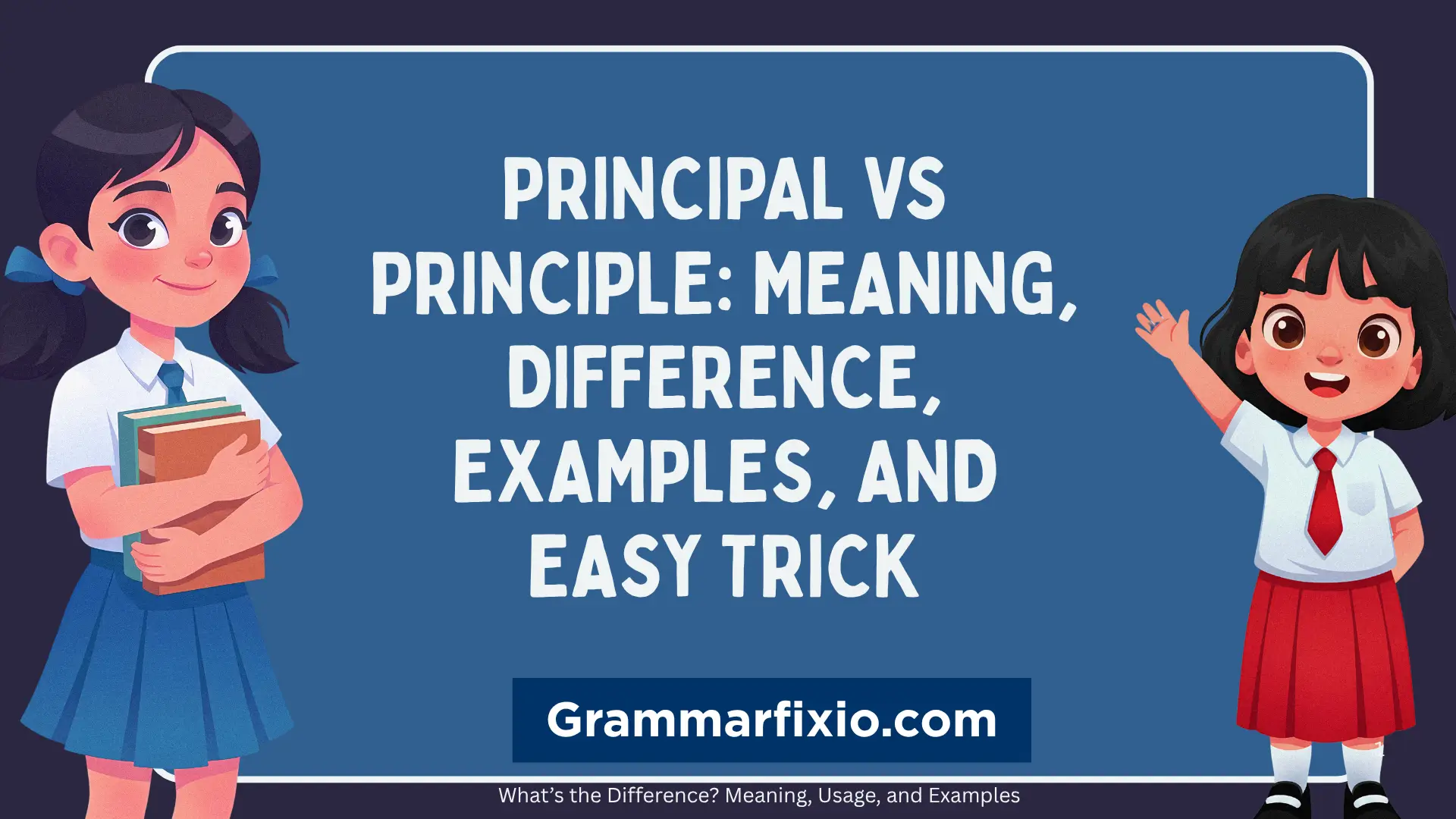
Many people get confused between principal vs principle because the two words sound almost the same.
But they have very different meanings.
The easiest way to remember the difference is this:
Principal usually means a person in charge or something that is most important.
Principle means a rule, belief, or basic idea.
For example:
The school principal spoke to the students.
Honesty is an important principle.
In the first sentence, principal means the head of a school. In the second sentence, principle means a belief or rule.
This guide explains the difference between principal and principle, shows simple examples, and gives you an easy trick to remember which word to use.
Also read this: Segway vs Segue: Meaning, Difference, Examples, and Correct Usage
Principal vs Principle: Quick Answer
The main difference between principal and principle is their meaning.
Use principal when talking about:
- the head of a school
- a person in charge
- the most important person or thing
- the original amount of money in a loan or investment
Use principle when talking about:
- a rule
- a belief
- a moral value
- a basic idea or law
Here is a quick comparison:
| Word | Meaning | Example |
|---|---|---|
| Principal | Person in charge or most important | The principal called a meeting. |
| Principle | Rule, belief, or idea | Respect is an important principle. |
What Does Principal Mean?
Principal can be a noun or an adjective.
As a noun, it often means a person who is in charge.
For example:
The school principal welcomed the new students.
Here, principal means the head of the school.
As an adjective, principal means main or most important.
For example:
Our principal goal is to improve customer service.
Here, principal means the most important goal.
The word is also used in finance.
For example:
She paid part of the principal on her loan.
In this sentence, principal means the original amount of money borrowed.
What Does Principle Mean?
Principle is a noun.
It means a rule, belief, standard, or basic idea.
For example:
Honesty is one of his strongest principles.
This means honesty is an important belief or moral rule for him.
Another example is:
The machine works on a simple scientific principle.
Here, principle means a basic scientific rule or idea.
More examples include:
- She lives by strong moral principles.
- Freedom is an important principle of democracy.
- The principle of gravity affects all objects.
- He refused to lie because of his principles.
- This idea is based on a simple principle.
Also read this: Stationary vs Stationery: Meaning, Difference, Examples, and Easy Trick
Principal as a School Leader
One of the most common uses of principal is for the head of a school.
For example:
The principal talked to the teachers.
Our principal announced the new school rules.
The student was called to the principal’s office.
In all these examples, principal refers to a person.
A useful way to remember this is:
The principal is your “pal.”
The word principal ends with pal.
A principal can be a person, and a pal is also a person.
This simple memory trick helps many learners.
Principle as a Rule or Belief
Use principle when you are talking about a rule, belief, or standard.
For example:
He believes in the principle of fairness.
She never breaks her moral principles.
The company follows strict business principles.
In these examples, principle does not refer to a person.
It refers to an idea, value, or rule.
Principal vs Principle Examples
Here are some simple examples to make the difference clearer.
Examples with Principal
The principal visited our classroom.
Here, principal means the head of the school.
The principal reason for the delay was bad weather.
Here, principal means the main reason.
He repaid the principal amount of the loan.
Here, principal means the original amount of money.
She is one of the principal members of the team.
Here, principal means one of the most important members.
Examples with Principle
Kindness is an important principle.
Here, principle means a moral value.
The project is based on a simple principle.
Here, principle means a basic idea.
He refused the offer on principle.
This means he refused because of his beliefs.
Good leaders follow strong principles.
Here, principles means rules or values.
Principal or Principle: How to Choose
When you are unsure which word to use, ask yourself one question:
Am I talking about a person, something important, or a rule?
If you mean a person in charge or something that is main or important, use principal.
If you mean a belief, rule, value, or idea, use principle.
For example:
The principal of the school is very kind.
This is a person, so use principal.
Kindness is an important principle.
This is a value, so use principle.
The Easy “Principal Is Your Pal” Trick
One of the most popular ways to remember principal vs principle is this:
Principal = pal
The word principal contains the word pal at the end.
A principal is often a person, such as a school principal.
So you can remember:
Your principal can be your pal.
For principle, think of a rule or belief.
For example:
A principle is a rule you follow.
This is an easy way to separate the two words.
Principal Meaning in Finance
The word principal is also common in banking, loans, and investments.
In finance, principal means the original amount of money borrowed or invested.
For example:
She borrowed $10,000 as the principal amount.
If interest is added later, the original $10,000 is still the principal.
Another example:
Your monthly payment includes both principal and interest.
Here, principal means the original loan amount, while interest is the extra money charged by the lender.
Principal Meaning as “Main”
Principal can also mean the most important thing.
For example:
The principal cause of the problem was poor planning.
This means poor planning was the main cause.
Another example:
Our principal concern is safety.
This means safety is the most important concern.
More examples:
- The principal reason for leaving was stress.
- She is the principal designer of the project.
- Their principal office is in London.
- Education is one of their principal priorities.
Principle Meaning in Morals and Values
When talking about personal beliefs or moral standards, use principle.
For example:
He is a man of strong principles.
This means he has strong moral beliefs.
Another example:
She would never cheat because it goes against her principles.
Here, principles means the values she believes in.
The phrase “on principle” is also common.
For example:
He refused to accept the gift on principle.
This means he refused because of his personal beliefs or rules.
Principle Meaning in Science
Principle is also used in science and education.
It can mean a basic law or idea.
For example:
The principle of gravity explains why objects fall.
Another example:
This machine works on a basic scientific principle.
In this use, principle means a fundamental rule or concept.
Common Mistakes with Principal and Principle
A common mistake is writing:
The school principle spoke to the students.
This is incorrect.
The correct sentence is:
The school principal spoke to the students.
A school leader is a principal.
Another common mistake is:
Honesty is a good principal.
This is also incorrect.
The correct sentence is:
Honesty is a good principle.
Honesty is a belief or value, so principle is correct.
Principal vs Principle in a Sentence
Compare these sentences:
The principal explained the school’s principles.
This sentence uses both words correctly.
Principal means the head of the school.
Principles means the school’s rules or values.
Another example:
The principal reason for his decision was based on a moral principle.
Here, principal means main, while principle means a moral belief.
Principal vs Principle: Easy Summary
You can remember the difference with these simple rules:
Principal = person, main, or money
Principle = rule, belief, or idea
Think:
Principal = pal
A principal can be a person.
And:
Principle = rule
A principle is something you believe in or follow.
Principal vs Principle FAQs
Principal means a person in charge, something that is most important, or the original amount of money in a loan.
Principle means a rule, belief, value, or basic idea.
The correct word is principal.
Example:
The school principal welcomed the students.
Honesty is a principle because it is a moral value or belief.
In finance, principal means the original amount of money borrowed or invested.
On principle means doing or refusing something because of your beliefs or values.
Example:
She refused to lie on principle.
Yes. Principal can be an adjective meaning main or most important.
Example:
The principal reason was cost.
No. Principle refers to a rule, belief, law, or idea. It does not normally refer to a person.
Final Thoughts
The difference between principal vs principle becomes easy once you remember their meanings.
Use principal for a person in charge, something important, or the original amount of money.
Use principle for a rule, belief, value, or basic idea.
The easiest memory trick is:
Principal = pal
Principle = rule
For example:
The principal explained an important principle.
Once you remember this simple rule, you can use principal and principle correctly in both speaking and writing.