Introduction
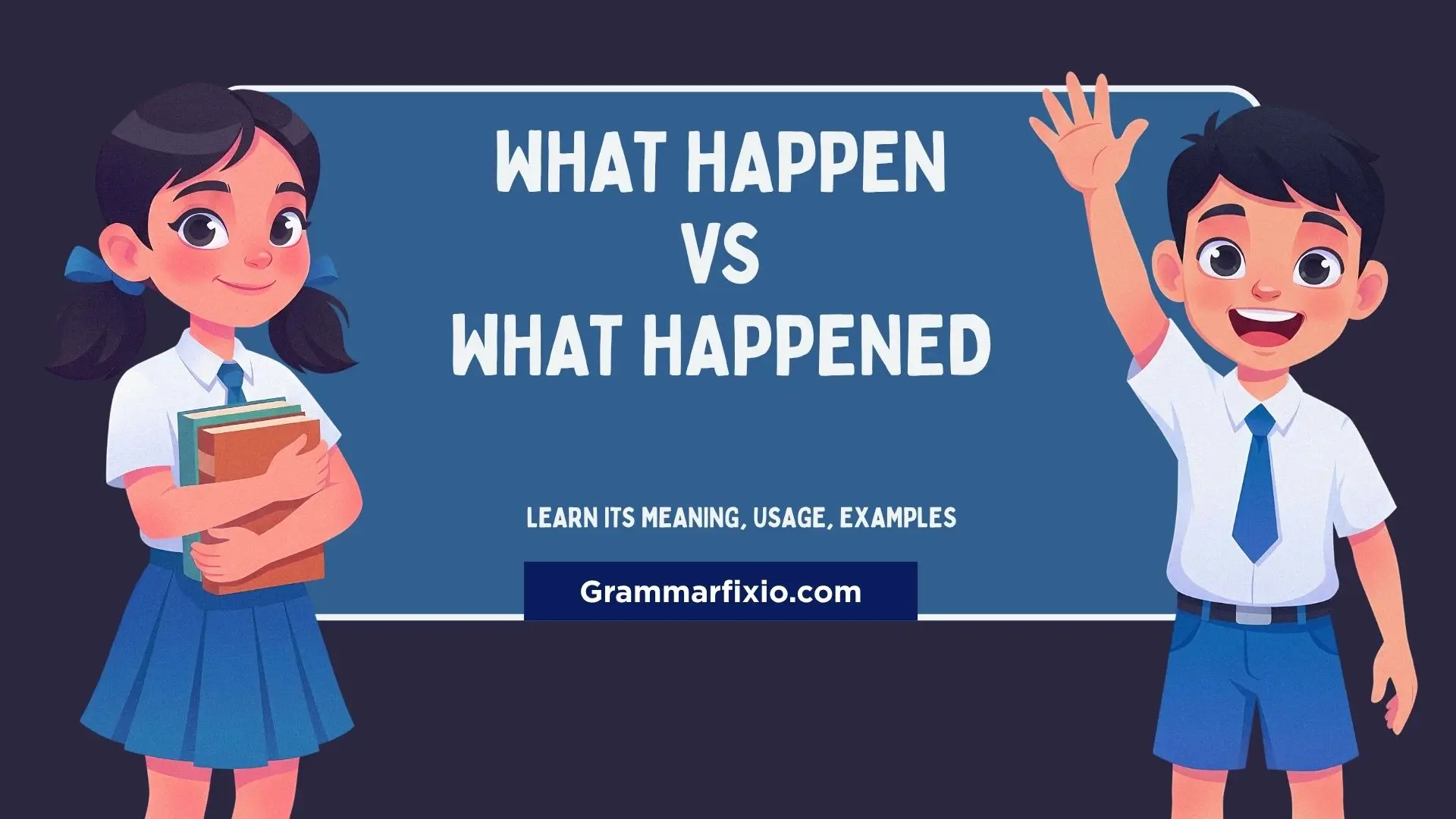
Many English learners get confused between “what happen” and “what happened.” The two phrases look similar, but only one is correct in most situations.
You may hear someone say “what happen?” in casual conversation, online comments, movies, or social media. Because of that, it can feel like a normal English phrase. However, in standard English grammar, “what happened?” is the correct form when asking about a past event.
This mistake usually happens because learners know the base verb “happen,” but they are unsure how to use it in questions. English verbs change depending on time. If something happened in the past, the verb must show the past tense. That is why we say “What happened?” instead of “What happen?”
Understanding this difference is important because it helps your English sound more natural, correct, and confident. Whether you are writing an email, speaking in class, chatting with friends, or preparing for an English test, using the right form matters.
In this guide, you will learn the difference between what happen vs what happened, why “what happened” is correct, when “happen” can be used correctly, and how to avoid common grammar mistakes. You will also see real-life examples, comparison tables, and simple rules that make the topic easy to remember.
What Does “What Happened” Mean?
“What happened?” means you are asking about something that already took place.
It is used when you want to know about a past event, accident, problem, situation, or change.
Examples
- “What happened yesterday?”
- “What happened to your phone?”
- “What happened at school?”
- “What happened after the meeting?”
- “I heard a loud noise. What happened?”
In all these sentences, the speaker is asking about something that happened before the present moment.
Real-Life Example
Imagine your friend comes to class with a bandage on their hand. You may ask:
“What happened to your hand?”
This means:
“Why is your hand injured?”
or
“What caused this?”
Is “What Happen” Correct?
Usually, no.
“What happen?” is not correct as a complete sentence in standard English.
The problem is the verb form. If you are asking about the past, you need the past tense form “happened.”
Incorrect:
- “What happen yesterday?”
- “What happen to your car?”
- “What happen after class?”
- “What happen at the party?”
Correct:
- “What happened yesterday?”
- “What happened to your car?”
- “What happened after class?”
- “What happened at the party?”
The correct phrase is “what happened” because the speaker is asking about a past event.
Why Is “What Happened” Correct?
To understand this clearly, look at the verb “happen.”
Happen is the base form.
Happened is the past tense form.
Happens is the present simple form used with singular subjects.
| Time | Correct Verb Form | Example |
|---|---|---|
| Present simple | happen / happens | “Accidents happen.” / “What happens next?” |
| Past simple | happened | “What happened yesterday?” |
| Future | will happen | “What will happen tomorrow?” |
When you ask about something in the past, you need “happened.”
That is why this sentence is correct:
“What happened last night?”
And this sentence is incorrect:
“What happen last night?”
What Happen vs What Happened: Quick Comparison
| Phrase | Correct? | Meaning | Best Use |
|---|---|---|---|
| What happen? | Usually incorrect | Nonstandard English | Casual/slang only |
| What happened? | Correct | Asking about the past | Standard English |
| What happens? | Correct | Asking about general or repeated situations | Present tense |
| What did happen? | Correct | Asking with emphasis or surprise | Special emphasis |
| What will happen? | Correct | Asking about the future | Future tense |
The safest choice is simple:
When asking about the past, use “What happened?”
See this also: Smooth vs Smoothe
Difference Between “Happen,” “Happens,” and “Happened”
Many learners confuse these three forms. Here is the simple difference.
Happen
“Happen” is the base verb. It is used with plural subjects, after modal verbs, and after auxiliary verbs like did, will, can, should, may, and might.
Examples
- “Accidents happen.”
- “Things happen for a reason.”
- “What can happen if I ignore this?”
- “What will happen next?”
- “What did happen there?”
Happens
“Happens” is used in the present simple tense with singular subjects.
Examples
- “What happens next?”
- “What happens if I press this button?”
- “This happens every time.”
- “A mistake happens when people rush.”
Happened
“Happened” is used for the past.
Examples
- “What happened yesterday?”
- “Something strange happened.”
- “The accident happened last night.”
- “What happened to your laptop?”
When Should You Use “What Happened?”
Use “what happened” when you are asking about a completed event in the past.
Use It For Past Events
- “What happened at the office?”
- “What happened during the match?”
- “What happened in the meeting?”
Use It For Problems
- “What happened to your phone?”
- “What happened to your car?”
- “What happened to the website?”
Use It For Accidents
- “What happened on the road?”
- “What happened to your leg?”
- “What happened after the crash?”
Use It For Sudden Changes
- “What happened to your plans?”
- “What happened to the project?”
- “What happened to your old job?”
In all these examples, the event is already finished, so “happened” is the correct verb.
When Can “Happen” Be Correct?
The word “happen” is correct in many sentences, but not usually in the phrase “what happen?”
You can use “happen” after helping verbs.
Correct Examples
- “What did happen?”
- “What will happen?”
- “What can happen?”
- “What could happen?”
- “What should happen?”
- “What might happen?”
This happens because English uses the base verb after helping verbs like did, will, can, could, should, and might.
Important Rule
After did, use the base verb.
Correct:
“What did happen?”
Incorrect:
“What did happened?”
Correct:
“Did it happen?”
Incorrect:
“Did it happened?”
What Did Happen vs What Happened
Both “what happened” and “what did happen” can be correct, but they are used differently.
What Happened?
This is the normal question.
Examples:
- “What happened at school?”
- “What happened to your bike?”
- “What happened after dinner?”
What Did Happen?
This is used for emphasis, surprise, doubt, or correction.
Examples:
- “Wait, what did happen there?”
- “If he didn’t quit, then what did happen?”
- “Nobody explained it clearly. So what did happen?”
Simple Difference
| Phrase | Use | Example |
|---|---|---|
| What happened? | Normal question | “What happened yesterday?” |
| What did happen? | Emphasis or surprise | “Then what did happen?” |
Most of the time, use “what happened?”
Use “what did happen?” only when you want to add emphasis.
What Happens vs What Happened
This is another common confusion.
“What happens” is present tense.
“What happened” is past tense.
| Phrase | Tense | Example |
|---|---|---|
| What happens? | Present / general | “What happens if I fail the test?” |
| What happened? | Past | “What happened after the test?” |
More Examples
Present:
- “What happens when water boils?”
- “What happens if you miss the deadline?”
- “What happens next in the story?”
Past:
- “What happened when water boiled?”
- “What happened after you missed the deadline?”
- “What happened at the end of the story?”
Use “what happens” for general results, repeated actions, or future-like possibilities.
Use “what happened” for completed past events.
Common Mistakes English Learners Make
Here are the most common mistakes with what happen vs what happened.
| Incorrect | Correct |
|---|---|
| What happen yesterday? | What happened yesterday? |
| What happen to you? | What happened to you? |
| What happen after class? | What happened after class? |
| What did happened? | What did happen? |
| What will happened? | What will happen? |
| What can happened? | What can happen? |
Simple Trick
Look for time words.
If the sentence has past time words, use “happened.”
Past time words include:
- yesterday
- last night
- last week
- earlier
- before
- after the meeting
- two days ago
Examples
- “What happened yesterday?”
- “What happened last night?”
- “What happened two days ago?”
- “What happened after the meeting?”
Why Do People Say “What Happen” Online?
You may see or hear “what happen” online because people do not always follow grammar rules in casual communication.
This can happen in:
- texting
- memes
- social media comments
- informal speech
- song lyrics
- movie dialogue
- slang
- regional English varieties
For example, someone may write:
“What happen bro?”
This may be understood in casual conversation, but it is still not standard grammar.
For school, exams, essays, emails, blogs, and professional writing, use:
“What happened?”
See this also: Seam vs. Seem
Real-Life Examples of “What Happened”
Example 1: At School
Wrong:
“What happen in class today?”
Correct:
“What happened in class today?”
Example 2: At Work
Wrong:
“What happen in the meeting?”
Correct:
“What happened in the meeting?”
Example 3: With a Friend
Wrong:
“You look upset. What happen?”
Correct:
“You look upset. What happened?”
Example 4: After an Accident
Wrong:
“What happen to your car?”
Correct:
“What happened to your car?”
Example 5: In a Text Message
Wrong:
“I saw your missed calls. What happen?”
Correct:
“I saw your missed calls. What happened?”
Examples in Conversations
Conversation 1: Correct Use
Ali: You look worried. What happened?
Sara: I lost my phone on the way home.
Conversation 2: Asking About a Problem
John: What happened to your laptop?
Emma: It stopped working after the update.
Conversation 3: Asking About an Event
Teacher: What happened after the experiment?
Student: The liquid changed color.
Conversation 4: Future Use with “Happen”
Ayesha: What will happen if we submit the form late?
Manager: It may not be accepted.
Conversation 5: Emphasis with “Did”
Mark: He didn’t resign.
Anna: Then what did happen?
These examples show how the correct verb form changes depending on tense and sentence structure.
Grammar Rule to Remember
Here is the easiest rule:
For the Past
Use:
“What happened?”
Examples:
- “What happened yesterday?”
- “What happened to him?”
- “What happened after lunch?”
For General Situations
Use:
“What happens?”
Examples:
- “What happens if I click this?”
- “What happens when ice melts?”
- “What happens next?”
For the Future
Use:
“What will happen?”
Examples:
- “What will happen tomorrow?”
- “What will happen if we are late?”
- “What will happen next year?”
After Helping Verbs
Use the base verb “happen.”
Examples:
- “What did happen?”
- “What can happen?”
- “What should happen?”
- “What might happen?”
Never write:
- “What did happened?”
- “What can happened?”
- “What will happened?”
Is “What Happen” Acceptable in Spoken English?
In very casual speech, some people may say “what happen?” and still be understood. However, it is not the best choice if you want to speak correct standard English.
It may sound:
- informal
- nonstandard
- grammatically weak
- influenced by slang or regional speech
For better English, say:
“What happened?”
This sounds natural, correct, and clear.
Correct Sentences With “Happen”
Here are correct ways to use “happen.”
- “Accidents happen.”
- “Mistakes happen.”
- “Things happen.”
- “What can happen next?”
- “What will happen tomorrow?”
- “What did happen after that?”
- “What should happen now?”
- “What might happen if we wait?”
In these examples, “happen” is correct because it is used as a base verb or present form.
Correct Sentences With “Happened”
Here are correct ways to use “happened.”
- “What happened?”
- “What happened yesterday?”
- “Something happened at work.”
- “The accident happened last night.”
- “What happened to your phone?”
- “Nothing happened after that.”
- “A strange thing happened today.”
- “What happened during the meeting?”
In these examples, “happened” is correct because the action is in the past.
Quick Practice Test
Choose the correct sentence.
1. Which sentence is correct?
A. What happen yesterday?
B. What happened yesterday?
Correct answer: B. What happened yesterday?
2. Which sentence is correct?
A. What did happen after that?
B. What did happened after that?
Correct answer: A. What did happen after that?
3. Which sentence is correct?
A. What will happen next?
B. What will happened next?
Correct answer: A. What will happen next?
4. Which sentence is correct?
A. What happens if I click this button?
B. What happened if I click this button?
Correct answer: A. What happens if I click this button?
5. Which sentence is correct?
A. What happened to your bag?
B. What happen to your bag?
Correct answer: A. What happened to your bag?
Quick Voice Search Answers
What is correct: “what happen” or “what happened”?
“What happened?” is correct when asking about something in the past. “What happen?” is usually incorrect in standard English.
Is “what happen” grammatically correct?
By itself, “what happen?” is usually not grammatically correct. Use “what happened?” for past events.
What does “what happened” mean?
“What happened?” means you are asking what took place or what occurred in the past.
Can I say “what did happen”?
Yes. “What did happen?” is correct when you want to add emphasis, surprise, or correction.
Is “what did happened” correct?
No. “What did happened” is incorrect. After “did,” use the base verb: “happen.”
FAQs About What Happen vs What Happened
1. Which is correct: “what happen” or “what happened”?
“What happened?” is correct in standard English when asking about a past event. “What happen?” is usually incorrect.
2. Why is “what happened” correct?
It is correct because “happened” is the past tense of “happen.” When asking about the past, English uses the past tense form.
3. Is “what happen” ever correct?
Not as a normal complete sentence. However, “happen” is correct after helping verbs, such as in “What will happen?” or “What did happen?”
4. Why do people say “what happen” in texting?
People often shorten grammar in texting, social media, and casual speech. It may be understood, but it is not standard English.
5. What is the difference between “happen” and “happened”?
“Happen” is the base or present form. “Happened” is the past tense form.
6. Is “what did happen” correct?
Yes, “what did happen” is correct when used for emphasis or surprise. Example: “If he didn’t leave, then what did happen?”
7. Is “what did happened” correct?
No. After “did,” use the base verb. The correct form is “what did happen?”
8. Can I use “what happened” in formal writing?
Yes. “What happened?” is correct in both spoken and written English.
9. What is the present tense of “what happened”?
The present tense is “what happens?”
10. What is the future tense of “what happened”?
The future form is “what will happen?”
Final Thoughts
The difference between what happen vs what happened is simple once you understand tense.
Use “what happened?” when you are asking about the past. This is the correct and natural form in standard English.
Use “what happens?” when asking about general situations, repeated actions, or possible results.
Use “what will happen?” when asking about the future.
Use “what did happen?” only when you want to add emphasis, surprise, or correction.
The biggest mistake to avoid is using “what happen?” as a complete question about the past. It may appear in casual speech or online comments, but it is not correct for formal English, schoolwork, professional writing, or clear communication.
The easiest rule to remember is:
Past = What happened?
Present/general = What happens?
Future = What will happen?
After did/will/can = happen
Once you learn this pattern, you will avoid one of the most common English grammar mistakes and sound more confident in both writing and speaking.