Have you ever wondered whether to write stopped or stoped? You’re not alone. This spelling confusion often occurs when people add -ed to short verbs. Although both versions might look reasonable at first glance, only one follows standard English spelling rules.
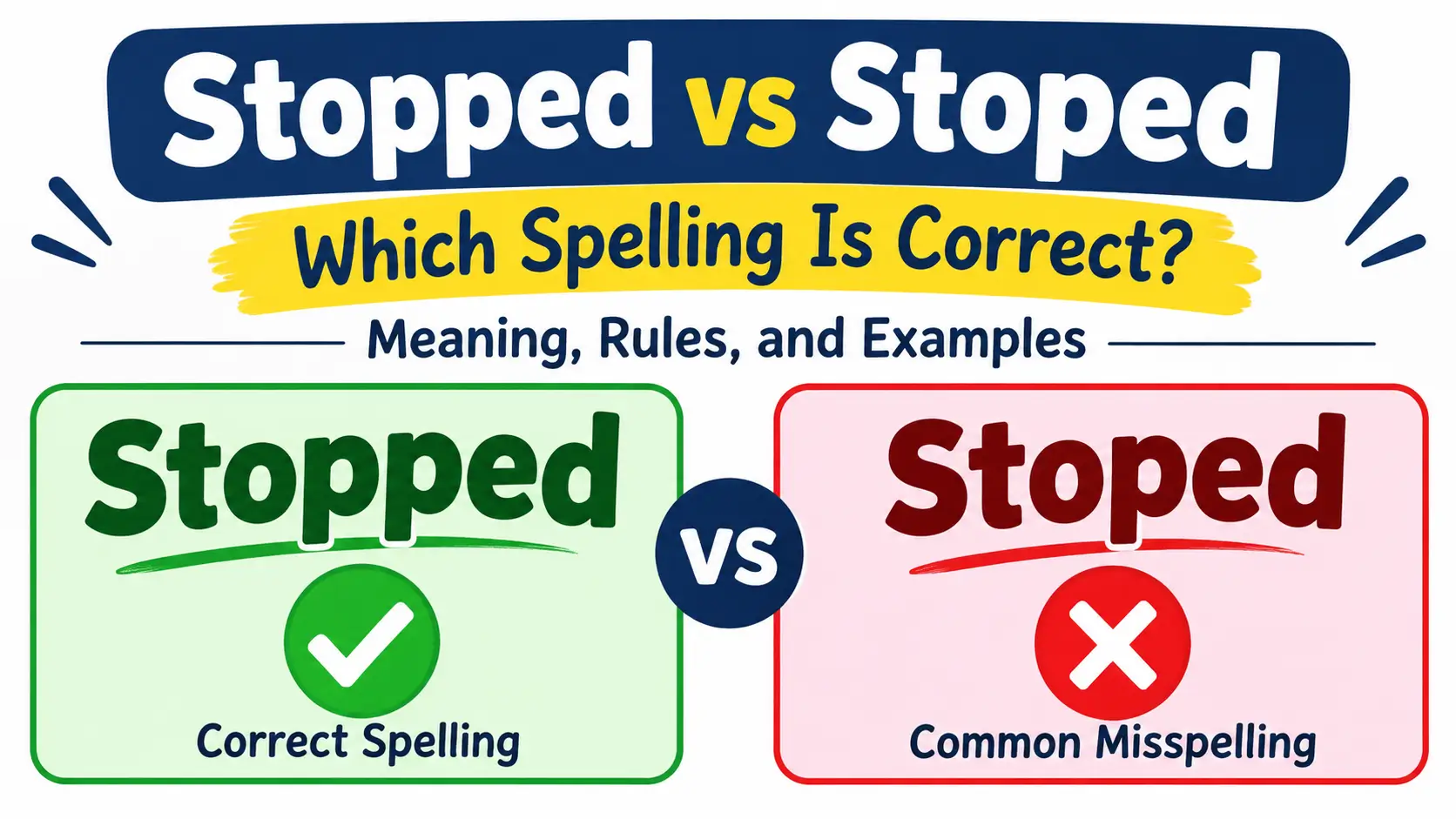
The correct spelling is stopped, with two P’s. The word stoped is a common misspelling and isn’t accepted as the standard past-tense form of stop.
But why does stop become stopped instead of stoped? The answer lies in an important English spelling convention called the consonant-doubling rule. Understanding this simple rule can also help you spell words such as stopping, planned, and hopped correctly.
Let’s explore the meaning, grammar, spelling rules, and practical examples to help you use this word confidently.
Stopped vs Stoped: Which One Is Correct?
Stopped is the correct spelling in standard English. It serves as both the simple past tense and past participle of the verb stop.
On the other hand, stoped is incorrect when you intend to describe an action that has already ended. You must double the final P before adding the -ed ending.
Consider these examples:
- Correct: The driver stopped the car near the entrance.
- Incorrect: The driver stoped the car near the entrance.
The difference comes down to one letter. However, that extra P makes the word grammatically correct.
| Spelling | Correct or incorrect? | Explanation |
| Stopped | Correct | Standard past-tense and past-participle form |
| Stoped | Incorrect | Does not follow the standard consonant-doubling rule |
Remember this simple pattern: Stop + P + ed = Stopped.
See this also: Your vs. You Are: Meaning, Grammar Rules, Differences, and 30 Easy Examples
What Does Stopped Mean?
The word stopped is the past-tense form of stop. It describes an action that has ended, a movement that has ceased, or an activity that someone has interrupted.
Depending on the sentence, it can communicate several different meanings.
Stopped as the Past Tense of Stop
When you use stopped in the simple past tense, you’re describing something that happened and finished in the past.
For example:
- Sarah stopped talking when the teacher entered.
- The rain stopped before lunchtime.
- My brother stopped playing video games yesterday.
- The bus stopped outside the shopping center.
In each sentence, the action occurred in the past. The word tells readers that someone or something no longer continued that activity.
Stopped as a Past Participle
Stopped also functions as a past participle. You commonly use it with helping verbs such as has, have, and had.
Examples include:
- The machine has stopped working.
- They have stopped discussing the issue.
- The traffic had stopped moving before the accident.
- She has stopped drinking coffee.
Notice the difference between these sentences and simple past-tense examples.
Compare:
- Simple past: He stopped working.
- Present perfect: He has stopped working.
- Past perfect: He had stopped working.
All three sentences use the same spelling. However, their grammatical structures and time references differ.
Different Meanings and Uses of Stopped
The word can describe several situations:
| Meaning | Example |
| Ending movement | The train stopped at the station. |
| Ending an activity | She stopped reading the book. |
| Preventing something | The security guard stopped the intruder. |
| Pausing temporarily | He stopped to answer his phone. |
| Ending a process | The factory stopped production. |
The surrounding words help readers understand which meaning applies.
Why Is Stopped Spelled With Two P’s?
The main reason stopped contains two P’s is the English consonant-doubling rule.
When you add a suffix beginning with a vowel to certain short words, you must double the final consonant. This rule applies to stop because it ends with a single consonant preceded by a short vowel sound.
Here’s how the spelling changes:
| Step | Word |
| Original verb | Stop |
| Double the final consonant | Stopp |
| Add the past-tense ending | Stopped |
The extra P isn’t optional. It forms part of the standard spelling.
The same principle applies when you add -ing:
Stop → Stopping
You can see the pattern in other common English words:
- Hop → Hopped
- Sit → Sitting
- Plan → Planned
- Drop → Dropped
- Run → Running
Understanding this pattern makes English spelling easier because you can apply the same rule to many different verbs.
The Consonant-Doubling Rule Explained
The consonant-doubling rule explains why certain English words need an extra consonant before a suffix.
Although the rule has a few conditions, the basic principle is straightforward.
What Is the Consonant-Vowel-Consonant (CVC) Rule?
CVC stands for consonant-vowel-consonant. It describes a common spelling pattern in which a vowel appears between two consonants.
The final three letters of stop follow this pattern:
- T = Consonant
- O = Vowel
- P = Consonant
The letter O produces a short vowel sound. Because stop is a one-syllable word ending in a single consonant after a short vowel, its final P doubles before a vowel suffix.
This gives us:
- Stop → Stopped
- Stop → Stopping
One important detail: the entire word stop isn’t strictly a three-letter CVC word because it begins with two consonants. Its final three letters follow the CVC pattern.
When Do You Double the Final Consonant?
You generally double the final consonant when these conditions apply:
- The word ends in a single consonant.
- A single vowel comes immediately before that consonant.
- The vowel has a short sound.
- You’re adding a vowel-starting suffix such as -ed, -ing, or -er.
For example:
| Base word | Added ending | Correct spelling |
| Stop | -ed | Stopped |
| Stop | -ing | Stopping |
| Hop | -ed | Hopped |
| Sit | -ing | Sitting |
| Big | -er | Bigger |
For words with multiple syllables, stress also matters. You generally double the final consonant when the final syllable receives the stress and meets the other spelling conditions.
For example:
- Admit → Admitted
- Prefer → Preferred
- Begin → Beginning
However, visit becomes visited, not visitted, because its stress falls on the first syllable.
Why Stop Becomes Stopped Instead of Stoped
The distinction becomes easier when you understand how English spelling treats short vowel sounds.
Compare these two forms:
- Stoped: Doesn’t follow the standard doubling rule.
- Stopped: Correctly doubles the final consonant before adding -ed.
The double P also appears in stopping. Learning these related forms together helps reinforce the correct spelling.
Stop, Stopped, and Stopping: Understanding the Word Forms
The verb stop changes its form depending on the sentence and grammatical tense.
Here’s a quick reference table:
| Word | Grammatical form | Example |
| Stop | Base form | Please stop shouting. |
| Stops | Third-person singular | He stops the vehicle. |
| Stopped | Simple past | She stopped running. |
| Stopped | Past participle | They have stopped working. |
| Stopping | Present participle | The driver is stopping. |
These forms serve different purposes, but they all come from the same original verb.
For example, you might say, “I stop working at five” when describing a routine. However, if you finished work yesterday, you’d say, “I stopped working at five.”
See this also: Your vs. You Are: Meaning, Grammar Rules, Differences, and 30 Easy Examples
Stopped vs Stoped: Correct and Incorrect Examples
Seeing the word in different contexts helps you understand how to use it naturally.
Correct Sentences Using Stopped
Here are examples from everyday situations:
Everyday conversations:
- I stopped at the grocery store after work.
- She stopped laughing when she heard the news.
- We stopped for lunch during the journey.
- My phone stopped working this morning.
School and educational examples:
- The students stopped writing when the bell rang.
- The teacher stopped the lesson to explain the answer.
- The children stopped talking during the examination.
Workplace examples:
- The manager stopped the meeting to address an urgent issue.
- Production stopped because of a technical problem.
- The company stopped accepting applications last Friday.
Incorrect Sentences Using Stoped
The following examples demonstrate common spelling errors:
| Incorrect sentence | Correct sentence |
| He stoped the car. | He stopped the car. |
| She stoped crying. | She stopped crying. |
| The machine stoped suddenly. | The machine stopped suddenly. |
| They stoped working. | They stopped working. |
The correction is the same in every example. Double the final P before adding -ed.
Stopped in Different Sentence Contexts
The word also appears naturally in several everyday situations.
- Travel: The train stopped because another vehicle blocked the tracks.
- Sports: The referee stopped the match after an injury.
- Technology: My computer stopped responding during the update.
- Daily activities: She stopped reading to answer the door.
These examples demonstrate how one verb can describe different actions without changing its spelling.
Stopping vs Stoping: Which Spelling Is Correct?
Another common spelling mistake involves the present participle of stop.
The correct spelling is stopping, with two P’s. The spelling stoping is incorrect when you mean the -ing form of the verb stop.
The same consonant-doubling rule applies here.
| Incorrect | Correct |
| Stoping | Stopping |
| Stoped | Stopped |
Examples:
- Correct: The bus is stopping near the school.
- Incorrect: The bus is stoping near the school.
- Correct: He is stopping the machine.
- Incorrect: He is stoping the machine.
Remember that stopped describes a completed action, while stopping describes an ongoing action or can function as a gerund.
Other Words That Follow the Same Doubling Rule
English contains many words that follow the same spelling pattern as stop. Learning these examples helps you recognize when to double a final consonant.
One-Syllable Words That Double Their Final Consonant
| Base word | Past tense | -ing form |
| Hop | Hopped | Hopping |
| Plan | Planned | Planning |
| Run | Ran | Running |
| Sit | Sat | Sitting |
| Drop | Dropped | Dropping |
| Clap | Clapped | Clapping |
| Grab | Grabbed | Grabbing |
Notice that some verbs have irregular past-tense forms. For example, run becomes ran, not runned. However, its present participle is still running.
Words That Do Not Double Their Final Consonant
Not every word needs an extra consonant before adding a suffix.
Consider these examples:
| Base word | Past tense | -ing form |
| Open | Opened | Opening |
| Help | Helped | Helping |
| Rain | Rained | Raining |
| Visit | Visited | Visiting |
| Jump | Jumped | Jumping |
| Need | Needed | Needing |
These words follow different spelling patterns because their endings or vowel sounds don’t meet the conditions for consonant doubling.
When Do You NOT Double the Final Consonant?
Knowing when not to double a letter is just as important as knowing when to double it.
Here are some common situations.
Words Ending in Two Consonants
When a word already ends in two consonants, you generally don’t double the final letter before adding a suffix.
Examples:
- Help → Helped
- Jump → Jumping
- Lift → Lifted
- Find → Finding
Adding another consonant would create an unnecessary spelling change.
Words With Long Vowel Sounds
Words containing two written vowels together generally don’t double their final consonants.
Examples:
- Rain → Rained
- Need → Needed
- Boat → Boating
- Look → Looking
The vowel pattern affects whether the final consonant needs doubling.
Two-Syllable Words Without Final Stress
Words with multiple syllables usually require consonant doubling only when the final syllable receives the main stress and meets the other conditions.
Compare:
- Admit → Admitted
- Prefer → Preferred
- Visit → Visited
- Open → Opened
The stress pattern explains why admitted doubles its final consonant while visited doesn’t.
Is Stopped Spelled the Same in American and British English?
Yes. Stopped has the same spelling in both American and British English.
You don’t need to change the number of P’s depending on your audience or location.
Some English words have different American and British spellings. For example:
| American English | British English |
| Color | Colour |
| Center | Centre |
| Traveling | Travelling |
| Canceled | Cancelled |
However, stopped remains unchanged in both varieties.
Whether you’re writing a school assignment in the United States or a professional email in the United Kingdom, always use stopped.
Common Mistakes Related to Stop and Its Word Forms
Spelling mistakes often happen when writers forget how a base verb changes before receiving a suffix.
Here are three common errors worth remembering:
| Incorrect spelling | Correct spelling |
| Stoped | Stopped |
| Stoping | Stopping |
| Stoppped | Stopped |
The last example contains three P’s instead of two. Although doubling is necessary, adding too many consonants creates another spelling error.
A useful way to avoid these mistakes is to learn related word forms together rather than memorizing each one separately.
Easy Ways to Remember How to Spell Stopped
A few simple techniques can help you remember the correct spelling without repeatedly checking a dictionary.
Remember the Double P
Connect the original verb with its past-tense form:
Stop → Stopped
Think of the additional P as part of the spelling change. This small visual reminder makes the correct form easier to recognize.
Learn the CVC Pattern
Remember that stop ends with a consonant-vowel-consonant pattern in its final three letters.
The short O sound and single final P trigger the doubling rule when you add -ed or -ing.
Remember Stopping and Stopped Together
Learning both forms reinforces the same spelling convention.
For example:
- Yesterday, the driver stopped the car.
- Today, the driver is stopping the car.
Both words contain two P’s because both endings follow the same doubling pattern.
Practice Exercise: Stopped or Stoped?
Test your understanding with these five sentences. Choose the correct spelling for each blank.
- The teacher ______ the lesson to answer a question.
- My computer has ______ working.
- The bus is ______ near the station.
- She ______ talking when the phone rang.
- The rain finally ______ after several hours.
Answers and Explanations
| Sentence | Correct answer |
| The teacher ___ the lesson. | Stopped |
| My computer has ___ working. | Stopped |
| The bus is ___ near the station. | Stopping |
| She ___ talking. | Stopped |
| The rain finally ___. | Stopped |
Every answer uses the double-P spelling. The first, second, fourth, and fifth sentences describe completed actions. The third uses the present participle to describe an ongoing action.
See also: Good vs. Well: Differences, Grammar Rules, and 40 Easy Examples
Frequently Asked Questions About Stopped vs Stoped
Stopped is correct. It is the standard past-tense and past-participle form of stop. The spelling stoped is incorrect in standard English.
The final P doubles because stop is a one-syllable verb with a short vowel sound followed by a single consonant. English spelling rules require doubling that consonant before adding -ed.
Stoped isn’t the standard spelling of the past tense of stop. In ordinary writing, use stopped instead.
The simple past tense is stopped.
Example: “The driver stopped at the traffic light.”
The past participle is also stopped.
Example: “The driver has stopped at the traffic light.”
Stopping is correct when referring to the present participle of stop. The final P doubles before adding -ing.
Yes. Both American and British English use stopped with two P’s.
The words follow different consonant-doubling conditions. Stop ends in a short vowel followed by a single consonant, so the P doubles. Open has two syllables with stress on the first syllable, so its final N doesn’t double.
Stop is the base form of the verb, while stopped describes an action completed in the past or serves as a past participle.
For example:
Stop making noise.
He stopped making noise.
Final Verdict: Stopped Is the Correct Spelling
When choosing between stopped and stoped, always use stopped. The version with one P is a common spelling mistake, not the standard past-tense form.
The reason is simple: English requires you to double the final consonant in certain short words before adding vowel-starting suffixes.
Keep these three forms in mind:
- Stop: Base verb.
- Stopped: Past tense and past participle.
- Stopping: Present participle and gerund.
Once you understand this spelling pattern, you’ll find it easier to recognize similar words and avoid unnecessary mistakes. One extra letter makes all the difference!