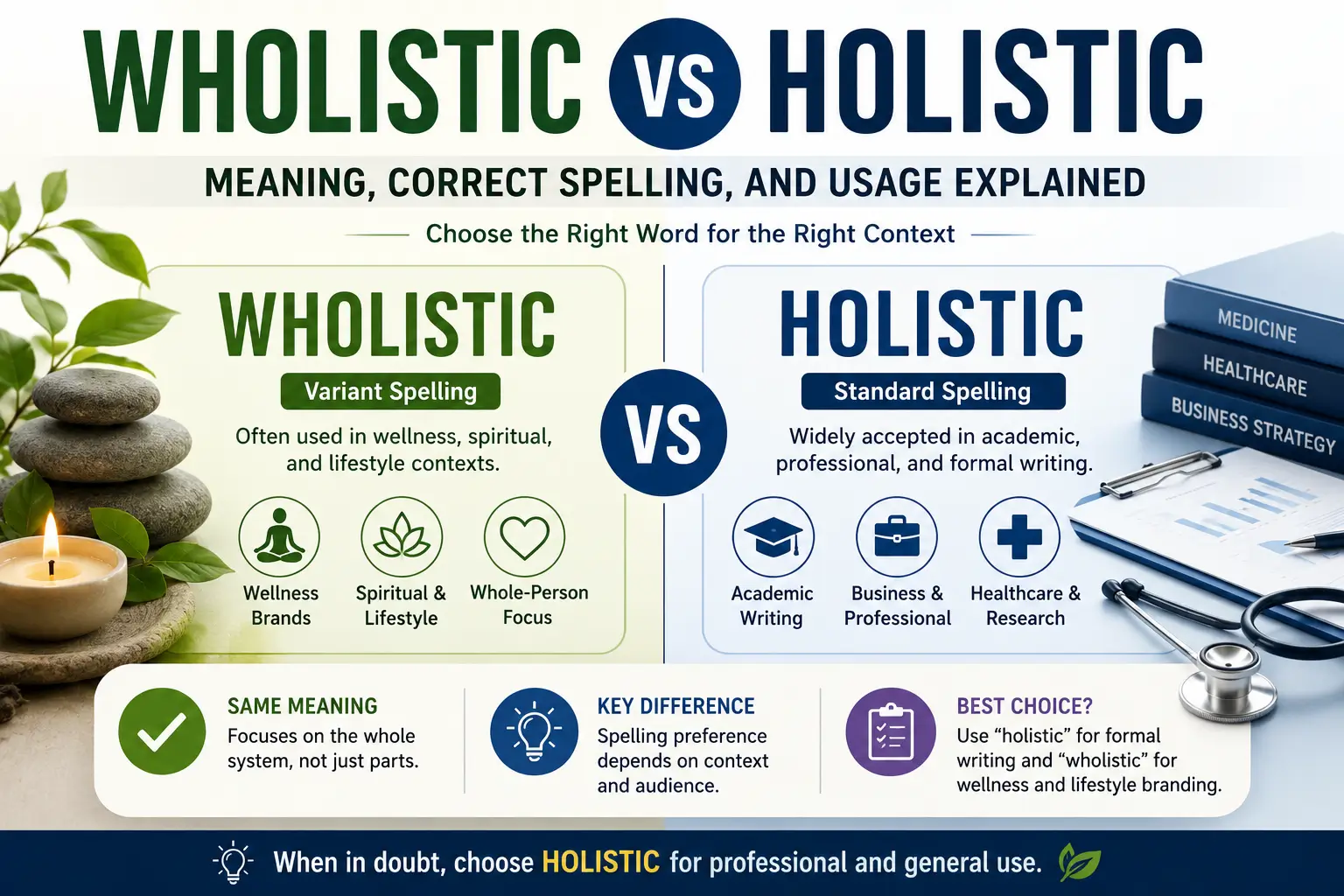
The debate over wholistic vs holistic often starts with a simple question: which spelling is correct?
Both words are used to describe an approach that considers the whole person or the entire system rather than focusing on individual parts. However, while they share a similar meaning, they are not used equally in modern English.
Today, holistic is the standard spelling found in academic writing, healthcare, business communication, and professional publications. Meanwhile, wholistic appears mainly in wellness, lifestyle, and spiritual branding, where the spelling intentionally emphasizes the idea of “wholeness.”
Understanding the difference between these terms can help you avoid spelling mistakes, improve your writing credibility, and choose the right word for your audience.
In this guide, you’ll learn the meaning of both words, their origins, key differences, real-world examples, and when to use each spelling confidently.
Quick Answer: Should You Use Holistic or Wholistic?
Most of the time, you should use holistic. It works for:
- Academic writing
- Business communication
- Medical or health-related content
- Professional blogs
Use wholistic only when:
- You’re building a wellness or spiritual brand
- You want a warm, personal, or alternative tone
- The audience expects a softer, lifestyle-focused language
Here’s a simple comparison:
| Situation | Recommended | Why |
| Academic paper | Holistic | Standard spelling |
| Corporate report | Holistic | Professional tone |
| Health blog | Holistic | Broad recognition |
| Wellness brand | Wholistic | Emphasizes “whole” visually |
| Yoga or spiritual retreat | Wholistic | Fits tone and branding |
What Does Holistic Mean?
Holistic describes an approach that considers the whole system, not just parts.
It applies to people, businesses, classrooms, technology, and environmental systems. Holistic thinking asks:
- How do all the parts connect?
- What are the root causes of the problem?
- How does one change affect everything else?
Examples of Holistic Thinking:
- Health: “The clinic uses a holistic approach considering sleep, nutrition, and stress.”
- Business: “A holistic strategy connects marketing, operations, and customer experience.”
- Education: “Holistic education focuses on emotional, social, and academic development.”
Holistic doesn’t mean abandoning conventional solutions. It simply adds context, patterns, and whole-system thinking.
What Does Wholistic Mean?
Wholistic is a variant spelling of holistic, often used to emphasize “whole-person” thinking.
It’s common in:
- Wellness coaching
- Spiritual content
- Lifestyle blogs
- Mind-body programs
Example sentences:
- “Her wholistic coaching program focuses on mindset, movement, and nutrition.”
- “The retreat offers a wholistic experience with meditation, journaling, and community activities.”
Tip: Wholistic works best when the brand intentionally wants the spelling to highlight “whole”. It may look informal or incorrect in professional writing.
Holistic vs Wholistic: Key Differences
Here’s a clear side-by-side:
| Feature | Holistic | Wholistic |
| Spelling | Standard | Variant |
| Tone | Professional, credible | Personal, wellness-focused |
| Use in academic writing | ✅ | ❌ |
| Use in wellness branding | ✅ | ✅ |
| Commonness | High | Low |
| Risk of confusion | Low | Moderate |
Why Is It Holistic, Not Wholistic?
The spelling comes from the term holism, derived from Greek holos, meaning whole.
- Holistic: follows the Greek-based spelling.
- Wholistic: emphasizes the English word “whole” visually.
Both refer to whole-system thinking, but holistic is widely accepted as correct in formal contexts.
Using Holistic in Sentences
Health:
“The clinic uses a holistic approach, reviewing sleep, nutrition, and stress factors.”
Education:
“Holistic education develops emotional, social, and academic skills.”
Business:
“A holistic strategy ensures marketing, operations, and customer experience work together.”
Technology:
“Holistic cybersecurity includes software, employee training, access control, and backups.”
Tip: Always specify what parts are included to make “holistic” actionable and credible.
Using Wholistic in Sentences
Wellness:
“Her wholistic program supports mindset, movement, and emotional balance.”
Spirituality:
“The retreat offers a wholistic experience through meditation, journaling, and community.”
Lifestyle:
“Wholistic living encourages daily habits, relationships, and purpose alignment.”
Branding:
“The studio chose Wholistic Roots to highlight its whole-person philosophy.”
Common Mistakes to Avoid
- Thinking Wholistic is always wrong – It’s a valid variant in wellness contexts.
- Using Wholistic in formal writing – This may distract or confuse readers.
- Assuming Holistic only means natural medicine – It applies to education, business, design, tech, and more.
- Using Holistic as a vague buzzword – Always explain which parts are connected.
Example:
- Weak: “We provide holistic solutions.”
- Strong: “We provide holistic solutions covering budgeting, nutrition, sleep, stress, and daily habits.”
Holistic Health Explained
Holistic health looks at the whole person:
- Physical health – Symptoms, nutrition, sleep, activity
- Mental health – Stress, focus, cognition
- Emotional health – Mood, resilience, relationships
- Lifestyle – Habits, routines, work-life balance
- Environmental – Home, workspace, safety
- Spiritual – Purpose, values, beliefs
Fact: Holistic care does not reject conventional medicine. It complements it by integrating whole-person context.
Holistic Thinking Beyond Health
Business
Holistic business planning prevents siloed decisions.
Example: Cutting customer support saves money but increases complaints, churn, and lost revenue.
Education
Holistic education nurtures mind, body, emotions, and creativity – not just grades.
Design Holistic design combines usability, aesthetics, accessibility, and long-term maintenance.
Technology
Holistic cybersecurity includes software, employee behavior, backups, access control, and response planning.
Environment
Holistic environmental planning considers communities, ecosystems, climate, and land use simultaneously.
Holistic Personal Development
Personal growth is interconnected:
- Habits affect health
- Health affects mood
- Mood affects work
- Work affects relationships
Case Study: Maya, a marketing manager, failed at early-morning productivity routines because her whole system—sleep, workload, workspace, habits—was unbalanced. A holistic review addressed all areas, not just “wake-up time.”
SEO and Content Writing Tips
- Use holistic vs wholistic naturally in H1, H2, and body text.
- Include keyword variations: holistic meaning, wholistic spelling, holistic health, holistic approach.
- Use short paragraphs (2–4 lines) for readability.
- Include tables, bullet points, and examples for skimmability.
- Use transition words: however, for example, therefore, additionally.
Example meta description:
“Discover the difference between holistic and wholistic, correct spelling, usage examples, and practical tips for writing clear, professional, and wellness-focused content.”
Simple Decision Rule
- Writing formally? ✅ Use holistic
- Wellness branding? ✅ Consider wholistic
- Unsure? ✅ Use holistic
When readers see holistic, they trust your writing. When you use wholistic, make it intentional and clear.
Related Words for Precision
| Word | Meaning | Example |
| Holism | Whole-system thinking | Holism shapes holistic strategies. |
| Holistically | In a whole-system way | Solve the problem holistically. |
| Whole-person care | Care considering all aspects | The clinic provides whole-person care. |
| Integrative | Combining methods | Integrative care includes lifestyle and medicine. |
| Comprehensive | Complete, wide-ranging | The report provides a comprehensive overview. |
FAQs About Wholistic vs Holistic
Q1:Is holistic or wholistic correct?
- Holistic is standard; wholistic is a variant for wellness/lifestyle.
Q2:Do they mean the same?
- Usually yes, but wholistic emphasizes “whole” visually.
Q3:Is wholistic a real word?
- Yes, but less common and formal.
Q4:Why doesn’t holistic have a “w”?
- It comes from Greek holos, via the term holism.
Q5:Can I use wholistic in academic writing?
- Usually no. Holistic is safer in formal contexts.
Final Verdict: Wholistic vs Holistic
When comparing wholistic vs holistic, the difference is mainly about spelling and context rather than meaning.
Holistic is the standard and widely accepted spelling. It appears in academic writing, healthcare, business communication, professional reports, and major dictionaries. If you’re writing for a broad audience or creating formal content, holistic is usually the best choice.
Wholistic is a recognized variant spelling that is most common in wellness, lifestyle, and spiritual communities. Many brands use it intentionally to emphasize the idea of whole-person growth and well-being.
If you’re unsure which version to use, choose holistic. It is the safer option, the most recognizable spelling, and the one preferred by editors, educators, and professionals.
In short, both words describe a whole-system approach, but holistic remains the standard spelling in modern English.





1 thought on “Wholistic vs Holistic: Meaning, Correct Spelling, and Usage Explained”