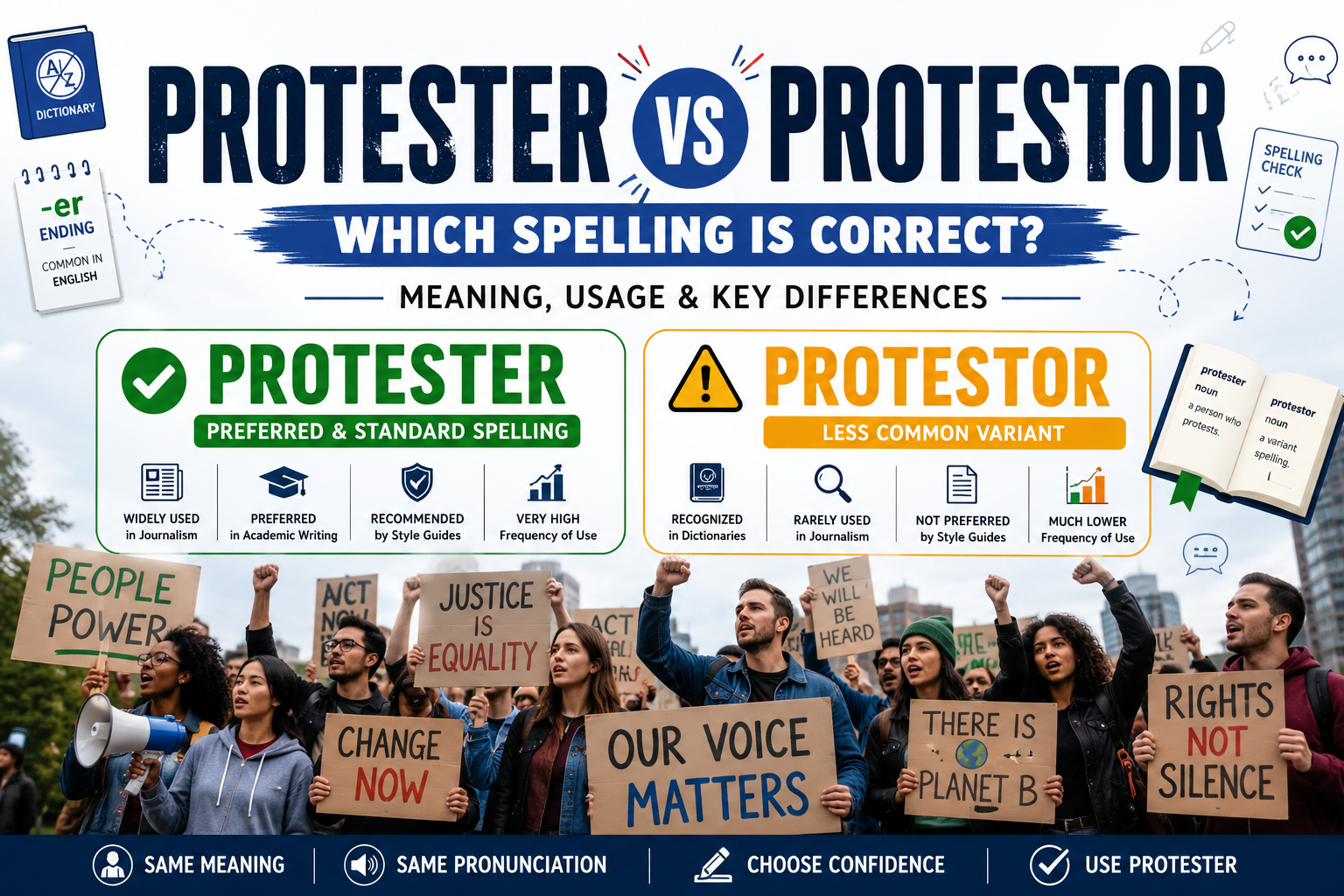
The topic protester vs protestor often creates a spelling question and spelling confusion in modern English and English language usage, especially in writing, where writers, experienced writers, students, bloggers, journalists, and professionals struggle with word choice and word selection.
This confusion comes from noun formation, nouns, -er ending, and -or ending, shaped by grammar rules, language rules, and linguistic pattern inside English grammar. Even though both forms exist as word forms, only one reflects standard accepted spelling, correct spelling, and spelling standards, making the correct word important for clear communication, writing accuracy, and proper language usage in content writing, copywriting, professional writing, educational writing, journalism, and blogging.
Protester vs Protestor: Quick Answer
Let’s start with the short answer.
Protester is the preferred and standard spelling in modern English.
Protestor exists and appears in some dictionaries. However, it is far less common and rarely preferred by editors, journalists, educators, or professional writers.
Quick Comparison Table
| Feature | Protester | Protestor |
| Meaning | Person who protests | Person who protests |
| Accepted in Dictionaries | Yes | Usually listed as a variant |
| Common in Journalism | Yes | Rare |
| Preferred in Academic Writing | Yes | Rare |
| Preferred by Style Guides | Yes | No |
| Frequency of Use | Very High | Much Lower |
Key Takeaway
If you’re unsure which spelling to choose, use protester. It is the safest and most widely accepted option in virtually every form of modern writing.
What Does Protester Mean?
A protester is a person who publicly expresses opposition, disagreement, or objection toward a policy, law, decision, event, or social issue.
People protest for many reasons. Some seek political change. Others advocate for environmental protection, civil rights, economic reforms, or workplace improvements.
Common Contexts Where Protester Is Used
You will frequently see the word protester in discussions involving:
- Political demonstrations
- Social justice movements
- Labor strikes
- Public rallies
- Human rights campaigns
- Environmental activism
- Community advocacy
Example Sentences with Protester
- The protester carried a sign demanding policy changes.
- Thousands of protesters gathered in the city center.
- A protester addressed the crowd through a loudspeaker.
- Police monitored the demonstration while protesters marched peacefully.
The word itself remains neutral. It simply describes someone participating in a protest.
What Does Protestor Mean?
The word protestor generally carries the same meaning as protester.
It refers to a person who protests.
There is no meaningful difference in definition between the two spellings.
Is Protestor a Real Word?
Yes.
Many dictionaries recognize protestor as an alternative spelling. However, recognition does not automatically make it the preferred choice.
Think of it as a less common variant rather than the standard form.
Example Sentences with Protestor
- A protestor stood outside the government building.
- Several protestors gathered near the entrance.
- The protestor voiced concerns about the proposal.
Although these examples are grammatically acceptable, most editors would change protestor to protester before publication.
Which Spelling Is Correct: Protester or Protestor?
This question creates most of the confusion.
Technically, both spellings exist. However, modern English overwhelmingly favors protester.
When dictionaries, style guides, newspapers, universities, and publishing houses make a choice, they almost always choose protester.
Why Most Dictionaries Favor Protester
Dictionaries aim to reflect actual language usage.
Since protester appears much more often in books, newspapers, academic articles, and digital publications, dictionaries naturally identify it as the primary form.
Why Editors Prefer Protester
Editors value consistency and clarity.
Using the spelling readers expect eliminates unnecessary distractions.
When readers encounter protester, they move through the text smoothly. When they see protestor, some pause and wonder whether the spelling is correct.
That tiny interruption matters in professional writing.
Why Is Protester More Common Than Protestor?
Language often follows patterns.
The spelling protester fits a well-established English word formation rule.
The verb protest naturally becomes protester when referring to someone performing the action.
English Word Formation Patterns
Consider these examples:
| Verb | Person Performing Action |
| Teach | Teacher |
| Farm | Farmer |
| Build | Builder |
| Write | Writer |
| Protest | Protester |
The pattern feels familiar to native speakers.
As a result, protester sounds natural and predictable.
Language Evolution Over Time
Languages constantly simplify themselves.
Over generations, people tend to favor forms that feel intuitive and easy to understand.
Protester gained popularity because it matched common English spelling conventions more closely than protestor.
The History and Origin of Protester and Protestor
Understanding the history behind these words helps explain their modern usage.
The root word protest comes from Latin origins related to public declaration and formal objection.
Over time, English adopted the term and expanded its usage.
As public demonstrations became more common, English speakers needed a noun describing participants in those actions.
Both protester and protestor emerged.
However, one gradually became dominant.
Historical Development
In earlier periods of English, variation in spelling occurred more frequently.
Writers often used multiple versions of the same word.
As dictionaries and style guides standardized English, protester became the preferred form.
By the twentieth century, major publications overwhelmingly favored protester.
Today, protestor survives mainly as a secondary spelling.
What Major Dictionaries Say About Protester vs Protestor
Modern dictionaries provide valuable insight because they document actual language usage.
Most major dictionaries:
- List protester as the primary entry.
- Recognize protestor as a variant spelling.
- Indicate that protester appears more frequently.
What This Means for Writers
If your goal is clear and professional communication, dictionary treatment strongly supports using protester.
The choice becomes even more important in:
- Academic writing
- Journalism
- Business communication
- Government publications
- Professional reports
What Style Guides Recommend
Style guides shape modern writing standards.
They influence newspapers, magazines, universities, and businesses worldwide.
Journalism Standards
Journalists rely heavily on consistency.
Major news organizations overwhelmingly use protester.
You’ll encounter headlines such as:
- Protesters gather outside parliament.
- Protesters demand environmental reforms.
- Protesters march through downtown streets.
The alternative spelling rarely appears.
Academic Writing Standards
Universities also favor protester.
Research papers, scholarly articles, and textbooks consistently use the more common form.
This preference helps maintain uniformity across academic publications.
Protester vs Protestor in American and British English
Some spelling differences depend on geography.
For example:
| American English | British English |
| Color | Colour |
| Favor | Favour |
| Organize | Organise |
Interestingly, protester does not follow this pattern.
Usage in the United States
American publications strongly favor protester.
Usage in the United Kingdom
British publications also strongly favor protester.
Important Fact
Unlike many spelling debates, this one is not primarily about American versus British English.
Both regions generally prefer the same spelling.
That makes protester one of the few words that enjoys broad agreement across major English variants.
Protester vs Protestor Usage Statistics
When examining modern language trends, one fact becomes immediately clear.
Protester appears significantly more often than protestor.
Where Protester Dominates
- Newspapers
- Academic journals
- Government reports
- Books
- Educational materials
- Professional websites
Usage Comparison
| Category | Protester | Protestor |
| News Articles | Extremely Common | Rare |
| Academic Writing | Extremely Common | Rare |
| Business Writing | Common | Uncommon |
| Legal Documents | Common | Rare |
| Online Publications | Very Common | Less Common |
These patterns explain why many people encounter protester regularly while rarely seeing protestor.
Why Do People Write Protestor Instead of Protester?
The mistake makes sense.
English contains many nouns ending in -or.
Examples include:
- Actor
- Doctor
- Editor
- Governor
- Auditor
Because these words feel familiar, some writers assume protestor follows the same pattern.
Why the Error Feels Logical
Imagine encountering the word for the first time.
Without checking a dictionary, protestor looks plausible.
It follows a spelling pattern seen in many English nouns.
That’s why the mistake appears so often.
The issue isn’t carelessness. It’s pattern recognition.
Understanding the -er vs -or Ending Rule
English does not always follow perfectly predictable rules.
Still, certain patterns occur frequently.
Common -er Endings
Many action-based nouns use -er.
Examples include:
- Teacher
- Builder
- Writer
- Runner
- Farmer
- Painter
- Protester
Common -or Endings
Many -or nouns entered English from Latin.
Examples include:
- Doctor
- Actor
- Governor
- Senator
- Editor
Because protest derives through a different development pattern, modern English settled on protester.
Simple Rule
When in doubt, choose protester.
You’ll almost always be correct.
Protester vs Protestor in Real-World Examples
Seeing words in context makes them easier to remember.
News Example
“Protesters gathered outside city hall to demand policy reforms.”
Academic Example
“The study examined how protesters organize large-scale demonstrations.”
Legal Example
“The protester claimed constitutional protections applied to the event.”
Community Example
“Local protesters raised concerns about environmental impacts.”
Notice how naturally protester fits into each sentence.
Protester vs Demonstrator: Are They the Same?
Many people use these terms interchangeably.
However, subtle differences exist.
Similarities
Both words describe people participating in public demonstrations.
Both often involve organized gatherings.
Both can appear in political and social contexts.
Differences
A demonstrator specifically participates in a demonstration.
A protester specifically expresses opposition to something.
Comparison Table
| Term | Primary Focus |
| Protester | Opposition or objection |
| Demonstrator | Public demonstration or gathering |
In many situations, either word works. Context determines the best choice.
Synonyms for Protester
Repeating the same word can make writing feel repetitive.
Fortunately, several alternatives exist.
Common Synonyms
- Demonstrator
- Activist
- Campaigner
- Dissenter
- Advocate
- Marcher
- Organizer
- Participant
Choosing the Right Alternative
Each synonym carries slightly different shades of meaning.
For example:
- Activist often implies ongoing involvement.
- Demonstrator emphasizes participation in a public event.
- Advocate suggests support for a specific cause.
Selecting the right word improves clarity and style.
Common Mistakes with Protester and Protestor
Several errors appear repeatedly.
Using Protestor in Formal Writing
While not technically incorrect, protestor can appear unconventional.
Most professional writers avoid it.
Mixing Both Spellings
Consistency matters.
Choose one spelling and stick with it.
Assuming They Have Different Meanings
Many people search for hidden distinctions.
In reality, both words refer to the same type of person.
Ignoring Audience Expectations
Readers expect protester.
Using an uncommon variant may distract from your message.
Case Study: A Newspaper Editor’s Choice
Consider a newspaper editor preparing coverage of a large public demonstration.
Reporters submit articles containing both protester and protestor.
The editor must choose one spelling.
What happens?
Nearly every major newsroom style guide recommends protester.
The editor standardizes every article accordingly.
The result is greater consistency, clearer communication, and alignment with reader expectations.
This real-world scenario illustrates why protester remains dominant.
How to Remember the Correct Spelling
Fortunately, remembering the preferred spelling is easy.
Memory Trick
Think about these familiar words:
- Writer
- Reader
- Teacher
- Speaker
- Protester
Notice the pattern?
All describe people performing actions.
Quick Formula
Protest + er = Protester
Simple. Practical. Easy to recall.
Protester vs Protestor Comparison Chart
| Question | Answer |
| Which spelling is preferred? | Protester |
| Are both recognized? | Generally yes |
| Which appears more often? | Protester |
| Which spelling should students use? | Protester |
| Which spelling should journalists use? | Protester |
| Which spelling should businesses use? | Protester |
| Do meanings differ? | No |
| Is protestor wrong? | Not usually, but less preferred |
Frequently Asked Questions
Q1:Is protester or protestor the correct spelling?
Protester is the preferred and standard spelling in modern English.
Q2:Is protestor considered incorrect?
Not necessarily. Most dictionaries recognize it, but they typically treat it as a less common variant.
Q3:Do protester and protestor have different meanings?
No. Both words refer to a person who protests.
Q4:Which spelling is used in journalism?
Professional journalism overwhelmingly favors protester.
Q5:Which spelling is used in academic writing?
Academic institutions generally prefer protester.
Q6:Is protestor outdated?
Some writers consider it old-fashioned or uncommon because modern usage strongly favors protester.
Q7:Why do dictionaries still include protestor?
Dictionaries document actual usage. Since some people still use protestor, many dictionaries continue to list it.
Q8:Which spelling should businesses use?
Businesses should typically use protester because it aligns with modern writing standards.
Q9:How do you pronounce protester?
The pronunciation remains the same regardless of spelling preferences.
Final Verdict: Protester vs Protestor
The debate over protester vs protestor turns out to be much simpler than many people expect. While both spellings exist and both refer to a person who protests, modern English overwhelmingly favors protester.
Major dictionaries identify it as the primary form. Journalists use it. Academics prefer it. Businesses choose it. Readers expect it.
Meanwhile, protestor survives as a recognized but far less common variant.
If your goal is clear, professional, and widely accepted writing, the safest choice is simple: use protester. Whether you’re writing a news article, school paper, blog post, business report, or social media update, that spelling will match modern standards and reader expectations.
When comparing protester vs protestor, one conclusion stands above the rest: protester is the spelling most writers should use.
Read this also:
- Molding vs Moulding: Which Spelling Is Correct?
- Absence vs Absense: Which Spelling Is Correct? Meaning, Usage, Examples, and Common Mistakes
- Discrete vs Discreet: What’s the Difference and Which Word Should You Use?
- Lovey or Lovie: Which Spelling Is Correct? Meaning, Usage, and Examples
- Sow vs. Sew: The Complete Guide to Two Words Everyone Mixes Up
- Who’s vs Whose: Meaning, Difference, Examples, and Easy Grammar Rules







1 thought on “Protester vs Protestor: Which Spelling Is Correct? Meaning, Usage, and Key Differences”