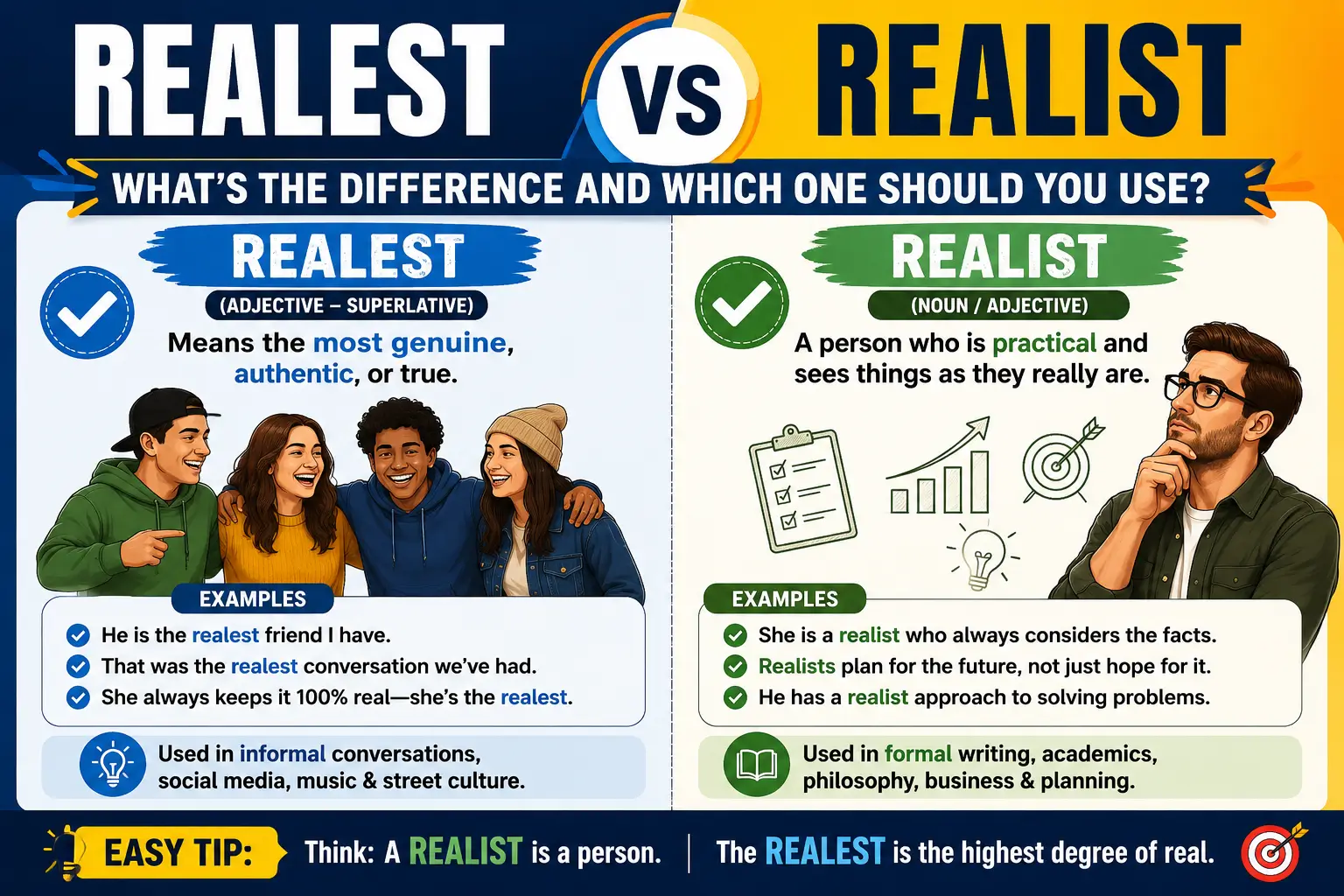
The confusion between realist vs realest is more common than it looks, especially when both words sound almost identical in everyday speech. At first glance, they seem interchangeable because they share the same root word “real,” but in actual usage, they serve completely different purposes.
A realist refers to a person who thinks in a practical, grounded, and fact-based way. This type of thinking is often seen in decision-making, philosophy, and real-world planning where emotions take a back seat and logic leads the way. On the other hand, realest is an informal expression used in modern language to describe someone who is extremely genuine, honest, or authentic.
It is commonly found in social media, music, and casual conversations rather than formal writing. Understanding this difference is important because using the wrong word can easily change the meaning of a sentence and create confusion.
Quick Answer: Realest vs Realist
Here’s the short answer:
- Realist refers to a person who sees situations as they truly are and focuses on practical realities rather than wishes or fantasies.
- Realest is the superlative form of real and means the most genuine, authentic, or true.
For example:
- Sarah is a realist who always considers the facts before making a decision.
- Among all my friends, Jake is the realest.
Although both words come from the word real, they perform completely different functions in a sentence.
A simple way to remember the difference is this:
A realist is a person. Realest is a description.
Realest vs Realist: Side-by-Side Comparison
| Feature | Realist | Realest |
| Part of Speech | Noun or adjective | Adjective |
| Main Meaning | A practical person who accepts reality | Most authentic or genuine |
| Formal Usage | Common | Rare |
| Informal Usage | Common | Very common |
| Academic Use | Frequent | Uncommon |
| Slang Use | Rare | Very common |
| Example | She is a realist. | He is the realest friend I know. |
This table highlights the biggest difference between Realest or Realist. One identifies a type of person while the other describes a degree of authenticity.
What Does “Realist” Mean?
The word realist has existed in English for centuries. It generally describes someone who focuses on reality and practical facts rather than idealistic expectations.
A realist accepts situations as they are rather than how they wish them to be.
Realist Definition
A realist is someone who:
- Recognizes facts and evidence
- Makes practical decisions
- Understands limitations
- Avoids unrealistic expectations
- Focuses on achievable outcomes
Realists are often viewed as balanced thinkers. They neither expect the worst nor assume everything will work out perfectly.
Instead, they evaluate situations objectively.
Realist as a Noun
Most commonly, realist functions as a noun.
Examples:
- The manager is a realist who plans for potential challenges.
- She remained a realist despite the excitement surrounding the project.
- Investors often succeed when they act like realists rather than dreamers.
In these examples, the word identifies a specific type of person.
Realist as an Adjective
Less commonly, realist can function as an adjective.
Examples:
- Realist art focuses on ordinary life.
- The museum displayed several realist paintings.
- The novel belongs to the realist literary tradition.
When used this way, the word describes a style that emphasizes accurate representation of reality.
Realist in Everyday English
In daily conversations, people often use realist to describe practical thinkers.
Consider these examples:
- A business owner who prepares for economic downturns.
- A student who sets achievable goals.
- A coach who evaluates team strengths honestly.
These individuals may be optimistic, but they still base decisions on facts.
Realist Synonyms
Depending on context, similar words include:
- Pragmatist
- Practical thinker
- Rational person
- Objectivist
- Sensible planner
- Practical observer
Each synonym carries slightly different shades of meaning, but all emphasize realism and practicality.
What Does “Realest” Mean?
Unlike realist, the word realest comes directly from the adjective real.
It is the superlative form, meaning something is more genuine, authentic, or truthful than everything else being compared.
Realest Definition
The word realest means:
- Most authentic
- Most genuine
- Most sincere
- Most honest
- Most true to oneself
People often use it to praise someone’s character.
Examples:
- She’s the realest person I’ve ever met.
- That was the realest conversation we’ve had all year.
- He stayed loyal through everything, making him the realest friend in the group.
Why “Realest” Is the Superlative Form of “Real”
English often creates comparisons using three levels:
| Degree | Example |
| Positive | Real |
| Comparative | Realer |
| Superlative | Realest |
Examples:
- This story feels real.
- That story feels realer.
- This is the realest story I’ve ever heard.
Although realer and realest are grammatically correct, many speakers prefer alternative phrases in formal writing.
Is “Realest” a Real Word?
Yes.
The word realest is recognized in English and appears in dictionaries.
However, its usage differs significantly from realist.
While realist appears frequently in academic, philosophical, and professional contexts, realest appears more often in casual speech and informal writing.
Realest Synonyms
Depending on context, similar words include:
- Most genuine
- Most authentic
- Most sincere
- Most truthful
- Most honest
- Most trustworthy
These alternatives often sound more professional in formal settings.
Realest in Informal Speech
The popularity of realest has grown substantially in modern culture.
People often use it when praising:
- Loyalty
- Honesty
- Authenticity
- Transparency
- Integrity
For example:
“You’ve always been there for me. You’re the realest.”
This sentence communicates admiration and trust.
Realist vs Realest: The Key Difference
Many writers struggle with Realest or Realist because both words originate from real. Yet they belong to entirely different grammatical categories.
Different Meanings
Let’s compare them directly.
Realist
- Refers to a person or philosophy.
- Focuses on practical reality.
- Describes a mindset.
Realest
- Describes authenticity.
- Measures the highest degree of being real.
- Functions as a superlative adjective.
Different Grammar Roles
| Word | Grammar Role |
| Realist | Noun or adjective |
| Realest | Adjective |
This distinction matters because grammar determines which word fits a sentence.
Correct:
- She is a realist.
Incorrect:
- She is a realest.
Correct:
- He is the realest friend I have.
Incorrect:
- He is the realist friend I have.
Why They Cannot Replace Each Other
Think of these words as tools designed for different jobs.
A hammer and a screwdriver both belong in a toolbox, but neither can fully replace the other.
Similarly:
- Realist identifies a thinker.
- Realest describes authenticity.
Switching them changes the meaning completely.
Easy Rule to Remember
Remember this simple formula:
Realist = Person
Realest = Most Genuine
If you’re talking about someone’s mindset, use realist.
If you’re talking about authenticity, use realest.
When to Use “Realist”
Knowing when to use realist helps eliminate confusion immediately.
In Conversations
You should use realist when discussing how someone thinks.
Examples:
- My father is a realist who always plans ahead.
- She’s a realist about the challenges facing the company.
- The coach remains a realist despite recent victories.
The focus here is practical thinking.
In Professional Writing
Business and workplace communication frequently use the term.
Examples include:
- Market analysis
- Financial forecasting
- Strategic planning
- Risk management
A realist evaluates risks honestly and prepares accordingly.
In Philosophy and Psychology
The term carries special significance in academic disciplines.
In philosophy, realism generally suggests that reality exists independently of human perception.
A philosophical realist believes objects continue to exist whether people observe them or not.
For example:
A mountain remains a mountain even when nobody is looking at it.
This concept has influenced philosophical debates for centuries.
In Literature and Art
Realism became one of the most influential artistic movements in history.
Key characteristics include:
- Accurate representation of life
- Ordinary characters
- Everyday situations
- Social realities
- Minimal romanticization
Famous realist works often focus on common people rather than heroes or mythical figures.
Authors and artists associated with realism aimed to portray life as it truly existed.
When to Use “Realest”
The word realest belongs primarily to informal communication.
In Casual Conversations
People often use realest when complimenting someone.
Examples:
- You’re the realest person I know.
- She gave me the realest advice.
- That was the realest reaction possible.
In each case, the speaker emphasizes authenticity.
In Slang and Pop Culture
Modern slang has greatly expanded the use of realest.
The term often celebrates qualities such as:
- Honesty
- Loyalty
- Trustworthiness
- Authenticity
- Staying true to personal values
Someone described as “the realest” usually earns deep respect.
In Social Media Posts
Social media platforms helped popularize the word even further.
Common examples include:
- “Realest friend ever.”
- “Keeping it real.”
- “The realest one in the room.”
These expressions communicate admiration and sincerity.
When Describing Authenticity
Authenticity has become increasingly important in modern culture.
People appreciate individuals who:
- Speak honestly
- Act consistently
- Avoid pretending
- Remain true to themselves
As a result, realest has become a powerful compliment.
Realist vs Realest in Sentences
Understanding theory is helpful, but sentences make everything click. Let’s break down how Realist or Realist vs Realest actually behaves in real usage.
Correct Examples of Realist
These sentences show realist as a mindset or type of person:
- He is a realist, so he never overpromises anything.
- As a realist, she always plans for the worst-case scenario first.
- The CEO is a realist who focuses on long-term stability over hype.
- I consider myself a realist because I prefer facts over assumptions.
- The coach stayed a realist even after the team’s winning streak.
Notice how realist always connects to thinking, behavior, or personality.
It never describes “how real something is.” It describes how a person thinks.
Correct Examples of Realest
Now let’s look at realest, which works very differently:
- You are the realest friend I have ever had.
- That was the realest conversation of my life.
- She stayed the realest person in the entire group.
- He gave me the realest advice when I needed it most.
- This moment feels the realest out of everything I’ve experienced.
Here, the word realest expresses emotional truth and authenticity.
It does not describe a mindset. It describes degree of genuineness.
Incorrect Examples and Fixes
Mistakes happen when people mix grammar roles.
- ❌ She is the realest thinker in the room.
✔ She is the most realistic thinker in the room. - ❌ He is a realist friend.
✔ He is a real friend / He is a loyal friend. - ❌ That’s the realist moment ever.
✔ That’s the realest moment ever.
This is where confusion around Realest or Realist becomes obvious. One describes identity, the other describes intensity.
Realist vs Idealist: Understanding the Difference
To fully understand realist, you also need to understand its opposite: idealist.
These two words often appear together in psychology, philosophy, and everyday discussions.
What Is an Idealist?
An idealist is someone who:
- Believes things can improve significantly
- Focuses on possibilities rather than limitations
- Trusts in positive outcomes
- Often expects the best-case scenario
Idealists see potential. Realists see probability.
Realist vs Idealist Comparison
| Trait | Realist | Idealist |
| Thinking Style | Practical | Hope-driven |
| Focus | Facts and limits | Possibilities |
| Decision Making | Evidence-based | Vision-based |
| Risk Approach | Cautious | Optimistic |
| Example Behavior | Plans backup options | Expects best outcome |
Both mindsets matter. A world full of only realists may lack innovation. A world full of only idealists may ignore reality.
The healthiest thinkers often balance both.
Which Mindset Fits Different Situations?
- Business planning → Realist
- Innovation and creativity → Idealist
- Crisis management → Realist
- Vision setting → Idealist
For example, a startup founder may act like an idealist when creating a product idea but switch to a realist when managing budget and logistics.
Is “Realest” Appropriate in Formal Writing?
This is where most writers make mistakes.
Academic Writing
In academic papers, realest is rarely acceptable.
Instead, use:
- Most authentic
- Most genuine
- Most realistic (depending on context)
Example:
- ❌ This is the realest interpretation of the data.
- ✔ This is the most accurate interpretation of the data.
Business Writing
In professional communication, clarity matters more than slang.
Better alternatives include:
- Most reliable
- Most honest
- Most transparent
- Most accurate
Example:
- ❌ He gave the realest forecast.
- ✔ He gave the most accurate forecast.
Professional Communication
Emails, reports, and presentations should avoid realest.
Why?
Because it sounds emotional and informal.
Employers and clients expect precision, not slang.
Better Alternatives to “Realest”
Instead of realest, choose:
- Authentic
- Genuine
- Honest
- Transparent
- Trustworthy
- Accurate
These words keep your writing sharp and professional.
Realest in Modern Culture and Slang
Even though realest is informal, it has strong cultural influence.
What Does “The Realest” Mean?
In modern slang, calling someone “the realest” means:
- They are honest no matter what
- They stay loyal in difficult times
- They don’t fake personality or emotions
- They keep things straightforward
It’s one of the highest compliments in casual speech.
Realest in Music and Entertainment
Hip-hop culture played a major role in popularizing the term.
Artists often use phrases like:
- “I’m the realest in the game”
- “Keep it real, stay realest”
- “Only real ones survive”
In this context, realest represents authenticity, struggle, and loyalty.
It’s not about grammar. It’s about identity and respect.
Why the Word Became Popular
Three main reasons explain its rise:
- Social media amplified slang language
- Music culture normalized informal grammar
- People value authenticity more than ever
Today, “realest” is less about correctness and more about emotional meaning.
Common Mistakes People Make
Many errors appear again and again when using Realest or Realist.
Using Realest as a Noun
- ❌ He is a realest.
- ✔ He is the realest person.
Why? Because realest is not a noun. It must modify something.
Using Realist as a Synonym for Authentic
- ❌ She is the realist friend.
- ✔ She is a real friend / She is the realest friend.
Remember: realist refers to thinking style, not authenticity.
Mixing Grammar Functions
People often confuse structure:
- Realist = person who thinks practically
- Realest = most genuine expression
Switching them changes meaning completely.
Choosing Wrong Context
- Formal report → avoid realest
- Casual chat → both may appear but still require correctness
Context always controls correctness.
Realist vs Realist vs Realistic
This trio causes even more confusion.
What Does “Realistic” Mean?
Realistic means:
- Practical
- Possible
- Based on reality
Example:
- We need a realistic timeline for this project.
How It Differs From Both Words
| Word | Meaning | Usage |
| Realist | Person who thinks practically | Noun |
| Realest | Most genuine or authentic | Slang adjective |
| Realistic | Practical or possible | Adjective |
Examples of Each Word
- He is a realist about business risks.
- That was the realest apology I’ve heard.
- We need a realistic plan to finish on time.
Each word fits a different role. They never replace each other.
Realest vs Most Real
This comparison is important for writing clarity.
Which Form Is Grammatically Correct?
Both appear in speech, but:
- Most real → more formal and widely accepted
- Realest → informal and slang-based
Example:
- This is the most real experience I’ve had. ✔
- This is the realest experience I’ve had. ✔ (informal)
When Native Speakers Prefer One Over the Other
- Academic writing → most real / most authentic
- Social media → realest
- Conversations → both, depending on tone
Memory Trick to Never Confuse Them Again
Here’s a simple trick that works instantly.
Simple Rule
- Realist = Thinker
- Realest = Feeling / Authenticity
Quick Visualization
Think of:
- A realist wearing glasses, analyzing data.
- A realest friend telling you the truth straight up.
This mental image helps lock in the difference.
Frequently Asked Questions
What is the difference between realist and realest?
A realist is someone who thinks practically. Realest means most authentic or genuine.
Is realest a correct English word?
Yes, but it is informal and mostly used in casual speech or slang.
Can a person be both a realist and the realest?
Yes. Someone can think practically (realist) and still be extremely genuine (realest).
Is realest formal or informal?
It is informal. Avoid it in academic or professional writing.
What does “the realest person” mean?
It means someone who is honest, loyal, and authentic in every situation.
Should I use realest or most real?
Use most real in formal writing and realest in casual speech.
What is the difference between realist and realistic?
Realist is a person. Realistic describes something practical or possible.
Why do people confuse realist and realest?
Because both come from the word real, but they serve completely different grammatical roles.
Final Verdict: Realest or Realist?
Here’s the simplest way to end the confusion:
- Realist → A practical thinker who focuses on reality
- Realest → The most genuine or authentic expression of truth
If you remember just one thing, remember this:
Realist is about thinking. Realest is about being real.
And once that clicks, you’ll never mix them up again.
Final Wrap-Up: Realest or Realist Made Simple for Everyday Use
Now that we’ve broken everything down, let’s bring it all together in a clean, practical way. This section helps you lock in the difference so you don’t second-guess yourself again when you see Realest or Realist in writing or conversation.Why People Still Confuse Realest or Realist
Even though the difference is clear in grammar, confusion still happens for a few real reasons:
- Both words come from the same root: real
- Both are used to describe people or behavior in some way
- Social media mixes slang with standard English
- Music and pop culture use “realest” freely
- Many people learn English through conversation, not grammar rules
So when you hear them in casual speech, they can sound interchangeable. But grammatically, they are not.
Real-Life Usage Breakdown (Simple Scenarios)
Let’s make this practical. Imagine you’re in different situations.
At Work
You say:
- “She is a realist when it comes to budgeting.”
You mean she is practical and focuses on facts.
You would NOT say:
- ❌ “She is the realest accountant.”
That sounds informal and unclear in a professional setting.
With Friends
You say:
- “You’re the realest friend I’ve got.”
Here, you mean loyal, honest, and authentic.
This is completely natural in casual conversation.
In School or Essays
You write:
- “A realist approach helps in decision-making.”
This is correct academic usage.
But:
- ❌ “He is the realest thinker in philosophy.”
This would not fit formal writing.
Quick Decision Guide: Realest or Realist
If you ever feel stuck, use this quick mental checklist:
- Are you talking about a type of person or mindset? → Use realist
- Are you describing authenticity or being genuine? → Use realest
- Is the tone formal or academic? → Avoid realest
- Is it casual or emotional speech? → Realest is fine
This simple filter removes 90% of confusion instantly.
Realist vs Realest vs Realistic (Final Clarity Table)
| Word | Meaning | Best Use | Example |
| Realist | Practical thinker | Psychology, business, philosophy | She is a realist in planning |
| Realest | Most genuine person | Casual speech, slang, social media | He is the realest friend |
| Realistic | Practical or possible | Academic, professional writing | We need a realistic goal |
Think of them as three different tools in the same toolbox. Each one has a job. None of them replace the others.
Cultural Insight: Why “Realest” Feels Powerful
Language is not only grammar. It’s emotion too.
The word “realest” became powerful because it expresses something deeper than correctness:
- Loyalty during hard times
- Truth without filters
- Emotional honesty
- Staying true under pressure
That’s why people don’t just say “you are honest.” They say:
“You’re the realest.”
It hits harder emotionally.
Common Confusion Patterns (And How to Fix Them)
Let’s quickly fix the most common mental mistakes.
Mistake: Thinking both mean “real person”
Fix:
- Realist = thinker
- Realest = authenticity level
Mistake: Using “realest” in formal writing
Fix:
Replace with:
- most authentic
- most accurate
- most genuine
Mistake: Using “realist” as a compliment
Fix:
- Don’t use realist to praise someone emotionally
- It describes thinking style, not loyalty or character
Simple Memory Trick That Always Works
Here’s a quick trick you can remember forever:
- Realist = Reality thinker (brain)
- Realest = Real feeling (heart)
If it’s about logic, use realist.
If it’s about loyalty or truth in emotion, use realest.
Mini Case Study: How Misuse Changes Meaning
Let’s look at a simple example.
Sentence 1:
- “He is a realist friend.”
This sounds slightly wrong because it mixes grammar roles.
Sentence 2:
- “He is the realest friend.”
Now the meaning is clear, emotional, and natural.
Sentence 3:
- “He is a realistic friend.”
This is grammatically correct but changes meaning again. It now suggests practicality, not loyalty.
One small word changes the entire message.
Final Summary: Realest or Realist Explained in One View
If we compress everything:
- Realist → A person who accepts and analyzes reality logically
- Realest → The highest level of being genuine or authentic
No overlap. No substitution. Just two different language tools.
Conclusion
The difference between realist vs realest becomes easy once you focus on how each word actually works in language. A realist describes a practical thinker who relies on facts, logic, and real-world understanding. In contrast, realest is an informal expression used to describe someone who is extremely genuine, honest, or authentic in character. The confusion usually happens because both words look and sound similar, but their purpose in communication is completely different.
FAQs
Q1: What is the difference between realist and realest?
A realist is a person who thinks practically and focuses on reality, while realest means someone is the most genuine or authentic in an informal sense.
Q2: Is “realest” a correct English word?
Yes, realest is a correct word, but it is mainly used in informal speech, slang, and social media rather than academic or professional writing.
Q3: Can a person be both a realist and the realest?
Yes. A person can be a realist in thinking (practical mindset) and also be called the realest by others for being honest and authentic.
Q4: When should I use realist vs realest?
Use realist when talking about mindset, logic, or practical thinking. Use realest when casually describing someone’s authenticity or loyalty.
Q5: Is realest appropriate in formal writing?
No, realest is not suitable for formal writing. Instead, use words like most genuine, most authentic, or most honest depending on context.