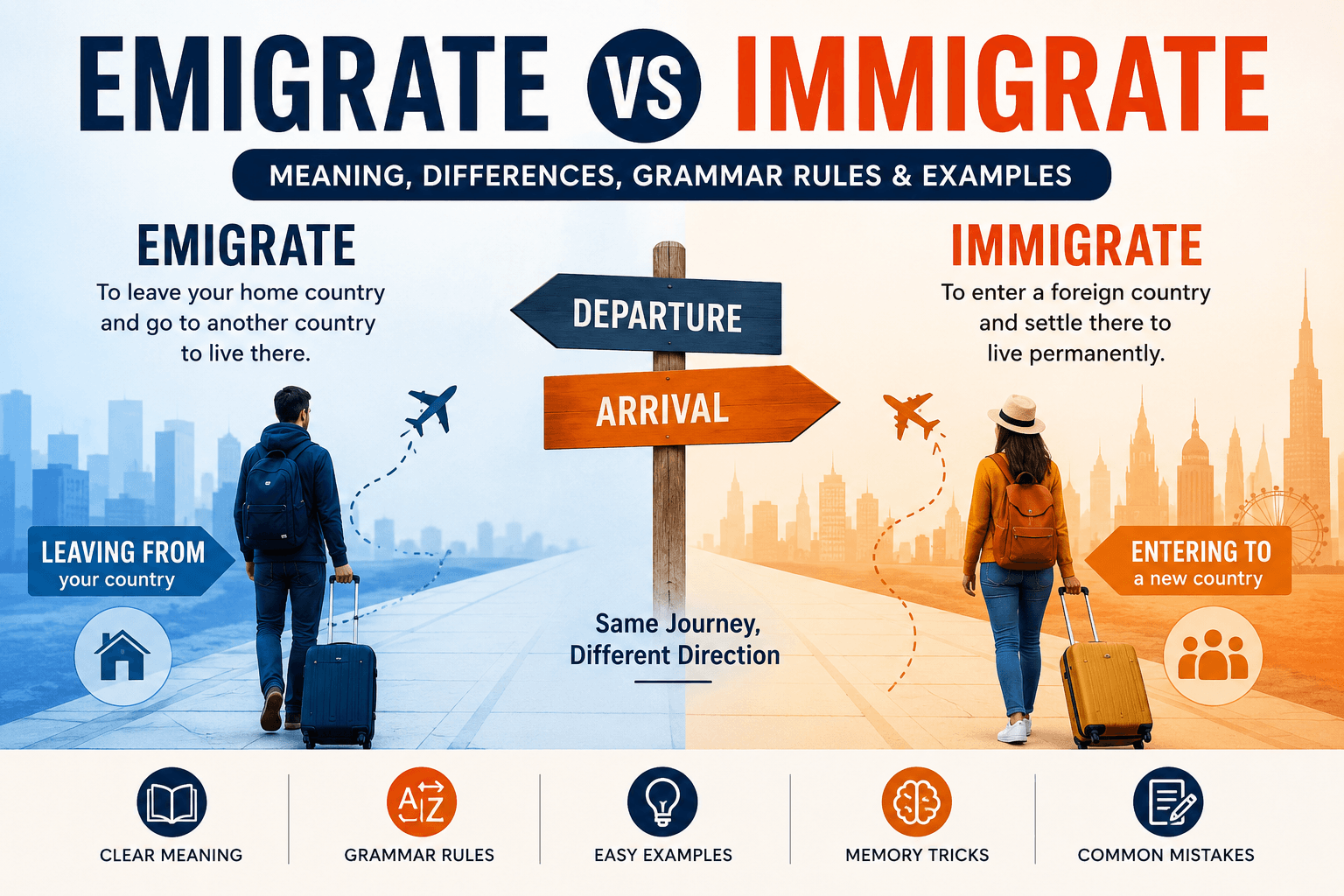
Understanding Immigration and Emigration
Many people get confused about emigrate vs immigrate because both words describe moving between countries. Immigrate means leaving a home country to enter and settle in a new country and live permanently there. Think of it as coming to a destination. For example, Yang and his parents immigrated to Australia in 1997 through an immigration policy that helped in bringing skilled workers into the country.
An immigrant like Lan may look for a fresh start, better opportunities, and a brighter future for children. In grammar, immigrate is a verb, immigration is a noun-action, and immigrant is a noun-person. The process includes immigration, obtaining residence, reaching an arrival point, choosing to enter a country, and creating a permanent settlement.
By contrast, Emigrate means moving out of a home country to live in another country. Maria decided to leave Thailand for a new job, while emigration from India to Australia has increased in recent years. José, an emigrant from the Philippines, began his journey with departure, exit, and leaving a country of residence. People often move abroad for work, education, or family reasons, resulting in relocation from an origin country and establishing a new residence abroad.
Quick Answer: Emigrate vs. Immigrate
Emigrate means to leave your country and settle somewhere else.
Immigrate means to enter another country and establish a new home there.
Here’s the easiest way to remember the distinction:
- Emigrate from a country
- Immigrate to a country
- Migrate between places
Consider this sentence:
Marco emigrated from Italy and immigrated to the United States.
Both verbs describe Marco’s relocation. The first looks at the country he left. The second looks at the country he entered.
Quick Comparison Table
| Word | Basic Meaning | Main Focus | Common Preposition | Example |
| Emigrate | Leave a country to live elsewhere | Departure | From | She emigrated from Spain. |
| Immigrate | Enter another country to settle there | Arrival | To | She immigrated to Canada. |
| Migrate | Move from one place to another | General movement | From, to, or between | Workers migrate between regions. |
A useful rule sums it up:
Emigrate looks back at the home you left. Immigrate looks toward the home you entered.
What Does Emigrate Mean?
Emigrate is a verb. It means to leave your country, homeland, or established place of residence and settle somewhere else.
The word emphasizes departure.
When a sentence focuses on a person leaving France, for example, “emigrate” fits naturally:
- “Luc emigrated from France.”
- “Many families emigrated from France during that period.”
- “Her parents decided to emigrate after receiving job offers abroad.”
The destination may appear in the sentence, but the action still begins from the place being left.
Emigrate Meaning in Simple Words
In simple terms, emigrate means to move out of a country.
It usually describes a serious or long-term relocation. Someone taking a two-week vacation hasn’t emigrated. Neither has a business traveler attending a conference.
The person normally intends to establish a home in another country.
However, “emigrate” doesn’t explain someone’s legal status. It describes movement. It doesn’t tell you whether the person received a particular visa, became a citizen, or followed a certain immigration process.
When to Use Emigrate
Use emigrate when the sentence emphasizes:
- A country someone left
- A homeland a family departed
- People moving out of a region
- Population loss caused by people leaving
- Historical departures from a particular country
- Someone’s decision to build a life abroad
For example:
- “Her grandparents emigrated from Poland after the war.”
- “Several skilled workers emigrated during the economic downturn.”
- “He plans to emigrate once he finds a permanent position overseas.”
- “The author’s family emigrated from Ireland to Australia.”
In each case, the original home matters.
Emigrate From or Emigrate To?
The most useful pattern is:
Emigrate from + place
Examples include:
- “They emigrated from Germany.”
- “She emigrated from South Africa.”
- “His family emigrated from Lebanon.”
Still, emigrate to isn’t automatically wrong.
A complete sentence can include both the origin and destination:
- “They emigrated from Germany to Argentina.”
- “She emigrated to Australia in 2008.”
- “His parents emigrated to the United Kingdom when he was young.”
Why does the memory rule favor “from”?
Because from reinforces the word’s main viewpoint: leaving.
When teaching or learning the difference, “emigrate from” provides the clearest mental shortcut. In natural English, though, writers sometimes use “emigrate to” when the destination matters or the country of origin is already understood.
Common Sentence Patterns With Emigrate
These patterns work well:
Subject + emigrate from + country
- “They emigrated from Greece.”
Subject + emigrate from + country + to + destination
- “They emigrated from Greece to Canada.”
Subject + emigrate to + destination
- “They emigrated to Canada.”
Subject + plan, hope, or decide + to emigrate
- “The couple decided to emigrate.”
- “She hopes to emigrate next year.”
The sentence doesn’t always need to name both countries. Context may already make the direction clear.
Examples of Emigrate in Sentences
- “Her family emigrated from Egypt in the late 1990s.”
- “Many residents emigrated in search of safer living conditions.”
- “He chose to emigrate rather than continue struggling to find work.”
- “The couple emigrated from India to New Zealand.”
- “Several generations of the family had considered emigrating.”
- “She wrote about the emotional cost of emigrating from her homeland.”
- “His parents emigrated before he was born.”
- “Young professionals sometimes emigrate to pursue specialized careers.”
These examples show that the word can describe personal, economic, historical, or social movement.
What Does Immigrate Mean?
Immigrate is also a verb. It means to enter a foreign country and settle there.
The word emphasizes arrival.
When a sentence focuses on someone entering Canada, Australia, Japan, or another destination, “immigrate” usually works best.
Examples include:
- “She immigrated to Canada.”
- “His parents immigrated to the United States.”
- “The family hopes to immigrate next year.”
- “Thousands of people immigrated to the region over several decades.”
The key idea isn’t simply entering the country. A tourist enters a country, too. Immigration normally suggests moving there to establish a home.
Immigrate Meaning in Simple Words
In simple language, immigrate means to move into another country to live.
The destination drives the sentence.
For example, imagine a man moving from Morocco to France. From Morocco’s viewpoint, he emigrates. From France’s viewpoint, he immigrates.
The journey remains the same. Only the camera angle changes.
When to Use Immigrate
Use immigrate when the sentence emphasizes:
- The new country someone entered
- A person establishing a home abroad
- People arriving from another country
- Population growth caused by new arrivals
- A family’s life in its destination country
- The receiving country’s perspective
For example:
- “Her parents immigrated to Canada from Pakistan.”
- “He immigrated to Germany as a young adult.”
- “The family plans to immigrate after completing the required process.”
- “Many workers immigrated to the country during its period of industrial growth.”
Each sentence points toward the destination.
Immigrate To or Immigrate From?
The clearest pattern is:
Immigrate to + destination
Examples include:
- “They immigrated to Australia.”
- “She immigrated to France.”
- “His grandparents immigrated to Brazil.”
However, you can also use from to identify someone’s country of origin:
- “They immigrated to Australia from Vietnam.”
- “She immigrated from Kenya when she was twelve.”
- “Many people who immigrated from Italy settled in the area.”
The expression “immigrated from” isn’t always incorrect. It works when the destination is stated elsewhere or understood from context.
Still, when you’re choosing between the two main verbs, remember this:
- Use emigrate from to emphasize departure.
- Use immigrate to to emphasize arrival.
Common Sentence Patterns With Immigrate
Subject + immigrate to + country
- “She immigrated to Norway.”
Subject + immigrate to + country + from + origin
- “She immigrated to Norway from Thailand.”
Subject + immigrate from + origin
- “Many families immigrated from Thailand.”
Subject + hope, plan, or apply + to immigrate
- “He hopes to immigrate.”
- “They plan to immigrate after graduation.”
That final pattern doesn’t name a destination. Yet the surrounding conversation may already identify it.
Examples of Immigrate in Sentences
- “The family immigrated to the United States in 2004.”
- “She immigrated to France from Senegal.”
- “His grandfather immigrated as a young man.”
- “They hope to immigrate and raise their children abroad.”
- “Several families immigrated to the city during the 1980s.”
- “She described the challenges of immigrating to a new country.”
- “After immigrating, he learned the local language.”
- “Her parents immigrated before she started school.”
Notice how these examples focus on arrival, settlement, and adjustment to a new home.
The Key Difference Between Immigrate and Emigrate
The central difference is point of view.
Emigrate describes the move from the country of origin.
Immigrate describes the move from the destination country.
Suppose Daniel moves from Mexico to Spain.
You could write:
- “Daniel emigrated from Mexico.”
- “Daniel immigrated to Spain.”
- “Daniel migrated from Mexico to Spain.”
- “Daniel moved from Mexico to Spain.”
All four sentences can describe the same event. However, each one highlights something different.
Origin Versus Destination
| Question | Best Word |
| Which country did the person leave? | Emigrate |
| Which country did the person enter? | Immigrate |
| Where did the person move in general? | Migrate |
| What do you call the person leaving? | Emigrant |
| What do you call the person arriving? | Immigrant |
The first two verbs work like opposite-facing windows.
One looks out from the old country. The other looks into the new one.
One Journey, Two Viewpoints
Picture an airport with two signs:
- Departures
- Arrivals
The departures board represents emigration.
The arrivals board represents immigration.
A traveler appears on both boards. Likewise, someone who permanently relocates may count as an emigrant in one country and an immigrant in another.
Can Someone Be Both an Emigrant and an Immigrant?
Yes.
A person who leaves Argentina to settle in Spain is:
- An emigrant from Argentina
- An immigrant to Spain
These labels don’t conflict. They describe the same person from different national viewpoints.
That distinction also applies to the processes:
- Argentina experiences emigration.
- Spain experiences immigration.
A single relocation creates both.
Emigrant vs. Immigrant
The verbs change into related nouns when you describe the person rather than the action.
What Is an Emigrant?
An emigrant is someone who leaves a country to live elsewhere.
Examples:
- “He was an emigrant from Ireland.”
- “The emigrants left their hometown in the spring.”
- “As an emigrant, she remained deeply connected to her birthplace.”
The noun looks backward toward the person’s former home.
What Is an Immigrant?
An immigrant is someone who enters another country to establish a home.
Examples:
- “She became an immigrant in Canada.”
- “The neighborhood welcomed immigrants from several countries.”
- “His experience as an immigrant shaped his writing.”
The noun looks toward the place of arrival.
Emigrant and Immigrant Comparison
| Term | Part of Speech | Meaning | Example |
| Emigrate | Verb | To leave a country | They emigrated from Italy. |
| Emigrant | Noun | A person leaving a country | He was an emigrant from Italy. |
| Immigrate | Verb | To enter another country to settle | They immigrated to Brazil. |
| Immigrant | Noun | A person entering a new country | He became an immigrant in Brazil. |
Avoid Mixing the Noun and Verb Forms
Incorrect:
- “She immigrant to Canada.”
- “He became an immigrate.”
- “They are planning their immigrate.”
Correct:
- “She immigrated to Canada.”
- “He became an immigrant.”
- “They are planning their immigration.”
The ending matters.
Words ending in -ate usually function as verbs here. Words ending in -ant describe people. Words ending in -ation describe the process.
Immigration vs. Emigration
Immigration and emigration are nouns. They describe the process or pattern of movement rather than the action performed by one person.
What Does Emigration Mean?
Emigration means leaving a country to settle elsewhere.
Examples:
- “The region experienced increased emigration.”
- “Researchers examined the causes of emigration.”
- “Economic uncertainty contributed to emigration.”
- “The novel explores separation, identity, and emigration.”
The term often appears in history, economics, population studies, and public policy.
What Does Immigration Mean?
Immigration means entering another country to live there.
Examples:
- “Immigration contributed to the city’s population growth.”
- “The museum documents several periods of immigration.”
- “The family’s immigration story began three generations ago.”
- “The report studied immigration patterns over twenty years.”
Again, the destination controls the viewpoint.
How One Move Creates Both Processes
Suppose 500 people leave Country A and settle in Country B.
Country A records their departure as emigration.
Country B records their arrival as immigration.
The number of travelers hasn’t changed. The reporting perspective has.
This distinction matters when reading population reports. A sentence about “rising emigration” focuses on people leaving. A sentence about “rising immigration” focuses on arrivals.
Immigrate, Emigrate, and Migrate
Migrate is the broader term.
It means to move from one place to another. Unlike the other two words, it doesn’t always involve crossing an international border.
People can migrate:
- Between countries
- Between cities
- From rural areas to urban areas
- Seasonally for work
- Temporarily because of weather or economic conditions
Animals also migrate. Birds fly south. Whales travel between feeding and breeding areas. Butterflies cross regions as seasons change.
What Does Migrate Mean?
Migrate describes movement without forcing the sentence to focus on departure or arrival.
Examples include:
- “Workers migrate to cities during the harvest season.”
- “The family migrated north.”
- “Birds migrate when temperatures fall.”
- “People migrated between the two regions for decades.”
- “The company migrated its records to a new system.”
The last example shows another difference. “Migrate” can describe technology, data, websites, and business systems. “Immigrate” and “emigrate” normally describe people.
Comparison of the Three Verbs
| Verb | Main Idea | International Border Required? | Usually Permanent? |
| Emigrate | Leaving a homeland | Usually | Usually long-term |
| Immigrate | Entering a new country | Usually | Usually long-term |
| Migrate | Moving between places | No | Not always |
When “Move” Works Better
Sometimes, the simplest word sounds best.
Instead of writing:
- “She migrated from Chicago to Boston.”
You might write:
- “She moved from Chicago to Boston.”
“Migrate” can work for movement within a country. However, “move” often sounds more natural when describing one person changing cities.
Use the formal terms when the direction, national context, or population pattern matters.
Grammar Tips for Using Immigrate and Emigrate
Understanding the definitions solves most of the problem. Still, correct prepositions make your sentences clearer.
Use “From” to Emphasize Departure
“From” points backward to the place someone left.
- “He emigrated from Egypt.”
- “They emigrated from Ireland.”
- “Her family emigrated from the Philippines.”
This pattern gives “emigrate” its strongest directional clue.
Use “To” to Emphasize Arrival
“To” points toward the destination.
- “He immigrated to Canada.”
- “They immigrated to Australia.”
- “Her family immigrated to the United States.”
This construction highlights the new home.
Include Both Countries When Helpful
You can show the complete movement in one sentence:
- “He emigrated from Egypt to Canada.”
- “He immigrated to Canada from Egypt.”
- “He moved from Egypt and settled in Canada.”
All three are correct. The strongest verb depends on what you want readers to notice.
Don’t Remove Necessary Prepositions
Incorrect:
- “They immigrated Canada.”
- “She emigrated France.”
- “His parents immigrated the United States.”
Correct:
- “They immigrated to Canada.”
- “She emigrated from France.”
- “His parents immigrated to the United States.”
These verbs don’t normally take a country as a direct object.
Verb Forms
| Base Form | Past Tense | Present Participle |
| Emigrate | Emigrated | Emigrating |
| Immigrate | Immigrated | Immigrating |
| Migrate | Migrated | Migrating |
Examples:
- “They emigrated last year.”
- “She is immigrating to Australia.”
- “Workers have migrated across the region.”
Perfect Tense Examples
- “They have emigrated from their home country.”
- “She has immigrated to Canada.”
- “Several families had migrated before the storm arrived.”
The verb form changes with the tense. The directional meaning stays the same.
Pronunciation of Emigrate and Immigrate
The similar pronunciation causes some of the confusion.
How to Pronounce Emigrate
Emigrate sounds like:
EM-ih-grayt
The first syllable resembles the beginning of “empty.”
A simplified pronunciation is:
EM-i-grate
How to Pronounce Immigrate
Immigrate sounds like:
IM-ih-grayt
The first syllable resembles the beginning of “inside.”
A simplified pronunciation is:
IM-i-grate
Why They Sound So Similar
Both words share the ending -migrate. In quick speech, the opening vowel may sound less distinct.
That’s why meaning provides a better clue than sound.
Don’t rely only on pronunciation. Ask whether the sentence focuses on leaving or entering.
Real-Life Examples
These verbs appear in personal stories, biographies, history books, news reports, and academic discussions.
Personal Example
“Layla’s parents emigrated from Jordan and immigrated to Canada before she was born.”
The first verb identifies the country they left. The second identifies their destination.
Biography Example
“After finishing university, the scientist emigrated from Hungary. She later immigrated to the United States and continued her research.”
A biography may use both verbs because both stages matter.
Historical Example
“Many families emigrated from Europe during periods of conflict and economic hardship. Some immigrated to North America, South America, or Australia.”
The passage first discusses departure. It then shifts toward the destinations.
Business Example
“A software engineer emigrated from his home country after accepting a permanent position abroad. He immigrated to the destination country with his family.”
Business writing may mention relocation when discussing international hiring. However, employers should use accurate legal terms when describing visas, residency, or work authorization.
Academic Example
“The researchers studied emigration from rural communities and immigration into growing urban centers.”
The sentence compares outward and inward movement.
News Example
“A news report may discuss rising emigration when residents leave a country. Another report may describe the same people as immigrants after they arrive elsewhere.”
News writers must identify the viewpoint. Otherwise, readers may misunderstand the direction.
Practical Case Study: One Family, Three Correct Verbs
Consider a fictional but realistic example.
The Rahman family lives in Pakistan. After one parent accepts a long-term job in Australia, the family moves to Melbourne and establishes a new home.
From Pakistan’s point of view:
- The family emigrated from Pakistan.
- They became emigrants from Pakistan.
- Their departure contributed to emigration.
From Australia’s point of view:
- The family immigrated to Australia.
- They became immigrants in Australia.
- Their arrival formed part of immigration.
From a broad viewpoint:
- The family migrated from Pakistan to Australia.
- They completed an international migration.
- They moved abroad.
Nothing about the physical journey changes. Only the speaker’s viewpoint changes.
This case also reveals why context matters. A Pakistani newspaper might emphasize emigration. An Australian report might discuss immigration. A global migration study might use the broader word “migration.”
Common Mistakes
Even fluent speakers sometimes mix up these terms. Most errors involve direction, prepositions, or word forms.
Mistake: Using Immigrate for Departure
Less clear:
- “She immigrated from France.”
This sentence can work when the destination is already understood. However, it may confuse readers when the focus is simply leaving France.
Clearer:
- “She emigrated from France.”
Mistake: Using Emigrate for Arrival
Less direct:
- “He emigrated to Canada.”
This construction can be grammatically acceptable. Still, if the sentence focuses only on his arrival in Canada, another choice sounds clearer:
- “He immigrated to Canada.”
Mistake: Treating Migrate as an Exact Synonym
“Migrate” is broader. It doesn’t automatically communicate permanent international settlement.
Compare:
- “The workers migrated between regions.”
- “The family immigrated to New Zealand.”
- “The family emigrated from Fiji.”
The first sentence describes movement. The next two identify direction.
Mistake: Confusing the Person and the Action
Incorrect:
- “She is an immigrate.”
- “He immigrant to Canada.”
- “They became emigrates.”
Correct:
- “She is an immigrant.”
- “He immigrated to Canada.”
- “They became emigrants.”
Mistake: Calling Tourists Immigrants
Tourism and immigration aren’t the same.
A traveler who visits Spain for ten days is a tourist. A student attending a short course may be an international student or temporary visitor. Someone who moves to establish a home may be described as immigrating in ordinary language.
Exact legal categories vary. Therefore, don’t use everyday grammar terms as substitutes for official legal classifications.
Mistake: Assuming the Words Reveal Legal Status
The terms describe direction and settlement. They don’t automatically tell you whether someone is:
- A citizen
- A permanent resident
- A temporary resident
- A refugee
- An asylum seeker
- A visa holder
- An undocumented resident
Those categories carry specific meanings. Use them only when the facts support them.
Easy Memory Tricks
A good memory trick should be quick enough to recall while writing.
E Means Exit
Emigrate begins with E.
Think:
E = Exit
You emigrate when you exit your old country.
I Means Into
Immigrate begins with I.
Think:
I = Into
You immigrate into a new country, though the normal phrase is “immigrate to.”
The Airport Trick
Picture two airport doors.
The departure door represents emigration.
The arrival door represents immigration.
Same traveler. Different sign.
The Camera Trick
Imagine two cameras filming one journey.
The first camera stays in the original country. It watches the person leave. That camera records emigration.
The second camera waits in the destination country. It watches the person arrive. That camera records immigration.
The Two-Question Test
Before choosing a word, ask:
- Which place is the person leaving?
- Which place is the person entering?
Use emigrate for the first question.
Use immigrate for the second.
Synonyms and Alternative Phrases
No synonym matches every shade of meaning. Still, several alternatives work in the right context.
Alternatives for Emigrate
Possible alternatives include:
- Move abroad
- Leave one’s homeland
- Relocate overseas
- Settle in another country
- Depart permanently
- Move out of the country
Example:
- “The family emigrated from Sweden.”
- “The family moved abroad from Sweden.”
The first sounds more precise. The second sounds more conversational.
Alternatives for Immigrate
Possible alternatives include:
- Settle in another country
- Move to a new country
- Relocate internationally
- Establish a home abroad
- Arrive and settle
- Move into the country
Example:
- “She immigrated to Japan.”
- “She moved to Japan and established a home there.”
Alternatives for Migrate
Possible alternatives include:
- Move
- Relocate
- Resettle
- Travel
- Shift
- Transfer
Be careful. “Travel” doesn’t always imply relocation. “Transfer” may describe work or data rather than people.
Related Words You Should Know
Understanding the word family helps you choose the right form.
| Word | Meaning |
| Emigration | The process of leaving a country |
| Immigration | The process of entering another country to settle |
| Migration | Movement from one place to another |
| Emigrant | A person who leaves a country |
| Immigrant | A person who enters another country to live |
| Migrant | A person who moves between places |
| Relocation | The act of moving to a new place |
| Diaspora | A population dispersed from an ancestral homeland |
| Expatriate | A person living outside their native country |
| Refugee | A person forced to flee because of serious danger or persecution |
These terms aren’t interchangeable.
For instance, a refugee leaves because of specific threats or unsafe conditions. An expatriate lives outside their native country, often for work, although usage varies. A migrant may move temporarily, seasonally, internally, or internationally.
Choose the word that matches the facts.
Frequently Asked Questions
1. What is the main difference between emigrate and immigrate?
The main difference is perspective. Emigrate means leaving one country to live in another, while immigrate means entering a new country to live there permanently.
2. Do people emigrate to a country or from a country?
People generally emigrate from a country and immigrate to a country. For example, someone may emigrate from India and immigrate to Canada.
3. Is migrate the same as immigrate and emigrate?
No. Migrate is a broader term that refers to movement from one place to another. It can describe people or animals moving temporarily or permanently.
4. How can I remember the difference between emigrate and immigrate?
A simple memory trick is that immigrate starts with “I” for “in,” while emigrate starts with “E” for “exit.” This helps you remember the direction of movement.
5. Can the same person be both an emigrant and an immigrant?
Yes. A person is an emigrant from the country they leave and an immigrant in the country where they arrive and settle.
Conclusion
Understanding the difference between emigrate and immigrate becomes much easier when you focus on the direction of movement. A person emigrates from a country when leaving it and immigrates to a country when arriving there to live. Although the two words describe the same journey, they are viewed from different perspectives. Remembering this simple distinction can help you avoid common grammar mistakes and communicate more clearly in writing and conversation. Whether you are discussing history, travel, family stories, or global migration, using the correct term will make your meaning accurate and easy to understand.