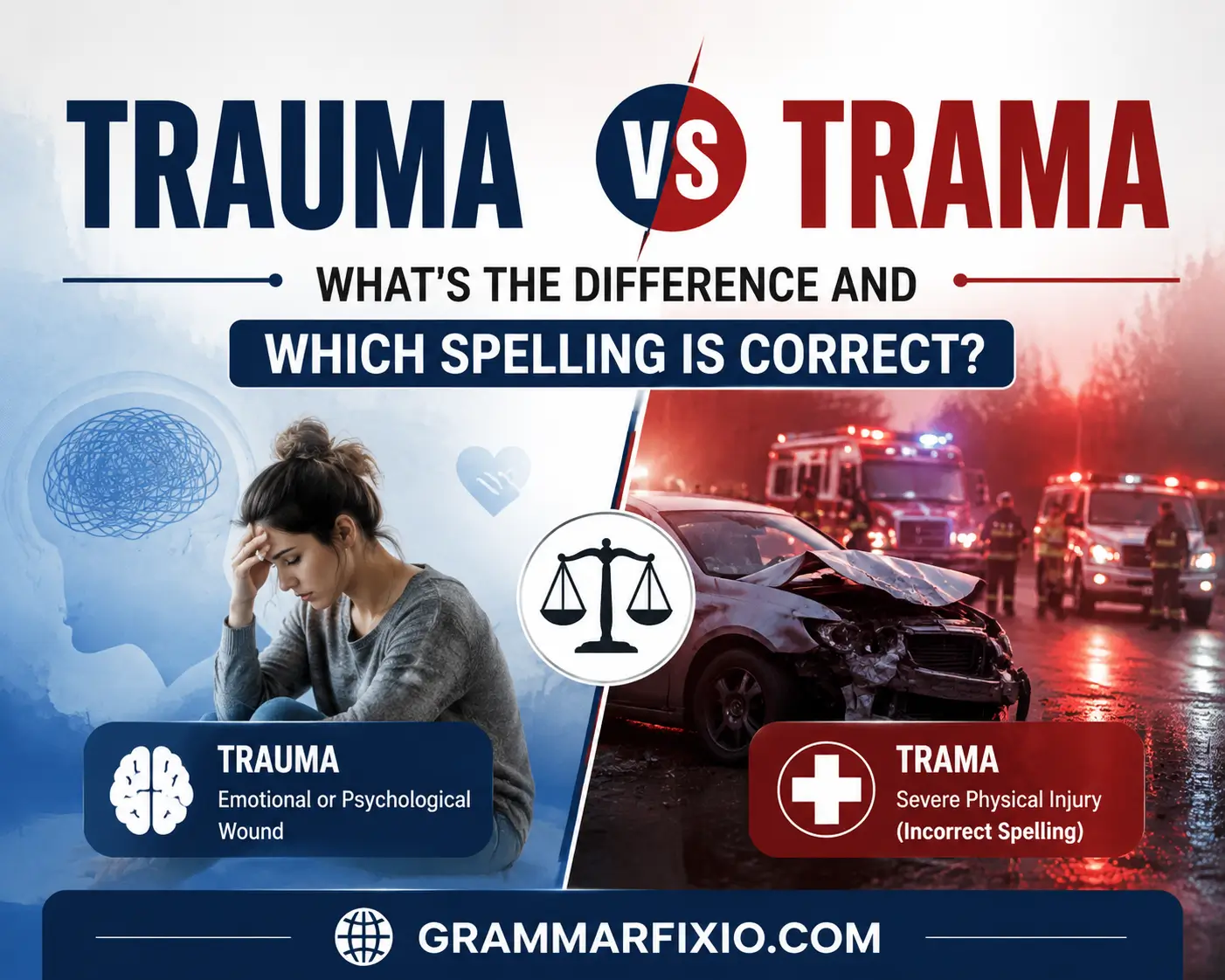
When you look at trauma vs trama, the first thing that usually happens is confusion. The word looks simple at first glance, yet the difference between them feels hidden. Many people get stuck on spelling because both words look almost the same. You might even find yourself staring at it for a moment, trying to decide what is right and what feels correct.
In real writing situations, I’ve noticed this issue comes up during academic work and even formal work, where clarity and credibility matter. A small mistake like a missing u changes everything.
The brain tries to fill the gap, and that creates confusion, especially when the sound feels identical and the meaning seems close at a reasonable glance. This is where writing, clear writing, and accurate writing become important, because one small spelling mistake can break the flow of communication and reduce confidence in the message.
What makes it more interesting is how fast typing, autocorrect errors, and bilingual influence increase this problem. You may see trama and trauma used in online posts, and both appear like different words, but only one is the recognized English word. The misspelling often spreads through online searches where thousands of people encounter terms and end up more confused. In such cases, even students, writers, and professionals depend on guide, understanding, and simple memory tricks to avoid repeated mistakes.
Trauma vs Trama: The Quick Answer
If you’re looking for a fast answer, here it is:
- Trauma is the correct English word.
- Trama is not the English spelling of trauma.
- In some languages, such as Spanish and Italian, trama has its own meaning.
- The words should not be used interchangeably.
Is It Trauma or Trama?
When writing in English, the correct spelling is almost always trauma.
For example:
✅ She experienced emotional trauma after the accident.
✅ The patient was admitted to the trauma unit.
❌ She experienced emotional trama after the accident.
The last example contains a spelling mistake in standard English.
Which Word Is Correct in English?
The answer is simple. Trauma is the accepted English word found in dictionaries, academic publications, medical journals, and everyday communication.
While trama exists in other languages, English speakers generally use trauma when referring to psychological or physical injury.
Quick Comparison Table
| Feature | Trauma | Trama |
| English word | Yes | No |
| Medical usage | Yes | No |
| Psychological usage | Yes | No |
| Found in English dictionaries | Yes | Usually no |
| Used in Spanish | No | Yes |
| Used in Italian | No | Yes |
| Refers to injury or distress | Yes | No |
Read this also: Cancellation vs Cancelation: Which Spelling Is Correct?
What Does Trauma Mean?
The word trauma carries significant weight because it describes experiences that can deeply affect a person’s body, mind, or emotional well-being.
Trauma Definition
Trauma refers to a deeply distressing event or physical injury that overwhelms a person’s ability to cope.
The impact may be immediate. Sometimes it appears weeks, months, or even years later.
A traumatic event can involve:
- Serious accidents
- Natural disasters
- Violence
- Abuse
- Military combat
- Sudden loss of a loved one
- Medical emergencies
Not everyone responds to difficult experiences in the same way. An event that causes severe trauma for one person may affect another person differently.
Trauma in Everyday Language
Outside professional settings, people often use trauma to describe painful experiences that leave lasting emotional effects.
Examples include:
- Childhood neglect
- Bullying
- Divorce
- Relationship abuse
- Witnessing violence
Many people associate trauma with dramatic events. However, emotional wounds can also develop from repeated stressful experiences over time.
Trauma in Medical Contexts
In medicine, trauma often refers to a serious physical injury.
Examples include:
- Broken bones
- Head injuries
- Severe burns
- Internal bleeding
- Vehicle accident injuries
Hospitals commonly have trauma centers that specialize in treating patients with life-threatening injuries.
Trauma in Psychology and Mental Health
Psychologists view trauma as an emotional response to an overwhelming event.
The effects may include:
- Fear
- Anxiety
- Flashbacks
- Emotional numbness
- Sleep disturbances
- Difficulty concentrating
Psychological trauma can alter the way a person views safety, trust, and relationships.
Trauma is not defined solely by what happened. It is also shaped by how the experience affects the individual afterward.
Types of Trauma
Not all trauma looks the same. Mental health professionals generally classify trauma into several categories.
Understanding these categories helps explain why people respond differently to difficult experiences.
Acute Trauma
Acute trauma results from a single distressing event.
Examples include:
- A car accident
- A violent assault
- A natural disaster
- A sudden medical emergency
Symptoms often appear shortly after the event. Some individuals recover relatively quickly, while others continue struggling for years.
Chronic Trauma
Chronic trauma develops when a person experiences ongoing or repeated stressful events.
Examples include:
- Domestic violence
- Long-term bullying
- Ongoing abuse
- Living in a conflict zone
Because the stress continues over time, the effects can become deeply rooted.
Complex Trauma
Complex trauma usually involves repeated exposure to traumatic experiences, often during childhood.
Examples include:
- Childhood abuse
- Neglect
- Family instability
- Long-term emotional mistreatment
Complex trauma can influence:
- Self-esteem
- Emotional regulation
- Relationships
- Identity development
Comparison of Trauma Types
| Type | Cause | Duration | Example |
| Acute Trauma | Single event | Short-term event | Car accident |
| Chronic Trauma | Repeated events | Long-term | Ongoing abuse |
| Complex Trauma | Multiple traumatic experiences | Often years | Childhood neglect |
Common Causes of Trauma
Trauma can emerge from many different situations. What matters most is how the event affects the individual.
Accidents and Injuries
Serious accidents remain one of the most common sources of trauma.
Examples include:
- Car crashes
- Workplace injuries
- Sports injuries
- Falls
Even after physical recovery, emotional distress may remain.
Read this also: Fliers vs Flyers: Which Spelling Is Correct and When Should You Use Each?
Violence and Abuse
Violence often leaves deep psychological scars.
Examples include:
- Physical abuse
- Sexual abuse
- Emotional abuse
- Community violence
Survivors may struggle with trust, fear, and feelings of vulnerability.
Natural Disasters
Natural disasters can suddenly destroy a person’s sense of safety.
Examples include:
- Earthquakes
- Floods
- Hurricanes
- Wildfires
The unpredictability of these events often contributes to long-lasting emotional effects.
Loss, Grief, and Major Life Changes
Trauma isn’t limited to violence or injury.
People may experience trauma after:
- Losing a loved one
- Serious illness
- Divorce
- Forced displacement
- Financial collapse
Life-changing events can challenge a person’s emotional stability and sense of control.
Signs and Symptoms of Trauma
Trauma affects people differently. Symptoms may be emotional, physical, behavioral, or cognitive.
Some signs appear immediately. Others emerge months later.
Emotional Symptoms
Many trauma survivors experience intense emotional reactions.
Common emotional symptoms include:
- Fear
- Anxiety
- Sadness
- Anger
- Shame
- Guilt
- Irritability
Some individuals feel emotionally overwhelmed. Others feel disconnected from their emotions altogether.
Physical Symptoms
Trauma can affect the body as much as the mind.
Physical symptoms may include:
- Headaches
- Fatigue
- Muscle tension
- Digestive issues
- Rapid heartbeat
- Sleep problems
The body’s stress response often remains activated long after the traumatic event ends.
Behavioral Symptoms
Behavior often changes following trauma.
Some common signs include:
- Social withdrawal
- Avoiding reminders of the event
- Increased substance use
- Risk-taking behavior
- Difficulty maintaining routines
These behaviors frequently develop as coping mechanisms.
Cognitive Symptoms
Trauma can influence thinking patterns and memory.
Examples include:
- Difficulty concentrating
- Confusion
- Negative thoughts
- Memory problems
- Intrusive memories
Many people describe feeling mentally exhausted even when they appear physically healthy.
How Trauma Affects the Brain and Body
Modern neuroscience has revealed that trauma can produce measurable changes in brain function.
These changes help explain why traumatic experiences can feel impossible to simply “forget.”
The Role of the Amygdala
The amygdala acts as the brain’s alarm system.
When trauma occurs:
- The amygdala becomes highly active.
- Threat detection increases.
- Fear responses become stronger.
As a result, survivors may remain alert even when no danger exists.
Effects on the Hippocampus
The hippocampus helps process memories.
Trauma can interfere with this process.
Consequences may include:
- Fragmented memories
- Difficulty organizing events chronologically
- Intrusive recollections
- Flashbacks
This explains why traumatic memories often feel vivid and immediate years later.
Changes in the Prefrontal Cortex
The prefrontal cortex supports rational thinking and decision-making.
During intense stress:
- Logical thinking may weaken.
- Emotional reactions may become stronger.
- Problem-solving abilities can decline temporarily.
This neurological response is a survival mechanism rather than a personal weakness.
Long-Term Impact on Health
Research increasingly shows connections between trauma and long-term health outcomes.
Potential effects include:
- Chronic stress
- Anxiety disorders
- Depression
- Cardiovascular issues
- Sleep disorders
- Immune system changes
The mind and body operate as a connected system. When trauma affects one, the other often feels the impact as well.
What Does Trama Mean?
Now let’s talk about the word that causes all the confusion: trama.
At first glance, it looks like a typo. In English writing, that is usually true. However, outside English, the word has real meanings and legitimate usage.
Is Trama an English Word?
In standard English, trama is not the correct word for physical or psychological trauma. If you use it in an English essay or article, it will be marked as a spelling mistake.
So in most English contexts:
- Trauma = correct
- Trama = incorrect spelling
But the story doesn’t end there.
Trama in Spanish
In Spanish, trama is a real and commonly used word. It means:
- Plot (of a story or film)
- Scheme or structure of events
- Intricate design or arrangement
For example:
- La trama de la película es compleja.
(The plot of the movie is complex.)
Here, “trama” has nothing to do with injury or emotional distress. It belongs to storytelling and narrative structure.
Trama in Italian
In Italian, trama also exists and carries similar meanings:
- Plot of a story
- Fabric or weaving structure
This is where things get even more interesting. The word connects storytelling and textiles, not psychology or medicine.
Trama in Literature and Storytelling
Writers often use “trama” to describe how a story unfolds. It refers to:
- The sequence of events
- The underlying structure of a narrative
- How characters and conflicts develop
Think of it as the “skeleton” of a story.
Trama in Textiles and Weaving
In textile terminology, trama refers to the horizontal threads woven through fabric.
In simple terms:
- Warp = vertical threads
- Trama = horizontal threads
Together, they create cloth.
So while “trama” looks similar to “trauma,” it belongs to an entirely different world.
Trauma vs Trama: Side-by-Side Comparison
This is where clarity becomes essential. One letter changes everything.
Meaning
- Trauma: Emotional or physical injury caused by distressing events
- Trama: Plot, structure, or weaving element in other languages
Language Usage
- Trauma: English
- Trama: Spanish, Italian
Pronunciation
- Trauma: /ˈtrɔː.mə/ or /ˈtraʊ.mə/
- Trama: /ˈtraː.ma/ (varies by language)
Usage Context
- Trauma: Psychology, medicine, everyday emotional language
- Trama: Literature, storytelling, textile industry
Quick Comparison Table
| Feature | Trauma | Trama |
| Language | English | Spanish / Italian |
| Meaning | Injury or distress | Plot / structure / weave |
| Field | Medicine, psychology | Literature, textiles |
| Correct in English | Yes | No |
Why People Misspell Trauma as Trama
This confusion is extremely common, and it happens for several understandable reasons.
Typing and Spelling Errors
Fast typing often removes letters unintentionally. Since “trauma” and “trama” differ by only one letter, it’s easy to miss the “u.”
Pronunciation Confusion
When spoken quickly, the “au” sound in trauma can feel subtle. Some listeners mentally simplify it to “trama.”
Autocorrect and Search Behavior
Sometimes devices even reinforce the mistake:
- People type “trama”
- Search engines still show results related to “trauma”
- This blurs the difference further
Influence of Other Languages
In multilingual regions, people may already know “trama” from Spanish or Italian. That familiarity carries over into English writing.
Trauma vs Trama in Sentences
Let’s make the difference crystal clear with real examples.
Correct Usage of Trauma
- She is recovering from emotional trauma after the accident.
- The hospital admitted several trauma patients after the crash.
- Childhood trauma can affect adult relationships deeply.
Correct Usage of Trama (Non-English Context)
- The trama of the novel keeps readers engaged until the end.
- In weaving, the trama forms the horizontal structure of fabric.
Incorrect Usage Examples
- ❌ He suffered trama after the explosion.
- ❌ The patient was treated for trama injuries.
These sentences are incorrect in English writing.
Case Study: Small Spelling, Big Impact
Imagine a student writing a psychology assignment.
Incorrect Version
“The patient experienced trama after the traumatic event.”
Correct Version
“The patient experienced trauma after the traumatic event.”
Why It Matters
That single missing letter:
- Changes credibility
- Affects grading in academics
- Reduces clarity in professional writing
In medical documentation, the difference can even affect interpretation.
SEE must: Realize vs Realise: Meaning, Differences, Grammar Rules, and Examples
How to Remember the Correct Spelling of Trauma
Here are simple tricks that actually work.
Memory Trick 1: “You need the U for Understanding”
Think of it like this:
- Trauma needs understanding
- Without “u,” it loses meaning in English
Memory Trick 2: Think of “Audio”
The “au” in trauma sounds like “aw.”
Say it slowly:
- Trau-ma → “aw” sound in the middle
Memory Trick 3: Break It Down
- Trau + ma
- Not Tra + ma
Just keeping that extra “u” in mind helps avoid mistakes.
Common Mistakes to Avoid
Many writers repeat the same errors without noticing.
Using Trama in English Writing
This is the most common mistake. Always double-check spelling before publishing.
Confusing Trauma with Stress
Stress and trauma are not the same:
- Stress = everyday pressure
- Trauma = deep emotional or physical shock
Overusing the Word Trauma
Not every difficult experience is trauma. Using it too loosely can weaken its meaning.
Trauma vs PTSD vs Stress
These three terms often get mixed up.
Trauma
- The experience or event
- Example: accident, abuse, disaster
PTSD (Post-Traumatic Stress Disorder)
- A medical condition that may develop after trauma
- Symptoms include flashbacks, anxiety, and avoidance
Stress
- Everyday pressure or tension
- Usually temporary
Simple Comparison Table
| Term | Definition | Severity |
| Stress | Daily pressure | Low to moderate |
| Trauma | Distressing event | High |
| PTSD | Clinical disorder | High and long-term |
Conclusion
Understanding Trauma vs Trama is really about fixing a small spelling slip that causes a big meaning gap. Trauma is the correct English word used in psychology, medicine, and everyday communication to describe emotional or physical injury. On the other side, trama belongs to other languages like Spanish and Italian, where it refers to things like story structure or weaving patterns, not emotional distress.
The confusion usually comes from how similar both words look and sound. Fast typing, autocorrect, and online habits make the mistake even more common. Once you clearly see the difference, it becomes easy to avoid the error and write with more clarity, accuracy, and confidence.
FAQs
Q1: What is the difference between Trauma vs Trama?
Trauma is the correct English word meaning emotional or physical injury. Trama is not used in English in this context and is considered a misspelling.
Q2: Is “trama” a real word?
Yes, but not in English psychology or medical usage. In Spanish and Italian, trama can mean plot, structure, or weaving pattern.
Q3: Why do people confuse trauma and trama?
People confuse them because the words look almost identical, differ by one letter, and sound very similar when spoken quickly.
Q4: Can trauma affect mental and physical health?
Yes. Trauma can lead to anxiety, stress, sleep problems, emotional distress, and even physical health issues over time.
Q5: How can I remember the correct spelling of trauma?
Think of the “u” in trauma as standing for “understanding.” Without it, the word loses its correct English meaning.