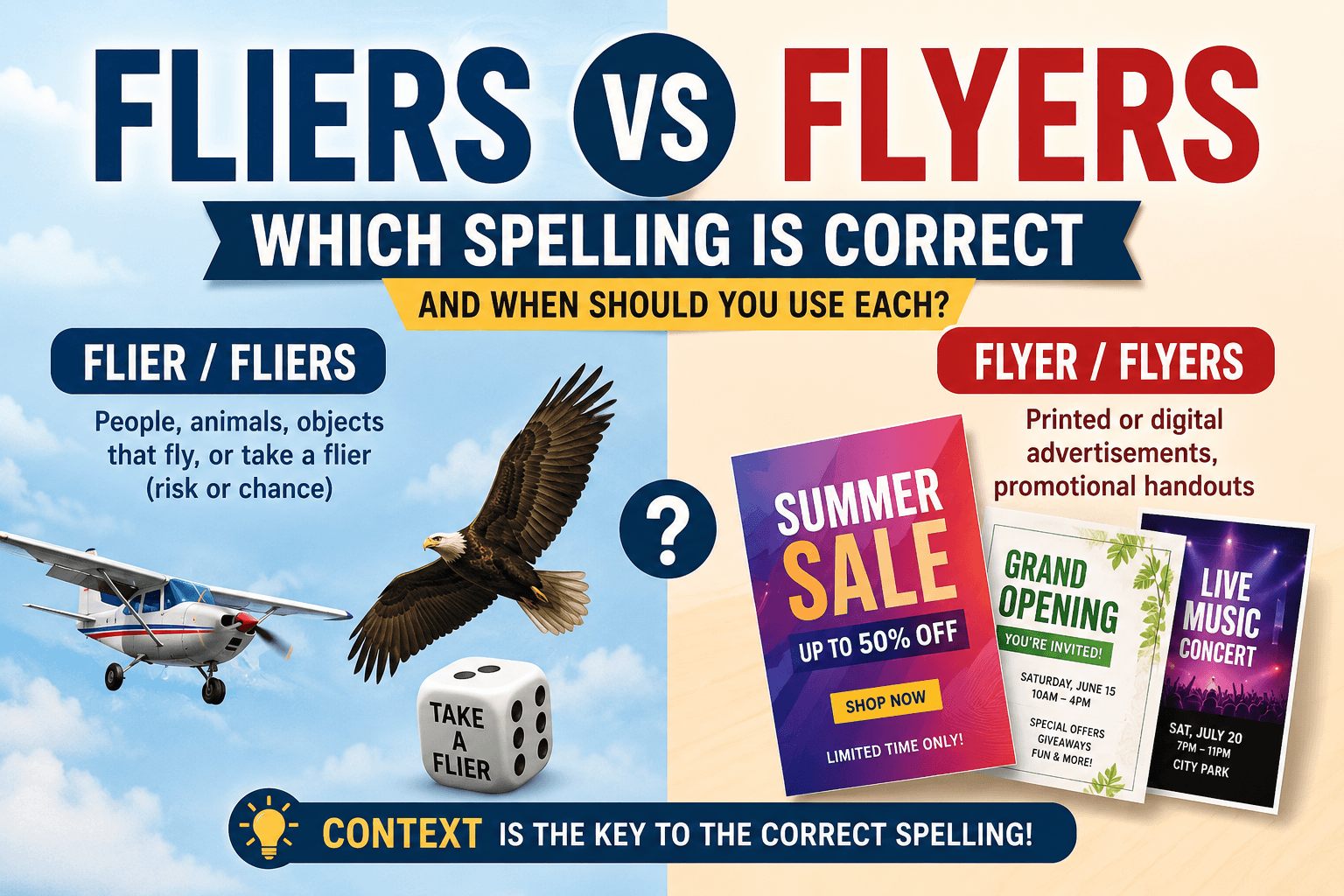
Fliers vs Flyers becomes easier when you match the spelling to the meaning, the sentence, and the style guide your reader expects in clear writing. Both forms are valid English words, and each works as a noun. They share the same pronunciation, but context gives each form its clearest use.
For advertising, flyer is the safer spelling choice. Use it for a printed advertisement, paper flyer, promotional handout, small pamphlet, or digital promotion. In aviation, flyer and flier may describe an air traveler, aviator, animal that flies, or flying object. Follow official names and your publication style.
Consistency prevents spelling confusion. Don’t switch spellings for the same meaning without a clear reason. Check singular forms and plural forms, including flyer, flier, flyers, and fliers. When no language rule applies, use flyer for promotional materials and everyday communication, while keeping flier in the established phrase “take a flier.”
Fliers vs Flyers: Quick Answer
Both flyers and fliers are valid English plurals.
However, modern usage doesn’t treat them equally in every situation.
Use flyers for printed or digital advertisements. For people and things that fly, either spelling may work, although many publications and organizations prefer flyers. Use flier in the idiom take a flier.
Here’s the practical rule:
Use “flyer” as your everyday default. Choose “flier” for “take a flier” or when your required style guide prefers it.
| Meaning or situation | Best general choice | Example |
| Printed advertisement | flyer | We distributed flyers before the event. |
| Digital promotional graphic | flyer | She posted the webinar flyer online. |
| Airline passenger | flyer or flier | He’s a nervous flyer. |
| Person who regularly travels by air | frequent flyer or frequent flier | Frequent flyers often collect loyalty points. |
| Pilot or aviator | flyer or flier | The skilled flier landed safely. |
| Bird, insect, or flying object | flyer or flier | Swallows are agile flyers. |
| Risky decision or investment | flier | The company took a flier on the idea. |
| Official title or brand | Follow the official spelling | The Philadelphia Flyers won the game. |
The main lesson is simple: both spellings exist, but some meanings strongly favor one form.
What Does “Flyer” Mean?
Flyer is a countable noun. Its meaning changes according to context.
Most readers immediately connect the word with a small printed advertisement. Still, it can also describe a traveler, pilot, bird, machine, or object that flies.
Flyer as an Advertisement
A flyer is usually a single printed or digital sheet that promotes something or shares information.
Businesses, schools, charities, political campaigns, clubs, and community groups use flyers to announce:
- Sales
- Concerts
- Meetings
- Job openings
- Fundraisers
- Classes
- Public events
- New products
- Local services
- Election campaigns
Examples:
- The bakery printed flyers for its grand opening.
- Volunteers handed out flyers near the train station.
- The school emailed a digital flyer to parents.
- A colorful flyer advertised the weekend market.
This spelling dominates in advertising because readers recognize it quickly. Although flier can sometimes carry the same meaning, flyer looks more natural in modern promotional language.
See must: Requester vs Requestor: Which Spelling Is Correct and When Should You Use It?
Flyer as a Person Who Travels by Air
A flyer can also mean someone who travels on an airplane.
Examples:
- She’s an experienced flyer who travels twice a month.
- Nervous flyers may prefer aisle seats.
- The airline offers benefits to frequent flyers.
- First-time flyers should arrive early at the airport.
In these examples, the person doesn’t need to control the aircraft. A passenger can be a flyer.
Flyer as a Pilot
The word may also describe someone who operates an aircraft.
Examples:
- The young flyer completed his first solo flight.
- Military flyers trained in difficult weather.
- She became a skilled flyer after years of practice.
However, pilot or aviator often provides greater precision. When clarity matters, choose the more specific term.
Flyer as Something That Flies
Birds, insects, aircraft, toys, and machines can all be called flyers.
Examples:
- Falcons are exceptionally fast flyers.
- This paper airplane is a surprisingly good flyer.
- Some beetles are stronger flyers than others.
- The experimental aircraft proved to be a stable flyer.
Here, the word describes an ability or tendency to fly.
What Does “Flier” Mean?
Flier is another countable noun pronounced exactly like flyer. Say both words as FLY-er.
The spelling often refers to a person or thing that flies. It may also describe an airplane traveler, pilot, printed circular, or speculative risk.
Flier as a Person or Thing That Flies
Many dictionaries accept flier for a bird, insect, pilot, passenger, aircraft, or other flying object.
Examples:
- The eagle is a powerful flier.
- He became a confident flier after taking several trips.
- The aircraft was a reliable flier.
- The bat is a highly maneuverable flier.
Some editors prefer this spelling because it follows a familiar pattern. For example, cry becomes crier, and try becomes trier. Yet English spelling rarely behaves with perfect consistency.
Flier as a Risky Venture
Flier also describes a speculative action or risky decision.
You’ll usually see this meaning in the expression “take a flier.”
Examples:
- The investor took a flier on an untested company.
- The coach took a flier on an inexperienced player.
- She took a flier and applied for the highly competitive role.
In each sentence, someone accepts uncertainty because the possible reward seems worthwhile.
Can Flier Mean an Advertisement?
Yes. Several respected dictionaries recognize flier as an alternative spelling for a paper advertisement.
For example:
- Campaign workers distributed fliers throughout the neighborhood.
- A local business mailed fliers to nearby homes.
These sentences aren’t grammatically wrong. Even so, flyers remains the clearer and more common choice for promotional sheets.
The Difference Between Flier and Flyer
The two words overlap heavily. They aren’t opposites, and one isn’t simply the British version of the other.
Their main difference comes from usage preference, not from a strict grammatical law.
| Feature | Flyer | Flier |
| Part of speech | Noun | Noun |
| Pronunciation | FLY-er | FLY-er |
| Advertisement meaning | Strongly preferred | Accepted by some dictionaries |
| Airline passenger meaning | Common | Common |
| Pilot meaning | Accepted | Accepted |
| Bird or object that flies | Accepted | Accepted |
| Risky venture meaning | Less conventional | Preferred |
| Plural | Flyers | Fliers |
| Singular possessive | Flyer’s | Flier’s |
The Meanings Often Overlap
When the word describes someone or something that flies, writers can often choose either form.
Both sentences can be correct:
- The bird is a graceful flyer.
- The bird is a graceful flier.
Likewise:
- She’s a frequent flyer.
- She’s a frequent flier.
The important point is consistency. Don’t alternate between spellings for the same meaning unless you need to preserve an official name.
One Meaning Strongly Favors Flyer
When discussing an advertisement, announcement, or promotional handout, use flyer.
For example:
- restaurant flyer
- campaign flyer
- concert flyer
- real estate flyer
- school flyer
- event flyer
- digital flyer
- job fair flyer
Readers understand this spelling instantly. Choosing flier may distract them even when a dictionary accepts it.
One Expression Strongly Favors Flier
The idiom “take a flier” traditionally uses the -ier form.
It refers to a risky attempt, gamble, investment, or decision.
- Correct conventional form: take a flier
- Less conventional form: take a flyer
This distinction gives writers an easy starting point.
Is It Flyer or Flier for an Advertisement?
Use flyer for a printed or digital advertisement.
A traditional flyer usually consists of one unfolded sheet. It may appear on a noticeboard, arrive in the mail, sit on a counter, or pass directly from one person to another.
Today, the same term also covers digital graphics shared through:
- Social media
- Messaging apps
- Websites
- Online community groups
- Event platforms
- Digital noticeboards
Advertisement Examples
- The gym created a flyer for its membership offer.
- We posted the event flyer on social media.
- Someone left a restaurant flyer at the front desk.
- The charity printed 1,000 flyers for its fundraiser.
- Students designed a flyer for the school play.
Flyer, Leaflet, Handbill, Pamphlet, or Brochure?
These terms overlap, but they don’t always describe the same format.
| Term | Typical meaning |
| Flyer | A single promotional or informational sheet |
| Leaflet | A small sheet that shares information or instructions |
| Handbill | A printed notice designed for public distribution |
| Pamphlet | A short, unbound publication about one subject |
| Brochure | A folded or multipage promotional document |
| Poster | A larger printed notice displayed on a wall or board |
| Circular | A notice distributed to a large group |
| Booklet | A small bound or folded publication with several pages |
In everyday speech, people may use these words loosely. A folded flyer might get called a brochure. A political leaflet might also be described as a campaign flyer.
Still, format and purpose can guide your choice.
A Practical Publishing Scenario
Imagine a local restaurant announcing a new lunch menu.
The restaurant creates a one-page sheet containing photos, prices, opening hours, and a discount code. Staff members distribute copies around the neighborhood.
Calling the sheet a flyer gives readers the clearest description.
Now imagine the restaurant creates a folded document with several panels covering its history, full menu, catering options, and contact details. In that case, brochure may fit better.
The difference isn’t only spelling. It also involves the document’s structure and purpose.
Is It Frequent Flyer or Frequent Flier?
Both frequent flyer and frequent flier can describe someone who travels regularly by airplane.
However, frequent flyer has become the more familiar form in general travel language.
Examples:
- She’s a frequent flyer who travels for work.
- Frequent flyers know how to move through security efficiently.
- He joined the airline’s frequent flyer program.
The alternative remains correct:
- She’s a frequent flier.
- Frequent fliers often prefer carry-on luggage.
Follow Official Program Names
Airlines, banks, credit-card companies, and travel programs may choose a specific spelling.
Always reproduce an official name exactly. Don’t “correct” a brand’s wording to match your preferred dictionary.
The same principle applies to:
- Company names
- Sports teams
- Loyalty programs
- Product names
- Awards
- Publications
- Registered trademarks
For example, Philadelphia Flyers is a proper name. Changing it to Philadelphia Fliers would create an error.
Hyphenating Frequent Flyer
As a standalone noun, write the phrase without a hyphen:
- She is a frequent flyer.
- The lounge welcomes frequent flyers.
Before another noun, some editorial styles use a hyphen:
- frequent-flyer benefits
- frequent-flyer account
- frequent-flyer program
However, many airlines and brands leave the phrase open:
- frequent flyer program
- frequent flyer miles
Therefore, follow your style guide or copy the official product name.
Flyer or Flier for a Pilot, Bird, or Flying Object?
Either spelling may work when the word refers to something that flies.
Still, consider whether a more precise noun would improve the sentence.
Instead of writing:
- The flier checked the controls.
You might write:
- The pilot checked the controls.
Instead of:
- The small flyer moved between flowers.
You might write:
- The butterfly moved between flowers.
Specific nouns usually create sharper images. Use flyer or flier when the ability to fly matters more than the exact identity.
Examples Involving People
- The rescue pilot was an accomplished flier.
- As a nervous flyer, Emma avoided window seats.
- The student flyer practiced landing in crosswinds.
- Experienced fliers remained calm during the delay.
Examples Involving Animals
- Swifts are remarkably efficient flyers.
- The falcon is a fast and agile flier.
- Young bats become stronger fliers with practice.
- Penguins are flightless birds, not aerial flyers.
Examples Involving Objects
- That kite is a steady flyer in strong wind.
- The prototype became a successful flier after several adjustments.
- His paper airplane was the best flyer in the class.
- The model plane is a difficult flier for beginners.
What Does “Take a Flier” Mean?
To take a flier means to accept a risk or try something with an uncertain outcome.
The phrase often appears in discussions about:
- Business
- Investing
- Hiring
- Sports
- Politics
- Creative work
- Career decisions
- Product development
Examples:
- The publisher took a flier on a first-time novelist.
- Investors took a flier on the small startup.
- The baseball team took a flier on an injured veteran.
- She took a flier and submitted her painting to the exhibition.
The expression doesn’t always imply recklessness. Sometimes, it describes a calculated risk with limited potential loss.
Real-Life Business Scenario
A small retailer finds an unfamiliar product from a new supplier. Customer demand remains uncertain, so the owner orders only 20 units.
The owner has taken a flier on the product.
If it sells well, the store can order more. If it fails, the limited order reduces the financial damage.
That’s a calculated gamble rather than a blind leap.
Synonyms for Take a Flier
Depending on the context, you could write:
- Take a chance
- Make a gamble
- Accept the risk
- Try your luck
- Make a speculative move
- Test an uncertain idea
- Give something a shot
- Venture into unknown territory
Choose carefully. Take a chance sounds neutral, while gamble may suggest greater danger.
What Style Guides and Dictionaries Recommend
The disagreement between flyer and flier comes partly from differences among language authorities.
No single dictionary controls all English writing. Publishers, newsrooms, schools, businesses, and professional organizations may follow different references.
| Authority | General treatment |
| AP Style | Prefers flyer for aircraft passengers and handbills; keeps flier in take a flier |
| Merriam-Webster | Gives flier priority for one that flies and a risky venture; usually uses flyer for an advertising circular |
| Cambridge Dictionary | Recognizes both spellings for advertisements and people who fly |
| Collins Dictionary | Recognizes flyer and flier across several overlapping meanings |
These differences explain why two careful writers may make different choices.
Which Rule Should You Follow?
Use this order of priority:
- Follow your organization’s house style.
- Preserve official names exactly.
- Use the dictionary required by your school or publisher.
- Stay consistent throughout the document.
- When no rule applies, choose flyer as the practical default.
For example, a newspaper following AP guidance should use frequent flyer. A publisher following Merriam-Webster closely may prefer frequent flier.
Neither writer acts carelessly. They simply follow different editorial authorities.
American English and British English Usage
This spelling issue isn’t a straightforward regional divide.
It doesn’t work like:
- color and colour
- center and centre
- organize and organise
- traveling and travelling
Both flyer and flier appear in American and British English.
Regional habits may influence frequency. However, meaning, editorial policy, official naming, and personal preference often matter more than location.
For an international audience, flyer usually gives you the most familiar general form, especially for advertisements and airline passengers.
High Flyer or High Flier?
A high-flyer is an ambitious, talented, or successful person who rises quickly.
The expression often describes people in business, finance, politics, education, or another competitive field.
Examples:
- She became a high-flyer in the technology industry.
- The company recruits young high-flyers from leading universities.
- He was once considered a political high-flier.
- Several financial high-flyers attended the conference.
Both forms appear, although high-flyer is widely recognized.
High-Flyer vs. High-Flying
These forms serve different grammatical roles.
| Form | Function | Example |
| high-flyer | Noun describing a successful person or thing | She’s a corporate high-flyer. |
| high-flier | Alternative noun spelling | He was a high-flier in finance. |
| high-flying | Adjective describing success or ambition | She joined a high-flying law firm. |
Compare these sentences:
- The high-flying executive became a well-known high-flyer.
- Investors watched the high-flying stock closely.
- Yesterday’s market high-flyer fell sharply today.
Grammar Rules for Flyer and Flier
The spelling choice affects plural and possessive forms.
Plural Forms
Add -s to flyer:
- one flyer
- two flyers
Change the y in flier only as part of its existing spelling, then add -s:
- one flier
- two fliers
Correct:
- The company printed 500 flyers.
- Several fliers waited near the gate.
Incorrect:
- The company printed 500 flyer’s.
An apostrophe doesn’t create a regular plural.
Singular Possessive Forms
Add an apostrophe and s:
- the flyer’s headline
- the flier’s luggage
Examples:
- The flyer’s headline was difficult to read.
- The flier’s suitcase arrived late.
Plural Possessive Forms
Add an apostrophe after the plural s:
- the flyers’ colors
- the fliers’ tickets
Examples:
- The flyers’ designs used the same logo.
- The fliers’ boarding passes were checked.
Quick Grammar Table
| Form | Meaning | Example |
| flyer | One advertisement or person | The flyer looks professional. |
| flyers | More than one | We printed 200 flyers. |
| flyer’s | Belonging to one | The flyer’s title is too small. |
| flyers’ | Belonging to several | The flyers’ layouts are similar. |
| flier | One person, thing, or venture | The bird is a strong flier. |
| fliers | More than one | The fliers boarded early. |
| flier’s | Belonging to one | The flier’s bag was missing. |
| fliers’ | Belonging to several | The fliers’ seats were reassigned. |
Real-Life Examples of Flier and Flyer Usage
Context becomes clearer when you see the spellings in practical situations.
Marketing Scenario
A community theater needs to promote a new play. Its designer creates a one-page advertisement containing the title, performance dates, ticket price, and venue.
The correct practical label is theater flyer.
The team could say:
- We designed a flyer for the new production.
- Volunteers will distribute flyers downtown.
- The digital flyer includes a ticket code.
Travel Scenario
Daniel travels by airplane every week for work. He belongs to several airline loyalty programs and knows how to pack quickly.
You could describe him as:
- a frequent flyer
- a frequent flier
- an experienced air traveler
The first form will look most familiar to many readers. The second remains valid.
Wildlife Scenario
A researcher compares two bird species. One travels long distances efficiently, while the other flies only short distances.
The researcher might write:
- The first species is a stronger flier.
- The first species is a stronger flyer.
Both spellings work because the word describes flying ability.
Investment Scenario
A person buys a small amount of stock in an unproven company. The investment could grow dramatically or lose its value.
The person has taken a flier on the company.
Here, the -ier spelling fits the established idiom.
Common Mistakes With Flyer and Flier
Most errors come from treating the spellings as completely separate words or assuming only one can ever be correct.
Claiming That Flier Is Always Wrong
Flier appears in established dictionaries and edited publications. It works for people and things that fly. It also remains standard in take a flier.
Using Flier for Every Meaning
Although dictionaries may permit flier for an advertisement, the spelling can look unusual to modern readers.
Less natural:
- The shop handed out sale fliers.
Clearer default:
- The shop handed out sale flyers.
Writing “Take a Flyer”
Readers will understand the phrase, but take a flier remains the conventional edited form.
Preferred:
- The manager took a flier on a new employee.
Switching Spellings Randomly
Inconsistent:
- The frequent fliers joined a program for frequent flyers.
Consistent:
- The frequent flyers joined a program for frequent flyers.
An official program name may justify a change. Otherwise, select one spelling and keep it.
Changing a Proper Name
Never alter the spelling of a registered name merely to satisfy a dictionary preference.
Correct:
- Philadelphia Flyers
- an airline’s officially named frequent-flyer program
- a company name containing Flyer
Proper names follow their owners’ choices.
Confusing Plurals and Possessives
Incorrect:
- We printed 300 flyer’s.
- The fliers bag was missing.
Correct:
- We printed 300 flyers.
- The flier’s bag was missing.
Easy Memory Tricks
A simple memory aid can settle the choice quickly.
The Advertising Y
Connect the y in flyer with common advertising words:
- your event
- your business
- your promotion
When promoting something to your audience, choose flyer.
The Risky I
Connect the i in flier with:
- investment
- idea
- insecurity
- incalculable risk
When someone takes a risky chance, choose flier.
The Default Rule
Remember this sentence:
A flyer promotes; a flier can be a gamble; either one may fly.
It isn’t a complete dictionary definition. However, it captures the most useful distinction.
Synonyms for Flyer and Flier
The best synonym depends on the intended meaning.
Synonyms for an Advertising Flyer
- Leaflet
- Handbill
- Circular
- Notice
- Advertisement
- Pamphlet
- Brochure
- Poster
- Announcement
- Promotional sheet
These words aren’t perfectly interchangeable.
For example, a poster usually hangs in a fixed place. A handbill is distributed by hand. A brochure often contains folds or several pages.
Synonyms for a Person Who Flies
- Pilot
- Aviator
- Air traveler
- Air passenger
- Airman
- Airwoman
- Crew member
Choose the most accurate term. A passenger isn’t necessarily a pilot, and a pilot isn’t always an airline employee.
Synonyms for a Risky Flier
- Gamble
- Chance
- Venture
- Speculation
- Risk
- Long shot
- Experiment
- Calculated bet
Again, tone matters. Experiment sounds measured, while gamble sounds more dangerous.
Related Words and Expressions
Understanding nearby terms can improve word choice.
Fly
The verb means to move through the air or travel by aircraft.
- Birds fly south.
- We’ll fly to Chicago tomorrow.
Flight
A flight may refer to the act of flying, a journey by aircraft, or a group of stairs.
- Our flight leaves at noon.
- The bird changed direction during flight.
- She climbed a flight of stairs.
Flying
Flying can function as a verb form, adjective, or noun.
- The plane is flying overhead.
- He took a flying leap.
- She has a fear of flying.
Aviator
An aviator is someone who operates an aircraft. The term sounds more formal than flyer or flier.
Leaflet
A leaflet is a small printed sheet or folded document that provides information. It may advertise something, explain a cause, or provide instructions.
Circular
A circular is a notice distributed to many people. Businesses may mail advertising circulars to local households.
Frequently Asked Questions
Q1.Which is correct, flier or flyer?
Both spellings are correct. Flyer is more common for advertisements and is also widely used for people or things that fly. Flier remains acceptable in many dictionaries and is preferred in the phrase “take a flier.”
Q2.Is it flyers or fliers for paper advertisements?
Use flyers for paper advertisements, event notices, sales sheets, and promotional handouts. Although some dictionaries accept fliers, the spelling flyers looks more familiar to most readers.
Q3.Is it frequent flyer or frequent flier?
Both forms are acceptable. Frequent flyer is the more familiar choice in general travel writing. Always copy the exact spelling used in an airline’s official loyalty program name.
Q4.Is flier the American spelling and flyer the British spelling?
No. Writers use both spellings in American English and British English. The choice depends more on meaning, dictionary preference, and publication style than on country.
Q5.What does “take a flier” mean?
To take a flier means to take a chance on something risky or uncertain. For example, a company may take a flier on a new product, or a team may take a flier on an unproven player
Conclusion
The difference between fliers and flyers depends mainly on context. Use flyer for a printed or digital advertisement. For a pilot, passenger, bird, or object that flies, both flyer and flier can be correct. However, flyer is usually the safer modern choice. Keep flier in the expression “take a flier,” which means taking a risk. Most importantly, follow your style guide, preserve official names, and use one spelling consistently..