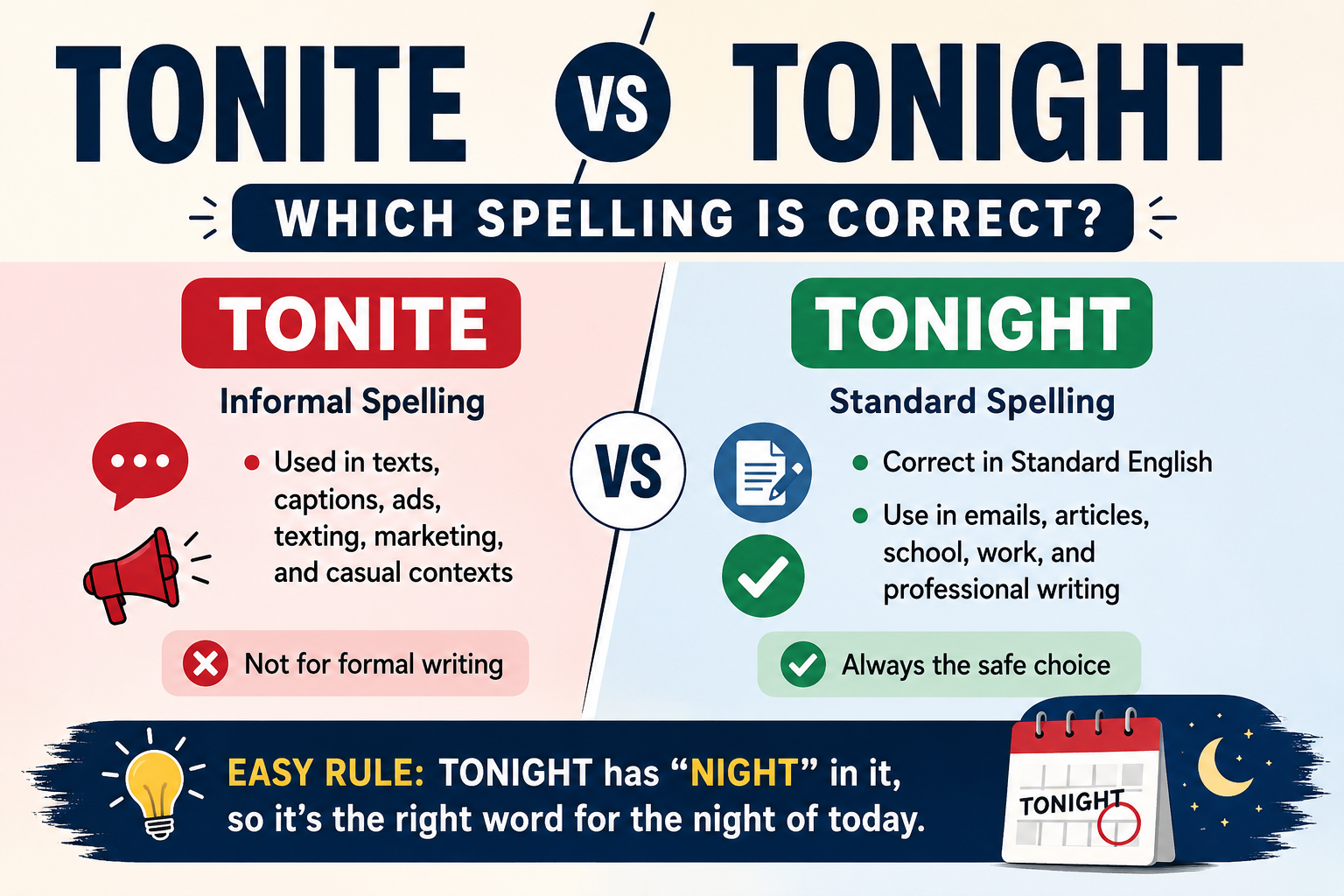
Tonite vs Tonight helps you choose standard English, avoid wrong spelling choice, and protect reader trust in daily writing.
This difference may look like a tiny difference, but the real difference affects credibility. While typing a message, email, caption, or article, using tonite instead of tonight can damage credibility. They sound the same, so people feel confused.
The spelling comparison is easy to break down. Tonight is the correct spelling, proper word, and right one to choose for formal English, professional English, formal writing, professional writing, and clear communication. It improves language clarity and writing accuracy.
Tonite is an informal variant, informal spelling, and shortcut spelling. You may see it in texts, captions, ads, texting, marketing, and casual contexts. In casual usage, that casual shortcut may fit the tone. Still, from practical editing experience, English spelling matters because each spelling sends a different signal.
Quick Answer: Use “Tonight” in Standard English
Use tonight in almost every normal situation.
Tonight is the standard spelling. You can use it in formal, informal, academic, professional, and everyday writing. It works in emails, articles, homework, business messages, invitations, captions, and conversations.
Tonite means the same thing, but it is informal. You may see it in casual texting, advertising, music titles, event posters, club flyers, brand names, or entertainment writing.
Here’s the fastest answer:
| Word | Correct in Standard English? | Meaning | Best Use |
| tonight | Yes | This evening or this night | School, work, emails, articles, daily writing |
| tonite | Informal only | Same general meaning as tonight | Texting, posters, branding, entertainment |
Examples:
- Correct: I’ll call you tonight.
- Correct: The show starts tonight.
- Informal: Live music tonite!
- Avoid in formal writing: The meeting is tonite.
If you want the safe spelling, choose tonight.
What Does “Tonight” Mean?
Tonight means during this evening or during the night of the present day.
You use it when something happens later today, usually in the evening or at night. It can refer to dinner plans, homework, travel, meetings, shows, sports, weather, or anything happening before tomorrow morning.
Examples:
- I’ll finish the report tonight.
- We’re having dinner tonight.
- The game starts tonight.
- It might rain tonight.
- She leaves for Chicago tonight.
The word is simple, but it does useful work. It tells the reader when something happens.
Read this also: Parents’ vs Parent’s — The Simple Grammar Rule That Finally Ends the Confusion
“Tonight” as an Adverb
Tonight often works as an adverb.
An adverb can tell when, where, how, or why something happens. In this case, tonight answers the question when?
Look at these examples:
| Sentence | Question Answered |
| She is studying tonight. | When is she studying? |
| They play tonight. | When do they play? |
| I’ll call you tonight. | When will I call? |
| The train leaves tonight. | When does the train leave? |
In each sentence, tonight tells the time.
Here’s an easy way to test it. Ask, “When?” If the answer is tonight, the word works as an adverb.
“Tonight” as a Noun
Tonight can also work as a noun.
As a noun, it names the present evening or night.
Examples:
- Tonight is important.
- Tonight feels peaceful.
- Tonight will be our last chance.
- Tonight might change everything.
- Tonight was colder than expected.
In these sentences, tonight acts like the subject or main thing being discussed.
That makes tonight flexible. It can describe when an action happens, or it can name the night itself.
Why “Tonight” Is the Standard Spelling
Tonight is the accepted spelling in standard English. Schools teach it. Editors expect it. Spellcheck tools recognize it. Dictionaries list it as the normal form.
It also contains the word night, which helps you remember the correct spelling.
The word breaks down like this:
| Word Part | Meaning |
| to | connected to the present time |
| night | the night part of the day |
| tonight | this night or this evening |
That spelling makes sense because tonight refers to the night of today.
You can use tonight in both formal and casual settings. It never looks too stiff. It never looks too childish. It simply looks correct.
What Does “Tonite” Mean?
Tonite is an informal spelling of tonight.
It usually means the same thing: this evening or this night. However, it has a different tone. It feels casual, playful, promotional, or stylized.
You might see it in places like:
- Event posters
- Music flyers
- Bar signs
- Social media captions
- Text messages
- Comedy show ads
- Brand names
- Song titles
- Nightclub promotions
Examples:
- Live Band Tonite
- Open Mic Tonite
- Pizza Special Tonite
- Movie Night Tonite
- See you tonite!
This spelling catches the eye because it looks short and punchy. However, it doesn’t fit careful writing.
Is “Tonite” Wrong?
Tonite isn’t the spelling you should use in standard English.
A better way to explain it is this: tonite is informal, nonstandard, and style-based.
It isn’t always “wrong” in every possible context. A music poster can use it on purpose. A brand may choose it for a retro look. A friend might text it quickly. In those cases, readers still understand the meaning.
However, in normal writing, tonite can look careless.
Use tonight in:
- School assignments
- Exams
- Essays
- Business emails
- Client messages
- Reports
- Blog posts
- News writing
- Academic content
- Professional invitations
Use tonite only when the informal style is intentional.
Tonite vs Tonight Comparison Table
This table shows the difference clearly.
| Feature | Tonight | Tonite |
| Standard spelling | Yes | No |
| Meaning | This evening or this night | Same general meaning |
| Tone | Clear, correct, polished | Casual, playful, promotional |
| Best for school | Yes | No |
| Best for business | Yes | No |
| Best for SEO content | Yes | Only in comparison topics |
| Common in ads | Yes | Sometimes |
| Common in texting | Yes | Sometimes |
| Spellcheck friendly | Yes | Often flagged |
| Safe choice | Yes | No |
The meaning stays close. The tone changes.
That’s the heart of the issue.
Key Differences Between “Tonite” and “Tonight”
The main difference is not time. Both words point to the evening or night of the current day.
The difference comes from spelling, tone, audience, and context.
The Difference Is Formality
Tonight works almost anywhere.
You can write:
- I’ll send the file tonight.
- The school event starts tonight.
- We’re meeting tonight.
- The weather may change tonight.
These sentences sound normal and clean.
Tonite feels informal. It may work on a poster, but it feels out of place in serious writing.
Example:
- Weak: I’ll send the contract tonite.
- Better: I’ll send the contract tonight.
In a business setting, one small spelling choice can change the tone of the whole message.
The Difference Is Reader Expectation
Readers expect tonight in normal writing.
When they see tonite, they may pause. Some may think it’s a typo. Others may read it as casual slang. Either way, the spelling draws attention to itself.
That can be useful in advertising.
It can hurt in professional writing.
A club flyer that says “Party Tonite” may feel energetic. A school essay that says “The event happened tonite” looks wrong.
Same meaning. Different effect.
The Difference Is Not the Time
Some learners wonder whether tonite means a different type of night.
It doesn’t.
Tonite and tonight usually refer to the same time. The difference is spelling style.
So, don’t think of them as two separate time words. Think of tonight as the standard form and tonite as a casual variation.
When to Use “Tonight”
Use tonight when you want your writing to look correct, clear, and polished.
That covers most situations.
Use “Tonight” in School Writing
Teachers expect standard spelling. So, always use tonight in schoolwork.
Correct:
- The moon is bright tonight.
- I will complete my homework tonight.
- The play begins tonight at 7 PM.
- We studied the poem in class tonight.
Avoid:
- The moon is bright tonite.
- I will complete my homework tonite.
Even if the meaning is clear, the spelling doesn’t fit academic writing.
Use “Tonight” in Work and Business
Professional writing needs trust. Small spelling choices matter because they shape how people see your message.
Use tonight in:
- Emails
- Reports
- Proposals
- Client updates
- Meeting reminders
- Project notes
- Business chats
- Workplace announcements
Examples:
- I’ll send the revised file tonight.
- The team meeting will happen tonight.
- Please review the final draft tonight.
- The payment report goes out tonight.
Tonite can make a work message feel rushed. It may also look like a typo.
Use “Tonight” in Blog and SEO Content
For SEO content, standard spelling usually works best.
Readers search for clean, trustworthy information. Search engines also process standard language more easily. If your article title says “Best Events Tonight,” it feels clearer than “Best Events Tonite.”
Use tonight in normal titles and headings:
| Better SEO Title | Risky or Too Casual |
| Best Things to Do Tonight | Best Things to Do Tonite |
| Dinner Specials Tonight | Dinner Specials Tonite |
| What to Watch Tonight | What to Watch Tonite |
| Events Happening Tonight | Events Happening Tonite |
There is one exception. If your article explains the spelling difference, then using Tonite vs Tonight makes sense as the target topic.
Use “Tonight” in Formal Invitations
Formal invitations should look polished.
Use tonight for:
- Weddings
- Corporate events
- School functions
- Fundraisers
- Religious gatherings
- Public announcements
- Award ceremonies
Examples:
- Dinner starts tonight at 7 PM.
- The ceremony begins tonight.
- Guests should arrive tonight before 6:30.
- The final session takes place tonight.
The standard spelling helps the invitation feel respectful and well-prepared.
When Can You Use “Tonite”?
You can use tonite when the informal style fits the purpose.
Still, use it carefully. It carries a strong casual flavor.
Use “Tonite” in Casual Texting
In a relaxed message to a friend, tonite may be fine.
Examples:
- Movie tonite?
- See you tonite!
- Dinner tonite at 8?
- Game night tonite?
However, tonight also works in texting. It looks cleaner and never feels wrong.
So, when in doubt, write:
- See you tonight.
Use “Tonite” in Posters and Flyers
Tonite often appears in entertainment-style design.
It can create a punchy, playful, retro look.
Examples:
- Karaoke Tonite
- Comedy Show Tonite
- Live Jazz Tonite
- Open Mic Tonite
- DJ Battle Tonite
Why does it work there?
Because posters often use short, bold words. Designers may choose tonite because it looks like nightlife language. It feels less formal and more energetic.
Still, tonight is safer if the event needs a polished tone.
Use “Tonite” in Brand Names or Titles
Names can break grammar rules.
A song, show, restaurant, product, or event can use Tonite as part of its official title. In that case, keep the spelling as the creator chose it.
Examples:
- A song title may use Tonite.
- A club event may use Tonite.
- A brand may use Tonite for style.
- A poster headline may choose Tonite for impact.
Proper names follow branding, not everyday grammar.
Real-Life Examples of Tonite and Tonight
Seeing the words in context makes the difference easier.
In a Text Message
Casual:
- See you tonite!
Standard:
- See you tonight!
Both may work between friends. However, tonight feels clearer.
In a Business Email
Weak:
- I’ll send the invoice tonite.
Better:
- I’ll send the invoice tonight.
The second version sounds more professional.
In a School Assignment
Incorrect for school:
- The stars are bright tonite.
Correct:
- The stars are bright tonight.
School writing needs standard spelling.
In Advertising
Standard:
- Sale Ends Tonight
Stylized:
- Sale Ends Tonite
Both can appear in ads. Still, tonight gives a more trustworthy tone. Tonite gives a more casual or retro tone.
In Social Media Captions
Casual:
- Big game tonite!
Cleaner:
- Big game tonight!
For a personal post, either may be understood. For a brand page, tonight usually looks better.
Common Mistakes with Tonite and Tonight
People don’t usually confuse the meaning. They confuse the situation.
Here are the mistakes that matter most.
Using “Tonite” in Formal Writing
Incorrect:
- The meeting will take place tonite.
Correct:
- The meeting will take place tonight.
Formal writing needs the standard spelling.
Thinking “Tonite” Is the Modern Correct Form
Some people assume shorter spelling means modern spelling.
Not always.
Tonite may look fresh, but it is not the standard form. It works as style, not as the main spelling.
The same idea appears in words like:
| Informal Style | Standard Form |
| thru | through |
| nite | night |
| lite | light |
| tonite | tonight |
Shorter spellings can feel catchy. Still, they don’t always belong in careful writing.
Mixing Both Spellings Randomly
Inconsistent spelling looks messy.
Weak:
- The event starts tonight. Tickets available tonite.
Better:
- The event starts tonight. Tickets are available tonight.
Or, if the brand uses a creative style:
- The event starts tonite. Tickets available tonite.
For most writing, keep tonight throughout.
Using “Tonite” in SEO Pages
If you write a normal SEO page, use tonight.
Example:
- Best Restaurants Open Tonight
- Movies Playing Tonight
- Events Near Me Tonight
Use tonite only when you target the spelling comparison itself.
For example, an article about tonite or tonight can naturally mention both forms. A local event page should use the standard spelling.
Ignoring Spellcheck
Many writing tools flag tonite.
That warning matters. It tells you the spelling may not fit standard English.
Of course, spellcheck doesn’t understand every creative choice. But in school, business, or blog writing, don’t ignore the warning unless you have a clear reason.
Grammar Tips for Using “Tonight” Correctly
The grammar is simple. The context decides the spelling.
Check Your Audience
Ask yourself, “Who will read this?”
| Audience | Better Choice |
| Teacher | tonight |
| Client | tonight |
| Boss | tonight |
| Search reader | tonight |
| Close friend | tonight or tonite |
| Concert crowd | tonight or tonite |
| Brand audience | depends on tone |
If the reader expects polished writing, choose tonight.
Check the Tone
Tone changes everything.
| Tone | Best Spelling |
| Formal | tonight |
| Neutral | tonight |
| Friendly | tonight |
| Casual | tonight or tonite |
| Retro | tonite may work |
| Nightlife style | tonite may work |
A spelling can carry personality. Tonite feels like a neon sign. Tonight feels like a clean sentence.
Check the Purpose
Need credibility? Use tonight.
Need a playful flyer? Tonite may work.
Need school-safe writing? Use tonight.
Need a brand title? Use the official spelling.
Purpose should guide the choice.
Easy Memory Trick for Tonite or Tonight
The easiest trick is inside the word.
Tonight contains night.
If you mean the night of today, write tonight.
Use this memory line:
Tonight has “night” inside it, so it belongs in real writing. Tonite is the “lite” version, so keep it for light, casual style.
That little trick works because tonite feels like lite. It’s shorter and more casual. But when accuracy matters, the full spelling wins.
Synonyms for Tonight
The word tonight has a few related expressions. They don’t always mean the exact same thing, but they can help vary your writing.
| Word or Phrase | Meaning |
| this evening | the evening of today |
| later today | sometime after now, still today |
| this night | the night of the present day |
| before tomorrow | sometime before the next day |
| after dark | after sunset |
| by nightfall | before or around evening darkness |
Examples:
- We’ll meet this evening.
- I’ll finish it later today.
- The temperature drops after dark.
- Please send the file before tomorrow.
However, don’t replace tonight every time. It is already short, clear, and natural.
Related Words and Phrases
Several words connect to tonight because they refer to time.
| Word | Meaning |
| today | the present day |
| tomorrow | the day after today |
| yesterday | the day before today |
| morning | early part of the day |
| afternoon | middle part of the day |
| evening | later part of the day |
| night | dark part of the day |
| midnight | 12 AM |
| dusk | time when daylight fades |
| nightfall | the start of night |
Here’s how they work together:
- Today is the full present day.
- This evening means the later part of today.
- Tonight usually means this evening or the night that follows.
- Tomorrow starts after today ends.
That timeline makes the word easier to place.
Mini Quiz: Tonite or Tonight?
Choose the better word for each sentence.
| Sentence | Best Answer |
| I’ll finish my homework ___. | tonight |
| Live music ___ at 9 PM! | tonight or tonite |
| The office update will go out ___. | tonight |
| Are you coming over ___? | tonight |
| Comedy Night ___! | tonight or tonite |
| The report is due ___. | tonight |
| The sale ends ___. | tonight |
| DJ party ___ at Club West. | tonite or tonight |
For standard writing, tonight is the best answer almost every time.
For posters and nightlife-style ads, tonite can work if the tone fits.
Quick Checklist: Which Spelling Should You Use?
Use tonight if:
- You’re writing for school.
- You’re sending a work email.
- You’re writing a blog post.
- You’re creating SEO content.
- You’re speaking to a client.
- You want standard spelling.
- You want your writing to look polished.
- You’re unsure which spelling fits.
Use tonite only if:
- You’re texting casually.
- You’re designing a playful flyer.
- You’re writing a brand name.
- You’re using a retro style.
- You’re creating nightlife or music copy.
- You intentionally want informal flavor.
When the context feels serious, tonight wins.
Short Case Studies: Small Spelling, Big Tone Shift
A Student Essay
A student writes:
The family went outside tonite to watch the stars.
The meaning is clear. Still, the spelling doesn’t fit school writing.
Better:
The family went outside tonight to watch the stars.
This version looks clean and correct.
A Freelance Email
A freelancer sends this message:
I’ll send the final design tonite.
The client will understand it. However, the spelling may make the message feel rushed.
Better:
I’ll send the final design tonight.
One word changes the tone from casual to professional.
A Music Poster
A poster says:
Live Jazz Tonite
Here, tonite may work. The spelling feels stylish and event-focused. It grabs attention.
Still, if the poster is for a formal concert hall, tonight may look better.
FAQs
Q1: Is “tonite” or “tonight” correct?
Tonight is correct in standard English. Tonite is an informal spelling, so it works only in casual texts, posters, ads, or creative writing.
Q2: Do “tonite” and “tonight” mean the same thing?
Yes, both usually mean this evening or this night. The difference is not the meaning. The difference is spelling, tone, and usage.
Q3: Can I use “tonite” in professional writing?
No, you should avoid tonite in professional writing. Use tonight in emails, reports, proposals, resumes, business messages, and formal content.
Q4: Why do people write “tonite”?
People write tonite because it looks shorter, casual, and catchy. You may see it in texting, music posters, ads, nightlife promotions, or brand-style writing.
Q5: How can I remember the difference between tonite and tonight?
Remember that tonight contains night. If you mean the night of today, write tonight. Use tonite only when you want an informal or creative style.
Conclusion
The difference between tonite and tonight is simple. Tonight is the correct spelling in standard English, while tonite is an informal spelling used in casual or creative places. Both words can point to the same time, but they don’t carry the same tone.
Use tonight when you write for school, work, emails, articles, SEO content, reports, or professional messages. It looks clear, polished, and trustworthy. Use tonite only when you want a relaxed style, such as in a friendly text, poster, event flyer, brand name, or entertainment caption.
A quick way to remember it is this: tonight has night inside it, so it fits real writing. Tonite looks like a shortcut, so keep it for light and casual use. When accuracy matters, tonight is always the safer choice.