Why “Flys” and “Flies” Confuse Learners
Flys vs Flies can confuse many learners because these two words look similar, but only one usually fits real English spelling rules.
This confusion happens a lot in language learning. English learners often see -s and -es endings and think both spellings work the same way. However, in real grammar practice, flys and flies do not have the same meaning in standard word usage. That idea is simply not true.
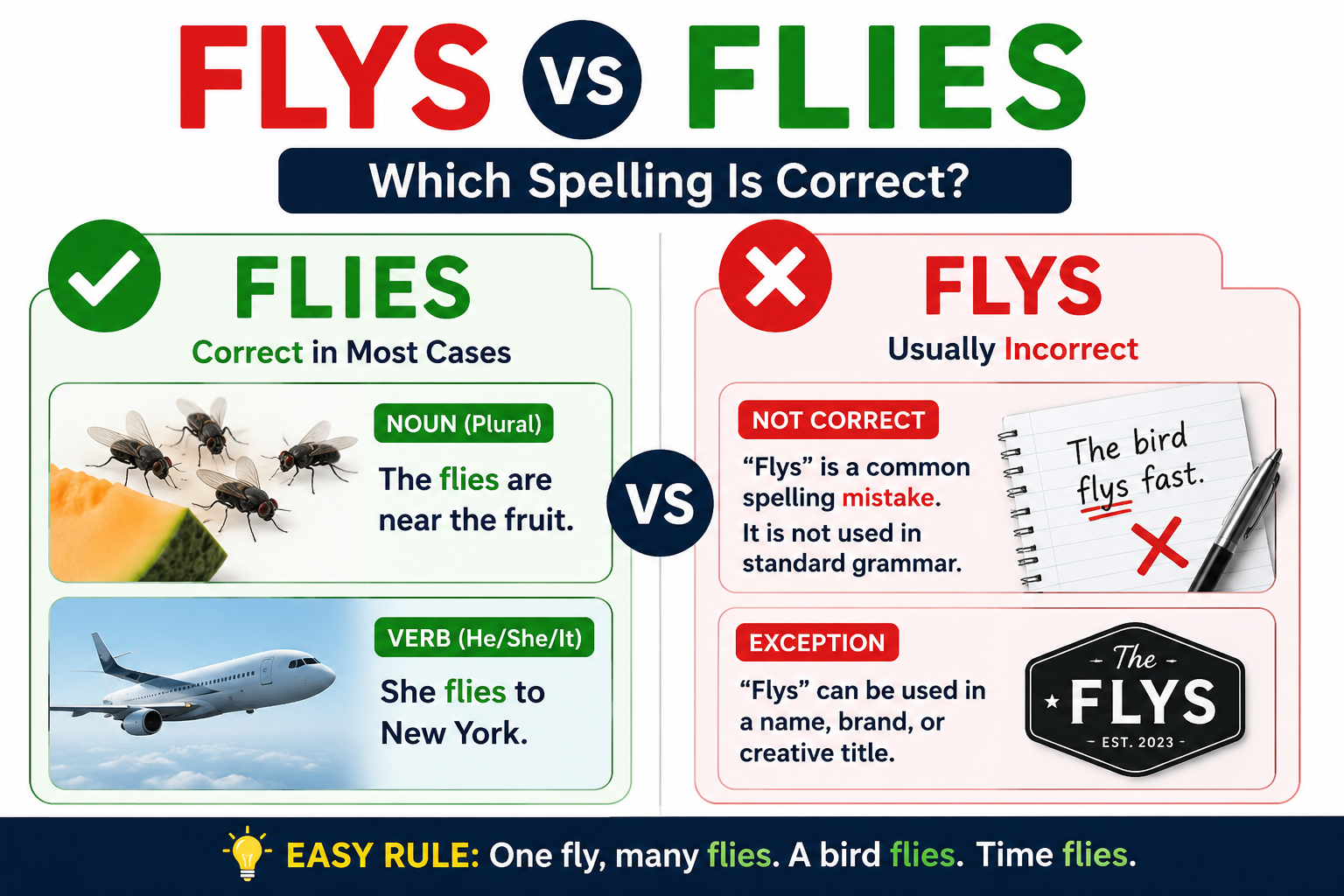
The main difference is easy. Flies is the correct word in most situations, while flys is usually the incorrect form. The correct form follows a spelling rule for words ending in y. When fly takes a plural ending, it becomes flies. It can also be a verb form, as in She flies home, or a noun form, as in flies near the fruit.
This article helps you learn the comparison in simple English. Once you understand the meaning difference clearly, you can choose the right spelling every time. In a specific case, flys may work as a name, brand, or creative spelling. In regular English, though, it’s not the right specific usage or safe answer for normal grammar.
Quick Answer: Flys vs Flies
Use flies, not flys, in normal writing.
Flies is correct in two common situations:
| Use | Correct Word | Example |
| Plural noun | flies | The flies gathered near the trash can. |
| Verb with he, she, it | flies | She flies to Boston every summer. |
Flys is usually a spelling mistake.
Here’s the simplest rule:
One fly, many flies. A bird flies. “Flys” usually flies out the window.
So, when you write schoolwork, emails, social posts, blog articles, captions, reports, or professional messages, use flies.
Read this also: Useable vs Usable: Which Spelling Is Correct in English (Complete 2026 Guide)
What Does “Fly” Mean?
Before comparing flys or flies, you need to understand the base word: fly.
The word fly can work as a noun or a verb.
As a noun, a fly is a small flying insect. You might see one near fruit, garbage, food, drains, or outdoor picnic tables.
As a verb, fly means to move through the air. Birds fly. Planes fly. Balloons can fly. People also fly when they travel by airplane.
Here are two simple examples:
| Sentence | Meaning |
| A fly landed on the window. | Fly means an insect. |
| Birds fly south in winter. | Fly means move through the air. |
That double use matters because flies also has two meanings. It can be the plural form of the noun fly, or it can be the verb form used with a singular subject.
What Does “Flies” Mean?
Flies is the standard spelling in English. It has two main meanings.
It can mean more than one fly insect.
It can also mean moves through the air when used with a singular subject like he, she, it, or the plane.
“Flies” as a Plural Noun
When you talk about more than one fly insect, use flies.
You don’t write flys. You write flies.
Examples:
- One fly landed on the plate.
- Three flies landed on the plate.
- The kitchen had too many flies.
- Fruit flies appeared near the bananas.
- The picnic attracted flies after someone opened the watermelon.
This spelling follows a common English pattern. When a noun ends in consonant + y, the plural usually changes to ies.
So, fly becomes flies.
“Flies” as a Verb
Flies also works as a verb.
Use flies when the subject is singular. That means the subject is he, she, it, or one person, animal, object, or thing.
Examples:
- She flies to New York twice a year.
- The eagle flies above the mountain.
- A plane flies over our house every morning.
- The butterfly flies from flower to flower.
- Time flies when you’re having fun.
Notice something interesting. The same spelling works in both meanings.
In “The flies are loud,” the word flies means insects.
In “The bird flies away,” the word flies means moves through the air.
Context does the heavy lifting.
What Does “Flys” Mean?
In standard English grammar, flys is usually incorrect.
People often write flys because it looks like a normal plural. That mistake makes sense at first glance. Many English words become plural by adding s:
| Singular | Plural |
| cat | cats |
| dog | dogs |
| book | books |
| car | cars |
| phone | phones |
So, a beginner may think:
fly → flys
However, that spelling breaks the normal consonant + y rule.
The correct pattern is:
fly → flies
Is “Flys” Ever Correct?
In everyday grammar, flys is not the correct spelling for the plural noun or the verb.
However, you may see Flys as a proper name. A band, brand, username, product, creative title, or fictional group could choose that spelling. Proper names can break spelling rules because names don’t always follow grammar.
For example:
- The Flys could be a band name.
- Flys could appear in a brand name.
- Someone could use flys in a username.
Still, that doesn’t make flys correct in a normal sentence.
Use this difference:
| Situation | Correct? | Example |
| Standard plural noun | No | The flys are everywhere. |
| Standard verb | No | She flys home tomorrow. |
| Proper name or title | Sometimes | The Flys performed live. |
If you’re writing an essay, article, exam answer, business email, caption, or report, choose flies.
Why Does “Fly” Become “Flies”?
English has a spelling rule for many words ending in y.
When a word ends in a consonant + y, you usually change the y to i and add es.
That sounds technical, but it’s easy once you see it.
The word fly ends with f + y.
The letter f is a consonant. Since the word ends in consonant + y, the spelling changes:
fly → flies
Here are more examples:
| Base Word | Rule | Correct Form |
| fly | change y to i + es | flies |
| cry | change y to i + es | cries |
| try | change y to i + es | tries |
| reply | change y to i + es | replies |
| baby | change y to i + es | babies |
| city | change y to i + es | cities |
| story | change y to i + es | stories |
This pattern appears all over English. Once you learn it, many confusing spellings become easier.
When You Don’t Change “Y” to “IES”
Here’s the twist. Not every word ending in y changes to ies.
If the letter before y is a vowel, you usually just add s.
Vowels are a, e, i, o, u.
Look at these examples:
| Base Word | Ending Type | Correct Form |
| boy | vowel + y | boys |
| toy | vowel + y | toys |
| day | vowel + y | days |
| key | vowel + y | keys |
| valley | vowel + y | valleys |
Now compare those with fly:
| Base Word | Ending Type | Correct Form |
| fly | consonant + y | flies |
| cry | consonant + y | cries |
| baby | consonant + y | babies |
| city | consonant + y | cities |
So the rule depends on the letter before y.
If a consonant comes before y, change y to ies.
If a vowel comes before y, add s.
That’s why day becomes days, but fly becomes flies.
Flys or Flies: Key Differences
The difference between flys and flies comes down to correctness and usage.
Flies is the correct word in standard grammar. Flys is usually a spelling error.
| Word | Correct in Standard Grammar? | Meaning | Example |
| flies | Yes | More than one fly insect | Flies gathered near the old fruit. |
| flies | Yes | He, she, or it moves through the air | The bird flies across the lake. |
| flys | No | Common misspelling | The bird flys fast. |
| Flys | Sometimes | Proper name or creative spelling | The Flys released a song. |
The easiest way to remember it is this:
Flies belongs in normal sentences.
Flys belongs only in special names, titles, or intentional creative spellings.
“Flies” as a Noun: More Than One Fly
When flies works as a noun, it means multiple insects.
A fly is one insect.
Flies are two or more insects.
Examples:
- A fly landed on my glass.
- Two flies landed on my glass.
- The room filled with flies after someone left the door open.
- Fruit flies showed up near the bananas.
- House flies often gather around food waste.
You may also see specific types of flies:
| Type of Fly | Meaning |
| house flies | common flies found around homes |
| fruit flies | tiny flies often found near ripe fruit |
| horse flies | larger flies that can bite animals and people |
| drain flies | small flies that appear near sinks or drains |
| blow flies | metallic-looking flies often found near decaying matter |
These are real insect names. In each case, the plural form still uses flies.
“Flies” as a Verb: He, She, or It Flies
When flies works as a verb, it describes movement through the air.
You use flies with singular subjects.
Here’s a simple breakdown:
| Subject | Correct Verb |
| I | fly |
| you | fly |
| we | fly |
| they | fly |
| he | flies |
| she | flies |
| it | flies |
| the plane | flies |
| the bird | flies |
Examples:
- I fly to Texas often.
- They fly every December.
- She flies to Texas often.
- The plane flies every morning.
- The bird flies back to its nest.
The subject controls the verb.
If the subject is plural, use fly.
If the subject is singular, use flies.
“Time Flies” or “Time Flys”?
The correct phrase is time flies.
Never write time flys in standard English.
This phrase means time seems to pass quickly. It doesn’t mean time literally grows wings and moves through the air. It’s an idiom, which means the phrase has a meaning beyond the exact words.
Examples:
- Time flies when you’re having fun.
- Time flies during summer break.
- Time flies when you’re busy with work.
- Time flies when you’re with people you love.
Why do we write flies here?
Because time is a singular subject. With singular subjects, the verb fly becomes flies.
Think of it like this:
| Subject | Verb | Sentence |
| Time | flies | Time flies quickly. |
| The week | flies | The week flies by. |
| The day | flies | The day flies when you’re busy. |
So, the correct version is always:
Time flies.
“Fly’s,” “Flies,” and “Flys”
Many writers also confuse flies with fly’s.
The apostrophe changes the meaning.
Fly’s is not the plural of fly. It usually shows possession. That means something belongs to one fly.
Examples:
- The fly’s wing was damaged.
- A fly’s body has several parts.
- The fly’s movement was hard to track.
Now compare the three forms:
| Word | Meaning | Example |
| fly | one insect or the base verb | A fly landed on the wall. |
| flies | plural noun | Flies landed on the wall. |
| flies | verb | The bird flies away. |
| fly’s | possessive form | The fly’s wing moved quickly. |
| flys | usually incorrect | The flys were loud. |
Apostrophes do not create regular plurals.
So don’t write:
- The fly’s are annoying.
- The flys are annoying.
Write:
- The flies are annoying.
Real-Life Examples of “Flies”
Grammar becomes easier when you see it in real situations. Here are practical examples you might use in daily English.
In Emails
- She flies in on Monday, so we can meet Tuesday.
- Our manager flies back from Denver tonight.
- We need to fix the trash area because flies keep entering the kitchen.
- The package flies through customs faster with the right documents.
On Social Media
- Time flies when life gets busy.
- This summer flies by every year.
- These flies won’t leave my picnic alone.
- My dog jumps like he flies across the yard.
In Daily Conversation
- That bird flies so close to the window.
- He flies home every holiday.
- There are flies near the fruit bowl.
- Time flies after you start working full-time.
In School or Homework
- A butterfly flies from plant to plant.
- The plural of fly is flies.
- The sentence “The bird flys” is incorrect.
- The correct sentence is “The bird flies.”
In Travel Writing
- The airline flies to several major cities.
- She flies nonstop to Los Angeles.
- The plane flies over the desert.
- Our group flies out at sunrise.
Grammar Tips for Using “Flies” Correctly
A few simple grammar tips can save you from this mistake every time.
Check the Meaning First
Ask yourself what you mean.
Do you mean more than one insect?
Use flies.
Do you mean one person, animal, or thing moves through the air?
Use flies.
Do you mean the base verb after I, you, we, or they?
Use fly.
Look at the Subject
The subject tells you which verb form to use.
| Subject | Correct Sentence |
| I | I fly often. |
| You | You fly well. |
| We | We fly tomorrow. |
| They | They fly every month. |
| He | He flies tomorrow. |
| She | She flies often. |
| It | It flies fast. |
| The plane | The plane flies high. |
If the subject is he, she, it, or one thing, use flies.
Remember the “Y to IES” Rule
When a word ends in consonant + y, change y to i and add es.
That gives you:
- fly → flies
- try → tries
- cry → cries
- reply → replies
- baby → babies
This rule helps with nouns and verbs.
Don’t Trust Spellings That “Look Right”
Flys may look simple, but simple doesn’t always mean correct.
English keeps many older spelling patterns. Some feel strange at first. However, once you learn the pattern, the spelling becomes easy.
Common Mistakes with Flys and Flies
Even careful writers make this mistake. Here are the most common ones.
Writing “Flys” as the Plural of Fly
Incorrect:
- The flys are buzzing near the window.
Correct:
- The flies are buzzing near the window.
Why?
Because the plural of fly is flies.
Writing “Flys” as a Verb
Incorrect:
- She flys to Miami every winter.
Correct:
- She flies to Miami every winter.
Why?
Because she needs the third-person singular verb form.
Using “Flies” with a Plural Subject
Incorrect:
- They flies to Chicago every year.
Correct:
- They fly to Chicago every year.
Why?
Because they is plural. Use fly, not flies.
Confusing “Fly’s” with “Flies”
Incorrect:
- The fly’s are near the trash.
Correct:
- The flies are near the trash.
Why?
Because fly’s shows possession. It does not show plural meaning.
Forgetting Idioms
Incorrect:
- Time flys when you’re having fun.
Correct:
- Time flies when you’re having fun.
Why?
Because time is singular, so the verb becomes flies.
Short Case Studies: How the Mistake Happens
Case Study: A Student Writing an Essay
A student writes:
“The butterfly flys from flower to flower.”
The sentence looks understandable, but the spelling is wrong. Since butterfly is a singular subject, the verb should be flies.
Correct version:
“The butterfly flies from flower to flower.”
The student doesn’t need a complicated grammar lecture. They only need the subject-verb rule: singular subject, flies.
Case Study: A Restaurant Sign
A restaurant prints this sign:
“Please close the door to keep flys out.”
The message makes sense, but the spelling looks unprofessional. Customers may still understand it, but a small typo can make a business look careless.
Correct version:
“Please close the door to keep flies out.”
This version looks cleaner and more trustworthy.
Case Study: A Travel Email
Someone writes:
“Sarah flys to Atlanta on Friday.”
Again, the meaning is clear. Still, the grammar is wrong.
Correct version:
“Sarah flies to Atlanta on Friday.”
Here, Sarah is one person. That means the verb must be flies.
Memory Tricks for Flys or Flies
Spelling rules stick better when they feel simple. Try these memory tricks.
One Fly, Many Flies
This is the fastest trick.
- One fly
- Many flies
If you see more than one insect, write flies.
He Flies, They Fly
Use this trick for verbs.
- He flies
- She flies
- It flies
- They fly
- We fly
- I fly
When the subject is one person, animal, or thing, use flies.
“Y” Changes When a Consonant Comes Before It
Think of fly as part of a family:
- fly → flies
- cry → cries
- try → tries
They all end in consonant + y.
So the y changes to ies.
A Tiny Joke That Works
If you write “flys,” let that spelling fly away.
Silly? Yes. Useful? Also yes.
Synonyms and Related Words
The word flies can mean insects or movement. Because of that, its related words depend on the context.
Related Words for Fly as an Insect
| Word | Meaning |
| insect | a small animal with six legs |
| bug | informal word for many small insects |
| housefly | common fly found around homes |
| fruit fly | tiny fly near ripe fruit |
| gnat | tiny flying insect |
| mosquito | biting flying insect |
Note that mosquito and gnat are not the same as a fly in everyday use. Still, readers often group them together as small flying insects.
Related Words for Fly as a Verb
| Word | Meaning |
| soar | fly high or smoothly |
| glide | move smoothly through air |
| hover | stay in one place in the air |
| travel | go from one place to another |
| take off | leave the ground |
| land | come down to the ground |
Examples:
- The eagle soars above the valley.
- The plane takes off at noon.
- The helicopter hovers over the field.
- She travels often for work.
Words That Follow the Same Pattern
Once you learn fly → flies, you can understand many similar words.
| Base Word | Correct Form | Example |
| cry | cries | The baby cries at night. |
| try | tries | She tries her best. |
| reply | replies | He replies quickly. |
| study | studies | She studies after dinner. |
| carry | carries | He carries the bag. |
| marry | marries | She marries her best friend. |
| party | parties | The group parties on weekends. |
This pattern works because each word ends in consonant + y.
However, remember the vowel rule.
| Base Word | Correct Form | Example |
| play | plays | She plays piano. |
| enjoy | enjoys | He enjoys coffee. |
| stay | stays | It stays cold. |
| buy | buys | She buys groceries. |
| say | says | He says hello. |
These words keep the y because a vowel comes before it.
Mini Practice: Choose the Correct Word
Test yourself with these sentences.
Choose fly, flies, fly’s, or flys.
| Sentence | Correct Answer |
| The bird ___ over the fence. | flies |
| Several ___ landed on the sandwich. | flies |
| I ___ to Dallas next week. | fly |
| The ___ wing looked damaged. | fly’s |
| Time ___ when you’re busy. | flies |
| They ___ to Florida every year. | fly |
| The airplane ___ above the clouds. | flies |
| Fruit ___ appeared in the kitchen. | flies |
If you got most of these right, you’ve got the rule. If you missed one, look at the subject and meaning again. That usually solves the problem.
Quick Editing Checklist
Before publishing or submitting your writing, run through this quick checklist.
- Did you write flies for more than one insect?
- Did you write flies with he, she, it, or a singular noun?
- Did you write fly with I, you, we, or they?
- Did you avoid flys in normal grammar?
- Did you use fly’s only for possession?
- Did you write time flies, not time flys?
Small spelling checks like this make your writing look sharper. They also help readers trust what you say.
FAQs
Q1: Is “flys” or “flies” correct?
Flies is correct in standard English. Use flies when you mean more than one fly insect or when the subject is singular, as in “The bird flies.”
Q2: What is the plural of fly?
The plural of fly is flies. For example, you would say, “There are flies in the kitchen,” not “There are flys in the kitchen.”
Q3: Why does fly become flies?
Fly becomes flies because it ends in a consonant plus y. In English, many words with this pattern change y to i and add es, like try → tries and cry → cries.
Q4: Is “time flies” or “time flys” correct?
Time flies is correct. The word time is singular, so the verb becomes flies. “Time flys” is not correct in standard English.
Q5: Can “flys” ever be used?
Flys may be used as a name, brand, title, or creative spelling. However, in normal grammar, you should use flies instead.
Conclusion
The difference between flys and flies is simple once you know the spelling rule. In normal English, flies is the correct word. You use it when talking about more than one fly, such as “The flies are near the fruit.” You also use it as a verb with a singular subject, such as “She flies home tomorrow.”
The word flys is usually incorrect in standard grammar. It may appear in a name, brand, or creative title, but you should not use it in regular writing. So, if you are writing for school, work, emails, blogs, or daily communication, flies is the safe and correct choice.
A good way to remember it is this: one fly, many flies. A bird flies. Time flies. Once this rule becomes clear, you can also understand similar words like tries, cries, replies, and stories more easily.