At the center of confusion the phrase midday vs mid day often creates grammar and spelling confusion for learners and writers due to evolution of spaced words into hyphenated forms and modern standardization. This shift causes mid-sentence pause when deciding separation hyphenation or single unit leading to repeated mistakes and reduced clarity in writing even among confident users. The transition across linguistic systems affects accuracy communication and understanding of rules during editorial development and standardization of orthography and structure.
At this stage of understanding midday vs mid day learners process Linguistic l repetition and usage trends shaping modern English. Writers build awareness through exposure and writing guidance tools internalizing correct structure without overthinking word choice improving interpretation and grammar learning supporting language modernization.
Eventually, mastery comes through consistent grammar learning supported usage examples and writing guidance tools creating fluency in midday vs mid day leading to modern usage trends in English.
Midday vs Mid Day: The Quick Answer
If you’re looking for the short answer, here it is:
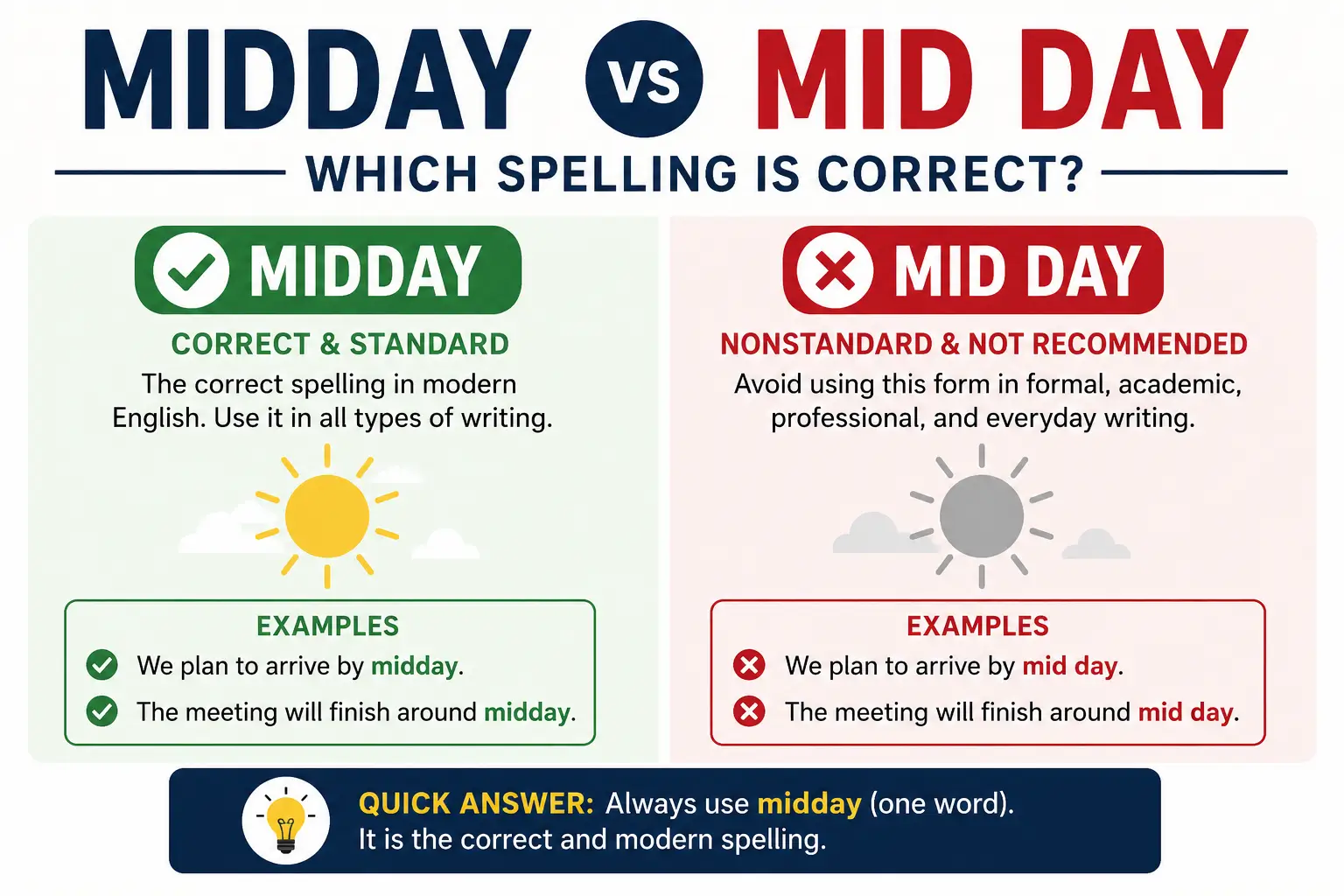
Midday is the correct and standard spelling in modern English.
Mid day is generally considered a nonstandard spelling and should usually be avoided in formal, academic, professional, and everyday writing.
Quick Example
✅ We plan to arrive by midday.
✅ The meeting will finish around midday.
❌ We plan to arrive by mid day.
❌ The meeting will finish around mid day.
In nearly all situations, you should write midday as one word.
What Does Midday Mean?
The word midday refers to the middle of the day. It commonly describes the period around noon when the sun reaches its highest point in the sky.
Definition of Midday
Midday means:
The middle part of the day, especially around noon.
Although people often use midday and noon interchangeably, midday can sometimes refer to a broader time window surrounding noon rather than the exact minute of 12:00 PM.
What Time Is Considered Midday?
Most people consider midday to occur around:
| Time Expression | Approximate Time |
| Mid-Morning | 10:00 AM–11:30 AM |
| Midday | Around 12:00 PM |
| Early Afternoon | 12:30 PM–2:00 PM |
The exact interpretation depends on context. In casual conversation, someone might say:
Let’s meet around midday.
This usually means sometime close to noon rather than exactly 12:00 PM.
Does Midday Always Mean Exactly 12 PM?
Not necessarily.
While dictionaries often define midday as noon, everyday speakers frequently use it more loosely. For example:
- Meet me at midday.
- The temperature peaks around midday.
- Traffic becomes heavier near midday.
In these examples, midday refers to the general period surrounding noon.
Midday vs Mid Day: What’s the Difference?
The difference is primarily one of spelling and modern usage.
Side-by-Side Comparison
| Feature | Midday | Mid Day |
| Standard Modern English | Yes | No |
| Dictionary Recognition | Yes | Rare |
| Professional Writing | Recommended | Not Recommended |
| Academic Writing | Recommended | Avoid |
| Common Everyday Usage | Very Common | Uncommon |
| Preferred Choice | Yes | No |
The meaning remains the same. The difference lies in which form modern English considers correct.
Why “Midday” Is Written as One Word
Many English words begin as separate terms before eventually becoming compound words.
Over time, frequent usage causes words to merge into a single accepted spelling.
Understanding Compound Words
A compound word forms when two separate words combine to create one concept.
Examples include:
| Separate Words | Modern Compound |
| any thing | anything |
| every day (adjective form differs) | everyday |
| some one | someone |
| mid day | midday |
Language naturally evolves toward efficiency. Words that frequently appear together often become a single unit.
How English Words Evolve
English contains thousands of compound words that developed gradually.
Many compounds follow a predictable pattern:
- Two separate words
- Hyphenated form
- Single-word form
For example:
- to day → to-day → today
- some body → some-body → somebody
- mid day → mid-day → midday
Midday followed the same linguistic journey.
Why Separate Forms Become Single Words
Writers, publishers, and dictionaries tend to favor consistency.
As usage increases, readers begin to recognize the combined form more easily than the separated version. Eventually, the merged spelling becomes standard.
That’s exactly what happened with midday.
Is “Mid Day” Ever Correct?
Technically, you may occasionally encounter mid day in very old texts, historical documents, or informal writing.
However, modern style guides overwhelmingly prefer midday.
Historical Usage
Centuries ago, spelling conventions were less standardized.
Writers often separated words that modern English combines today. As a result, older publications sometimes contain spellings such as:
- mid day
- to day
- some body
- any thing
Those spellings were accepted in earlier periods but no longer represent modern standards.
Rare Exceptions
You may occasionally see “mid day” used for stylistic reasons, branding, or creative writing.
Examples include:
- Company names
- Event titles
- Marketing campaigns
- Artistic projects
Even then, those uses reflect stylistic choices rather than standard grammar.
Modern Recommendation
For modern writing, always choose midday.
Midday vs Mid-Day vs Mid Day
Some writers wonder whether the hyphenated version is acceptable.
The answer depends on context.
Comparison Table
| Form | Status | Recommended |
| Midday | Standard Modern Form | Yes |
| Mid-Day | Occasionally Seen | Usually No |
| Mid Day | Nonstandard | No |
Which Form Is Most Common Today?
Among the three options, midday dominates modern English.
Most dictionaries, publications, educational institutions, and businesses use the closed compound form.
What About Mid-Day?
The hyphenated version appears occasionally in older publications.
While not always incorrect, it looks outdated in contemporary writing.
For that reason, most editors prefer midday.
Midday vs Noon: Are They the Same?
Many people use these terms interchangeably.
In most situations, that’s perfectly acceptable.
Similarities Between Midday and Noon
Both words refer to the middle of the day.
Examples:
- The train arrives at noon.
- The train arrives at midday.
Both sentences communicate nearly the same idea.
Key Difference
Noon usually refers to a specific moment:
12:00 PM
Midday can sometimes refer to a slightly broader period surrounding noon.
Quick Comparison
| Term | Meaning |
| Noon | Exact 12:00 PM |
| Midday | Around the middle of the day |
Because of this subtle distinction, midday often sounds slightly more flexible.
Midday vs Afternoon
Another common point of confusion involves midday and afternoon.
Where Midday Ends
Midday generally centers around noon.
Afternoon begins immediately after noon.
Time Comparison
| Time Period | Approximate Range |
| Morning | Sunrise–11:59 AM |
| Midday | Around 12:00 PM |
| Afternoon | 12:01 PM–5:00 PM |
| Evening | After 5:00 PM |
Example
Consider this schedule:
- 9:00 AM — Morning meeting
- 12:00 PM — Midday break
- 2:00 PM — Afternoon workshop
Each label helps define a different part of the day.
How to Use Midday Correctly in a Sentence
Using midday correctly is simple once you know its meaning.
Everyday Examples
- We usually eat lunch at midday.
- The park becomes crowded around midday.
- The delivery should arrive by midday.
- Midday temperatures reached 95 degrees.
- The market closes at midday.
Professional Examples
- Please submit the report by midday Friday.
- The conference will pause at midday.
- Customer support experiences peak demand around midday.
Academic Examples
- Researchers recorded data at midday.
- The experiment concluded shortly after midday.
- Midday observations showed the highest temperatures.
Common Phrases That Use Midday
Certain expressions appear frequently in English.
At Midday
Example:
- The ceremony begins at midday.
Around Midday
Example:
- The storm is expected around midday.
By Midday
Example:
- Finish your assignment by midday.
Until Midday
Example:
- The road remains closed until midday.
Midday Break
Example:
- Employees receive a midday break.
Midday Sun
Example:
- The midday sun can be extremely intense during summer.
Common Mistakes Writers Make
Even experienced writers occasionally make errors with this term.
Splitting the Word
The most common mistake involves writing:
❌ Mid Day
Instead, write:
✅ Midday
Mixing Different Forms
Consistency matters.
Avoid switching between:
- Midday
- Mid-Day
- Mid Day
Choose the standard spelling and use it throughout your document.
Confusing Midday with Noon
Although similar, they are not always identical.
Noon refers to a precise time.
Midday often describes a time period.
Following Outdated Sources
Some older books contain alternative spellings.
Modern writing standards favor midday.
Midday in American and British English
One reason this spelling question causes confusion is that many English words differ between regions.
Fortunately, midday is not one of them.
American English
American writers overwhelmingly use:
Midday
British English
British writers also prefer:
Midday
Is There a Regional Difference?
No significant regional difference exists.
Whether you write for audiences in the United States, the United Kingdom, Canada, Australia, or New Zealand, midday remains the preferred spelling.
Midday in Journalism, Business, and Formal Writing
Professional writers value consistency.
That’s why major publications generally follow established style guides.
Journalism
News organizations frequently use midday in headlines and reports.
Examples include:
- Midday weather update
- Midday market report
- Midday traffic alert
Business Writing
Business communication often includes phrases such as:
- By midday
- Midday deadline
- Midday briefing
Academic Writing
Universities and research institutions also favor the single-word form.
The result is a clear consensus across professional fields.
Synonyms and Related Time Expressions
Several terms share a similar meaning with midday.
Noon
The most direct synonym.
Lunchtime
Refers to the period when people typically eat lunch.
High Noon
A more dramatic or literary expression.
Mid-Morning
Occurs before midday.
Mid-Afternoon
Occurs after midday.
Comparison Table
| Expression | General Time |
| Mid-Morning | 10–11 AM |
| Midday | Around 12 PM |
| Noon | Exactly 12 PM |
| Lunchtime | Around 12 PM |
| Mid-Afternoon | Around 3 PM |
Examples of Midday in Real-Life Contexts
Understanding real-world usage helps reinforce the correct spelling.
Work Schedules
Many offices schedule lunch breaks around midday because employees naturally expect a pause during the middle of the day.
School Timetables
Schools often divide lessons into morning and afternoon sessions with a midday break between them.
Travel and Transportation
Airports frequently experience increased passenger activity around midday due to overlapping flight schedules.
Weather Reports
Meteorologists often mention midday temperatures because the sun’s position significantly affects daily weather patterns.
News Headlines
Journalists regularly use midday in concise headlines:
- Midday Update
- Midday Briefing
- Midday Forecast
Quick Tips to Remember the Correct Spelling
Remembering the correct form doesn’t have to be difficult.
Memory Trick #1
Think of these words:
- Today
- Tonight
- Tomorrow
- Midday
Each appears as a single word.
Memory Trick #2
If your spell checker highlights “mid day,” that’s usually a sign that midday is the preferred choice.
Easy Rule
When referring to the middle of the day, write:
Midday
One word. No space.
Midday vs Mid Day: Final Verdict
After examining grammar rules, dictionary standards, professional usage, and real-world examples, the answer is clear.
In the debate of midday vs mid day, midday is the correct spelling for modern English.
The separate form mid day rarely appears in current writing and generally looks outdated or incorrect.
Whether you’re writing an email, article, school assignment, business report, or social media post, choose midday for clarity, consistency, and accuracy.
Frequently Asked Questions
Q1: Is midday one word or two words?
Midday is one word in modern English and is the standard spelling used by dictionaries and style guides.
Q2: Is “mid day” grammatically correct?
While it may appear in historical texts, modern English generally treats it as a nonstandard spelling.
Q3: Is midday the same as noon?
They are very similar. Noon usually means exactly 12:00 PM, while midday can refer to the period around noon.
Q4: What time is considered midday?
Midday typically refers to the middle of the day, usually around 12:00 PM.
Q5: Can I write “mid-day” with a hyphen?
You may occasionally see it in older writing, but modern usage strongly favors midday.
Q6: Is midday used in formal writing?
Yes. Midday is widely accepted in academic, professional, journalistic, and business writing.
Q7: How do you use midday in a sentence?
Example: “The package should arrive by midday.”
Q8:Is midday a noun, adjective, or adverb?
It most commonly functions as a noun, though it can also act as an adjective in phrases such as “midday heat” or “midday sun.”
Q9: Which spelling do dictionaries recommend?
Major dictionaries recommend midday as the standard spelling.
Q10: Is midday used differently in British and American English?
No. Both British and American English overwhelmingly prefer the spelling midday.
Conclusion
The confusion surrounding midday vs mid day is understandable because both forms appear logical at first glance. However, modern English has settled on a clear winner.
Midday is the accepted spelling used in dictionaries, style guides, newspapers, academic institutions, and professional communication. The separated version, mid day, has largely disappeared from standard usage.
Whenever you need to refer to the middle of the day, keep it simple. Write midday as one word, stay consistent throughout your writing, and you’ll be following modern English conventions with confidence.