Email still runs the professional world. Whether you’re writing to a client, colleague, or manager, small grammar mistakes can quietly damage your credibility. One of the most common mix-ups? “over time” vs. “overtime.”
At first glance, they look almost identical—but they don’t work the same way at all. One describes gradual change, while the other is linked to extra working hours or even sports.
Most people won’t call you out for using the wrong one. But trust this—someone will notice.
Let’s clear the confusion once and for all so you can use both terms confidently and correctly.
Quick Answer: What’s the Difference?
The difference is simple—but important.
“Over time” (two words) is used when something happens gradually or develops step by step. It’s about change across a period.
“Overtime” (one word) refers to extra hours worked beyond the normal schedule, or extended play in sports.
It may look like a small spacing issue, but it completely changes the meaning. Mix them up, and your sentence can sound off—or even confusing.
Over Time vs. Overtime: Side-by-Side Comparison
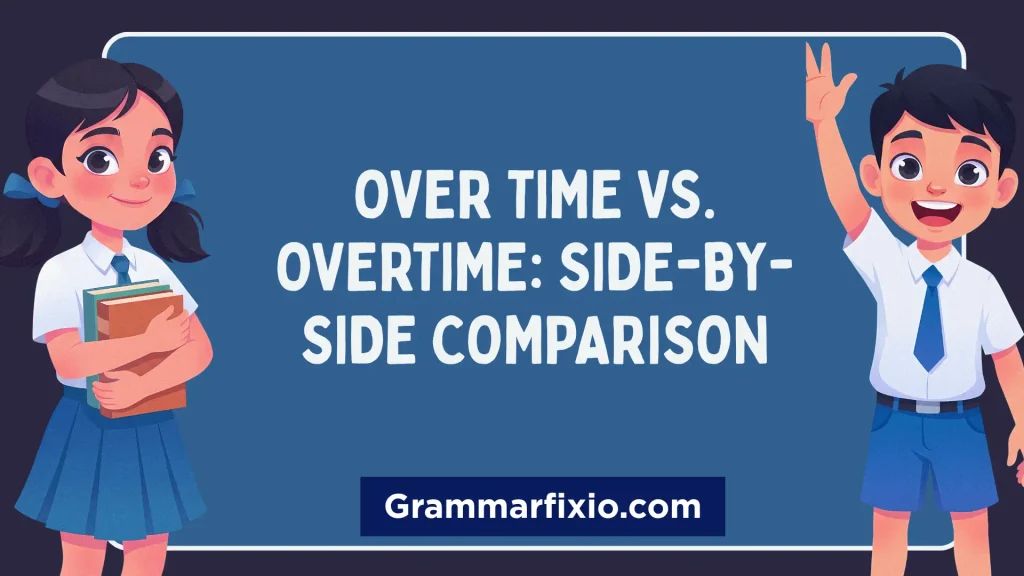
- Over Time = Used when something happens gradually or changes step by step over a period.
👉 Example: Over time, his English improved. - Overtime = Used for extra working hours beyond the normal schedule, or extended play in sports.
👉 Example: She worked overtime to finish the project.
Core Difference Explained (Meaning + Function)
The real difference comes down to how each term works in a sentence.
“Over time” is a phrase used to describe something that happens gradually. It doesn’t act as a thing—it simply explains how or when something changes. In most cases, you can replace it with “gradually” and the meaning stays the same.
On the other hand, “overtime” is a noun (and sometimes an adjective). It refers to something specific—usually extra working hours or additional pay. That means it can act as the subject or object in a sentence.
Here’s the simplest way to tell them apart:
If your sentence is talking about progress or change, use over time.
If it’s talking about extra hours, pay, or extended play, use overtime.
That small space completely changes the role of the word—and the meaning of your sentence.
What Does “Over Time” Mean?
Meaning of “Over Time”
“Over time” simply means something happens gradually or little by little. It’s used when change doesn’t happen instantly but develops across a period.
How It Works in Sentences
“Over time” works as a phrase that describes how something changes. It usually connects with verbs and explains progress, improvement, or decline.
A quick trick: if you can replace it with “gradually”, you’re using it correctly.
Examples of “Over Time”
- Over time, her writing skills improved.
- The system became more efficient over time.
- Trust builds over time, not overnight.
Where “Over Time” Is Used (Contexts)
You’ll mostly see “over time” in situations involving:
- Growth → skills, knowledge, business
- Change → habits, behavior, performance
- Trends → data, markets, technology
- Long-term results → health, relationships, learning
In short, whenever something evolves step by step instead of happening instantly, “over time” is the right choice.
What Does “Overtime” Mean?
Meaning of “Overtime”
“Overtime” refers to extra time beyond the normal limit. Most commonly, it means additional working hours after the regular schedule. It can also refer to extra play time in sports when a game is tied.
Uses of “Overtime” (Work + Sports)
In the workplace, “overtime” is about working longer than usual hours, often with extra pay. It’s commonly used in jobs, payroll discussions, and company policies.
In sports, “overtime” happens when a match doesn’t have a winner in regular time. Extra minutes are added so one side can win.
Examples of “Overtime”
- She stayed late to complete the report and earned overtime.
- The company pays overtime for weekend shifts.
- The match went into overtime after a last-minute equalizer.
Select 78 more words to run Humanizer.
Overtime in the Workplace
In a work setting, “overtime” simply means putting in hours beyond your normal schedule. But it’s not just about staying late—it has clear rules, purposes, and real impact on both employees and businesses.
What Counts as Overtime
Overtime begins when an employee works more than their regular working hours. This could be extra time after a shift, weekend work, or extended hours during busy periods. In many jobs, these extra hours are tracked separately and often come with additional pay.
Why Companies Use Overtime
Companies rely on overtime when workload increases and deadlines get tight. Instead of hiring new staff for short-term needs, they ask existing employees to work extra hours. It helps businesses:
- Meet urgent deadlines
- Handle seasonal demand
- Maintain productivity without delays
For employees, it can also mean higher earnings, especially when overtime pay is offered.
Common Situations
Overtime usually shows up in real-world scenarios like:
- Project deadlines → Teams stay late to finish important tasks
- Busy seasons → Retail, healthcare, or finance jobs during peak periods
- Staff shortages → Fewer employees handling more work
- Emergency situations → Urgent fixes or unexpected workload
In short, overtime isn’t random—it’s used when work demands go beyond the usual limits.
Overtime Pay Explained
Overtime pay is the extra money employees earn for working beyond their regular hours. It’s designed to compensate the added time and effort.
How Overtime Pay Works
When someone works extra hours, those hours are counted separately from normal working time. In many cases, companies pay a higher rate for these extra hours instead of the standard hourly wage.
Basic Calculation Idea
A common approach is paying more than the normal rate—for example, time-and-a-half (1.5× the regular pay). So if someone earns $10 per hour, overtime could be $15 per hour for extra time.
Why It Matters
Overtime pay isn’t just a bonus—it ensures fair compensation. It also motivates employees during busy periods and helps companies manage heavy workloads without overburdening staff unfairly.
Overtime in Sports
In sports, “overtime” refers to extra time added when a game ends in a tie.
What Overtime Means in Sports
It’s an additional period played to decide a winner when regular time isn’t enough.
When It Happens
Overtime kicks in when both teams have the same score at the end of normal play.
Simple Examples
- The match went into overtime after a 2–2 draw.
- They scored the winning goal in overtime.
- The final was decided in overtime after a tense game.
When to Use “Over Time”
Use “over time” when you’re talking about something that happens gradually or step by step.
Clear Rule
If the meaning is close to “gradually” or “over a period,” use over time.
Examples
- Over time, his skills improved.
- The system became more stable over time.
- Customer trust builds over time.
When to Use “Overtime”
Use “overtime” when referring to extra hours, extra pay, or extended play.
Clear Rule
If your sentence is about work hours, payment, or sports, use overtime.
Examples
- She worked overtime to meet the deadline.
- Employees are paid overtime on weekends.
- The game went into overtime.
Grammar Rules: Spacing, Structure & Usage
Spacing vs One Word Rule
This is the simplest rule:
- Over time = two words → a phrase
- Overtime = one word → a noun or adjective
That space completely changes the meaning.
Context-Based Meaning Rule
Always look at what your sentence is talking about:
- Talking about change or progress? → use over time
- Talking about extra hours or extended play? → use overtime
If you focus on the meaning first, you’ll almost never get it wrong.
Common Mistakes and How to Avoid Them
Even though the difference looks small, this is where most people slip up. A tiny spacing mistake can completely change your meaning.
Wrong Spacing Errors
The most common mistake is mixing up the spacing.
People often write “overtime” when they actually mean gradual change, or split it into “over time” when talking about work hours.
- ❌ The company improved overtime.
- ✅ The company improved over time.
- ❌ She earned over time for extra hours.
- ✅ She earned overtime for extra hours.
👉 Simple fix: Always check if your sentence needs two words or one.
Context Confusion
Another mistake happens when writers don’t focus on meaning.
They use the wrong term because they’re thinking about time in general, not the specific context.
- ❌ Productivity increased overtime after training.
- ✅ Productivity increased over time after training.
👉 If the sentence is about progress or change, it’s always over time.
Incorrect Substitution
Some people treat both terms like they’re interchangeable—but they’re not.
Switching one for the other can make your sentence sound unnatural or confusing.
- ❌ Employees worked over time to finish the project.
- ✅ Employees worked overtime to finish the project.
👉 Quick rule:
- Work hours = overtime
- Gradual change = over time
If you train yourself to check meaning first, spelling second, you’ll avoid almost all of these mistakes.
Memory Tricks to Remember the Difference

Sometimes you don’t need rules—you just need a quick shortcut that sticks.
- Think “Paycheck = One Word”
Overtime is one word, just like paycheck. Both are connected to money and work hours. Easy link. - Replace Test Trick
If you can replace it with “gradually”, then it must be over time.
👉 Over time, things improved → Gradually, things improved ✔ - Work vs Progress Rule
- Work, salary, hours → overtime
- Growth, change, trends → over time
Quick Test to Check Yourself
Try this quick mental check before you write:
👉 Ask yourself:
“Am I talking about extra work hours or gradual change?”
- Extra hours or pay? → overtime
- Slow change over a period? → over time
If you can answer that question, you’ll almost never get it wrong.
Real-Life Examples (Correct vs Incorrect)
Seeing the mistake side-by-side makes it stick instantly.
- ❌ Sales improved overtime after the new strategy.
✅ Sales improved over time after the new strategy. - ❌ He worked over time to finish the project.
✅ He worked overtime to finish the project. - ❌ Her confidence increased overtime with practice.
✅ Her confidence increased over time with practice. - ❌ Employees earned over time for weekend shifts.
✅ Employees earned overtime for weekend shifts.
👉 Notice the pattern:
If it’s about progress → over time
If it’s about extra hours/pay → overtime
Professional & Daily Usage Examples
Business & Workplace Examples
- Over time, the company’s customer base expanded into new markets.
- Employees worked overtime during the product launch week.
- Product quality improved over time due to regular testing and feedback.
Email & Communication Examples
- Please note that performance improves over time with consistent training.
- Kindly submit your overtime hours for payroll approval.
- We expect response times to improve over time after system updates.
Regional Differences (US vs UK Usage)
There is no major difference in meaning between US and UK English for these terms.
- Both use “over time” for gradual change
- Both use “overtime” for extra work hours or sports extensions
👉 The rules stay the same globally. Only minor differences appear in labor laws, not in grammar or usage.
Similar Confusing Words (1-word vs 2-word)
These follow the same pattern as over time vs overtime:
- Anytime vs Any Time
- Anytime = at any moment
- Any time = a specific amount of time
- Everyday vs Every Day
- Everyday = common or usual (adjective)
- Every day = each day (time expression)
👉 Same idea:
One word = concept/idea
Two words = time or separate meaning
Practice Exercises (Test Yourself)
Fill in the Blanks
- The company improved _____ after the new policy.
- She worked _____ to meet the deadline.
- Customer trust builds _____ with consistency.
- The match went into _____ after a tie.
- Skills develop _____ with practice.
Pro Tips for Natural Usage
- Always ask: “Is this about change or extra work?”
- Replace “over time” with “gradually” to check accuracy
- Link “overtime” with money, job, or sports
- When proofreading, scan specifically for these two terms—they are easy to mix up
- Don’t rely on sound—both sound the same, meaning is the only guide
FAQ (People Also Ask Optimization)
What is the difference between “over time” and “overtime”?
“Over time” means something happens gradually or step by step. “Overtime” means extra working hours beyond the normal schedule, or extra time in sports to decide a winner.
When should I use “over time”?
Use “over time” when talking about slow or gradual change. If you can replace it with “gradually”, it’s correct.
Example: Over time, habits become stronger.
When should I use “overtime”?
Use “overtime” when referring to extra work hours, pay, or extended sports play.
Example: She worked overtime to finish the project.
Why does spacing matter?
Because spacing changes meaning completely.
- Over time (two words) = gradual change
- Overtime (one word) = work hours or sports extension
That small space is what separates two totally different ideas.
Is there a difference in British and American English?
No major difference. Both UK and US English follow the same rule:
- “over time” = gradual change
- “overtime” = extra work or sports time
The usage stays consistent across both varieties.
Conclusion
At the end of the day, the difference is simple but powerful. “Over time” is used when something changes gradually, while “overtime” is used for extra work hours or extended play in sports. The only difference is a small space, but it completely changes the meaning. Once you understand the context, choosing the right one becomes effortless—and your writing instantly sounds more accurate and professional.