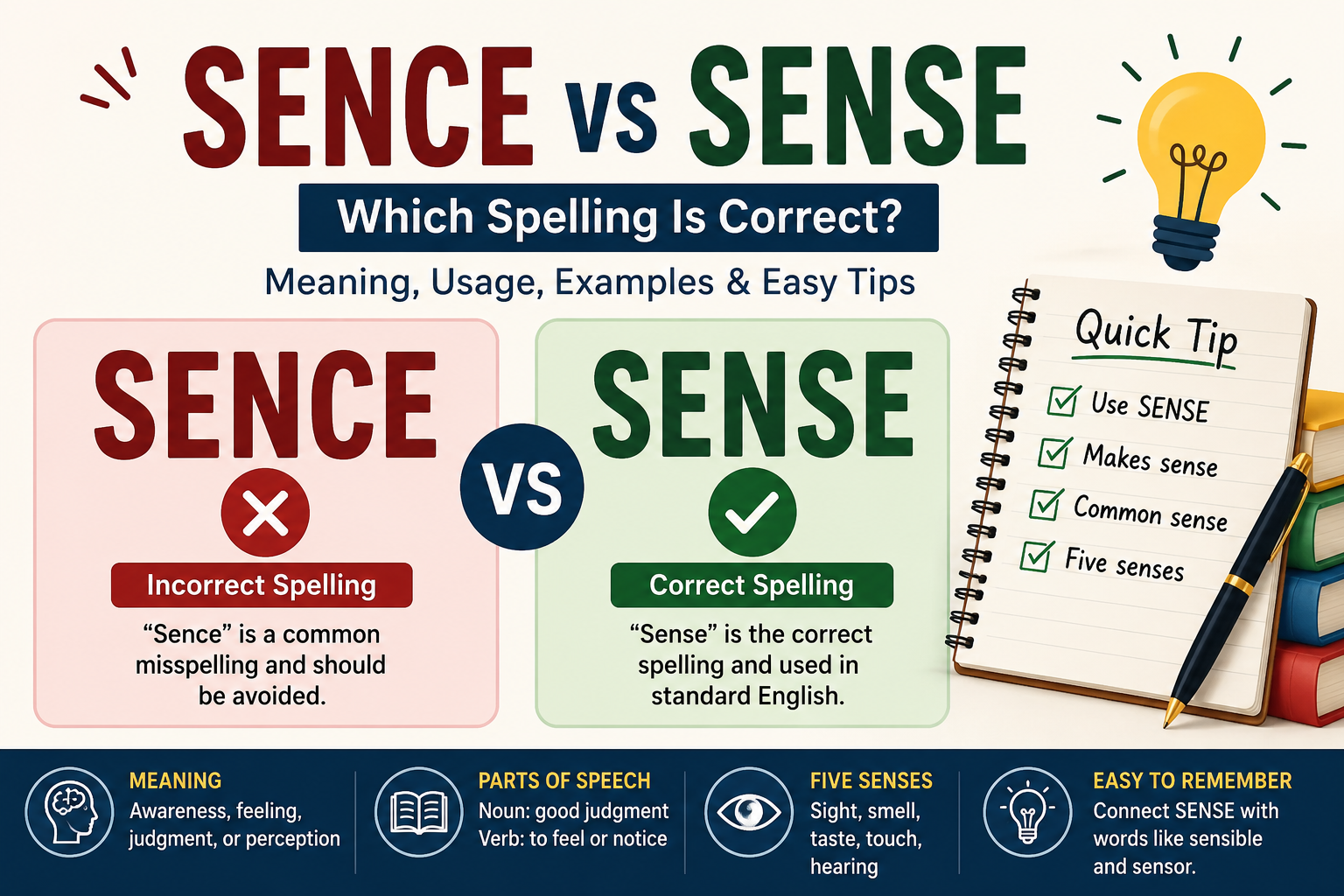
The Sence vs. Sense question is simple: sense is the correct English word, while sence is an incorrect spelling and common misspelling in writing. English spelling causes spelling confusion because sence or sense has a similar pronunciation to pence, fence, tense, and dense. The correct spelling ends with the letter s.
In the parts of speech, sense works as a noun or verb. As a noun, it can mean awareness, a vague impression, good judgment, or a particular meaning. As a verb, it means to feel through perception. It also describes five sensory faculties: sight, smell, taste, touch, and hearing. This grammar supports clear written English and writing accuracy.
I once stopped mid-sentence while writing an email because sence sounded right but felt off. A quick search check caught the common spelling mistake before sending. Proofreading improved my self-correction, spelling recognition, and spelling confidence. When words sound the same, check their meaning instead of trusting pronunciation.
Sence or Sense: The Quick Answer
Sense is the correct spelling in standard American and British English.
Use it when you mean:
- A physical ability, such as sight or hearing
- Awareness of something
- Practical judgment
- The meaning of a word or statement
- An instinctive feeling
- The ability to notice or detect something
Sence isn’t an accepted alternative spelling of sense in ordinary English.
Here’s the difference at a glance:
| Spelling | Is It Correct? | Meaning | Example |
| Sense | Yes | Perception, awareness, judgment, meaning, or detection | “That explanation makes sense.” |
| Sence | Usually no | No standard meaning as a substitute for sense | “That explanation makes sence” is incorrect. |
The most important rule is easy to remember:
When you mean awareness, meaning, judgment, or perception, spell the word sense.
Read this also: Maintained vs Maintenanced: Meaning, Grammar Rules, and Correct Usage Explained
What Does Sense Mean?
The word sense has several related meanings. Its exact definition depends on the sentence.
At its core, the word connects to perception and understanding. You may perceive something through your body, recognize it mentally, or understand its meaning.
That broad idea explains why the same word works in many different contexts.
Sense as Physical Perception
A sense can describe one of the body’s systems for receiving information.
People traditionally learn about five senses:
- Sight
- Hearing
- Smell
- Taste
- Touch
For example:
- “Her sense of smell became stronger during pregnancy.”
- “Bright lights can affect your sense of sight.”
- “A cold may temporarily weaken your sense of taste.”
These abilities help the brain collect and interpret information from the surrounding environment.
However, the human body detects more than five types of information. Scientists also discuss systems related to balance, temperature, pain, and body position.
So, the familiar “five senses” model works well as a basic introduction. It doesn’t describe every way the nervous system receives information.
Sense as Awareness
The word can also describe a general awareness that something exists or is happening.
For instance:
- “There was a sense of excitement in the room.”
- “He felt a growing sense of responsibility.”
- “The empty streets created a sense of unease.”
In these examples, sense doesn’t refer to sight, hearing, or another physical system. Instead, it describes an impression, atmosphere, or internal awareness.
Sense as an Intuitive Feeling
Sometimes, sense refers to a feeling that isn’t based on obvious evidence.
Consider these examples:
- “I had a sense that she wanted to leave.”
- “His parents sensed that something was wrong.”
- “She could sense tension between the two coworkers.”
The speaker notices clues, patterns, or emotional signals. Yet the conclusion may come through intuition rather than direct proof.
Sense as Practical Judgment
Sense can mean the ability to make reasonable decisions.
For example:
- “He had the good sense to bring extra water.”
- “Use common sense when sharing information online.”
- “She showed excellent business sense.”
Here, the word refers to sound judgment. It suggests that someone understands a situation and responds wisely.
Sense as Meaning
In language, sense can refer to the meaning or interpretation of a word, statement, or idea.
For example:
- “The word light has more than one sense.”
- “In what sense are these two ideas related?”
- “The statement makes sense in context.”
A word may carry different meanings in different sentences. The surrounding context tells you which sense the writer intends.
Sense as Ability or Aptitude
The word can also describe a person’s natural ability in a particular area.
Common examples include:
- Sense of direction
- Sense of humor
- Sense of timing
- Sense of style
- Sense of rhythm
- Sense of proportion
Someone with a strong sense of direction can usually find their way around. A person with a sharp sense of humor recognizes or creates comedy.
How to Use Sense as a Noun
As a noun, sense names a perception, feeling, ability, meaning, or form of judgment.
A noun answers questions such as “what?” or “which ability?”
In the sentence below, sense names an ability:
- “Nora has a strong sense of direction.”
In the next example, it names a feeling:
- “A sense of relief spread through the team.”
The word can be countable or uncountable depending on its meaning.
Countable Uses
A countable noun can appear in singular or plural form.
Examples include:
- “Humans rely on several senses.”
- “The word has three different senses.”
- “Her sense of smell is unusually strong.”
Uncountable or Abstract Uses
In other situations, sense describes an abstract quality.
For example:
- “Use common sense.”
- “He showed good business sense.”
- “There’s no sense in worrying about something you can’t change.”
In these expressions, you usually don’t count individual “senses.” The word refers to a general quality or principle.
Examples of Sense as a Noun
- “The room gave me a strange sense of calm.”
- “Good sense prevented her from making a rushed decision.”
- “His dry sense of humor made everyone laugh.”
- “The phrase has a different sense in legal writing.”
- “Losing your sense of direction can feel disorienting.”
- “The story creates a powerful sense of place.”
How to Use Sense as a Verb
As a verb, sense means to notice, detect, feel, or become aware of something.
It describes an action.
For example:
- “I sense a problem.”
- “She sensed hesitation in his voice.”
- “The device senses movement.”
The verb changes form according to tense and subject.
| Verb Form | Word | Example |
| Base form | sense | “Dogs can sense fear.” |
| Third-person singular | senses | “The alarm senses smoke.” |
| Past tense | sensed | “She sensed a change.” |
| Past participle | sensed | “The movement was sensed immediately.” |
| Present participle | sensing | “The animal is sensing danger.” |
When Sense Means Detect
Machines, animals, and people can all sense things.
- A thermostat senses temperature changes.
- A motion detector senses movement.
- A dog may sense a person’s nervousness.
- A person may sense hostility in a conversation.
The method of detection may differ. Still, the core meaning remains the same: something notices or responds to information.
When Sense Means Feel Intuitively
The verb often refers to emotional or social awareness.
Examples:
- “She sensed that the meeting wasn’t going well.”
- “I can sense your frustration.”
- “They sensed an opportunity and acted quickly.”
In these sentences, the person gathers subtle clues. Tone, body language, timing, or past experience may shape the impression.
Why Sence Is Usually Incorrect
English spelling doesn’t always match pronunciation perfectly.
When people say sense, the final sound may resemble the ending in words such as fence or hence. As a result, some writers assume that the word should end in -ence.
It doesn’t.
The correct spelling ends in -ense:
- sense
- senses
- sensed
- sensing
The mistake may also appear because several English nouns end in -ence, including:
- difference
- confidence
- patience
- influence
- experience
However, spelling patterns aren’t interchangeable. A familiar ending can’t replace the established spelling of a different word.
Related Words Support the Correct Spelling
Several related words begin with sens-:
- Sensible
- Sensitive
- Sensation
- Sensory
- Senseless
- Sensibility
These words offer a helpful clue. When the meaning relates to perception or judgment, the sens- family often appears.
Is Sence Ever Correct?
In normal sentences, sence is almost always an error.
However, unusual exceptions may exist. The spelling could appear as:
- A surname
- A company or product name
- A username
- An artistic title
- A fictional name
- A deliberate creative spelling
Proper names don’t always follow standard dictionary rules. A brand may spell its name in an unconventional way to stand out.
For example, suppose a fictional technology company officially calls itself “Sence Labs.” You should preserve that spelling when referring to the company.
Still, that special name wouldn’t change standard English.
You would write:
- “Sence Labs created a sensor that can sense heat.”
The first spelling acts as a proper name. The second works as the standard verb.
Key Differences Between Sence and Sense
Although the distinction looks small, the two forms don’t carry equal status.
| Feature | Sense | Sence |
| Standard English word | Yes | No, except as a possible proper name |
| Can act as a noun | Yes | No |
| Can act as a verb | Yes | No |
| Used in “make sense” | Yes | No |
| Used in “common sense” | Yes | No |
| Accepted in American English | Yes | No |
| Accepted in British English | Yes | No |
| Appropriate in formal writing | Yes | Only when it forms part of an official name |
The practical difference is simple. Sense has recognized meanings and grammatical functions. Sence doesn’t replace it.
Common Expressions That Use Sense
The word appears in many everyday expressions. Learning these phrases makes the correct spelling easier to remember.
Make Sense
Make sense means to be logical, understandable, or reasonable.
Examples:
- “Your explanation makes sense.”
- “It makes sense to compare prices first.”
- “That rule doesn’t make sense.”
A statement can make sense because its meaning is clear. A decision can also make sense because it seems practical.
Make Sense or Makes Sense
Both forms can be correct. The subject determines which verb form you need.
Use makes sense with a singular third-person subject:
- “This answer makes sense.”
- “Her decision makes sense.”
- “It makes sense to leave early.”
Use make sense with plural subjects and with pronouns such as I, you, we, and they:
- “These answers make sense.”
- “Your concerns make sense.”
- “Do I make sense?”
Make Sense Of
Make sense of means to understand or interpret something confusing.
Examples:
- “Can you make sense of this report?”
- “The detective tried to make sense of the evidence.”
- “I can’t make sense of these instructions.”
The phrase often appears when someone faces complicated, incomplete, or disorganized information.
Common Sense
Common sense means practical judgment based on ordinary experience.
Examples:
- “Common sense tells you to wear a seat belt.”
- “Use common sense when choosing a password.”
- “The solution requires patience and common sense.”
Common sense doesn’t mean that everyone will always reach the same conclusion. Personal experience, culture, and available information can affect what people consider obvious.
Still, the phrase generally refers to sensible everyday reasoning.
Sense of Humor
A sense of humor is the ability to recognize, enjoy, or produce comedy.
Examples:
- “Lena has a playful sense of humor.”
- “His sense of humor helped the team relax.”
- “The joke didn’t match her sense of humor.”
Humor varies widely. Someone may enjoy dry wit, slapstick comedy, satire, wordplay, or dark humor.
Sense of Direction
A sense of direction is the ability to understand location and navigate.
Examples:
- “My sense of direction disappears in large parking garages.”
- “Kai has such a good sense of direction that he rarely uses a map.”
- “The hikers lost their sense of direction in the fog.”
Visual landmarks, spatial memory, and environmental clues can all support navigation.
In a Sense
In a sense means “in one way” or “from a particular point of view.”
Examples:
- “In a sense, the delay helped us.”
- “Both answers are correct in a sense.”
- “The character is, in a sense, responsible for the conflict.”
Writers use this phrase to qualify a statement. It signals that the claim is true under a specific interpretation.
Read this also: Present vs Presant: Meaning, Spelling Rules, and Real Usage Explained
No Sense in Doing Something
The phrase there’s no sense in means that an action has little purpose or benefit.
Examples:
- “There’s no sense in arguing about the weather.”
- “There’s no sense in buying equipment you won’t use.”
- “There’s no sense in blaming yourself for an honest mistake.”
Come to Your Senses
To come to your senses means to begin thinking or behaving reasonably again.
Example:
- “He finally came to his senses and canceled the risky plan.”
The expression can sound humorous, critical, or relieved depending on the context.
Sense, Since, Cents, and Sent
Several words sound similar to sense, especially in quick speech. Yet they have different meanings and grammatical roles.
| Word | Meaning | Example |
| Sense | Perception, judgment, meaning, or detection | “That makes sense.” |
| Since | From a past time until now, or because | “I’ve lived here since 2022.” |
| Cents | Units of money | “The item costs fifty cents.” |
| Sent | Past tense of send | “I sent the email this morning.” |
Sense
Use sense for meaning, perception, awareness, or judgment.
- “I sense a change.”
- “Use common sense.”
Since
Use since to discuss time or reason.
Time:
- “We’ve been friends since childhood.”
- “She hasn’t called since Tuesday.”
Reason:
- “Since the store is closed, we’ll return tomorrow.”
Cents
Use cents when talking about money.
- “The total came to ninety-nine cents.”
- “He found twenty-five cents under the couch.”
Sent
Use sent as the past tense of send.
- “She sent the package yesterday.”
- “They sent us a confirmation message.”
Make Sense or Make Since?
The correct expression is make sense.
Use it when something seems understandable, reasonable, or logical.
Correct:
- “The instructions make sense.”
- “Your suggestion makes sense.”
- “Does that make sense?”
Incorrect:
- “The instructions make since.”
- “Your suggestion makes since.”
Since relates to time or reason. It doesn’t carry the meaning required by this expression.
My Two Cents or My Two Sense?
The standard expression is my two cents.
It means “my opinion” or “my small contribution to the discussion.”
For example:
- “Here’s my two cents: simplify the opening paragraph.”
- “Can I add my two cents?”
- “She offered her two cents on the new policy.”
The phrase refers figuratively to a small amount of money. It presents an opinion modestly, as though the speaker is offering a contribution of limited value.
Although the expression involves an opinion or judgment, sense isn’t the correct word.
Common Sence or Common Sense?
The correct phrase is common sense.
Correct:
- “Use your common sense.”
- “The decision showed common sense.”
- “A little common sense can prevent expensive mistakes.”
Incorrect:
- “Use your common sence.”
This error appears often because the incorrect version looks similar to many words ending in -ence. However, the phrase always retains the spelling sense.
Five Sences or Five Senses?
The correct plural form is senses.
When a noun ending in e becomes plural, English usually adds -s:
- sense → senses
- house → houses
- place → places
Therefore, write:
- “Children learn about the five senses.”
- “Smell and taste are closely connected senses.”
- “Animals rely on their senses to find food and avoid danger.”
Don’t remove the final e or change the word to sences.
Does That Make Sence or Sense?
The correct question is:
“Does that make sense?”
This phrase asks whether an explanation, idea, or statement is understandable.
Common variations include:
- “Does this make sense?”
- “Do these instructions make sense?”
- “That doesn’t make sense.”
- “Now it makes sense.”
- “Am I making sense?”
Notice that does carries the third-person singular ending. Therefore, the main verb stays in its base form:
- Correct: “Does it make sense?”
- Incorrect: “Does it makes sense?”
Correct Uses of Sense in Different Contexts
The word works in casual conversations, academic discussions, workplaces, technical settings, and emotional situations.
Everyday Conversation
- “That plan makes sense to me.”
- “I sense that you’re still worried.”
- “Use common sense and bring an umbrella.”
- “She has a great sense of humor.”
These examples use natural, familiar meanings.
Academic Writing
- “The term carries a narrower sense in legal scholarship.”
- “The theory makes sense within its historical context.”
- “Students must distinguish between the literal and figurative senses of the word.”
Academic writers often use sense to discuss meaning, interpretation, or logical coherence.
Workplace Communication
- “It makes sense to move the deadline.”
- “The manager sensed growing frustration among the staff.”
- “The proposal shows sound business sense.”
- “The system senses unusual account activity.”
The word can describe both human judgment and technological detection.
Emotional Situations
- “She felt a deep sense of loss.”
- “He sensed disappointment in her voice.”
- “The reunion created a strong sense of belonging.”
- “A sense of uncertainty affected the whole team.”
In emotional writing, sense often captures an atmosphere or internal impression.
Physical Perception
- “The infection affected his sense of taste.”
- “Cats use their senses to track movement.”
- “The patient reported a reduced sense of touch.”
- “Strong odors can overwhelm the sense of smell.”
Technical Contexts
Engineers and product designers often use the verb when discussing sensors.
- “The device senses pressure changes.”
- “The camera can sense low-light conditions.”
- “The alarm senses smoke and heat.”
- “Smart lighting systems sense when someone enters a room.”
A sensor is a device that detects or measures a physical condition. The shared root makes the spelling easy to remember.
Real-Life Examples and Mini Case Studies
Examples from realistic situations show how the word changes according to context.
A Confusing Email at Work
A manager sends this message:
“The new schedule doesn’t make sence, so please review it.”
The meaning is clear, but the misspelling can weaken the message’s professional tone.
A corrected version reads:
“The new schedule doesn’t make sense, so please review it.”
The revision changes only one letter. Yet it makes the sentence look more polished and credible.
A Student Explaining an Argument
A student writes:
“In one sense, the character acts selfishly. In another sense, she protects her family.”
Here, sense means interpretation or point of view. The student isn’t discussing a physical sense.
This example shows why dictionary definitions alone aren’t enough. Context determines the intended meaning.
A Smart Home Device
A product description states:
“The device senses movement and turns on the lights.”
In this case, senses functions as a verb. It means detects.
A noun appears in the related word sensor:
“The motion sensor activates the light.”
An Intuitive Social Moment
During a conversation, someone says:
“I sensed that he didn’t want to discuss the issue.”
The speaker may have noticed a change in tone, eye contact, or posture. Although no one directly stated the feeling, subtle clues created an impression.
Read this also: Icycle vs Icicle: Meaning, Difference, Usage, and Common Confusion Explained
Common Writing Mistakes
Writers often make more than one error around this word.
| Incorrect Sentence | Correct Sentence | Explanation |
| “It makes sence.” | “It makes sense.” | Sense is the correct spelling. |
| “Use common sence.” | “Use common sense.” | The fixed phrase uses sense. |
| “I can sence trouble.” | “I can sense trouble.” | The verb is spelled sense. |
| “That makes since.” | “That makes sense.” | Since refers to time or reason. |
| “Here’s my two sense.” | “Here’s my two cents.” | The idiom uses the money term. |
| “Humans have five sences.” | “Humans have five senses.” | The plural is senses. |
| “Does that makes sense?” | “Does that make sense?” | Use the base verb after does. |
| “These idea makes sense.” | “These ideas make sense.” | A plural subject takes make. |
Mistaking Sence for an Alternative Spelling
Some spelling differences change between American and British English. Examples include color/colour and center/centre.
However, sence isn’t a regional variation.
Both American and British English use sense.
Confusing Sense and Since
Quick speech can blur the sounds. Still, the meanings remain separate.
Use sense for awareness or meaning:
- “That makes sense.”
Use since for time or reason:
- “I’ve known her since 2018.”
- “Since you’re here, let’s begin.”
Using Makes After Does
The auxiliary verb does already shows third-person singular agreement. The main verb should remain in its base form.
Correct:
- “Does that make sense?”
Incorrect:
- “Does that makes sense?”
Compare:
- “That makes sense.”
- “Does that make sense?”
Grammar Tips for Using Sense Correctly
A few grammar patterns will help you use the word confidently.
Use Make With Plural Subjects
- “These results make sense.”
- “Your concerns make sense.”
- “The changes make sense.”
Use Makes With Singular Third-Person Subjects
- “The result makes sense.”
- “Her concern makes sense.”
- “This change makes sense.”
Use Sense With Modal Verbs
After modal verbs such as can, could, may, and might, use the base form.
- “Dogs can sense fear.”
- “She could sense his discomfort.”
- “The machine may sense movement.”
Don’t write can senses or could sensed.
Use Sensed for Completed Past Actions
- “I sensed a problem yesterday.”
- “The animal sensed danger and ran.”
- “She sensed that the mood had changed.”
Use Sensing for Ongoing Actions
- “The detector is sensing movement.”
- “He’s sensing resistance from the team.”
- “The dog appears to be sensing something nearby.”
Easy Ways to Remember the Correct Spelling
Spelling rules help, but simple associations often work better.
Connect Sense With Sensible
Both words begin with sens-:
- sense
- sensible
If an idea is sensible, it makes sense.
This creates a useful memory line:
If it’s sensible, spell it sense.
Connect Sense With Sensor
A sensor can sense something.
- A heat sensor senses heat.
- A motion sensor senses motion.
- A light sensor senses changes in brightness.
The shared sens- spelling makes the pattern easier to remember.
Memorize Common Phrases as Complete Units
Instead of memorizing the word alone, learn familiar expressions:
- make sense
- common sense
- sense of humor
- sense of direction
- five senses
- sense of smell
Repeated exposure builds automatic recall.
Picture the Final S
The correct word begins and ends with s:
sense
Think of the two s letters as “signals” surrounding the word. That visual trick can help prevent the -ence mistake.
Sense in American and British English
American and British English both use the same spelling:
| Variety | Correct Spelling |
| American English | sense |
| British English | sense |
| Canadian English | sense |
| Australian English | sense |
Unlike color/colour or organize/organise, this word doesn’t change across the major English varieties.
Therefore, a British writer and an American writer should both write:
- “That makes sense.”
- “Use common sense.”
- “She sensed danger.”
Synonyms for Sense
The best synonym depends on the meaning.
Synonyms Related to Awareness
- Awareness
- Feeling
- Impression
- Consciousness
- Recognition
Example:
- “She had a sense of danger.”
- “She had an awareness of danger.”
Synonyms Related to Perception
- Perception
- Sensation
- Faculty
- Ability
Example:
- “His sense of smell is strong.”
- “His ability to smell is strong.”
Synonyms Related to Judgment
- Judgment
- Wisdom
- Reason
- Prudence
- Understanding
Example:
- “She showed good sense.”
- “She showed good judgment.”
Synonyms Related to Meaning
- Meaning
- Interpretation
- Significance
- Implication
Example:
- “The word has another sense.”
- “The word has another meaning.”
Verb Synonyms
When sense functions as a verb, possible alternatives include:
- Detect
- Notice
- Feel
- Perceive
- Recognize
- Discern
- Identify
Example:
- “The device senses heat.”
- “The device detects heat.”
Synonyms aren’t always interchangeable. “I sense sadness” sounds intuitive and emotional. “I identify sadness” sounds more analytical.
Choose the replacement that fits the tone and meaning.
Related Words
Learning related forms can improve both spelling and vocabulary.
| Word | Part of Speech | Meaning |
| Sensible | Adjective | Practical or reasonable |
| Sensitive | Adjective | Quick to notice or react |
| Sensation | Noun | A physical feeling or strong impression |
| Sensory | Adjective | Related to the senses |
| Senseless | Adjective | Without meaning or good judgment |
| Sensor | Noun | A device that detects changes |
| Sensibility | Noun | Sound judgment or emotional awareness |
| Nonsense | Noun | Words or ideas without clear meaning |
Examples:
- “That’s a sensible solution.”
- “The skin is sensitive to heat.”
- “The treatment caused a tingling sensation.”
- “The room provides a calming sensory experience.”
- “The argument seems senseless.”
- “The sensor detected smoke.”
- “His artistic sensibility shaped the design.”
- “The claim is complete nonsense.”
Practice: Choose the Correct Word
Fill each blank with sense, since, cents, or sent.
- That explanation doesn’t make _____.
- We’ve lived here _____ 2021.
- The machine can _____ movement.
- The notebook costs ninety _____.
- She _____ the document yesterday.
- He has an excellent _____ of humor.
- I haven’t eaten _____ breakfast.
- The dog _____ danger before anyone else noticed it.
Answers
- That explanation doesn’t make sense.
- We’ve lived here since 2021.
- The machine can sense movement.
- The notebook costs ninety cents.
- She sent the document yesterday.
- He has an excellent sense of humor.
- I haven’t eaten since breakfast.
- The dog sensed danger before anyone else noticed it.
Correct the Misspellings
Rewrite each sentence correctly.
- “Use your common sence.”
- “I can sence trouble.”
- “Does this make since?”
- “Humans rely on their five sences.”
- “Here’s my two sense.”
- “That ideas makes sense.”
Corrected Sentences
- “Use your common sense.”
- “I can sense trouble.”
- “Does this make sense?”
- “Humans rely on their five senses.”
- “Here’s my two cents.”
- “Those ideas make sense.”
Frequently Asked Questions
Q1. Is It Sence or Sense?
Sense is the correct spelling in standard English. Sence is usually a spelling mistake and should not replace sense in normal writing.
Q2. Is It “Make Sense” or “Make Sence”?
The correct phrase is make sense. It means that something is clear, logical, or easy to understand.
Example: “Your explanation makes sense.”
Q3. Can Sense Be a Noun and a Verb?
Yes. As a noun, sense can mean awareness, judgment, perception, or meaning. As a verb, it means to feel, notice, or detect something.
Example: “I sensed a problem.”
Q4. What Is the Plural of Sense?
The plural of sense is senses. For example, the traditional five senses are sight, hearing, smell, taste, and touch.
Q5. Is Sence a British English Spelling?
No. Both American and British English use sense. Sence is not a standard regional variation.
Conclusion
The difference between sence and sense comes down to one clear rule: sense is the correct English spelling. You can use it as a noun for awareness, judgment, meaning, or perception. You can also use it as a verb meaning to feel or detect something.
Remember common phrases such as make sense, common sense, and five senses. When the spelling looks uncertain, connect sense with related words such as sensible and sensor. That simple link can help you avoid the common misspelling sence and write with greater confidence.