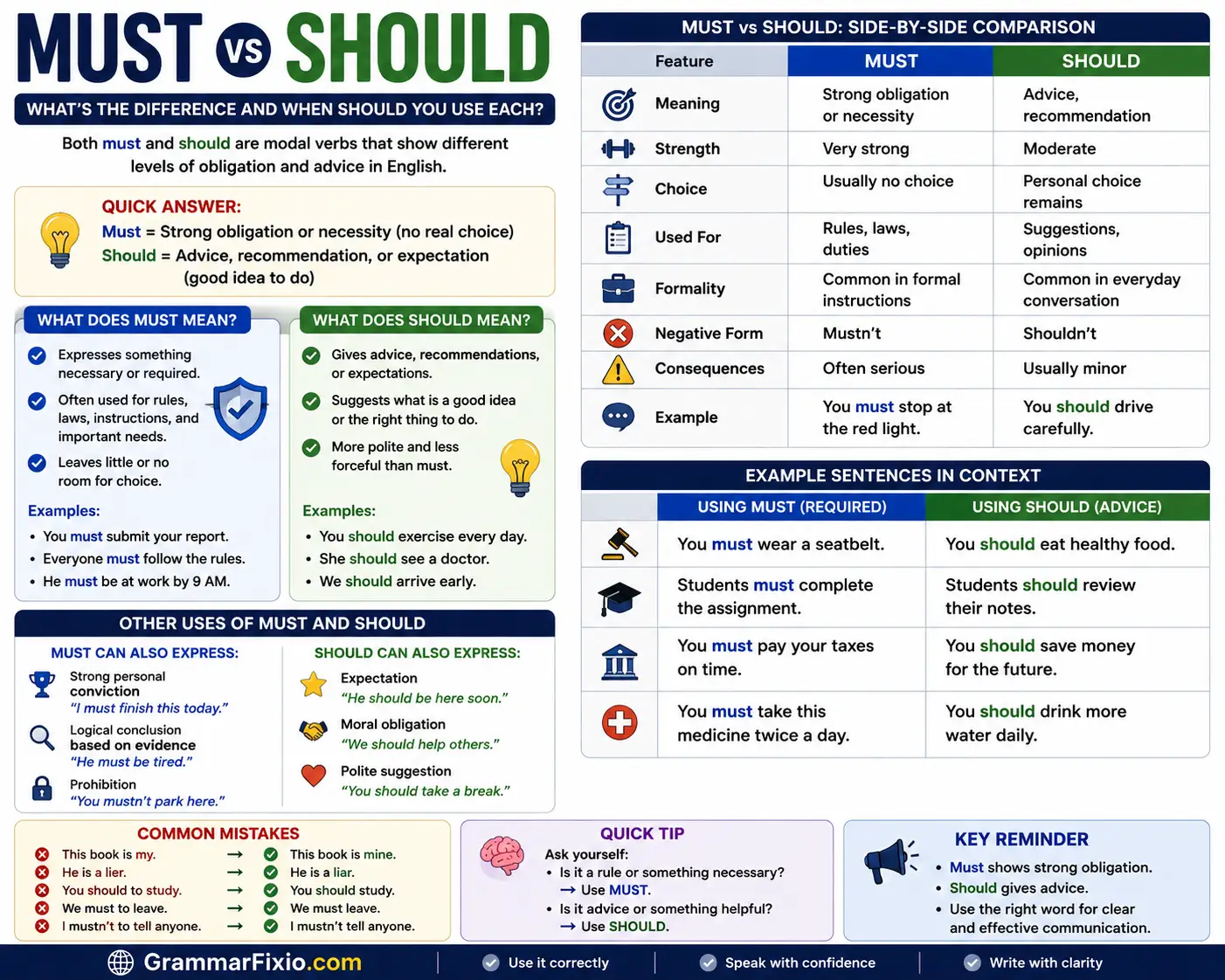
Many learners search Must vs Should because both are modal verbs in English, but they show different levels of strength in communication. Must expresses strong obligation and necessity, while Should is mainly used for advice and expectations. Learning this difference improves clear communication, accurate communication, and language precision in both spoken English and written English.
Both modal auxiliary verbs help you express obligation, express advice, express necessity, express ability, express conditionality, express possibility, and express permission. Knowing when to use each one makes correct usage easier. Whether you are giving advice or making formal statements, these terms help you communicate with better grammar, English grammar, written communication, and spoken communication.
From my experience, the easiest way to learn Must and Should is through regular practice instead of memorizing rules. This article explains their usage, distinction, strength, ability, conditionality, possibility, permission, expectations, and obligation in simple words. A clear understanding will improve your writing, reduce confusion, and help you use both verbs correctly with confidence.
Quick Answer: Must vs Should
The main difference between must and should is the strength of obligation.
- Must expresses a requirement, necessity, or strong obligation.
- Should expresses advice, recommendation, expectation, or something that is a good idea.
Examples:
- You must submit your tax forms by April 15. ✔ (Required)
- You should save copies of your tax documents. ✔ (Recommended)
A simple way to remember it is this:
Must = No real choice
Should = Good advice
Read this also: Layed or Laid: Which Is Correct? Meaning, Grammar Rules, and Examples
What Are “Must” and “Should” in English Grammar?
Both must and should belong to a group of helping verbs called modal verbs. A modal verb changes the meaning of the main verb by adding ideas such as necessity, possibility, permission, ability, or advice.
Unlike regular verbs, modal verbs don’t change their form.
Examples:
- She must finish the report.
- They should arrive before noon.
- You must be careful.
- We should leave soon.
Notice that the verb after a modal stays in its base form.
Correct:
- You must study.
- You should call.
Incorrect:
- You must studies.
- You should calling.
This simple grammar rule applies to every modal verb in English.
Must vs Should: Side-by-Side Comparison
| Feature | Must | Should |
| Meaning | Strong obligation or necessity | Advice or recommendation |
| Strength | Very strong | Moderate |
| Choice | Usually no choice | Personal choice remains |
| Used for | Rules, laws, duties | Suggestions, opinions |
| Formality | Common in formal instructions | Common in everyday conversation |
| Negative form | Mustn’t | Shouldn’t |
| Consequences | Often serious | Usually minor |
| Example | You must stop at the red light. | You should drive carefully. |
The easiest way to tell them apart is to ask yourself one question:
Is this required, or is it simply recommended?
If it’s required, use must.
If it’s advice, use should.
What Does “Must” Mean?
The modal verb must expresses something that is necessary, required, or unavoidable. It often leaves little or no room for choice.
Expressing Obligation
Many rules, workplace policies, and official instructions use must because they describe something mandatory.
Examples:
- Employees must wear identification badges.
- Students must complete the final exam.
- Visitors must sign in at reception.
These actions aren’t optional.
Showing Necessity
Sometimes there isn’t an official rule, but something is necessary to achieve a goal.
Examples:
- You must save your work before shutting down your computer.
- We must leave now to catch the flight.
- I must remember to call my doctor.
Here, must emphasizes that something is extremely important.
Using “Must” for Logical Conclusions
One interesting use of must is expressing certainty based on evidence.
Examples:
- The lights are off. They must be asleep.
- She’s smiling. She must have received good news.
- His car isn’t outside. He must have left already.
This doesn’t mean someone is required to do something.
Instead, must shows the speaker believes something is almost certainly true.
What Does “Should” Mean?
While must sounds firm, should sounds much softer. It gives advice instead of commands.
People use should every day when making recommendations or expressing opinions.
Giving Advice
This is the most common use.
Examples:
- You should drink more water.
- You should back up your files regularly.
- We should leave before traffic gets worse.
These are suggestions, not requirements.
Expressing Expectations
Sometimes should shows what is expected to happen.
Examples:
- The package should arrive tomorrow.
- The meeting should end by noon.
- Your order should be ready soon.
These sentences describe expectations rather than certainty.
Talking About What Is Right
People also use should to discuss morals, responsibilities, or good behavior.
Examples:
- We should respect other people’s opinions.
- Drivers should watch for pedestrians.
- Parents should encourage healthy habits.
Although these are strong recommendations, they are still different from legal or mandatory requirements.
The Biggest Difference Between Must and Should
Many English learners understand the dictionary meanings but still struggle to choose between them in real conversations.
The easiest way is to think about how serious the obligation is.
| Situation | Correct Choice |
| Law | Must |
| Company rule | Must |
| Safety instruction | Must |
| Medical advice | Usually Should |
| Friendly suggestion | Should |
| Personal opinion | Should |
| Recommendation | Should |
Compare these examples:
You must stop when the traffic light is red.
Ignoring this could cause an accident or break the law.
You should slow down in heavy rain.
This is excellent advice, but it’s presented as a recommendation.
Notice how the meaning changes even though both sentences discuss driving.
Required Action vs Recommended Action
Think about consequences.
If someone ignores must, something important usually happens.
For example:
- breaking a law
- violating company policy
- creating a safety risk
- missing an important deadline
If someone ignores should, the consequences are often less severe.
Examples:
- getting tired
- making life harder
- missing a useful opportunity
- producing lower-quality work
This difference explains why native English speakers carefully choose between these two modal verbs.
Choosing the Right Level of Force
Consider these workplace examples.
Manager:
“You must complete the security training before accessing company systems.”
This isn’t optional.
Now compare it with:
“You should review last month’s report before the meeting.”
This recommendation will probably help, but it isn’t mandatory.
One word completely changes the tone.
When to Use “Must”
Although must has several meanings, it usually appears in situations involving strong obligation.
Rules and Laws
Governments, schools, and organizations frequently use must for official rules.
Examples:
- You must have a valid passport.
- Cyclists must obey traffic signals.
- Passengers must fasten their seat belts.
These rules are expected to be followed.
Workplace Requirements
Employers often use must in employee handbooks and policy documents.
Examples:
- Staff must report safety hazards immediately.
- Employees must protect customer information.
- All visitors must check in with security.
The wording leaves little room for interpretation.
School Requirements
Teachers and universities also rely on must.
Examples:
- Students must submit assignments before midnight.
- Every student must complete the required credits.
- Candidates must present valid identification during the exam.
Again, these aren’t suggestions.
Personal Obligations
People often use must when talking to themselves.
Examples:
- I must clean the garage this weekend.
- I must remember my mother’s birthday.
- We must start saving for retirement.
No one else may be enforcing the action, but the speaker feels it is necessary.
Strong Logical Conclusions
As mentioned earlier, must also expresses near certainty.
Examples:
- She must be the new manager.
- That must have been an expensive mistake.
- They must know the answer.
This meaning is common in everyday American English.
When to Use “Should”
Unlike must, should allows more flexibility.
It encourages rather than commands.
Friendly Advice
Friends often use should when helping each other.
Examples:
- You should try that new restaurant.
- You should call your grandparents more often.
- You should wear a jacket because it’s cold outside.
The listener remains free to decide.
Professional Recommendations
Doctors, teachers, financial advisors, and coaches often use should.
Examples:
- You should exercise at least three times a week.
- Businesses should update their passwords regularly.
- Students should review their notes every day.
These recommendations are based on experience or best practices.
Health and Safety Suggestions
Not every health statement requires must.
Many recommendations use should because they describe healthy habits rather than legal obligations.
Examples:
- Adults should get enough sleep each night.
- Children should eat balanced meals.
- Travelers should carry emergency contact information.
These sentences encourage good decisions without sounding overly strict.
Expressing ExpectationsAnother common use of should involves expected results.
Examples:
- The repair should take about an hour.
- Your refund should appear within five business days.
- The weather should improve this afternoon.
These statements express reasonable expectations rather than certainty.
Must vs Should in Everyday American English
Native speakers naturally switch between these modal verbs depending on the situation.
Consider how they appear in everyday life.
| Situation | Example |
| At home | You should clean your room today. |
| School | You must submit the project by Friday. |
| Hospital | Patients must wear identification bracelets. |
| Restaurant | You should try the homemade soup. |
| Airport | Passengers must show identification. |
| Gym | Members should stay hydrated. |
Notice that everyday conversations usually contain more instances of should, while official notices often use must.
Negative Forms: Mustn’t vs Shouldn’t
The negative forms of must and should often confuse English learners because they express very different ideas.
- Mustn’t means do not do something because it is prohibited.
- Shouldn’t means it is not a good idea to do something.
Although both are negative, mustn’t is much stronger.
What “Mustn’t” Really Means
Use mustn’t when something is forbidden.
Examples:
- You mustn’t park in front of a fire hydrant.
- Employees mustn’t share confidential information.
- Visitors mustn’t enter this area without permission.
Ignoring these instructions may lead to penalties or safety issues.
What “Shouldn’t” Really Means
Use shouldn’t when giving advice against doing something.
Examples:
- You shouldn’t stay up too late before an exam.
- You shouldn’t spend all of your paycheck at once.
- We shouldn’t ignore customer feedback.
These are recommendations rather than strict rules.
Don’t Confuse “Mustn’t” with “Don’t Have To”
This is one of the most common grammar mistakes.
| Expression | Meaning |
| Mustn’t | It is prohibited. |
| Don’t have to | It is not necessary. |
Compare these examples:
- You mustn’t touch the artwork. (It’s forbidden.)
- You don’t have to bring your own laptop. (It’s optional.)
Those meanings are completely different.
Common Grammar Patterns with Must and Should
Both modal verbs follow simple grammar patterns. Once you learn them, you’ll avoid many common mistakes.
Must + Base Verb
After must, always use the base form of the verb.
Correct:
- You must finish your homework.
- We must leave now.
- She must call her manager.
Incorrect:
- You must finishes your homework.
- She must calling her manager.
Should + Base Verb
The same rule applies to should.
Correct:
- You should study every day.
- We should arrive early.
- They should apologize.
Incorrect:
- You should studies.
- They should arriving.
Must Have + Past Participle
This pattern expresses a logical conclusion about the past.
Examples:
- She must have forgotten the meeting.
- They must have left already.
- He must have studied hard.
The speaker is making a strong guess based on evidence.
Should Have + Past Participle
This structure talks about past advice, regret, or missed opportunities.
Examples:
- I should have called you.
- We should have booked earlier.
- She should have listened to the warning.
These sentences suggest something would have been better if it had happened.
Common Mistakes and How to Fix Them
Many English learners know the meanings of must and should, but they still misuse them in everyday writing and conversation.
Here are the mistakes you should avoid.
Using “Must” for Simple Advice
❌ You must try this coffee shop.
✔ You should try this coffee shop.
Unless you’re joking or exaggerating, should sounds more natural.
Using “Should” for Mandatory Rules
❌ Employees should wear safety helmets.
✔ Employees must wear safety helmets.
Safety rules require must because they are not optional.
Confusing “Mustn’t” with “Don’t Have To”
❌ You mustn’t attend tomorrow’s meeting.
This sentence means attending is prohibited.
If you mean attendance is optional, say:
✔ You don’t have to attend tomorrow’s meeting.
Using “Must” Too Often
Some learners think must always sounds more correct.
However, native speakers often prefer have to in everyday conversation.
Compare:
- I must go now.
- I have to go now.
Both are correct, but the second sentence is more common in spoken American English.
Must, Should, and Have To: What’s the Difference?
Many learners compare must vs should, but another important comparison is must vs have to.
Although both express obligation, they are not always identical.
Must vs Have To
| Must | Have To |
| Often expresses the speaker’s authority or personal obligation | Often expresses an external rule or circumstance |
| Slightly more formal | More common in everyday conversation |
| Frequently used in written rules | Common in speech |
Examples:
- I must remember my password.
- I have to work tomorrow.
- You must wear safety goggles.
- We have to pay taxes.
Both can express obligation, but have to sounds more natural in many casual situations.
Should vs Have To
These two have different strengths.
Compare:
- You should exercise regularly. (Advice)
- You have to exercise before surgery. (Requirement)
Always ask yourself whether the action is optional.
Which Sounds More Natural in American English?
In modern American English:
- Have to is very common in conversation.
- Must often appears in rules, instructions, notices, and formal writing.
- Should is common almost everywhere because people give advice every day.
Must, Should, or Shall?
Some learners also wonder how shall compares.
Why “Shall” Is Less Common in American English
In modern American English, shall is much less common than must or should.
Most Americans say:
- I will call you tomorrow.
instead of
- I shall call you tomorrow.
When You May Still See “Shall”
Although uncommon in conversation, shall still appears in:
- legal documents
- contracts
- government regulations
- formal policies
For example:
The tenant shall pay rent on the first day of each month.
In legal writing, shall creates an obligation similar to must.
Real-Life Examples of Must vs Should
Seeing these words in everyday situations makes them easier to remember.
Home and Family
Must
- You must lock the front door before leaving.
Should
- You should call your parents more often.
School
Must
- Students must bring their ID cards.
Should
- Students should review class notes every evening.
Office
Must
- Employees must complete cybersecurity training.
Should
- You should reply to client emails within one business day.
Travel
Must
- Passengers must present valid identification.
Should
- Travelers should arrive at the airport early.
Healthcare
Must
- Patients must follow the surgeon’s instructions after the operation.
Should
- Adults should have regular health checkups.
Online Communication
Must
- Users must create a secure password.
Should
- You should avoid sharing personal information online.
Practice Exercise: Choose Must or Should
Fill in each blank with must or should.
- You ______ wear a helmet while riding a motorcycle.
- We ______ drink more water during hot weather.
- Employees ______ complete safety training before starting work.
- You ______ back up your important files.
- Drivers ______ stop at red lights.
- Students ______ review their notes before the exam.
- Visitors ______ sign in at the front desk.
- You ______ eat breakfast before a long meeting.
Answer Key
- must
- should
- must
- should
- must
- should
- must
- should
Notice that must is used for rules and requirements, while should expresses helpful advice.
Quick Tips to Remember the Difference
Remember these simple rules.
- Must = Required
- Should = Recommended
- Mustn’t = Forbidden
- Shouldn’t = Not a good idea
- Must have = Strong conclusion
- Should have = Regret or missed advice
Memory Trick
Imagine a traffic light.
- 🔴 Must = Red light. You have to stop.
- 🟡 Should = Yellow light. It’s wise to slow down, but the situation depends on context.
This visual trick helps many learners remember the difference instantly.
Synonyms and Related Words
Understanding similar words can improve your vocabulary.
Words Related to Must
- have to
- need to
- be required to
- be obligated to
- be necessary to
Words Related to Should
- ought to
- be advised to
- be encouraged to
- be expected to
- be recommended to
Keep in mind that these expressions are similar but not always interchangeable.
See this also: ASL Meaning in Text: What Does ASL Mean in Texting and Social Media?
FAQs
Q1.What is the main difference between must and should?
Must expresses a strong obligation or necessity, while should is used to give advice, recommendations, or express what is expected.
Q2.When should I use must?
Use must when something is required or mandatory, such as following rules, laws, or important instructions.
Q3.When should I use should?
Use should when giving advice, making suggestions, or talking about something that is recommended but not required.
Q4.Is must stronger than should?
Yes. Must shows a much stronger level of obligation than should.
Q5.Can must and should be used in the same sentence?
Yes. For example: You must wear a helmet, but you should also wear reflective clothing for safety.
Q6.Are must and should modal verbs?
Yes. Both must and should are modal verbs used to express obligation, advice, necessity, and other meanings.
Q7.Can I use should for rules?
Usually, no. If something is mandatory, must is the better choice. Should is more suitable for recommendations.
Q8.Is must used in formal writing?
Yes. Must is commonly used in legal documents, official instructions, policies, and formal writing to show requirements.
Q9.How can I remember the difference between must and should?
A simple trick is to remember that must means required, while should means recommended.
Q10.Why do English learners confuse must and should?
Many learners confuse them because both talk about actions and responsibilities. The key is remembering that must is compulsory, while should simply gives advice or guidance
Conclusion
Understanding Must vs Should helps you choose the right modal verb for every situation. While must expresses a strong obligation, necessity, or requirement, should is used for advice, recommendations, or expectations. Knowing this difference makes your spoken and written English clearer and more natural. Whether you’re writing an email, speaking in a meeting, or completing a school assignment, using the correct word improves your grammar and helps others understand your message without confusion.







2 thoughts on “Must vs Should: What’s the Difference and When Should You Use Each?”