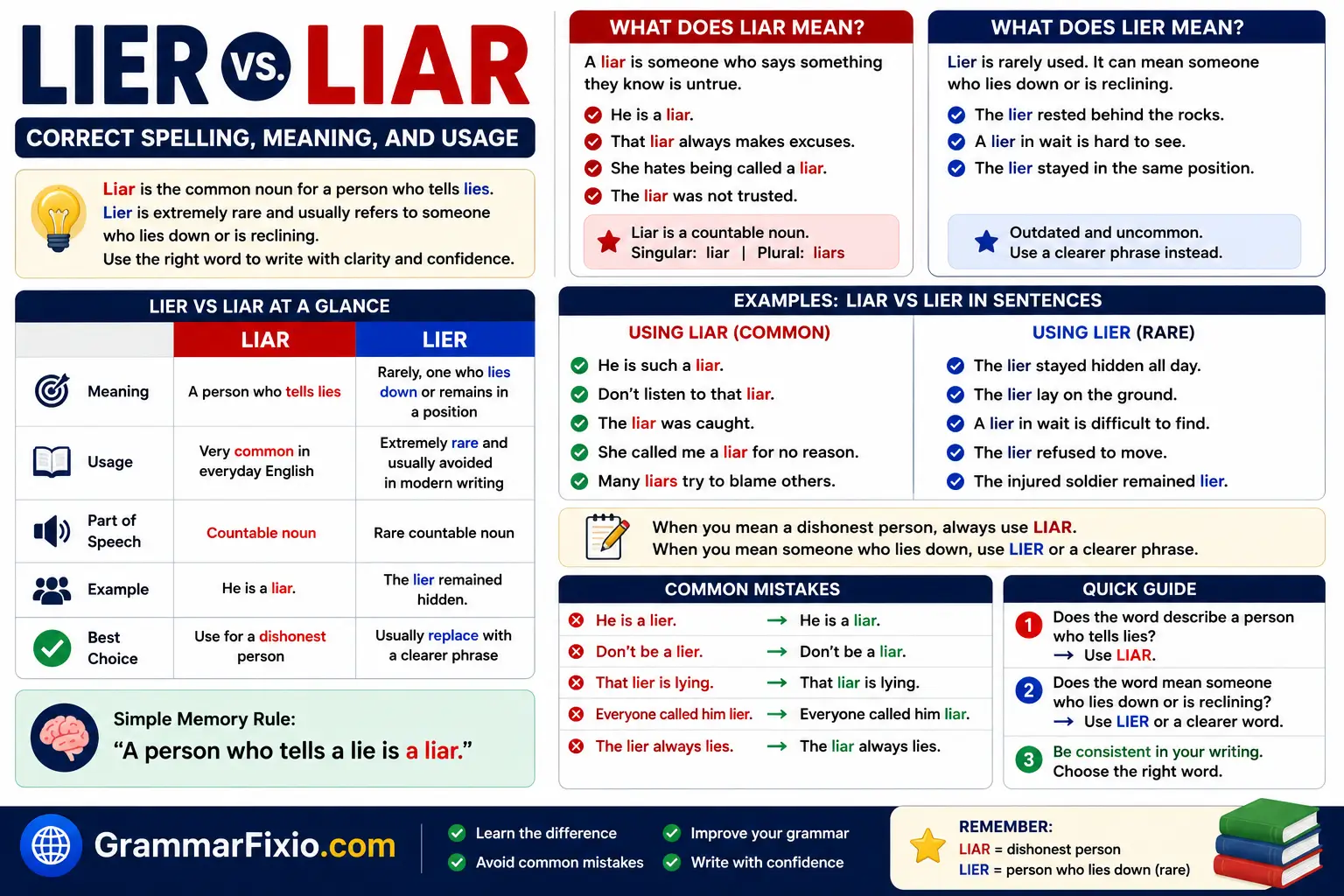
Many English learners and native speakers search for Lier vs Liar because these similar words have different meanings and spelling. In modern English and everyday speech, liar is the common noun for someone who tells untruths or lies, while lier is rarely used for someone who lies down or is reclining. Knowing this difference helps you avoid grammar mistakes.
The confusion comes from word formation patterns because the verb lie makes people expect a simple noun change. However, spelling rules are not always direct in English. A single letter mistake can cause unclear writing, academic mistakes, and professional miscommunication. This complete guide explains the correct noun formation, grammatical purposes, and real world usage with easy examples.
Using the right word improves grammar accuracy, clarity, correctness, and confidence in formal writing and casual writing. Practice with exercises and answers helps you understand these related confusing words. Clear examples make the distinction easier and help protect your credibility in every sentence and conversation.
Quick Answer: Is It Lier or Liar?
Use liar when you mean a person who tells lies.
- Correct: She accused him of being a liar.
- Incorrect: She accused him of being a lier.
- Correct: The character is a convincing liar.
- Incorrect: The character is a convincing lier.
The simplest memory rule is:
A person who tells a lie is a liar.
The word lier is rare. When it appears, it may describe someone or something lying down, resting, or remaining in a position. In modern writing, a clearer phrase is usually better.
Lier vs Liar at a Glance
| Feature | Liar | Lier |
| Standard meaning | A person who tells lies | Rarely, one who lies down or remains in a position |
| Part of speech | Countable noun | Rare countable noun |
| Pronunciation | LYE-er | Usually LYE-er |
| Frequency | Very common | Extremely uncommon |
| Typical context | Dishonesty, false claims, deception | Rare, specialized, or dated wording |
| Best modern choice | Use for a dishonest person | Usually replace with a clearer phrase |
| Example | He is a poor liar. | The lier remained hidden. |
| Reader expectation | Recognized immediately | Often seen as a misspelling |
For nearly every everyday question about lier or liar, the answer is liar.
What Does Liar Mean?
A liar is a person who says something they know or believe is untrue. The word is a noun, so it names a person rather than an action.
Compare these forms:
- Lie: an untrue statement
- Liar: the person who tells the untrue statement
- Lied: told an untruth in the past
- Lying: telling an untruth now or as an activity
For example:
- He told a lie.
- He is a liar.
- He lied yesterday.
- He is lying now.
These sentences describe related ideas, but each word has a different grammatical role.
Read this also: My vs Mine: Meaning, Grammar Rules, and Correct Usage
Liar as a Countable Noun
Liar is a countable noun. Therefore, it has singular and plural forms.
- one liar
- two liars
- a liar
- the liar
- several liars
- those liars
Because it is a singular countable noun, liar normally needs an article or another determiner.
Correct:
- He is a liar.
- She called him the liar.
- Nobody trusted that liar.
Incorrect:
- He is liar.
The sentence needs a because it identifies one person as a member of a category.
Corrected:
- He is a liar.
What Makes Someone a Liar?
In ordinary usage, a liar knowingly gives false information. However, an honest mistake doesn’t automatically make a person a liar.
Consider the difference:
- Maria gave the wrong meeting time because she misunderstood the email.
- Maria gave the wrong meeting time because she wanted John to miss the meeting.
The first situation involves an error. The second may involve deliberate deception.
Therefore, writers should avoid using liar when they can’t show intent. A statement may be false without being a deliberate lie.
Is Lier a Real Word?
Lier is technically recorded as a rare noun, but it is uncommon in modern American English. It can refer to someone or something that lies, rests, or remains in a position.
However, most readers will assume lier is a misspelling of liar. For that reason, it is usually better to replace it with a clearer phrase.
Possible alternatives include:
- a person lying down
- someone resting
- a reclining person
- someone lying in wait
- an object lying on the ground
- a person remaining in place
For example, this sentence may confuse readers:
- The lier stayed behind the wall.
A clearer version would be:
- The person lying in wait stayed behind the wall.
- The person lying down stayed behind the wall.
The best replacement depends on the intended meaning.
When Lier Is the Wrong Spelling
Lier is incorrect when you mean a dishonest person.
Incorrect:
- Don’t trust him because he is a lier.
- She called the witness a lier.
- The story’s narrator is an unreliable lier.
Correct:
- Don’t trust him because he is a liar.
- She called the witness a liar.
- The story’s narrator is an unreliable liar.
Even if a spelling tool accepts lier, the word is still wrong in these sentences because the intended meaning is dishonesty.
How to Pronounce Liar and Lier
Liar is pronounced LYE-er in American English.
Its common pronunciation is:
/ˈlaɪ.ɚ/
The word normally has two syllables:
- LYE
- er
The first syllable receives the stress.
Examples:
- a convincing liar
- a terrible liar
- an experienced liar
The rare word lier is generally pronounced the same way. Therefore, pronunciation alone may not reveal the correct spelling.
This similarity explains why learners often write lier after hearing liar in conversation.
Why Is Liar Spelled with “-ar”?
Many English nouns are formed by adding -er to a verb.
Examples include:
| Verb | Person Noun |
| Teach | Teacher |
| Work | Worker |
| Sing | Singer |
| Drive | Driver |
| Paint | Painter |
Based on this pattern, lier may seem logical. However, English word formation is not always regular.
The standard noun is:
- lie → liar
Not:
- lie → lier
Therefore, you must learn liar as the accepted spelling.
Liar as an Agent Noun
An agent noun names the person who performs an action.
Examples:
- A teacher teaches.
- A singer sings.
- A writer writes.
- A liar lies.
In this sense, liar is the agent noun related to lie. Still, its spelling does not follow the most obvious verb + -er pattern.
Why “Lie-er” Is Incorrect
Some learners may try to preserve the full verb and write lie-er. However, standard English does not use that spelling.
Incorrect:
- lie-er
- lieer
- lier, when referring to dishonesty
Correct:
- liar
Spelling a word only by sound can cause mistakes because English pronunciation and spelling do not always match neatly.
The Two Meanings of Lie
The verb lie has two unrelated meanings. This fact causes much of the confusion around lier, liar, lying, lay, and lain.
Lie Meaning to Say Something Untrue
The first verb means to make a statement that you know is false.
Its forms are:
| Form | Word | Example |
| Base form | lie | Don’t lie to me. |
| Third-person singular | lies | He lies about his age. |
| Past tense | lied | She lied yesterday. |
| Past participle | lied | They have lied before. |
| Present participle | lying | He is lying now. |
| Person noun | liar | The character is a liar. |
This verb follows a fairly simple tense pattern. Both the past tense and past participle are lied.
Examples:
- I never lie about my work.
- She lies whenever she feels trapped.
- They lied on the application.
- He has lied several times.
- The witness may be lying.
- Nobody trusted the known liar.
Lie Meaning to Recline or Rest
The second verb means to rest in a horizontal position or remain somewhere.
Its forms are different:
| Form | Word | Example |
| Base form | lie | I need to lie down. |
| Third-person singular | lies | The book lies on the desk. |
| Past tense | lay | She lay on the couch yesterday. |
| Past participle | lain | He has lain there for an hour. |
| Present participle | lying | The dog is lying by the door. |
This pattern is irregular. In particular, the past tense is lay, while the past participle is lain.
Examples:
- I usually lie down after lunch.
- The keys lie beside the phone.
- Yesterday, the dog lay near the fireplace.
- The papers have lain untouched for weeks.
- The child is lying on the floor.
Although lier may be connected with this meaning in rare usage, modern writers usually choose a descriptive phrase instead.
Liar, Lie, Lied, and Lying
Choosing the right word becomes easier when you identify whether the sentence needs a person, statement, or action.
When to Use Liar
Use liar when naming a person.
- The suspect was a skilled liar.
- Nobody likes being called a liar.
- The novel presents the narrator as a charming liar.
The word doesn’t describe the act itself. Instead, it identifies the person.
When to Use Lie
Use lie as a noun for an untrue statement.
- That story was a lie.
- He told one small lie.
- Repeating a lie doesn’t make it true.
You can also use lie as a verb.
- Don’t lie to your parents.
- People sometimes lie to avoid embarrassment.
When to Use Lied
Use lied for a completed act of dishonesty in the past.
- She lied about her experience.
- The applicant lied on his résumé.
- He admitted that he had lied.
Do not use lay for this meaning.
Incorrect:
- She lay about her age.
Correct:
- She lied about her age.
When to Use Lying
Use lying for an ongoing action or for the general act of dishonesty.
Ongoing action:
- He is lying about what happened.
General activity:
- Lying can damage trust.
Adjectival use:
- The lying witness changed his story again.
Be careful with the spelling. Lieing is incorrect.
Incorrect:
- She is lieing to us.
Correct:
- She is lying to us.
The final e in lie is removed before -ing is added.
Main Differences Between Lier and Liar
The most important difference is meaning and modern usage.
Difference in Meaning
Liar means a person who tells lies.
Lier is a rare word associated with someone or something lying down, remaining, or resting in a place.
Compare:
- The witness was a liar.
- The person lying in wait stayed silent.
The first sentence concerns dishonesty. The second concerns position or concealment.
Difference in Frequency
Liar is a common word in everyday American English.
You may hear it in:
- conversations
- movies
- news reports
- novels
- social media
- arguments
- court reporting
By contrast, lier is so uncommon that many readers do not recognize it as a word.
Difference in Reader Expectations
When readers see liar, they immediately understand that the sentence involves dishonesty.
When they see lier, they may:
- assume it is a typo
- pause to interpret it
- misunderstand the sentence
- think the writer does not know the correct spelling
Therefore, even when a rare use of lier is defensible, clearer wording usually communicates the idea better.
Correct Examples with Liar
The noun liar appears in casual, literary, professional, and public contexts.
Everyday Conversation
- Don’t call me a liar.
- He is a terrible liar because he never remembers his stories.
- I knew the caller was a liar when the details kept changing.
- She felt hurt when her friend called her a liar.
These examples use the word directly and emotionally.
School and Literature
- The narrator is an unreliable liar.
- The main character becomes a skilled liar to protect his secret.
- The essay explores whether the speaker is a liar or simply confused.
- The novel shows how one lie can turn an honest person into a habitual liar.
In literary analysis, liar may be appropriate when the text provides evidence of deliberate deception.
Workplace English
- The manager accused the employee of being a liar.
- The complaint states that a supervisor called the worker a liar.
- The investigator found that the employee had repeatedly given false information.
The third sentence is often more suitable for a formal report because it describes the evidence rather than attacking the person.
News and Social Media
- The post called the public figure a liar.
- Commenters accused the creator of lying about the product.
- The article reported that the attorney called the witness a liar.
Notice the use of attribution. The final sentence reports what someone said without presenting the label as the writer’s own conclusion.
Common Mistakes and Corrections
Several errors appear because lie can function as both a noun and verb.
Using Lier for a Dishonest Person
Incorrect:
- Everyone knows he is a lier.
Correct:
- Everyone knows he is a liar.
The person tells lies, so the standard noun is liar.
Confusing Liar with Lie
Incorrect:
- He told a liar.
Correct:
- He told a lie.
A lie is the false statement. A liar is the person who makes it.
Compare:
- The story was a lie.
- The storyteller was a liar.
Leaving Out the Article
Incorrect:
- She is liar.
Correct:
- She is a liar.
Because liar is a singular countable noun, it normally needs an article or determiner.
Using Liar Instead of Lying
Incorrect:
- He is liar about his qualifications.
Correct:
- He is lying about his qualifications.
Alternative:
- He is a liar.
The first correction describes the action. The second labels the person.
Misspelling Lying
Incorrect:
- The child is lieing.
Correct:
- The child is lying.
This spelling applies to both meanings of lie:
- The child is lying on the bed.
- The child is lying about the broken lamp.
Context tells you which meaning is intended.
Using Liar for an Honest Mistake
Potentially unfair:
- She gave the wrong address, so she is a liar.
More accurate:
- She gave the wrong address.
- She may have misunderstood the directions.
- Her statement was inaccurate.
A mistake and a lie are not the same. A lie normally involves an intent to deceive.
Why People Confuse Lier and Liar
The confusion is understandable because several English patterns point learners toward the wrong spelling.
The Common “-er” Pattern
English often uses -er for a person who performs an action:
- run → runner
- teach → teacher
- speak → speaker
- write → writer
Therefore, someone may assume:
- lie → lier
However, the correct established form is:
- lie → liar
Pronunciation Doesn’t Reveal the Spelling
Both liar and the rare lier sound like LYE-er.
As a result, hearing the word does not show whether the second syllable should be written -ar or -er.
Lie Has Two Meanings
One form of lie means dishonesty. Another means to recline.
The verbs share these forms:
- lie
- lies
- lying
However, their past forms differ:
- dishonesty: lied
- reclining: lay
That overlap makes the word family harder to master.
Spellcheck May Not Solve the Problem
Some spelling tools may flag lier. Others may accept it because it exists as a rare word.
Even advanced writing tools can misunderstand unusual contexts. Therefore, use the sentence’s meaning as your main guide.
A Simple Decision Guide
Use these questions whenever you are unsure.
Are You Naming a Dishonest Person?
Use liar.
- The caller was a liar.
Are You Naming a False Statement?
Use lie.
- The caller told a lie.
Are You Describing Dishonesty Happening Now?
Use lying.
- The caller is lying.
Are You Describing Past Dishonesty?
Use lied.
- The caller lied yesterday.
Are You Describing Someone Resting Horizontally?
Use lying down, not lier, in normal writing.
- A person was lying down beside the road.
This version is more natural than:
- A lier was beside the road.
Easy Ways to Remember Lier vs Liar
A Person Is a Liar
Connect the a in liar with a person:
A person who lies is a liar.
This reminder makes the unusual spelling easier to remember.
Learn Lie and Liar as a Pair
Instead of applying the normal -er rule, memorize the words together:
- lie → liar
You can use the same approach with other unusual forms.
Remember the Familiar Rhyme
The childhood expression can reinforce the spelling:
Liar, liar, pants on fire.
The phrase is informal and often teasing. Still, its repeated liar spelling can serve as a useful memory aid.
Synonyms for Liar
Several words are related to liar, but they do not all mean exactly the same thing.
| Word | Typical Meaning |
| Deceiver | Someone who deliberately misleads others |
| Fabricator | Someone who invents false details or stories |
| Fraud | A person who deceives others, often for personal gain |
| Trickster | Someone who uses tricks, sometimes playfully |
| Impostor | Someone pretending to be another person |
| Dishonest person | A neutral descriptive phrase |
| False witness | Someone who gives untrue testimony |
Choose the word that fits the context.
For example, an impostor lies about identity. A fabricator invents information. A fraud may use deception to gain money or status.
Related Words for False Statements
Not every false or misleading statement is described in the same way.
Lie
A knowingly false statement.
- He told a lie about his qualifications.
Falsehood
A formal word for something untrue.
- The report contained several falsehoods.
Fabrication
A made-up story or claim.
- Her explanation was a complete fabrication.
Exaggeration
A statement that makes something seem greater or more extreme than it is.
- Calling the small delay a disaster was an exaggeration.
Misleading Claim
A statement that creates a false impression, even if part of it is technically true.
- The advertisement made a misleading claim.
Omission
Leaving out important information.
- The description was deceptive because of a major omission.
These distinctions help you describe the exact problem without applying the broad label liar too quickly.
Liar vs Related Confusing Words
Liar vs Lie
Liar names a person. Lie names the false statement or the action.
- She is a liar.
- She told a lie.
- She may lie again.
Liar vs Lying
Liar is a noun. Lying is usually a verb form, gerund, or adjective.
- He is a liar.
- He is lying.
- Lying damages trust.
- The lying witness changed her story.
Lie vs Lay
Use lie when someone or something rests without acting on an object.
- I need to lie down.
Use lay when someone places an object somewhere.
- Please lay the book on the desk.
The main clue is that lay normally takes an object.
- Lay what on the desk? The book.
However, lay is also the past tense of the reclining verb lie:
- Yesterday, I lay on the couch.
Lie vs Lye
Lie refers to dishonesty or reclining.
Lye is a strong alkaline chemical used in products such as soap and certain cleaners.
- He told a lie.
- The soap was made with lye.
Liar vs Layer
A liar tells lies.
A layer is a level, covering, or person who puts something down.
- The cake has three layers.
- The witness was a liar.
Liar vs Lawyer
A lawyer is a legal professional. A liar is a dishonest person.
The words may sound slightly similar in fast speech, but their spelling and meanings are unrelated.
Formal, Informal, and Sensitive Usage
The word liar is grammatically simple, but its tone can be strong.
Casual Conversation
In everyday speech, liar may express anger, disbelief, or playful teasing.
Serious:
- You lied to me. You’re a liar.
Playful:
- You met the actor? You’re such a liar!
Tone and context determine whether the word sounds hostile or humorous.
Professional Writing
In reports, emails, and investigations, describe the evidence instead of labeling the person.
Emotional:
- The vendor is a liar.
More professional:
- The vendor’s statement conflicts with the invoice.
- The vendor provided inaccurate information.
- The records do not support the vendor’s claim.
These alternatives sound more objective and reduce unnecessary conflict.
Academic Writing
Academic writers may use liar when analyzing literature, communication, ethics, or documented behavior.
Example:
- The narrator is an unreliable liar who manipulates the reader.
However, writers should explain the evidence behind the label.
Journalism and Legal Contexts
Attribution is important when reporting accusations.
Better:
- The attorney accused the witness of lying.
- The senator called the report’s author a liar.
These sentences clearly show who made the accusation.
A reporter should not turn an allegation into a fact without strong support.
Psychological Labels
Terms such as compulsive liar and pathological liar are often used casually. However, they can suggest psychological or medical conclusions.
Therefore, avoid using them as informal diagnoses. Instead, describe the observed behavior:
- He repeatedly gave false accounts.
- Her stories changed when evidence appeared.
- The person showed a long pattern of deception.
Real-Life Usage Case Studies
Workplace Email
A manager writes:
Jordan is a lier and cannot be trusted.
Two problems appear. First, lier is misspelled for the intended meaning. Second, the sentence sounds personal and unsupported.
Correct spelling:
Jordan is a liar and cannot be trusted.
More professional version:
Jordan’s statement conflicts with the attendance records.
The final version focuses on verifiable information.
School Essay
A student writes:
The narrator tells many liars throughout the novel.
The sentence confuses the person with the false statements.
Correct version:
The narrator tells many lies throughout the novel.
Alternative:
The narrator is a liar who repeatedly misleads the reader.
Social Media Post
A user writes:
Stop lieing about the price.
The meaning is clear, but the spelling is wrong.
Correct version:
Stop lying about the price.
Conversation
Someone says:
He is liar.
The noun needs an article.
Correct version:
He is a liar.
However, a more specific statement may be fairer:
He lied about where the money went.
Practice Exercise
Choose the correct word: liar, lie, lied, lying, lay, lain, or a clearer phrase instead of lier.
- She told a ______ about finishing the assignment.
- The witness ______ during yesterday’s hearing.
- Nobody wanted to be called a ______.
- He is ______ about the amount he spent.
- Yesterday, the dog ______ beside the front door.
- The papers have ______ untouched for weeks.
- I need to ______ down for a few minutes.
- The article described the narrator as a convincing ______.
- A person was ______ behind the fallen tree.
- She is ______ if she says the meeting was canceled.
- The applicant admitted that he had ______ on the form.
- He is not necessarily a ______; he may simply be mistaken.
Answer Key
- Lie — The sentence needs a noun naming the false statement.
- Lied — The action happened in the past.
- Liar — The sentence names a dishonest person.
- Lying — The dishonesty is happening now.
- Lay — This is the past tense of lie, meaning to rest.
- Lain — The present-perfect form requires the past participle.
- Lie — The base verb follows need to.
- Liar — The sentence identifies the narrator as a dishonest person.
- Lying — The person was resting or hiding in a position.
- Lying — The sentence describes an ongoing false claim.
- Lied — The past participle after had is lied.
- Liar — The grammar requires the noun, although the sentence warns against assuming deliberate dishonesty.
See this also: Grey vs. Gray: Meaning, Spelling, and Correct Usage
FAQs
A liar is someone who tells untruths, while a lier is a rare word for someone who lies down or reclines.
Yes, lier can be a correct word, but it is rarely used in modern English and usually refers to someone lying down.
Both spellings exist, but liar is the correct choice when describing a person who tells lies.
People confuse them because both words look similar, sound similar, and come from the verb lie.
Liar is a noun because it names a person who tells lies.
Lier means someone who lies down or reclines, but this usage is uncommon today.
No, lier is not commonly used in everyday speech. Most people use liar when talking about dishonesty.
Example: The liar admitted that the story was not true.
Example: The lier rested quietly on the sofa. (This usage is rare.)
Remember that liar relates to lies and dishonesty, while lier relates to lying down or resting.
Conclusion
Understanding Lier vs Liar becomes simple when you focus on their meanings and usage. Liar is the correct and commonly used word for a person who tells lies, while lier is rarely used and usually refers to someone who lies down. Although these words look similar, they serve different purposes in English. Learning this difference helps you avoid spelling mistakes, improve grammar accuracy, and write with more confidence. By practicing real examples and understanding word formation patterns, you can easily choose the correct word in any situation.






2 thoughts on “Lier vs Liar: Correct Spelling, Meaning, and Usage”