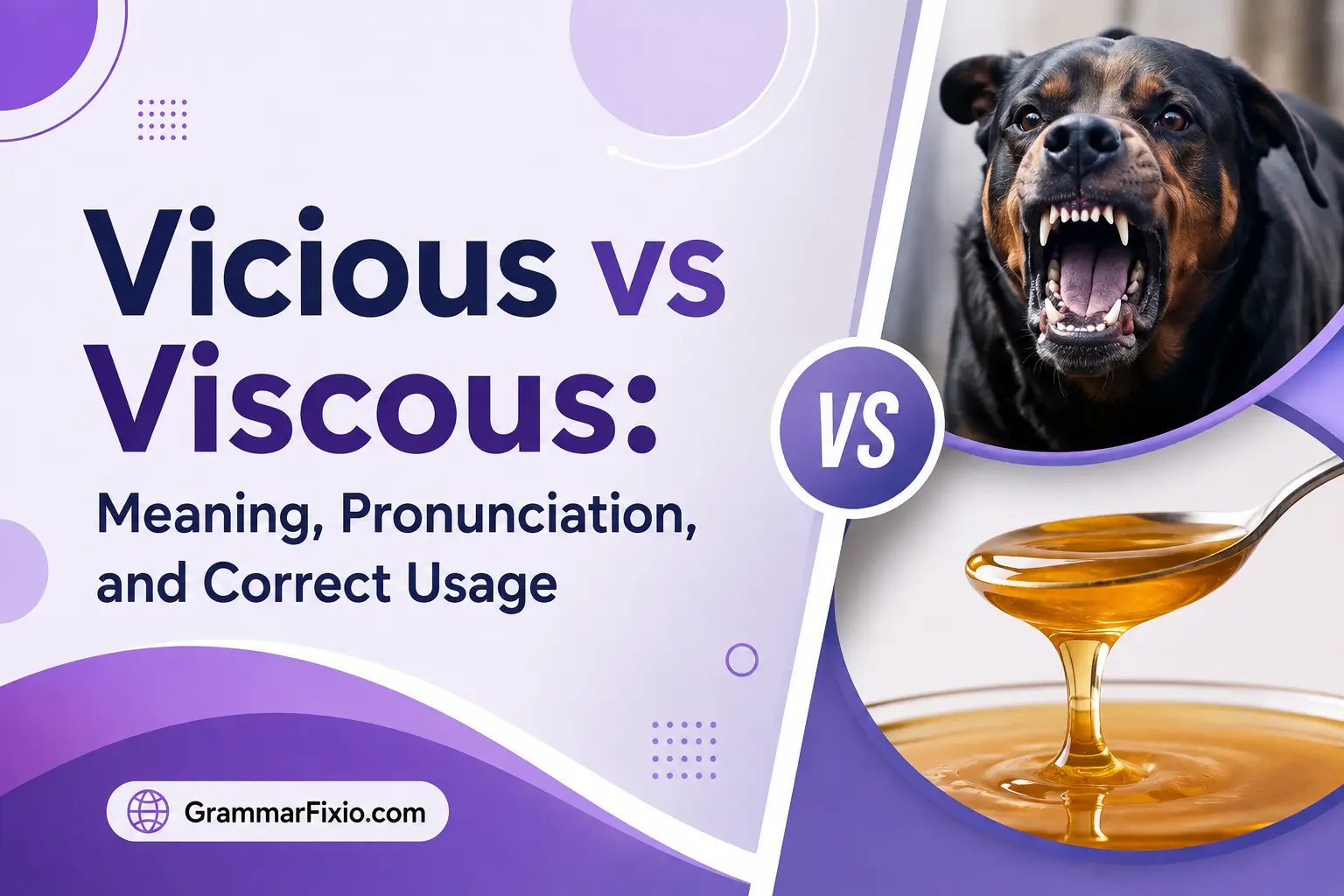
Many learners mix up Vicious vs Viscous because the words have similar spelling and similar pronunciation, but their meanings are completely different. Vicious is an adjective about cruelty, aggression, danger, violence, an attack, or a rumor, while viscous describes the physical property of a liquid like honey or oil with a thick texture. This mistake is common in workplace emails, academic papers, school essays, blog posts, news articles, science discussions, and everyday conversation, causing misunderstandings and reducing clarity.
A good grammar guide should explain the difference, help you understand the context and usage, and improve communication. This complete guide includes explanations, real-world examples, common mistakes, confusing words, practical exercises, answers, memory tips, and pronunciation support. Whether you are a student, professional writer, or simply interested in learning, these tools build vocabulary, writing skills, and confidence through clear communication.
Both writers, experienced writers, speakers, and experienced speakers know that choosing the correct word instead of the wrong word improves precision and credibility. It also helps you compare, clarify, distinguish, choose, and pronounce words correctly. Over time, this will sharpen your professional writing, creative writing, every article, and your understanding of the language, making confusing word pairs much easier and preventing them from making you trip up.
Quick Answer: Vicious vs Viscous
The simplest rule is:
Use vicious for cruelty, violence, harm, or extreme severity. Use viscous for a thick fluid that resists flowing.
Consider these examples:
- The reporter received a vicious personal attack.
- The cold syrup became too viscous to pour.
- Lack of sleep can create a vicious cycle of stress and exhaustion.
- The engineer tested the viscous fluid in the machine.
Although the words look similar, they aren’t interchangeable.
Vicious vs Viscous at a Glance
| Feature | Vicious | Viscous |
| Basic meaning | Cruel, violent, harmful, or severe | Thick and resistant to flowing |
| Part of speech | Adjective | Adjective |
| US pronunciation | VISH-us | VIS-kus |
| IPA | /ˈvɪʃ.əs/ | /ˈvɪs.kəs/ |
| Commonly describes | Attacks, behavior, animals, criticism, cycles | Liquids, oils, mixtures, fluids, gels |
| Common contexts | Conversation, news, business, social media | Science, cooking, medicine, engineering |
| Related noun | Viciousness | Viscosity |
| Example | It was a vicious argument. | The mixture was highly viscous. |
A useful meaning test is to replace the word with a simpler synonym:
- If cruel, violent, or harmful fits, use vicious.
- If thick, syrupy, or slow-flowing fits, use viscous.
Read this also: Lier vs Liar: Correct Spelling, Meaning, and Usage
How to Pronounce Vicious and Viscous
The words have similar beginnings, but their middle sounds are different. Listening for that difference can help you choose the correct spelling.
How to Pronounce Vicious
Vicious is pronounced VISH-us.
Its American English pronunciation is /ˈvɪʃ.əs/. The first syllable receives the stress. The middle sound is like the sh in ship or wish.
Examples:
- a vicious dog
- a vicious rumor
- a vicious attack
The word has two syllables: vish-us.
How to Pronounce Viscous
Viscous is pronounced VIS-kus.
Its American English pronunciation is /ˈvɪs.kəs/. Unlike vicious, it contains a clear s-k sound in the middle.
Examples:
- a viscous liquid
- viscous oil
- a highly viscous mixture
The word also has two syllables: vis-kus.
Are Vicious and Viscous Homophones?
No. Vicious and viscous are not homophones because they don’t have the same pronunciation.
Compare their middle sounds:
- Vicious: “sh” sound
- Viscous: “sk” sound
However, they can sound similar in fast speech. Their spelling also begins and ends in a similar way, which adds to the confusion.
What Does Vicious Mean?
Vicious is an adjective that usually means cruel, violent, aggressive, malicious, or severely harmful. It can describe physical actions, hurtful words, dangerous animals, intense competition, or repeating harmful situations.
The exact meaning depends on the noun it modifies.
Vicious Meaning: Cruel or Violent
The most direct meaning of vicious is cruel or violent. In this sense, the word describes someone or something likely to cause serious harm.
Examples:
- The victim suffered a vicious attack.
- The normally calm dog became vicious when threatened.
- Police warned residents about a vicious criminal.
- The two animals were involved in a vicious fight.
In each sentence, vicious suggests more than ordinary anger. It points to extreme aggression or brutality.
Compare:
- The dog was unfriendly.
- The dog was vicious.
An unfriendly dog may avoid people or growl. A vicious dog may actively attack or cause harm. Therefore, vicious carries a much stronger meaning.
Vicious Meaning: Malicious or Deliberately Hurtful
Vicious can also describe language, criticism, rumors, and behavior intended to hurt someone emotionally or damage a reputation.
Examples:
- She posted a vicious comment about her coworker.
- The actor faced a vicious online campaign.
- A vicious rumor spread through the school.
- His review was not constructive; it was simply vicious.
This meaning is common in news reports, workplace discussions, social media, and everyday conversation.
A critical comment points out a problem. A vicious comment, however, attacks the person in a cruel or malicious way.
Vicious Meaning: Severe or Intense
Sometimes, vicious means extremely severe, forceful, or unpleasant. The situation may not involve deliberate cruelty.
Examples:
- A vicious storm damaged several homes.
- The company faces vicious competition in the market.
- She woke up with a vicious headache.
- A vicious winter wind swept through the city.
This use emphasizes intensity. However, it is often informal when used for pain or weather.
In formal medical writing, a doctor would normally use severe headache, not vicious headache. In casual speech, though, the stronger expression may sound natural.
What Does Vicious Cycle Mean?
A vicious cycle is a harmful pattern in which one problem causes another problem, which then makes the original problem worse.
For example:
- A person feels stressed.
- Stress makes it difficult to sleep.
- Poor sleep increases stress.
- The pattern repeats.
That is a vicious cycle because each part strengthens the next problem.
Other examples include:
- Debt leads to higher interest costs, which create more debt.
- Low confidence causes avoidance, which prevents improvement and lowers confidence further.
- Poor sales lead to budget cuts, which reduce marketing and cause even lower sales.
Vicious circle has the same basic meaning. Both expressions are correct, although vicious cycle is especially common in American English.
Common Phrases with Vicious
The adjective often appears in fixed or familiar combinations called collocations. A collocation is a group of words that commonly occur together.
Common examples include:
- vicious attack
- vicious dog
- vicious cycle
- vicious circle
- vicious rumor
- vicious criticism
- vicious campaign
- vicious temper
- vicious fight
- vicious competition
These combinations sound natural because English speakers use them frequently.
Word Forms Related to Vicious
The word belongs to a small family of related forms.
| Word | Part of Speech | Meaning | Example |
| Vicious | Adjective | Cruel, violent, or harmful | It was a vicious attack. |
| Viciously | Adverb | In a cruel or violent manner | The dog barked viciously. |
| Viciousness | Noun | The quality of being vicious | The viciousness of the comment shocked everyone. |
Use viciously to describe how an action happens:
- The two candidates attacked each other viciously.
- The animal reacted viciously when cornered.
Use viciousness when naming the quality itself:
- The viciousness of the online abuse surprised the moderator.
What Does Viscous Mean?
Viscous is an adjective that describes a liquid, fluid, or semiliquid substance that is thick and resistant to flowing.
A viscous substance moves more slowly than a thin liquid. Honey, syrup, molasses, glue, and cold motor oil are common examples.
Viscous Meaning in Everyday English
You may use viscous when describing the texture or movement of a substance.
Examples:
- The honey was too viscous to pour quickly.
- The sauce should become smooth and slightly viscous.
- The cold syrup had a thick, viscous texture.
- The artist mixed a viscous gel into the paint.
The term is more precise than simply saying thick. Thickness can describe many physical dimensions, while viscous specifically refers to resistance to flow.
For example, a thick wooden board isn’t viscous because it doesn’t flow. Honey can be viscous because it is a fluid that moves slowly.
Viscous Meaning in Science
In science, viscous describes a fluid with noticeable resistance to movement or flow. That resistance is called viscosity.
A fluid with high viscosity flows slowly. A fluid with low viscosity flows more easily.
Compare:
| Substance | Relative Viscosity | Flow |
| Water | Low | Flows quickly |
| Cooking oil | Moderate | Flows more slowly than water |
| Syrup | High | Flows slowly |
| Honey | High | Flows very slowly |
| Molasses | Very high | Flows extremely slowly |
Temperature can also affect viscosity. For many liquids, heating reduces viscosity. As a result, warm honey usually pours more easily than cold honey.
Motor oil provides another practical example. Cold oil is more viscous, so it moves slowly. As the engine warms, the oil becomes less viscous and circulates more easily.
Can Gases Be Viscous?
Yes. In physics, both liquids and gases are fluids, and both have viscosity.
However, everyday speakers usually use viscous for liquids and semiliquid substances. A scientist or engineer may discuss a viscous gas, but the phrase is uncommon in casual conversation.
This distinction matters because viscous doesn’t technically mean “liquid.” Instead, it describes resistance to flow.
Does Viscous Mean Sticky?
Viscous and sticky are related ideas, but they don’t mean exactly the same thing.
- Viscosity concerns how strongly a fluid resists flowing.
- Stickiness concerns how strongly a substance clings to another surface.
Honey is both viscous and sticky. However, a substance may resist flowing without strongly sticking to your hands or another surface.
For example, some industrial oils are highly viscous but not especially adhesive. Therefore, viscous shouldn’t automatically be treated as a synonym for sticky.
Viscous vs Nonviscous
Nonviscous means having little or no noticeable resistance to flow. In everyday descriptions, a nonviscous liquid flows easily.
For example:
- Water is relatively nonviscous compared with honey.
- A thin cleaning solution may appear almost nonviscous.
However, in scientific terms, real fluids still have some viscosity. Therefore, low-viscosity is often more accurate than saying a substance has no viscosity at all.
Common Phrases with Viscous
Common collocations include:
- viscous liquid
- viscous fluid
- viscous oil
- viscous material
- viscous mixture
- viscous solution
- viscous substance
- viscous flow
- highly viscous
- less viscous
These expressions often appear in chemistry, engineering, medicine, cooking, manufacturing, and automotive work.
Word Forms Related to Viscous
| Word | Part of Speech | Meaning | Example |
| Viscous | Adjective | Thick and resistant to flow | The liquid was viscous. |
| Viscosity | Noun | A fluid’s resistance to flow | The technician measured the oil’s viscosity. |
| Viscously | Adverb | In a viscous manner | The material moved viscously through the tube. |
Viscosity is much more common than viscously.
For example:
- Correct: The fluid has high viscosity.
- Correct but less common: The fluid moved viscously through the pipe.
In most technical writing, the noun viscosity is clearer and more natural.
Key Differences Between Vicious and Viscous
Although both words are adjectives, their meanings, contexts, and emotional tones differ.
Difference in Meaning
Vicious refers to:
- Cruelty
- Violence
- Malice
- Harm
- Severity
- Destructive patterns
Viscous refers to:
- Thickness
- Fluid movement
- Resistance to flow
- Physical properties of liquids or gases
Compare:
- a vicious animal
- a viscous liquid
The first phrase describes behavior. The second describes a physical property.
Difference in the Nouns They Modify
The noun after the adjective often tells you which word you need.
| Use Vicious With | Use Viscous With |
| Attack | Liquid |
| Dog | Fluid |
| Rumor | Oil |
| Comment | Mixture |
| Cycle | Gel |
| Criticism | Solution |
| Campaign | Substance |
| Fight | Material |
Of course, context still matters. However, these pairings provide a useful guide.
Difference in Tone
Vicious usually carries a strong negative and emotional tone. It often expresses fear, anger, criticism, or danger.
Viscous is neutral and descriptive. It normally explains a measurable or observable physical quality.
Compare:
- The article contained a vicious accusation.
- The container held a viscous substance.
The first sentence involves judgment and harm. The second gives a physical description.
Difference in Register
Vicious appears in many types of communication:
- Casual conversation
- News reports
- Social media
- Business writing
- Political commentary
- Fiction
Viscous appears more often in:
- Scientific reports
- Medical descriptions
- Engineering documents
- Product instructions
- Cooking discussions
- Automotive maintenance
Even so, viscous isn’t limited to academic writing. You can use it whenever you need a precise word for a thick, slow-flowing substance.
Correct Examples of Vicious
The following examples show how vicious works in different situations.
Everyday Conversation
- That was a vicious thing to say.
- The dog looked friendly, but it became vicious when approached.
- She had a vicious headache after the long flight.
The first two examples involve cruelty or aggression. The third uses vicious informally to mean severe.
School and Academic Contexts
- The student became the target of a vicious rumor.
- The essay examines the vicious cycle between poverty and limited educational access.
- The debate became unusually vicious.
In academic writing, vicious cycle is appropriate when explaining a repeating harmful process. However, emotionally strong uses should be supported by context.
Workplace and Business English
- The company entered a vicious cycle of falling sales and reduced advertising.
- The manager received vicious criticism after announcing the layoffs.
- Competition between the two firms became vicious.
In professional writing, use the word carefully. It is stronger than intense, harsh, or competitive.
Social Media and News
- The journalist faced a vicious online backlash.
- A vicious misinformation campaign damaged the candidate’s reputation.
- Commenters launched vicious personal attacks against the speaker.
These uses describe intentionally harmful or extremely hostile communication.
Correct Examples of Viscous
Cooking
- Continue stirring until the sauce becomes viscous.
- Cold honey is more viscous than warm honey.
- The mixture should be thick but not overly viscous.
In recipes, thick is more common in casual instructions. However, viscous is useful when discussing how a mixture flows.
Science Class
- The students compared a viscous fluid with water.
- The experiment measured how temperature affected viscosity.
- The liquid became less viscous when heated.
These examples focus on measurable physical properties.
Automotive Use
- Cold engine oil may be more viscous.
- The mechanic selected oil with the correct viscosity.
- An overly viscous lubricant may not circulate properly at low temperatures.
In automotive contexts, viscosity is important because oil must flow under changing temperatures.
Medicine and Biology
- The sample contained a highly viscous fluid.
- Dehydration can make certain body fluids more viscous.
- The researcher examined the substance’s viscosity.
Medical and biological writing often uses the word in a precise, technical sense.
Common Mistakes with Vicious and Viscous
Because both words are correctly spelled, spellcheck may not catch the wrong choice. You must check the meaning of the sentence.
Mistake: Using Vicious for a Thick Liquid
Incorrect: The honey was too vicious to pour.
Correct: The honey was too viscous to pour.
Honey isn’t cruel or violent. The sentence describes its resistance to flow, so viscous is correct.
Mistake: Using Viscous for Cruel Behavior
Incorrect: He made a viscous attack on his coworker.
Correct: He made a vicious attack on his coworker.
A personal attack can be cruel, malicious, or harmful. Therefore, use vicious.
Mistake: Writing Viscous Cycle
Incorrect: Poor sleep can create a viscous cycle of stress.
Correct: Poor sleep can create a vicious cycle of stress.
A cycle isn’t a flowing substance. The phrase describes a harmful repeating pattern, so the correct expression is vicious cycle.
Mistake: Calling Every Thick Object Viscous
Incorrect: The wall was made from viscous concrete after it hardened.
Better: The wall was made from thick concrete that later hardened.
Wet concrete may be described as viscous because it can flow. Once it becomes a solid wall, however, viscosity is no longer the relevant property.
Mistake: Treating Vicious as a General Synonym for Bad
Weak: The restaurant gave us vicious service.
Better: The restaurant gave us terrible service.
Vicious usually suggests cruelty, aggression, or deliberate harm. It sounds unnatural when the speaker only means disappointing or poor.
Why People Confuse Vicious and Viscous
Several features make this word pair difficult.
Their Spellings Look Similar
Both words:
- Begin with vi
- End with ous
- Have two syllables
- Function as adjectives
The important spelling difference appears in the middle:
- vicious
- viscous
Because readers often recognize a word by its overall shape, the difference can be easy to miss.
Their Pronunciations Begin and End Similarly
Both words start with a short i sound and end with an unstressed us sound.
However:
- Vicious contains sh.
- Viscous contains sk.
Saying the word slowly can help you hear the difference.
Viscous Is Less Common in Daily Conversation
Most speakers encounter vicious more often than viscous. Therefore, they may automatically choose the more familiar spelling, even when discussing a fluid.
This problem often appears in essays, lab reports, recipe descriptions, and automotive content.
Grammar Checkers May Miss the Error
Both words can correctly appear before a noun because both are adjectives.
For example:
- a vicious mixture
- a viscous mixture
The second phrase normally describes texture or flow. However, the first could be grammatically possible if the mixture is extremely harmful.
A grammar checker cannot always determine the intended meaning. Therefore, human review remains important.
A Simple Decision Guide
Use this process whenever you are unsure.
Ask What the Word Describes
Does the sentence describe cruelty, aggression, harm, or extreme severity?
Use vicious.
Does it describe a fluid’s thickness or resistance to flow?
Use viscous.
Try a Synonym
Replace the uncertain word with a simpler one.
For vicious, try:
- cruel
- violent
- malicious
- savage
- severe
- harmful
For viscous, try:
- thick
- syrupy
- slow-flowing
- glue-like
Example:
- The cold oil was thick.
Because thick fits, viscous is probably correct.
Another example:
- The article made a malicious accusation.
Because malicious fits, choose vicious.
Look at the Noun
Certain nouns strongly suggest one choice:
- attack, rumor, cycle, dog, criticism → usually vicious
- oil, liquid, gel, mixture, fluid → usually viscous
This isn’t an absolute rule, but it works in most common situations.
Easy Memory Tricks
Connect Vicious with Cruel
Both vicious and cruel contain the letter c.
Think:
Vicious = cruel conduct
This reminder works for attacks, comments, animals, rumors, and behavior.
Connect Viscous with Syrup and Science
Viscous, syrup, and science all contain the letter s.
Think:
Viscous = syrupy substance
This connection can remind you that viscous describes thick fluids.
Listen for the Middle Sound
- Vicious sounds like VISH-us.
- Viscous sounds like VIS-kus.
The k sound in viscous can remind you of a scientific or technical term.
Synonyms and Related Words
Synonyms for Vicious
Depending on context, possible synonyms include:
- Cruel
- Violent
- Brutal
- Savage
- Malicious
- Hostile
- Ferocious
- Severe
- Destructive
- Spiteful
However, these words aren’t always interchangeable.
For example, ferocious may describe intense force without suggesting moral cruelty. Spiteful usually refers to a desire to hurt someone emotionally. Vicious can cover both physical and verbal harm.
Synonyms for Viscous
Possible alternatives include:
- Thick
- Syrupy
- Gooey
- Glue-like
- Sticky
- Gel-like
- Slow-flowing
Still, each word has a different level of precision.
Gooey is informal. Sticky describes adhesion rather than flow resistance. Viscous is the best choice in scientific or technical contexts.
Viciousness vs Viscosity
These nouns belong to different word families.
- Viciousness means cruelty, violence, or harmful intensity.
- Viscosity means resistance to flow.
Examples:
- The viciousness of the attack shocked the community.
- The technician measured the liquid’s viscosity.
Never use viciousness to describe a fluid’s thickness.
Real-Life Usage Case Studies
Workplace Communication
A manager writes:
The team is trapped in a viscous cycle of missed deadlines and low morale.
The sentence is incorrect because the cycle isn’t physically thick. The writer means that each problem makes the other worse.
Corrected version:
The team is trapped in a vicious cycle of missed deadlines and low morale.
Science Report
A student writes:
The vicious solution moved slowly through the tube.
The sentence uses the wrong adjective. The solution isn’t cruel. It resists flow.
Corrected version:
The viscous solution moved slowly through the tube.
Social Media Post
A user writes:
People left viscous comments under the video.
The intended meaning is cruel or malicious.
Corrected version:
People left vicious comments under the video.
These examples show why sentence meaning matters more than spelling alone.
Practice Exercise
Choose vicious or viscous for each blank.
- The cold syrup became so ______ that it barely moved.
- The journalist received a ______ threat online.
- Debt and high interest can form a ______ cycle.
- The mechanic tested the ______ oil before replacing it.
- The frightened animal became ______ when approached.
- The laboratory mixture was dark and highly ______.
- Her ______ criticism embarrassed the employee.
- The sauce should have a smooth, slightly ______ texture.
- A ______ rumor spread across the office.
- The fluid becomes less ______ as its temperature rises.
Answer Key
- Viscous — The sentence describes syrup that flows slowly.
- Vicious — A harmful or cruel threat is vicious.
- Vicious — “Vicious cycle” is the correct expression for a harmful repeating pattern.
- Viscous — The sentence describes the physical flow of oil.
- Vicious — The animal became aggressive or dangerous.
- Viscous — The mixture is thick and resistant to flow.
- Vicious — The criticism was deliberately cruel or harsh.
- Viscous — The sentence describes the sauce’s flowing texture.
- Vicious — A cruel or damaging rumor can be vicious.
- Viscous — Temperature affects the fluid’s resistance to flow.
Read this also: My vs Mine: Meaning, Grammar Rules, and Correct Usage
Faqs for Vicious vs Viscous
Vicious describes someone or something cruel, violent, or dangerous. Viscous describes a thick liquid, such as honey or syrup.
Yes. Vicious is an adjective used to describe harmful, aggressive, or cruel people, animals, actions, or behavior.
Most of the time, yes. Viscous describes liquids or substances that flow slowly because they are thick.
People confuse them because they have similar spelling and pronunciation, even though their meanings are completely different.
No. Viscous describes the texture of a substance, not a person’s behavior or personality.
A correct example is: The dog made a vicious attack on the intruder.
A correct example is: The engine oil became more viscous in cold weather.
Think of vicious as relating to violence and viscous as relating to viscosity or thick liquids like honey.
No. They sound similar but are pronounced differently, which is why many English learners mix them up.
Yes. Using the correct word makes your writing clearer, more professional, and helps you avoid confusing your readers.
Conclusion
Understanding Vicious vs Viscous is easier once you know what each word describes. Vicious relates to cruelty, violence, or harmful behavior, while viscous describes a thick, sticky liquid. Although the words look and sound similar, they have completely different meanings and should never be used in place of each other. Remembering the difference will help you avoid common writing mistakes, improve your grammar, and communicate with more confidence. With regular practice and real-life examples, choosing the correct word will soon become natural.










1 thought on “Vicious vs Viscous: Differences, Meaning, Pronunciation, and Correct Usage”