Understanding the Difference Between Inclosed and Enclosed
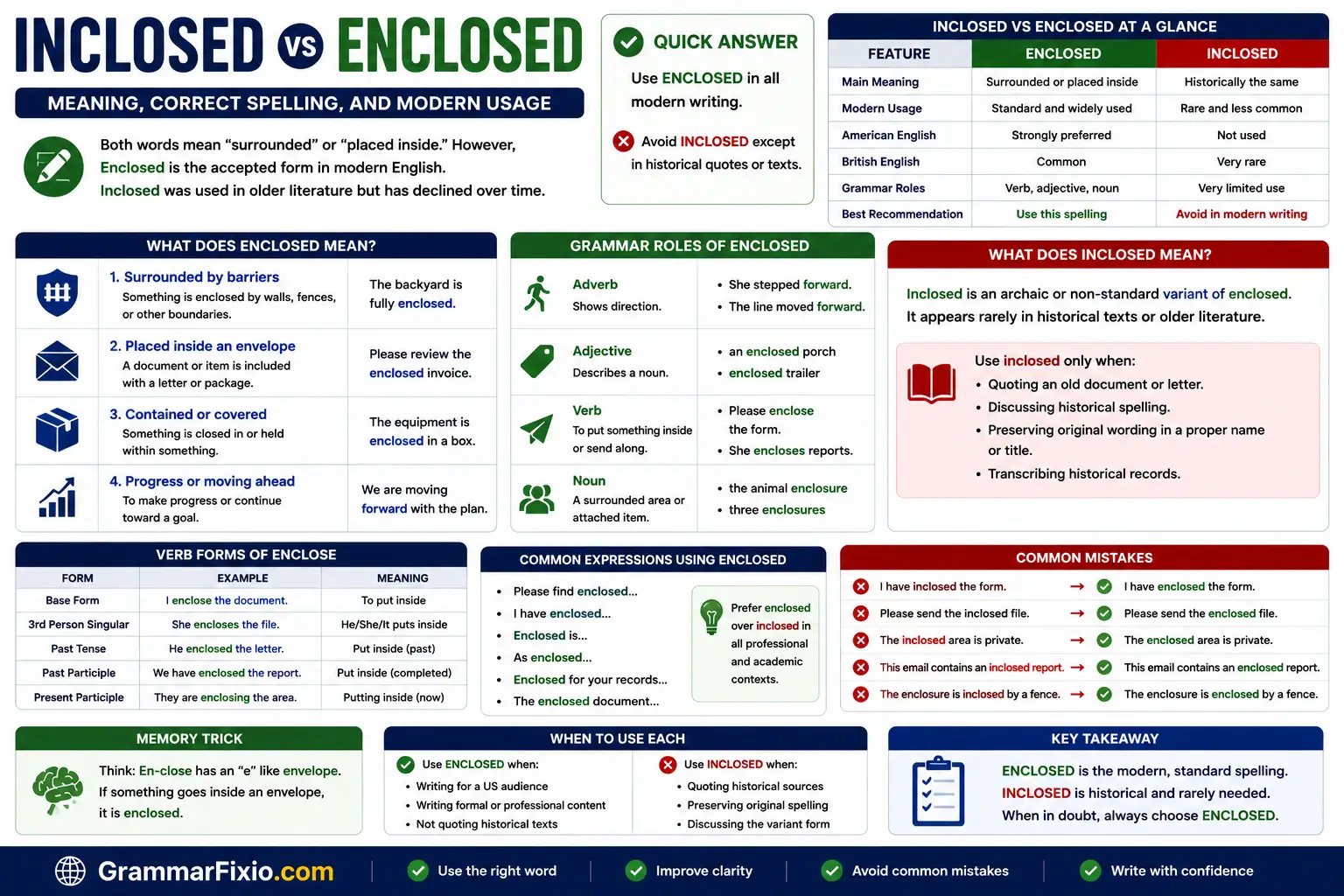
Many people searching Inclosed vs Enclosed wonder which spelling is correct. The confusion exists because both words share a similar history, but Enclosed is the accepted form in modern English. Inclosed was used in older literature, English-language books, and published essays, but it has declined over the centuries. Ngram graphs from 1800 to 2000 show that Enclosed became the preferred verb, while Inclose, inclosing, inclosure, and other variants are now mostly found in poetic contexts.
Using the right word is important in business, legal, and academic writing. Whether you write emails, letters, academic papers, legal papers, official documents, or business correspondence, choosing Enclosed helps you follow correct spelling, proper usage, and accepted writing standards. When you insert or enclose a document, papers, important details, or a small thing inside an envelope, mailed package, or package, your professional writing becomes more credible, clear, and easy to understand.
As an editor, I always recommend reviewing the context, terminology, terms, usage, examples, derived words, and corresponding sources before sending any message. This simple habit improves clarity, precision, confidence, and communication, while helping writers avoid common mistakes, misspelling, misunderstanding, and second-guessing. Understanding the difference, origin, historical spelling, language evolution, frequency, and accepted variants gives you the confidence to write accurate, natural, and professional English every time.
Quick Answer: Is Inclosed or Enclosed Correct?
Enclosed is the standard spelling for modern writing.
Use it when something:
- Is surrounded by walls, fences, or other barriers
- Is contained inside something
- Is placed in an envelope or package
- Has been closed in
- Accompanies a physical letter
Correct examples include:
- The backyard is fully enclosed.
- Please return the enclosed application.
- I enclosed a copy of the receipt.
- The equipment must remain in an enclosed area.
Inclosed can carry the same basic meaning. However, it is a less common variant and may appear old-fashioned or incorrect to modern readers.
Therefore, use enclosed in schoolwork, business writing, professional emails, reports, applications, websites, and everyday communication.
Read this also: Entwined vs Intertwined: Difference, Meaning & Correct Usage Guide
Inclosed vs Enclosed at a Glance
| Feature | Enclosed | Inclosed |
| Basic meaning | Surrounded, contained, or placed inside | Historically the same basic meaning |
| Modern status | Standard and widely used | Rare and less common |
| Recommended in current writing | Yes | Usually no |
| Common in American English | Yes | No |
| Common in British English | Yes | No |
| Suitable for business writing | Yes | Best avoided |
| Suitable for academic writing | Yes | Only when discussing or quoting old usage |
| Example | The enclosed form is complete. | Found mainly in older or unusual texts |
| Best advice | Use this spelling | Preserve only when context requires it |
The difference is not mainly about meaning. Instead, it concerns frequency, convention, and reader expectations.
What Does Enclosed Mean?
Enclosed is the past-tense form and past participle of the verb enclose. It can also function as an adjective.
The verb enclose has two common ideas:
- To surround or close something in
- To put something inside an envelope, parcel, or package
These meanings appear in both American and British dictionary sources.
Enclosed as the Past Tense of Enclose
Use enclosed when an action happened in the past.
- The builders enclosed the porch last summer.
- A stone wall enclosed the garden.
- I enclosed a check with my application.
- The package enclosed the product securely.
In these examples, enclosed describes a completed action.
The full verb pattern is:
| Verb Form | Example |
| Base form | enclose |
| Third-person singular | encloses |
| Past tense | enclosed |
| Past participle | enclosed |
| Present participle | enclosing |
For example:
- I usually enclose a receipt.
- She encloses a return label.
- They enclosed the patio.
- We have enclosed the requested documents.
- He is enclosing a signed copy.
Enclosed as a Past Participle
A past participle often appears with a helping verb such as has, have, had, is, was, or were.
- We have enclosed the signed agreement.
- The yard was enclosed by a wooden fence.
- The documents are enclosed in a sealed envelope.
- The patio had been enclosed before the house was sold.
The helping verb and participle work together to form a verb phrase.
For instance, was enclosed uses the passive voice. It focuses on the yard rather than the person who built the fence.
Enclosed as an Adjective
Enclosed can also describe a noun. In that role, it acts as an adjective.
- an enclosed porch
- an enclosed courtyard
- an enclosed trailer
- an enclosed workspace
- the enclosed application
An enclosed porch is surrounded by walls, screens, windows, or similar structures. Meanwhile, an enclosed application is an application placed inside the same envelope or package.
The surrounding sentence makes the meaning clear.
What Does Inclosed Mean?
Inclosed is a less common spelling of enclosed. It comes from the verb inclose, which dictionaries may list as a variant of enclose.
Merriam-Webster labels inclose as a less common variant. The American Heritage Dictionary also records enclose with inclose as an alternative form. Therefore, calling inclosed completely nonexistent would be inaccurate. Still, it is not the form most modern readers expect.
Is Inclosed a Misspelling?
The answer depends on context.
Historically and lexically, inclosed has been used as a variant. Therefore, it is not simply an invented collection of letters.
However, in ordinary modern writing, many readers will assume it is a spelling mistake. They are accustomed to seeing:
- enclosed yard
- enclosed document
- enclosed porch
- enclosed payment
- enclosed space
For that reason, enclosed is the safer and clearer choice.
Why Inclosed Looks Possible
The spelling inclosed may seem logical because the prefix in- often relates to being inside.
English has many words beginning with in-, including:
- include
- insert
- interior
- internal
- inside
However, word formation does not always follow a simple modern pattern. The established standard verb is enclose, so its regular forms are enclosed, encloses, and enclosing.
You should not choose a spelling only because its parts appear logical. Instead, follow current standard usage.
When Inclosed May Be Appropriate
You may retain inclosed in a few limited situations:
- An exact quotation from an old book
- A historical letter or diary
- An archived legal record
- A transcription that preserves original spelling
- A proper name or official historical title
- A discussion about the spelling itself
For example:
The 19th-century record states that the land was “inclosed by a timber fence.”
Here, changing inclosed could make the quotation inaccurate. Outside the quotation, however, a modern writer would normally use enclosed.
The Main Difference Between Inclosed and Enclosed
The central difference is modern acceptability, not a dependable difference in meaning.
Both forms have been used for the ideas of surrounding, confining, or placing something inside. Yet enclosed became the standard spelling readers recognize today.
Enclosed Is the Standard Modern Form
Choose enclosed for:
- Essays
- Exams
- College applications
- Résumés and cover letters
- Business letters
- Contracts
- Reports
- Government forms
- Product instructions
- News articles
- Website content
- Everyday messages
This form communicates the meaning without distracting the reader.
Inclosed Is a Rare Variant
Although dictionaries may record inclosed, using it creates unnecessary risk.
A teacher may mark it as an error. A client may think the document was not proofread. In addition, automated writing tools may flag it because the form is uncommon.
A rare word is not always wrong. However, effective writing depends on more than dictionary recognition. You must also consider what readers expect.
Are They Interchangeable?
They can represent the same basic idea, but they are not equally suitable in modern communication.
Consider these versions:
- Please review the enclosed invoice.
- Please review the inclosed invoice.
The second sentence can be understood. However, the first is natural, standard, and professional.
Therefore, treat the pair as unequal choices. Use enclosed unless you have a specific historical reason not to.
Enclosed as a Verb and an Adjective
The same spelling can perform different grammatical jobs.
Enclosed as a Verb
In the following sentence, enclosed shows an action:
- The contractor enclosed the balcony.
The subject, contractor, performed the action. The balcony received that action.
Another example is:
- I enclosed the payment with the form.
Here, the speaker placed the payment inside an envelope or package.
Enclosed as an Adjective
Now compare:
- We sat on the enclosed balcony.
In this sentence, enclosed describes the noun balcony. It tells you what kind of balcony it is.
Likewise:
- Please sign the enclosed form.
The word describes the form sent inside the letter.
How Sentence Position Changes the Role
| Sentence | Role of Enclosed | Explanation |
| They enclosed the garden. | Verb | Describes an action |
| The garden was enclosed. | Past participle | Works with “was” |
| We entered the enclosed garden. | Adjective | Describes “garden” |
| I enclosed a photograph. | Verb | Means placed inside |
| The enclosed photograph is damaged. | Adjective | Describes “photograph” |
Understanding the sentence role helps you identify the meaning.
How to Use Enclosed Correctly
Enclosed works in several common contexts.
When Something Is Surrounded
Use it when a boundary surrounds an area.
- The children played in an enclosed yard.
- A high wall enclosed the property.
- The hotel has an enclosed courtyard.
- Keep the dog in the enclosed area.
The boundary may be a fence, wall, screen, railing, or natural feature.
When Something Is Covered or Closed In
An area can be enclosed above as well as around its sides.
- The restaurant added an enclosed patio for winter.
- The truck has an enclosed cargo area.
- We waited inside an enclosed shelter.
- The balcony was fully enclosed with glass.
An enclosed place is not always airtight. The word mainly suggests that it is surrounded or separated from the open area around it.
When Something Is Inside a Letter or Package
Use enclosed for an item physically placed with other mailed materials.
- Please complete the enclosed form.
- I have enclosed a copy of my identification.
- The enclosed check covers the remaining balance.
- Sign and return the enclosed agreement.
Oxford’s American dictionary entry includes the meaning of putting something in the same envelope or package. It also lists enclosed for something sent with a letter.
When Something Is Contained
The word can also describe materials held within a structure or container.
- The gas remained enclosed in the chamber.
- Store the chemical in an enclosed container.
- The wires are enclosed in protective tubing.
- The machine operates as an enclosed system.
In technical writing, be precise about the type of containment. An enclosed system may still allow controlled movement, ventilation, or access.
Enclosed, Attached, and Included
These words overlap, but they are not exact synonyms.
| Word | Best Used For | Example |
| enclosed | An item inside a physical letter or package | Please sign the enclosed form. |
| attached | A file connected to an email or message | I’ve attached the report. |
| included | Something that forms part of a group, price, service, or contents | Breakfast is included. |
| inserted | Something placed into a space or document | A card was inserted into the package. |
Use Enclosed for Physical Mail
Traditional business letters often refer to physical materials as enclosed.
- Enclosed is your replacement card.
- Please review the enclosed contract.
- I have enclosed two copies of the agreement.
The item is literally inside the envelope or parcel.
Use Attached for Email Files
For digital communication, attached is usually clearer.
Natural:
- I’ve attached the invoice.
- The requested file is attached.
- Please review the attached document.
Less natural in a routine email:
- Please review the enclosed document.
The last sentence is understandable. However, readers may wonder whether the writer means a digital attachment or a physical enclosure.
Use Included for General Content
Included means something forms part of a larger group, amount, service, or package.
- Shipping is included in the price.
- The kit includes three replacement filters.
- Instructions are included with every order.
- Your name was included on the list.
You cannot always replace included with enclosed.
Incorrect:
- Breakfast is enclosed in the room rate.
Correct:
- Breakfast is included in the room rate.
Is “Please Find Enclosed” Correct?
Yes, please find enclosed is grammatically correct. It is especially suitable for a formal letter containing a physical document.
For example:
- Please find enclosed the signed contract.
- Please find enclosed a copy of your receipt.
- Please find the completed application enclosed.
However, the phrase can sound formal or dated in everyday business communication.
Clearer Alternatives for Letters
You can often write:
- I’ve enclosed the signed contract.
- The signed contract is enclosed.
- Enclosed is a copy of the receipt.
- Please review the enclosed application.
These options are direct and easy to read.
Better Alternatives for Email
For an email attachment, use:
- I’ve attached the signed contract.
- The signed contract is attached.
- Please review the attached file.
- You’ll find the report attached.
These sentences identify the delivery method clearly.
Is “Enclosed Please Find” Correct?
Enclosed please find appears in older business correspondence. Readers can understand it, but its inverted word order sounds stiff today.
Instead of:
- Enclosed please find our completed application.
Write:
- Our completed application is enclosed.
- We have enclosed our completed application.
For email, write:
- We have attached our completed application.
Correct Examples of Enclosed
The following examples show how the word works across different settings.
Physical Spaces
- The apartment has an enclosed balcony.
- A metal fence enclosed the playground.
- Employees must smoke only in the enclosed area.
- The resort offers an enclosed pool for winter use.
Letters and Packages
- I enclosed the original receipt.
- Please return the enclosed questionnaire.
- The enclosed label provides the return address.
- A warranty card is enclosed with the product.
Academic and Technical Writing
- Researchers stored the samples in an enclosed container.
- The experiment took place in an enclosed chamber.
- The diagram represents an enclosed system.
- Each specimen was enclosed in a separate case.
Workplace Communication
- The enclosed proposal includes the updated budget.
- We enclosed two signed copies for your records.
- Please review the enclosed payment schedule.
- The equipment sits inside an enclosed workspace.
Everyday American English
- Our porch is fully enclosed.
- The cat escaped from the enclosed patio.
- I enclosed some photos with the birthday card.
- The trailer provides enclosed storage.
Inclosed and Enclosed in American and British English
Inclosed vs enclosed is not a normal American-versus-British spelling pair.
Real regional spelling differences include:
| American English | British English |
| color | colour |
| center | centre |
| canceled | cancelled |
| traveled | travelled |
By contrast, enclosed is standard in both present-day American and British English. Oxford provides enclose and enclosed in both its general learner and American dictionary entries.
Therefore, switching to British English does not create a reason to write inclosed.
You may still find the variant in historical British or American material. That reflects age, individual spelling, publishing practice, or preserved source language rather than a simple regional rule.
Common Mistakes With Inclosed and Enclosed
Several nearby words cause confusion.
Using Inclosed in Modern Professional Writing
Avoid:
- The inclosed invoice is due Friday.
Prefer:
- The enclosed invoice is due Friday.
The first spelling may have dictionary history. However, the second matches modern professional expectations.
Using Enclose Instead of Enclosed
Incorrect:
- Please review the enclose document.
Correct:
- Please review the enclosed document.
The base verb enclose cannot directly describe document in this structure. You need the adjective or past participle enclosed.
Compare:
- Please enclose the document.
- Please review the enclosed document.
The first sentence gives an instruction. The second identifies the document.
Using Enclosed When Attached Is Clearer
Awkward in a routine email:
- I have enclosed the spreadsheet.
Clearer:
- I have attached the spreadsheet.
However, enclosed is still correct when the email discusses a physical space:
- The photograph shows an enclosed staircase.
The communication method does not change the word’s physical meaning.
Confusing Enclosed With Included
Incorrect:
- Internet service is enclosed in the monthly price.
Correct:
- Internet service is included in the monthly price.
Included means it forms part of the total. Enclosed suggests physical or conceptual containment.
Confusing Enclosed With Closed
A closed place is shut, unavailable, or not operating. An enclosed place is surrounded.
Compare:
- The store is closed on Sunday.
- The mall has an enclosed play area.
A business can be open while its patio is enclosed. Likewise, an outdoor business can be closed without being enclosed.
Confusing Enclosed With Sealed
Sealed suggests that an opening has been secured to prevent access, leakage, or contamination.
- The medication arrived in a sealed package.
- The animals remained in an enclosed field.
A field may be enclosed by a fence but not sealed. A bottle may be sealed even though you would not normally call the surrounding room enclosed.
Confusing Enclosed With Encased
Encased often suggests a close or protective covering.
- The phone was encased in rubber.
- The courtyard was enclosed by brick walls.
Rubber closely covers the phone. The walls surround the courtyard at a greater distance.
Enclose, Enclosed, Enclosing, and Enclosure
These related forms perform different jobs.
Enclose
Enclose is the base verb.
- Please enclose a copy of your license.
- Workers will enclose the patio next month.
- A fence can enclose the entire property.
Enclosed
Enclosed can be the past tense, a past participle, or an adjective.
- I enclosed the payment.
- The payment was enclosed.
- The enclosed payment covered the fee.
Enclosing
Enclosing is the present participle.
- I am enclosing a copy of the invoice.
- Workers are enclosing the outdoor dining area.
- Enclosing the balcony will reduce exposure to rain.
Enclosure
Enclosure is a noun. It can mean an area surrounded by a barrier.
- The horses remained inside the enclosure.
- The zoo added a larger animal enclosure.
It can also mean an item sent inside a letter or package.
- The letter contained three enclosures.
- Please review the enclosure before signing.
Enclosed vs Enclosure
Use enclosed to describe something or express an action.
- the enclosed form
- the enclosed yard
- I enclosed the form
Use enclosure as a noun.
- a secure enclosure
- an enclosure with the letter
Synonyms and Related Words
No synonym works in every sentence. Choose one that matches the exact idea.
Synonyms for Surrounded
Depending on context, enclosed may be similar to:
- surrounded
- encircled
- fenced in
- closed in
- bordered
- contained
- confined
For example:
- Mountains surrounded the valley.
- Mountains enclosed the valley.
Both sentences are possible. However, enclosed may create a stronger sense of limited openings or boundaries.
Synonyms for Placed Inside
When referring to mail or a package, related words include:
- inserted
- included
- packed
- placed inside
- added
- enclosed with
Example:
- A return label was inserted into the package.
- A return label was enclosed with the package.
The meanings overlap, but enclosed fits traditional correspondence more naturally.
Related Words That Are Not Exact Synonyms
- Attached: connected physically or digitally
- Included: made part of a group or total
- Sealed: securely closed
- Encased: closely covered
- Confined: restricted within limits
- Contained: held within something
- Covered: placed beneath or behind a covering
- Wrapped: surrounded with paper, fabric, or another flexible material
Pronunciation and Spelling of Enclosed
Enclosed is pronounced approximately in-KLOHZD in American English. The final part contains the sound of close as a verb, followed by a d sound. Cambridge gives the American pronunciation as /ɪnˈkloʊzd/.
Compare:
- close the door: klohz
- enclosed area: in-klohzd
The final consonant group may sound compressed in fast speech. However, the spelling remains enclosed.
How to Spell Enclosed
Start with the base verb:
- enclose
Then add d:
- enclose + d = enclosed
Because enclose already ends in e, you add only d, not another full -ed spelling.
The same pattern appears in:
- use + d = used
- close + d = closed
- change + d = changed
- provide + d = provided
A Simple Memory Trick
Connect enclosed with envelope:
Something enclosed may be inside an envelope.
Both words begin with en-.
This is only a spelling aid. Still, it helps you avoid writing inclosed in modern communication.
A Simple Decision Guide
Use enclosed when:
- Something is surrounded by a fence, wall, or barrier.
- A space has been closed in.
- An item is inside a physical envelope or package.
- You need the past tense of enclose.
- You need an adjective before a noun.
- You are writing in modern American English.
Use inclosed only when:
- Quoting a historical source exactly
- Preserving original spelling in a transcription
- Referring to an official historical title or name
- Discussing the variant itself
Use attached when:
- A digital file accompanies an email
- A document has been added to an online message
- You want to describe an email attachment clearly
Use included when:
- Something forms part of a price, set, service, or group
- You are listing contents or features
- Physical containment is not the main idea
Practical Communication Scenarios
A Job Application Sent by Mail
A candidate includes a résumé and references inside an envelope.
Best wording:
- Please review the enclosed résumé and reference list.
Here, enclosed accurately describes physical documents inside the mailing envelope.
A Job Application Sent by Email
The same candidate sends PDF files electronically.
Best wording:
- I’ve attached my résumé and reference list.
Using attached prevents confusion about how the files were delivered.
A Construction Report
An inspector describes a porch surrounded with walls and windows.
Best wording:
- The home includes a fully enclosed porch.
In this case, enclosed describes the physical design.
A Historical Research Paper
A student quotes a deed that uses the spelling inclosed.
Best approach:
The deed describes the parcel as “inclosed by a stone wall.”
The student should preserve the original spelling inside the quotation. Outside it, the paper should use enclosed.
Practice Exercise: Choose the Best Word
Choose enclosed, attached, included, closed, or enclosure.
- I’ve ___ the sales report to this email.
- Please sign and return the ___ form.
- The admission price has parking ___.
- The restaurant is ___ on Mondays.
- The goats escaped from their ___.
- The patio is fully ___ with glass.
- A return label is ___ inside the package.
- The manager ___ a copy of the receipt with the letter.
- The email has two files ___.
- The historical document uses the spelling “___.”
Practice Answers and Explanations
- Attached
The report is a digital email file. - Enclosed
The form is inside a physical letter or package. - Included
Parking forms part of the admission price. - Closed
The restaurant is not operating that day. - Enclosure
A noun is required for the fenced area. - Enclosed
Glass surrounds the patio. - Enclosed
The label is physically contained in the package. - Enclosed
The manager placed the receipt inside the letter. - Attached
Digital files accompany the email. - Inclosed
The sentence specifically asks for a historical spelling.
See this also: Envelop vs Envelope: Correct Usage, Meaning, and Easy Guide
FAQs
Yes. Inclosed is a real English word, but it is considered archaic. It appears mostly in older books and historical writing rather than modern English.
Enclosed is the correct spelling for modern English. It is the standard choice in formal, academic, business, and everyday writing.
The confusion happens because both words have similar meanings and were used interchangeably in older English. Today, however, Enclosed is the accepted form.
No. In professional communication, you should always use Enclosed because it follows current English writing standards.
It is rarely used. You may find it in historical documents, classic literature, or old letters, but it is uncommon in modern writing.
Enclosed means something has been included, placed inside, surrounded, or attached, such as a document inside an envelope or an attachment with an email.
Use Enclosed when referring to attached documents, letters, reports, forms, contracts, or any item placed inside an envelope or package.
In most modern situations, yes. While it is historically correct, using Inclosed today can make your writing seem outdated or unprofessional.
Yes. Enclosed is the preferred spelling in legal documents, academic papers, business correspondence, and official communication.
A simple tip is to remember that Enclosed is the modern standard used in everyday and professional English, while Inclosed belongs mainly to historical and literary contexts.
Conclusion
Understanding Inclosed vs Enclosed is simple once you know their history and modern usage. Although Inclosed appeared in older English and historical texts, Enclosed is the correct and widely accepted spelling today. It is the preferred choice in business emails, official documents, academic writing, and everyday communication. Using Enclosed helps your writing look clear, professional, and up to date. If you ever feel unsure, remember that Enclosed is the standard form for modern English, while Inclosed is mainly kept for historical or literary references.
1 thought on “Inclosed vs Enclosed: Meaning, Correct Spelling, and Modern Usage”