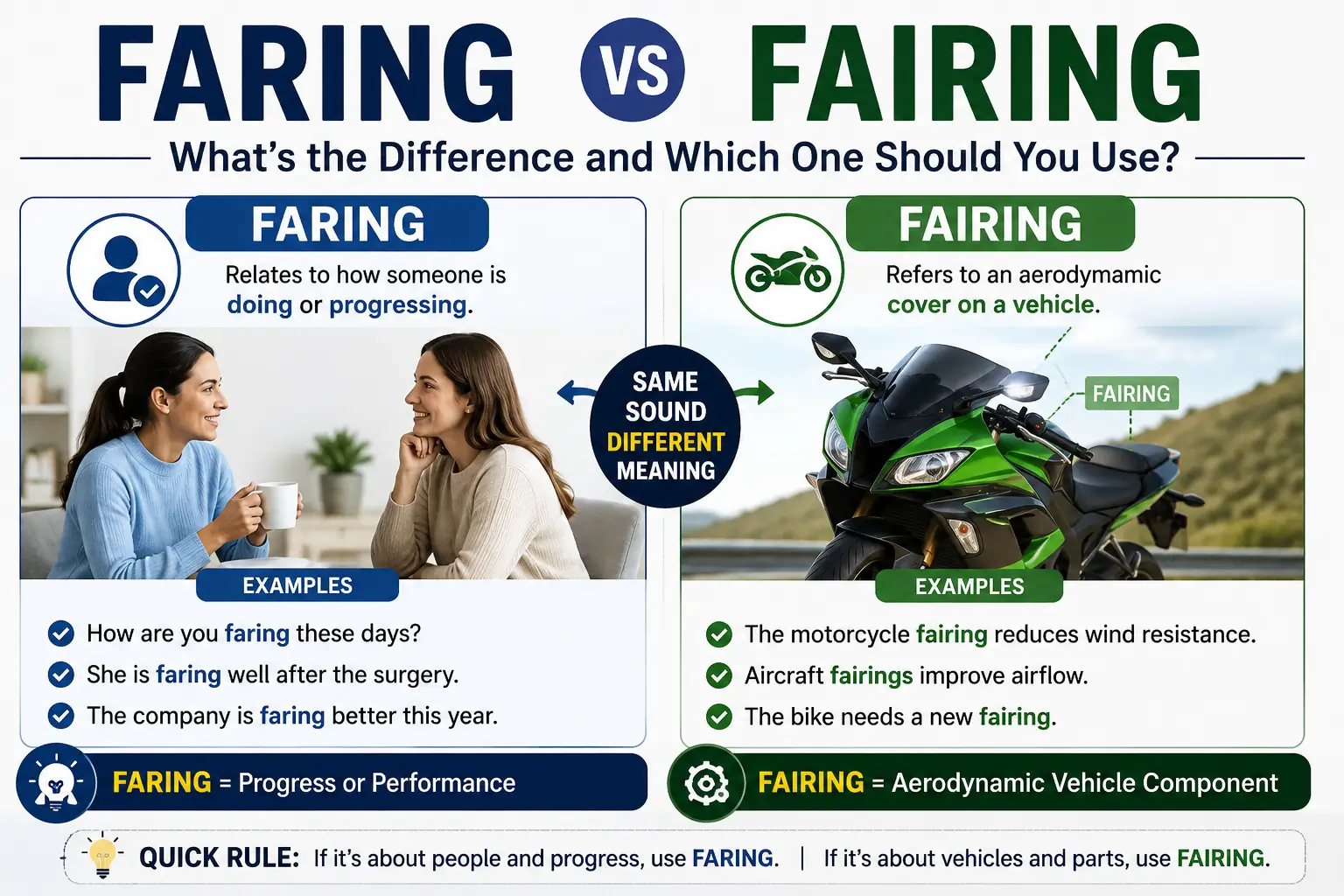
Many experienced writers encounter confusion when discussing faring vs fairing because the two terms sound alike in spoken English. A simple question such as how are you faring can suddenly create doubt about spelling, meaning, and correct usage. This common issue appears in everyday writing, conversation, email, and professional communication. A small mistake or simple spelling mistake may seem harmless, yet it can reduce clarity, hurt professionalism, and make otherwise strong writing look less polished. The challenge comes from homophones, tricky words, and the fact that both terms fit naturally into a sentence even though their difference is significant.
In most cases, faring well relates to a person, people, life, health, well-being, progress, coping, managing, work, project, challenge, or personal situation. Writers often use it in phrases that show care, interest, and concern for someone’s progress. By contrast, fairing, fairing on well, vehicle structure, physical component, vehicles, transportation, engineering, vehicle design, and aerodynamics belong to a completely different context. This distinction becomes clear through sentence examples, pronunciation tips, and memory tricks that help readers understand the exact meaning of each word.
The truth is that choosing the wrong term creates a critical error that can affect website ranking, especially when Google recognizes obvious grammar mistakes. Learning the exact difference improves vocabulary, builds confidence, and helps you select the right word in every situation. Whether you are reviewing words, analyzing contexts, listening to a listener, participating in a polite conversation, encouraging thoughtful communication, or following a practical guide, understanding these terms prevents common mistakes and supports stronger technical English as well as everyday English.
Faring vs Fairing: Quick Answer
If you’re talking about how someone is doing, progressing, coping, or performing, use faring.
If you’re referring to an aerodynamic covering on a motorcycle, aircraft, boat, or vehicle, use fairing.
The Simple Rule
- Faring = Progress or performance
- Fairing = A physical vehicle component
Quick Examples
| Correct Word | Example |
| Faring | How are you faring after the storm? |
| Faring | The company is faring well this year. |
| Fairing | The motorcycle fairing reduced wind resistance. |
| Fairing | The aircraft fairing improved airflow. |
That single letter changes the entire meaning.
Faring vs Fairing at a Glance
| Feature | Faring | Fairing |
| Meaning | Progressing or doing | Aerodynamic covering |
| Part of Speech | Verb form | Noun |
| Common Contexts | Health, work, school, business | Motorcycles, aircraft, engineering |
| Related Word | Fare | Fair |
| Example | She is faring well. | The bike needs a new fairing. |
What Does Faring Mean?
The word faring comes from the verb fare.
Historically, fare meant “to get along,” “to proceed,” or “to experience a condition.”
Today, people commonly use faring to describe someone’s situation, progress, success, or overall condition.
Definition of Faring
Faring means:
- Doing
- Progressing
- Managing
- Coping
- Performing
Whenever you ask how someone is doing, you’re often asking how they’re faring.
Examples
- How are you faring after the move?
- The students are faring better this semester.
- Small businesses are faring well despite challenges.
- She is faring better than expected.
Notice that every example relates to performance, progress, or well-being.
Common Situations Where Faring Is Used
Personal Well-Being
People frequently use faring when discussing emotional or physical health.
Examples:
- How is your father faring after surgery?
- She’s faring remarkably well.
- The patient is faring better each day.
Academic Performance
Teachers and schools often discuss how students are faring.
Examples:
- Students are faring better in mathematics this year.
- How are new learners faring in the program?
Business Performance
Companies, investors, and analysts use the word regularly.
Examples:
- The startup is faring well in a competitive market.
- Local businesses are faring better than predicted.
Financial Results
Financial publications frequently use faring.
Examples:
- Technology stocks are faring well.
- The market is faring better than expected.
Difficult Circumstances
The word often appears during crises.
Examples:
- Communities are faring well after recovery efforts.
- Farmers are faring better despite drought conditions.
What Does Fairing Mean?
Unlike faring, fairing belongs primarily to engineering and transportation.
A fairing is a structure added to a vehicle to improve aerodynamics and reduce drag.
Engineers use fairings to help air flow smoothly around an object.
Definition of Fairing
A fairing is:
A smooth covering placed on a vehicle or structure to reduce air resistance and improve efficiency.
Fairings appear on:
- Motorcycles
- Aircraft
- Spacecraft
- Boats
- Racing vehicles
- Bicycles
Why Fairings Matter
Without proper aerodynamics, vehicles face greater resistance.
More resistance means:
- Lower speed
- Higher fuel consumption
- Increased noise
- Reduced efficiency
Fairings help solve these problems.
Motorcycle Fairings
Motorcycle fairings are perhaps the most recognizable example.
They cover parts of the motorcycle and direct airflow around the rider.
Benefits include:
- Reduced wind resistance
- Improved fuel efficiency
- Better rider comfort
- Enhanced appearance
Aircraft Fairings
Aircraft use fairings extensively.
Common examples include:
- Wing root fairings
- Landing gear fairings
- Engine fairings
These components smooth airflow and reduce turbulence.
Automotive Fairings
Many modern cars use fairings underneath the vehicle.
These panels improve fuel economy and reduce drag.
Marine Fairings
Boats and underwater structures also benefit from fairings.
They improve water flow and increase efficiency.
How Are You Faring or Fairing?
This question generates enormous confusion.
The correct phrase is:
Correct
How are you faring?
Incorrect
How are you fairing?
Why?
Because the question asks about someone’s condition or progress.
You’re asking how the person is doing.
That meaning belongs to faring.
Correct Examples
- How are you faring after graduation?
- How are you faring in your new job?
- How are you faring during recovery?
Incorrect Examples
- How are you fairing after graduation?
- How are you fairing in your new job?
Unless you’re literally asking whether someone has become an aerodynamic vehicle component, fairing doesn’t belong in these sentences.
Faring Well Meaning Explained
The expression faring well appears frequently in both casual and formal writing.
It means:
- Doing well
- Performing successfully
- Coping effectively
- Experiencing positive outcomes
Examples
- The team is faring well this season.
- New employees are faring well.
- The economy is faring better than expected.
Related Expressions
You may also see:
- Faring better
- Faring poorly
- Faring worse
- Faring successfully
- Faring admirably
Each expression focuses on performance or condition.
How Did You Fare? Understanding the Root Word
Understanding the base word helps eliminate confusion.
What Does Fare Mean?
The verb fare means:
- To get along
- To progress
- To perform
- To experience a condition
Verb Forms
| Form | Example |
| Fare | How will you fare? |
| Fared | She fared well. |
| Faring | They are faring well. |
Examples
- How did you fare during the interview?
- She fared better than expected.
- The organization fared well despite difficulties.
Key Differences Between Faring and Fairing
Although they sound identical, they belong to completely different categories.
Meaning
| Word | Meaning |
| Faring | Progress or performance |
| Fairing | Aerodynamic structure |
Function
| Word | Part of Speech |
| Faring | Verb form |
| Fairing | Noun |
Context
| Faring | Fairing |
| Health | Motorcycles |
| Education | Aviation |
| Business | Engineering |
| Performance | Transportation |
Pronunciation
Interestingly, both words share the same pronunciation.
This similarity explains why people confuse them so often.
Why People Confuse Faring and Fairing
Several factors contribute to the confusion.
They Sound Exactly Alike
English contains many homophones.
Examples include:
- Their and there
- Flour and flower
- Fare and fair
Faring and fairing belong to this group.
Spell Check Isn’t Perfect
Many spelling tools recognize both words.
As a result, software may not flag the mistake.
Context Gets Ignored
Writers often choose words based on sound rather than meaning.
That’s where errors happen.
Similar Letter Patterns
Both words differ by only one letter.
That tiny variation is easy to overlook.
Faring vs Fairing vs Fare vs Fair
Many learners also confuse these related words.
| Word | Meaning | Example |
| Fare | To get along or a transportation fee | How did you fare? |
| Faring | Progressing or doing | She is faring well. |
| Fair | Just, reasonable, or an event | That’s a fair decision. |
| Fairing | Aerodynamic covering | The motorcycle fairing cracked. |
Understanding all four words makes mistakes much less likely.
Common Mistakes and How to Avoid Them
Mistake: Fairing Well
Incorrect:
- The company is fairing well.
Correct:
- The company is faring well.
Mistake: How Are You Fairing?
Incorrect:
- How are you fairing?
Correct:
- How are you faring?
Mistake: Using Faring for Vehicle Parts
Incorrect:
- The motorcycle needs a new faring.
Correct:
- The motorcycle needs a new fairing.
Memory Tricks That Actually Work
Let’s make this simple. You don’t need to memorize rules for hours. A small mental shortcut does the job better.
Think of it like this:
- Faring = Feeling + Forward movement
- Fairing = Flying machines and fast vehicles
When you link faring with how someone feels or performs, it sticks instantly. You naturally connect it with life situations like work, health, or studies.
Now picture fairing. Imagine a motorcycle speeding down a highway or an airplane cutting through the sky. That smooth outer cover you see? That’s the fairing.
Quick Memory Hooks
- Faring → “Are you doing okay?”
- Fairing → “Vehicle part, not people”
- Faring = Fare (progress or journey)
- Fairing = Engineering shell
This tiny mental switch removes most confusion in real writing situations.
Faring in Everyday Sentences
You’ll see faring everywhere once you start noticing it. It quietly appears in conversations, emails, and news reports.
Workplace Examples
- The team is faring better after the new strategy.
- Employees are faring well under updated policies.
Academic Examples
- Students are faring strongly in science exams this year.
- New learners are faring better with practice sessions.
Health Examples
- The patient is faring well after treatment.
- She is faring better than expected after recovery.
Personal Life Examples
- How are you faring after the move?
- He is not faring well in stressful conditions.
News and Media Examples
- The economy is faring better than analysts predicted.
- Small businesses are faring well despite inflation.
Notice how every example connects to progress or condition, not objects.
Fairing in Technical Sentences
Now let’s switch gears completely. Fairing belongs to machines, speed, and design.
Motorcycle Examples
- The motorcycle fairing reduced wind resistance.
- He replaced the damaged fairing after the crash.
Aviation Examples
- The aircraft fairing improves airflow near the wings.
- Engineers redesigned the landing gear fairing.
Engineering Examples
- The fairing improves structural aerodynamics.
- Designers tested new composite fairings for efficiency.
Manufacturing Examples
- The fairing was built using lightweight carbon fiber.
- Each fairing must pass strict aerodynamic testing.
Here, you can clearly see it never relates to people or emotions. It always connects to physical structure.
Synonyms and Related Words
Understanding related vocabulary makes the difference even clearer.
Synonyms for Faring
- Doing
- Coping
- Progressing
- Managing
- Performing
- Getting along
Related Words for Fairing
- Covering
- Shell
- Panel
- Housing
- Casing
- Aerodynamic structure
British English vs American English
Good news here. There is no major spelling difference between British and American English for these words.
Both regions use:
- Faring for progress
- Fairing for vehicle parts
However, confusion still happens globally because pronunciation is identical in both accents.
Real-World Usage Analysis
Let’s look at how these words behave in real writing environments.
Where “Faring” Appears Most
- News articles
- Health updates
- Business reports
- Educational writing
- Social conversations
Where “Fairing” Appears Most
- Automotive industry
- Aerospace engineering
- Motorcycle design blogs
- Technical manuals
Key Insight
If the topic involves humans, emotions, or progress → faring
If the topic involves machines or airflow → fairing
That single filter works in almost every situation.
Practice Exercises
Try these to test yourself. Don’t overthink it.
Fill in the blanks
- How are you ___ after the accident?
- The aircraft ___ improves fuel efficiency.
- The company is ___ well this year.
- The motorcycle ___ was replaced.
Multiple Choice
Pick the correct option:
- How are you (faring / fairing)?
- The engine (faring / fairing) design reduces drag.
Identify the correct word
- Progress in life → ______
- Aerodynamic cover → ______
Practice Answers
- Faring
- Fairing
- Faring
- Fairing
Final Takeaway
If you strip everything down, the rule becomes very simple.
- Faring = people and progress
- Fairing = machines and movement design
You don’t need complicated grammar theory here. Just remember the context. Once your brain links meaning with situation, you’ll stop mixing them up completely.
And honestly, that’s the goal—write clearly, sound natural, and never second-guess a simple word again.
Frequently Asked Questions
Q1: What is the difference between faring and fairing?
Faring means doing or progressing in a situation, like health or work. Fairing refers to a physical structure used in vehicles like motorcycles or aircraft to reduce air resistance.
Q2: Is it correct to say “How are you fairing”?
No, that is incorrect in normal English. The correct phrase is “How are you faring?” because you are asking about someone’s condition or progress.
Q3: What does “faring well” mean?
Faring well means someone is doing good or handling a situation successfully. For example, “She is faring well after the surgery” means she is recovering nicely.
Q4: What is a fairing in simple words?
A fairing is a smooth cover on vehicles like motorcycles or airplanes. It helps reduce wind drag and improves speed and efficiency.
Q5: Why do people confuse faring and fairing?
People confuse them because they are homophones, meaning they sound the same but have different meanings. Since spelling is similar, many writers mix them up in emails and everyday writing.
Read this also: Protester vs Protestor: Which Spelling Is Correct? Meaning, Usage, and Key Differences
Conclusion
The difference between faring vs fairing comes down to one simple idea: context. When you talk about how someone is doing in life, work, or health, you use faring. When you talk about engineering parts like motorcycle or aircraft covers, you use fairing.
At first, the two words feel confusing because they sound the same. However, once you connect each word to its real-world use, the mistake becomes easy to avoid. Think of faring as human progress and fairing as machine design. That mental picture alone clears up most errors.
So next time you type “How are you ___?”, pause for a second. You’ll likely pick the right word without even thinking twice.