Why This Tiny Hyphen Causes So Much Confusion
Are you unsure whether to write check in or check-in? You’re not alone. This small punctuation difference causes confusion for many writers, especially in emails, travel documents, workplace communication, and everyday conversations. Although the two forms look almost identical, they serve different grammatical purposes.
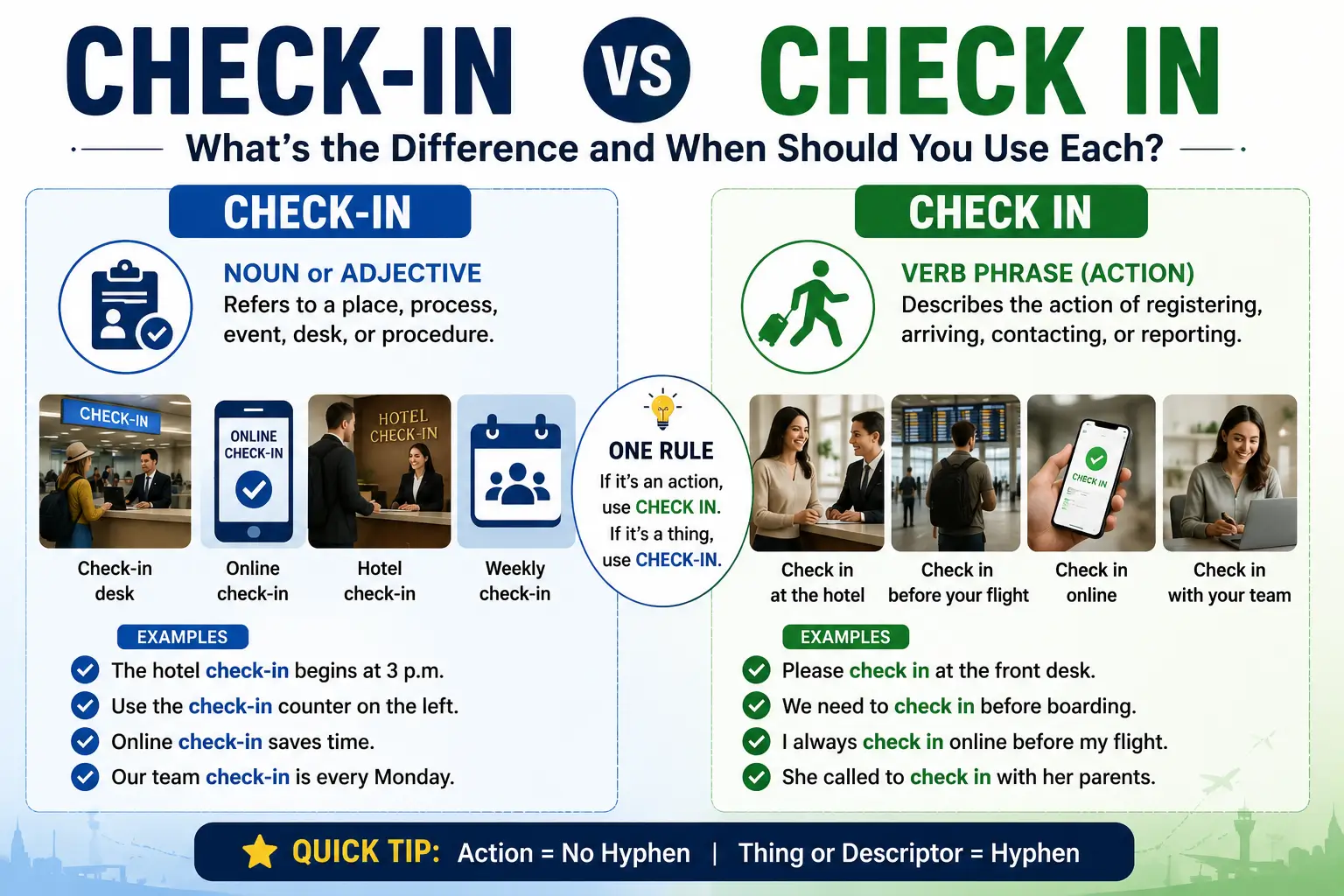
Check in is a verb phrase that describes an action, such as registering at a hotel, boarding a flight, or contacting someone for an update. Check-in, on the other hand, functions as a noun or adjective, referring to a process, event, desk, or procedure. Understanding this simple grammar rule will help you write more clearly, avoid common mistakes, and use each form with confidence.
Check-In vs Check In: The Quick Difference
The difference comes down to grammar.
- Check in = Verb phrase (an action)
- Check-in = Noun or adjective (a thing or descriptor)
Think of it this way:
If someone performs an action, use check in.
If you’re talking about a process, event, location, or object, use check-in.
Quick Examples
| Correct Form | Example |
| Check in | Please check in at the front desk. |
| Check in | We need to check in before boarding. |
| Check-in | Hotel check-in begins at 3 p.m. |
| Check-in | Use the check-in counter. |
| Check-in | The weekly check-in lasted thirty minutes. |
One tiny hyphen makes a big difference.
What Does “Check In” Mean?
Check in is a verb phrase.
It describes the action of registering, reporting arrival, confirming attendance, or making contact with someone.
Whenever someone performs the action, you should use the two-word version.
Common Meanings of Check In
- Registering at a hotel
- Reporting at an airport
- Logging into a system
- Contacting another person
- Confirming attendance
- Updating a supervisor or manager
Examples
- We need to check in before entering the conference.
- Please check in at reception when you arrive.
- I always check in online before my flight.
- She called to check in with her parents.
- Employees must check in with their managers every morning.
Notice that every sentence involves an action.
Someone is actively doing something.
That’s the easiest way to identify the correct form.
What Does “Check-In” Mean?
Check-in functions as either a noun or an adjective.
Instead of describing an action, it refers to a thing, process, meeting, counter, procedure, or event.
Check-In as a Noun
A noun names a person, place, thing, or concept.
Examples:
- The hotel check-in was quick and efficient.
- Online check-in saves time.
- The weekly check-in helped the team stay aligned.
- Airport check-in starts three hours before departure.
In these examples, check-in acts as a thing.
Check-In as an Adjective
When check-in modifies another noun, it becomes an adjective.
Examples:
- Check-in desk
- Check-in counter
- Check-in procedure
- Check-in process
- Check-in area
Example sentences:
- Follow signs to the check-in counter.
- The airline changed its check-in procedure.
- The check-in desk opens at 6 a.m.
The hyphen joins the words together so they function as a single modifier.
The Grammar Rule Explained
Grammar doesn’t have to be complicated.
The rule for check-in vs check in can be summarized in one sentence:
Use “check in” when it’s an action. Use “check-in” when it’s a noun or adjective.
Use Check In as a Verb
Verb phrases describe actions.
Examples:
✅ Check in at the hotel.
✅ Check in before your flight.
✅ Check in with your team.
✅ Check in online.
❌ Complete your hotel check in.
The last sentence is incorrect because “check in” acts as a noun.
Use Check-In as a Noun
Examples:
✅ Hotel check-in starts at noon.
✅ The online check-in was easy.
✅ Our morning check-in lasted ten minutes.
Use Check-In as an Adjective
Examples:
✅ Check-in desk
✅ Check-in station
✅ Check-in process
✅ Check-in kiosk
Whenever the phrase comes before another noun and describes it, use the hyphen.
Check-In vs Check In Comparison Table
| Function | Correct Form | Example |
| Verb | Check in | We must check in before departure. |
| Verb | Check in | Please check in online. |
| Noun | Check-in | The check-in begins at noon. |
| Noun | Check-in | Online check-in saves time. |
| Adjective | Check-in | Use the check-in kiosk. |
| Adjective | Check-in | Visit the check-in counter. |
This table covers nearly every situation you’ll encounter.
When to Use Check In
Let’s look at real-world situations where the verb form is required.
Hotel Check In Examples
Hotels require guests to register upon arrival.
Examples:
- Guests can check in after 3 p.m.
- Please check in at the front desk.
- We checked in immediately after arriving.
Airport Check In Examples
Air travelers use the phrase constantly.
Examples:
- You should check in online before your flight.
- Passengers must check in at least two hours early.
- We checked in and proceeded to security.
Workplace Check In Examples
Managers frequently ask employees to check in.
Examples:
- Team members check in every Monday morning.
- Employees should check in with supervisors regularly.
- Remote workers often check in through video meetings.
Personal Relationship Examples
The phrase isn’t limited to travel or work.
Examples:
- I wanted to check in with you.
- She checks in with her grandmother every weekend.
- Friends often check in during difficult times.
When to Use Check-In
Now let’s focus on the noun and adjective forms.
Hotel Check-In
Examples:
- Hotel check-in begins at 3 p.m.
- Early check-in may require an additional fee.
- Express check-in speeds up the process.
Airport Check-In
Examples:
- Airport check-in closes one hour before departure.
- Online check-in reduces waiting times.
- Mobile check-in has become increasingly popular.
Team Check-Ins
Modern workplaces often schedule regular check-ins.
Examples:
- Weekly check-ins improve communication.
- Performance check-ins help employees grow.
- Monthly check-ins identify challenges early.
Healthcare Check-Ins
Medical facilities also use the term.
Examples:
- Patient check-in takes place at reception.
- Digital check-in reduces paperwork.
- Check-in procedures ensure accurate records.
Common Phrases and Their Correct Forms
Many people struggle with fixed expressions.
Here’s a quick reference guide.
| Phrase | Correct Form |
| Check in at a hotel | Check in |
| Check in for a flight | Check in |
| Check in online | Check in |
| Check in with someone | Check in |
| Hotel check-in | Check-in |
| Airport check-in | Check-in |
| Employee check-in | Check-in |
| Online check-in | Check-in |
| Self check-in kiosk | Check-in |
Remember:
Actions use two words.
Things use the hyphen.
Common Mistakes People Make
Even experienced writers make these errors.
Using a Hyphen With a Verb
Incorrect:
❌ We need to check-in before boarding.
Correct:
✅ We need to check in before boarding.
Forgetting the Hyphen in a Noun
Incorrect:
❌ Hotel check in begins at 2 p.m.
Correct:
✅ Hotel check-in begins at 2 p.m.
Writing “Checkin”
Many writers remove the space and hyphen entirely.
Incorrect:
❌ Checkin
Correct:
✅ Check in
✅ Check-in
Standard English does not recognize “checkin” as the preferred spelling.
Mixing Forms in Business Writing
Incorrect:
❌ Please complete your check in.
Correct:
✅ Please complete your check-in.
Small errors like these can make professional communication look careless.
Check-In vs Check In in Different Writing Styles
Different writing situations require different levels of formality.
The grammar rule stays the same regardless of style.
Academic Writing
Academic papers demand precision.
Examples:
- Participants completed check-in procedures.
- Researchers asked subjects to check in daily.
Business Communication
Examples:
- Employee check-ins improve engagement.
- Please check in with Human Resources.
Professional Emails
Examples:
- Please check in upon arrival.
- Your online check-in is complete.
Informal Conversations
Examples:
- Just checking in.
- I wanted to check in and see how you’re doing.
The same grammar applies everywhere.
Check In vs Check On vs Check In With vs Check In On
Many people confuse these phrases because they seem similar.
They aren’t interchangeable.
Check In
Meaning:
Report arrival or make contact.
Example:
- I’ll check in when I arrive.
Check On
Meaning:
Monitor progress or condition.
Example:
- I’ll check on the kids.
Check In With
Meaning:
Contact someone for an update.
Example:
- Please check in with your manager.
Check In On
Meaning:
Visit or monitor someone.
Example:
- She checked in on her elderly neighbor.
Comparison Table
| Phrase | Meaning |
| Check in | Report arrival |
| Check on | Monitor condition |
| Check in with | Contact someone |
| Check in on | Visit or monitor someone |
Understanding these distinctions improves both writing and speaking.
Correct Sentence Examples
Examples of Check In
- We need to check in before noon.
- Guests may check in after 2 p.m.
- Please check in online.
- I check in with my team daily.
- Travelers should check in early.
- Students must check in at registration.
- Parents often check in with teachers.
- Employees check in each morning.
- Pilots check in before departure.
- Visitors should check in at reception.
Examples of Check-In
- Hotel check-in begins at 3 p.m.
- The airport check-in was crowded.
- Online check-in saves valuable time.
- The employee check-in lasted fifteen minutes.
- Mobile check-in improves convenience.
- Express check-in reduced delays.
- The check-in process was smooth.
- We used a self-service check-in kiosk.
- Early check-in was available.
- Digital check-in increased efficiency.
Quick Memory Trick
Need a simple shortcut?
Ask yourself one question:
Is someone doing something?
If yes, use check in.
Example:
- We need to check in.
If you’re naming something, use check-in.
Example:
- Hotel check-in starts at 3 p.m.
Easy Formula
| Situation | Form |
| Action | Check in |
| Thing | Check-in |
| Process | Check-in |
| Event | Check-in |
| Activity | Check in |
This trick works almost every time.
Practice Quiz
Choose the correct answer.
Fill in the Blank
- We need to ______ before boarding.
- Airport ______ opens at 5 a.m.
- Please ______ with your manager.
- The hotel ______ was fast.
- Travelers should ______ online.
Answers
- Check in
- Check-in
- Check in
- Check-in
- Check in
Identify the Usage Type
| Sentence | Verb or Noun? |
| Please check in. | Verb |
| Hotel check-in begins at 2 p.m. | Noun |
| Use the check-in desk. | Adjective |
| We checked in online. | Verb |
| Weekly check-ins help teams. | Noun |
Frequently Asked Questions
What is the difference between check-in and check in?
Check in is a verb phrase that describes an action, such as registering at a hotel or airport. Check-in is a noun or adjective used to describe a process, event, counter, or procedure.
Is check-in always hyphenated?
Yes. When check-in functions as a noun or adjective, it should be hyphenated. For example, “hotel check-in” and “check-in desk” are both correct.
How do I know whether to use check in or check-in?
A simple trick is to identify whether the phrase describes an action or a thing. If it describes an action, use check in. If it names or describes something, use check-in.
Is “checkin” one word?
No. Standard English generally recognizes only check in and check-in. Writing “checkin” as a single word is usually considered incorrect in formal writing.
Can check in be used in professional and business communication?
Yes. Check in is commonly used in workplaces when discussing updates, meetings, or progress reports. For example, “Let’s check in next week.” The noun form check-in is also widely used, such as “weekly team check-in.”
Read this also: Absence vs Absense: Which Spelling Is Correct? Meaning, Usage, Examples, and Common Mistakes
Conclusion
Understanding the difference between check-in and check in becomes much easier once you know their grammatical roles. Check in functions as a verb phrase that describes an action, while check-in serves as a noun or adjective that names or describes something. Although the distinction may seem small, using the correct form improves clarity in emails, workplace communication, travel documents, and everyday writing. Whenever you’re unsure, remember this simple rule: if someone is performing an action, use check in. If you’re referring to a process, place, event, or description, use check-in.