How Lay and Lie Work in Real English
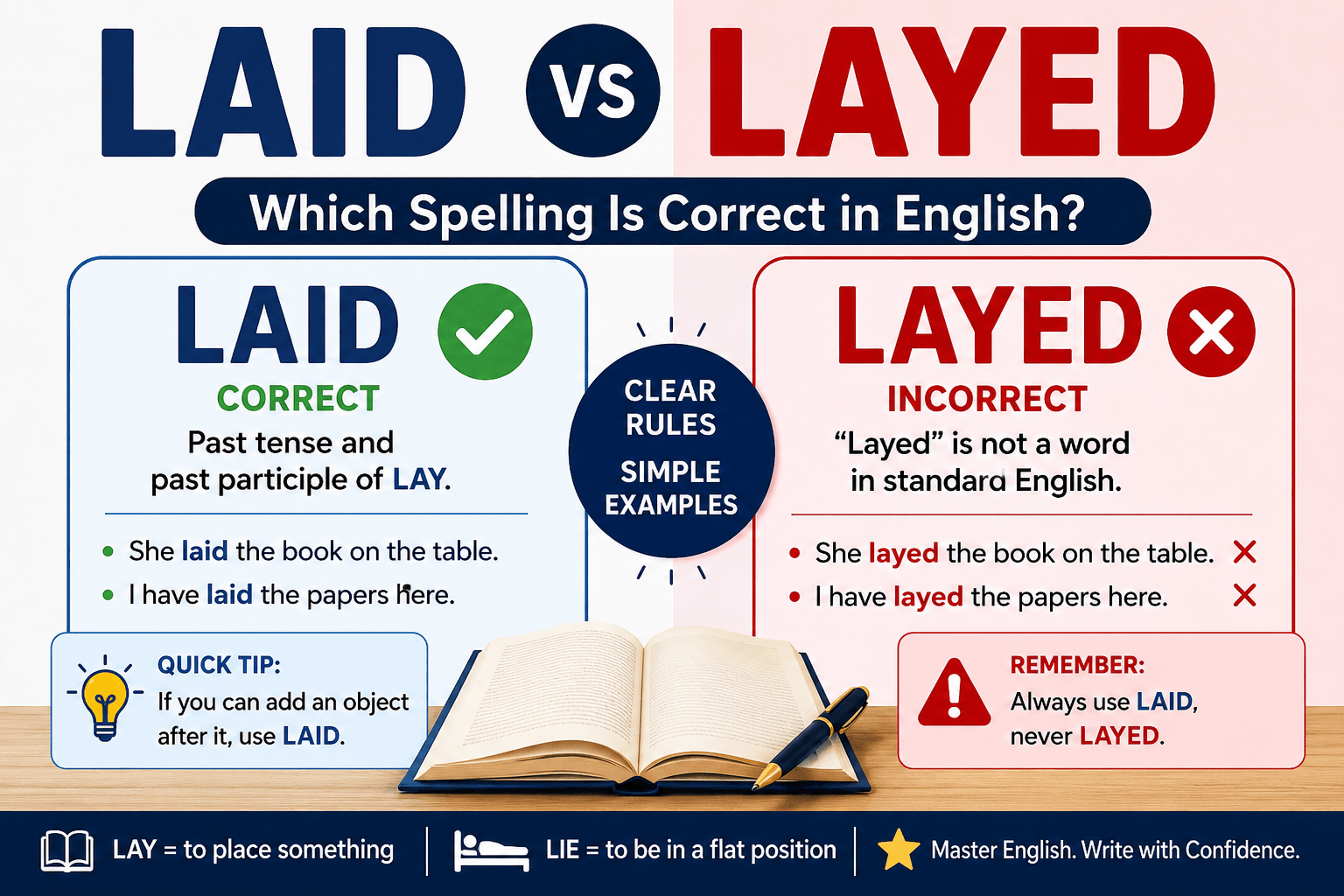
Laid vs Layed becomes clearer when you separate spelling from grammar: laid is correct, while layed is a common error in standard English today. Use laid as the past tense and past participle of lay, which means to place something down.
The deeper problem involves lay and lie. Lay needs a direct object: “Lay the book on the desk.” Lie takes no object and means to rest horizontally: “I lie down after lunch.” In the past, lie changes to lay, while lay changes to laid.
A quick object test prevents most mistakes. Ask whether someone placed something. If yes, use lay, laying, or laid. If the subject simply rested, use lie, lying, lay, or lain. This rule works in American and British English, including emails, school assignments, and professional writing. It also keeps casual and formal sentences clear without forcing readers to memorize a long chart of confusing verb forms.
Quick Answer: Is It Laid or Layed?
Laid is the correct past tense and past participle of the verb lay, which usually means to put or place something somewhere.
Layed isn’t accepted as the standard modern spelling.
- Correct: She laid the keys on the counter.
- Incorrect: She layed the keys on the counter.
- Correct: The workers laid new flooring.
- Incorrect: The workers layed new flooring.
Here’s the basic rule:
Use “laid” when someone placed, arranged, or put something somewhere in the past.
The word normally acts on an object. In other words, someone lays something down.
Laid or Layed at a Glance
| Word | Is It Standard? | Grammatical Use | Example |
| Laid | Yes | Past tense of lay | She laid the folder on my desk. |
| Laid | Yes | Past participle of lay | She has laid the folder on my desk. |
| Layed | No | Common misspelling | She layed the folder on my desk. |
| Lay | Yes | Present tense of lay | Lay the folder on my desk. |
| Lay | Yes | Past tense of lie | Yesterday, she lay on the couch. |
The confusing part is easy to spot. Lay can describe a present action involving an object, but it can also describe a past action involving rest.
That overlap causes far more trouble than the spelling alone.
What Does Laid Mean?
Laid is the simple past tense and past participle of lay.
The verb lay means to place, position, spread, arrange, install, or set something somewhere. It usually needs a direct object.
Consider this sentence:
Maya laid the blanket on the grass.
- Maya performed the action.
- Laid describes what she did.
- The blanket received the action.
- On the grass tells us where she placed it.
Without an object, the sentence often feels incomplete.
- Incomplete: Maya laid.
- Complete: Maya laid the blanket down.
The object doesn’t always appear immediately after the verb. Still, the action normally affects something.
- The hen laid an egg.
- The crew laid the pipes underground.
- We laid our concerns before the committee.
Laid as a Simple Past-Tense Verb
Use laid when someone completed the action in the past.
- He laid his phone beside the lamp.
- They laid the foundation last summer.
- The server laid the menus on the table.
- She laid the sleeping child in the crib.
- We laid the documents out before the meeting.
Time words often signal the simple past:
- Yesterday
- Last night
- Earlier
- Last week
- In 2024
- Before lunch
For example:
Yesterday, the contractor laid tiles in the kitchen.
The work happened in the past. Therefore, laid fits.
Laid as a Past Participle
The past participle also takes the form laid. It often follows helping verbs such as has, have, or had.
- She has laid the paperwork on your chair.
- They have laid several miles of cable.
- The bird had laid three eggs by morning.
- We had already laid the table when the guests arrived.
The pattern looks like this:
| Tense | Structure | Example |
| Present perfect | has/have + laid | She has laid the book down. |
| Past perfect | had + laid | She had laid the book down. |
| Future perfect | will have + laid | She will have laid the book down. |
Notice that the spelling never changes to layed.
Laid in Passive Sentences
Writers use passive constructions when they want to emphasize the object, result, or process rather than the person performing the action.
- The cables were laid beneath the road.
- The table was laid for six guests.
- New carpet had been laid throughout the office.
- The plans were laid before the board.
Active voice often sounds clearer:
- Passive: The bricks were laid by the workers.
- Active: The workers laid the bricks.
However, passive voice makes sense when the person responsible doesn’t matter.
New tracks were laid across the northern route.
The sentence focuses on the tracks and the completed work.
Why Layed Looks Correct
Many English verbs form their past tense by adding -ed.
- Walk becomes walked.
- Clean becomes cleaned.
- Open becomes opened.
- Place becomes placed.
Following that familiar pattern, layed seems logical. Yet English doesn’t always reward logic.
The verb lay changes to laid, just as:
- Say changes to said.
- Pay changes to paid.
- Hear changes to heard.
- Sell changes to sold.
Because lay is irregular, you can’t create its past tense by simply attaching -ed.
Social media, text messages, and informal online posts also spread the incorrect spelling. When readers see the same error repeatedly, it begins to look normal.
Still, frequency doesn’t make a spelling standard.
Is Layed Ever a Real Word?
You may encounter layed in older texts, historical reproductions, dialect writing, or unedited material. Some archaic spellings once varied more than they do today.
However, modern schools, publishers, dictionaries, editors, and professional publications use laid.
For contemporary writing, follow this rule:
- Use laid in articles, essays, emails, reports, and social posts.
- Keep layed only when reproducing an old quotation exactly.
- Don’t treat layed as a British spelling.
In modern usage, laid works in both American and British English.
Lay vs Lie: The Real Grammar Problem
The verbs lay and lie cause confusion because their forms overlap.
Lay means to place something somewhere.
Lie means to rest, recline, or remain in a horizontal position.
Compare these sentences:
- I lay the baby in the crib every evening.
- I lie on the sofa after dinner.
In the first sentence, the baby receives the action. In the second, the speaker rests without acting on an object.
Here’s the rule worth remembering:
If the action lands on an object, use “lay.” If the subject rests, use “lie.”
Complete Forms of Lay and Lie
| Meaning | Base Form | Simple Past | Past Participle | Present Participle |
| Put something somewhere | lay | laid | laid | laying |
| Rest or recline | lie | lay | lain | lying |
| Say something untrue | lie | lied | lied | lying |
This table explains why people struggle.
The word lay performs two different jobs:
- It is the present tense of lay.
- It is the past tense of lie.
Present tense of lay
I lay the newspaper on the table every morning.
The newspaper receives the action.
Past tense of lie
Yesterday, I lay on the couch for an hour.
The speaker rested. Nothing received the action.
The Direct-Object Test
A direct object answers what? or whom? after the verb.
Consider:
She laid the jacket on the chair.
She laid what?
The jacket.
Because the action affects an object, laid is correct.
Now compare:
She lay on the chair.
She didn’t place an object. Instead, she rested on the chair. Therefore, lay is the correct past tense of lie.
Use this quick test:
- Did someone put something somewhere? Use lay or laid.
- Did someone rest or recline? Use lie, lay, or lain, depending on the tense.
Key Differences Between Laid, Lay, Lain, Laying, and Lying
| Word | Main Use | Example |
| Lay | Present placement | Please lay the towels here. |
| Laid | Past placement | She laid the towels here. |
| Laid | Completed placement | She has laid the towels here. |
| Lie | Present reclining | I lie down after lunch. |
| Lay | Past reclining | I lay down after lunch yesterday. |
| Lain | Completed reclining | I have lain here for an hour. |
| Laying | Ongoing placement | She is laying the towels out. |
| Lying | Ongoing reclining | She is lying on the bed. |
The best clue is often the object.
- Laying bricks: The bricks receive the action.
- Lying down: The person rests.
- Laying a baby down: The baby receives the action.
- Lying beside a baby: The person rests next to the baby.
How to Use Laid in Real Sentences
Placing everyday objects
- She laid her glasses beside the sink.
- I laid the package near the door.
- He laid his wallet on the counter.
- They laid the map across the hood of the car.
Arranging or installing materials
- The crew laid new railroad tracks.
- Workers laid fresh asphalt before sunrise.
- The plumber laid pipes beneath the building.
- We laid stones around the garden.
Producing eggs
Birds, reptiles, fish, and some other animals lay eggs.
- The hen laid an egg this morning.
- The turtle laid her eggs in the sand.
- The insects had laid hundreds of eggs beneath the leaves.
The egg functions as the direct object.
Preparing a table
In British English, lay the table commonly means to prepare it for a meal. American speakers often say set the table.
- She laid the table before the guests arrived.
- The dining table was laid with polished silverware.
Both varieties still use laid, not layed.
Establishing a plan or foundation
The word also appears in figurative expressions.
- The research laid the groundwork for later discoveries.
- The manager laid out a practical strategy.
- The agreement laid the foundation for cooperation.
- The report laid bare several weaknesses.
Here, nothing may be physically placed. However, the verb keeps the broader idea of arranging, presenting, or establishing something.
Laid Down, Lay Down, or Lain Down?
All three phrases can be correct. Their meanings and tenses differ.
When laid down is correct
Use laid down when someone placed an object somewhere.
- She laid the baby down gently.
- I laid the book down and answered the door.
- He laid his tools down beside the truck.
The phrase also has figurative meanings.
- The committee laid down strict rules.
- The soldiers laid down their weapons.
- The judge laid down the conditions of release.
When lay down is correct
Use lay down as a present-tense command involving an object.
- Lay the box down carefully.
- Please lay your coat down over there.
You can also use lay down as the past tense of reclining.
- I felt dizzy, so I lay down.
- She lay down after lunch.
This sentence often trips people up:
- Standard: I lay down for a nap yesterday.
- Common but nonstandard: I laid down for a nap yesterday.
Because the speaker reclined and didn’t place an object, lay fits.
When lain down is correct
Use lain after has, have, or had when describing rest.
- She has lain down for a while.
- He had lain down before the call came.
- I have lain awake for hours.
Although lain can sound formal, it remains the standard past participle of lie.
Is “I laid myself down” correct?
Yes.
In that sentence, myself acts as the object.
- I laid myself down beside the fire.
- She laid herself down on the narrow bench.
However, most people would use the simpler form:
- I lay down beside the fire.
- She lay down on the narrow bench.
Laid in Bed or Lay in Bed?
Use lay in bed when describing someone resting in the past.
- I lay in bed until noon.
- She lay in bed reading a novel.
- He lay in bed and listened to the rain.
Use these forms for other tenses:
| Time | Correct Form | Example |
| Present | lie | I lie in bed when my back hurts. |
| Present continuous | am lying | I am lying in bed now. |
| Simple past | lay | I lay in bed yesterday. |
| Present perfect | have lain | I have lain in bed all morning. |
Laid in bed needs an object.
- She laid the baby in bed.
- He laid the clean clothes on the bed.
- The nurse laid the patient’s arm beside him.
Therefore:
- Standard: I lay in bed all morning.
- Nonstandard: I laid in bed all morning.
- Correct with an object: I laid the books on the bed.
Laying or Lying?
Use laying when someone is putting, arranging, installing, or producing something.
- She is laying the plates on the table.
- The workers are laying carpet.
- The bird is laying an egg.
- He is laying the documents beside the printer.
Use lying when a person, animal, or object rests in a horizontal position.
- She is lying on the sofa.
- The dog is lying near the fireplace.
- Your phone is lying under the chair.
- The papers are lying on the floor.
Lying can also mean making a false statement.
- He is lying about where he went.
- They accused the witness of lying.
Context reveals the meaning.
Is Laying Still the Same as Sleeping?
No.
In standard grammar, a person who rests horizontally is lying still, not laying still.
- Correct: The child is lying still.
- Nonstandard: The child is laying still.
Also, lying still doesn’t necessarily mean sleeping. Someone can remain motionless while awake.
- She was lying still and listening carefully.
- He lay still because he heard footsteps.
- The dog was lying still but watching the door.
Sleeping involves unconscious rest. Lying still only describes position and movement.
Common Phrases With Laid
Laid out
Laid out can mean arranged, displayed, explained, spent, or knocked unconscious.
- She laid out the clothes on the bed.
- The report laid out the risks clearly.
- They laid out thousands of dollars for repairs.
- One punch laid him out.
The correct phrase is laid out, not layed out.
Laid off
Laid off usually means that an employer ended someone’s job because of restructuring, reduced demand, financial pressure, or another business reason.
- The factory laid off 80 workers.
- She was laid off during the reorganization.
- The company has laid off several employees.
A layoff generally differs from dismissal for misconduct or poor performance. However, workplace terminology and legal definitions can vary by location.
Laid up
Laid up means temporarily unable to work, travel, or move normally because of illness or injury.
- He was laid up in bed with the flu.
- A knee injury left her laid up for two weeks.
- The damaged ship remained laid up in port.
The correct phrase is laid up, not layed up.
Laid to rest
The phrase can refer to burial.
- The family laid him to rest near his parents.
It can also mean ending a worry, rumor, or disagreement.
- The test results laid her fears to rest.
- The final report laid the rumor to rest.
Laid the groundwork
This expression means preparing the conditions for future progress.
- The first meeting laid the groundwork for an agreement.
- Her early research laid the groundwork for the project.
Laid bare
Laid bare means revealed or exposed.
- The audit laid bare the company’s financial problems.
- His testimony laid bare the flaws in the process.
Laid-back
Laid-back is an adjective meaning calm, relaxed, or informal.
- He has a laid-back personality.
- The restaurant offers a laid-back atmosphere.
Use a hyphen when the phrase appears before a noun.
- A laid-back manager
- A laid-back weekend
Laid on the Floor or Lay on the Floor?
Both can be correct, depending on the meaning.
Someone placed an object
She laid the rug on the floor.
The rug receives the action.
Someone rested
She lay on the floor.
The person reclined.
Compare these examples:
- He laid the child on the floor.
- He lay on the floor beside the child.
- They laid the tools on the floor.
- The tools lay on the floor overnight.
The last example uses lay as the past tense of lie. Objects can “lie” somewhere when they remain in a resting position.
Common Grammar Mistakes
Adding -ed to lay
Incorrect:
She layed the papers on the table.
Correct:
She laid the papers on the table.
Because lay is irregular, its past tense is laid.
Using laid for personal rest
Incorrect in standard edited English:
I laid on the couch all afternoon.
Correct:
I lay on the couch all afternoon.
No object receives the action. The speaker simply rested.
Using laying without an object
Incorrect:
The cat is laying near the window.
Correct:
The cat is lying near the window.
The cat isn’t placing anything. It is resting.
Using has laid instead of has lain
Incorrect:
He has laid in bed since breakfast.
Correct:
He has lain in bed since breakfast.
However, has laid works when an object follows.
He has laid the clean laundry on the bed.
Confusing laid and lied
Laid comes from lay and usually involves placement.
Lied comes from lie and means making a false statement.
- She laid the receipt on the desk.
- She lied about losing the receipt.
Treating laid and layed as regional spellings
This isn’t like color and colour.
Standard American and British English both use:
- Lay
- Laid
- Laid
- Laying
Neither variety treats layed as the normal past tense.
Real-Life Editing Case Study
Imagine a manager writes this email:
Yesterday, we layed the equipment on the loading platform. After lunch, two employees laid down because they felt unwell. The equipment has laid there overnight.
The message contains three different problems.
Original sentence
We layed the equipment on the loading platform.
Corrected sentence
We laid the equipment on the loading platform.
The equipment receives the action, and the action happened in the past.
Original sentence
Two employees laid down because they felt unwell.
Corrected sentence
Two employees lay down because they felt unwell.
The employees reclined. They didn’t place an object.
Original sentence
The equipment has laid there overnight.
Corrected sentence
The equipment has lain there overnight.
The equipment remained in one position. Therefore, use the past participle lain.
The polished version reads:
Yesterday, we laid the equipment on the loading platform. After lunch, two employees lay down because they felt unwell. The equipment has lain there overnight.
This example shows why spelling and sentence structure must work together.
Memory Tricks That Actually Help
Connect lay with place
Both verbs involve putting something somewhere.
- Lay the book down.
- Place the book down.
If place fits naturally, a form of lay may work.
Connect lie with recline
Both words describe resting.
- Lie on the couch.
- Recline on the couch.
This pairing makes the meaning easier to remember.
Match laid with paid
The spelling pattern is similar:
- Lay becomes laid.
- Pay becomes paid.
That small rhyme can stop the extra e from sneaking in.
Look for an object
Ask:
What received the action?
- She laid what? The blanket.
- He laid what? The phone.
- They laid what? The foundation.
When there is no object and the subject rests, choose a form of lie.
Use the ten-second test
Before choosing a word, check these points:
- Putting something somewhere now: lay
- Put something somewhere in the past: laid
- Has put something somewhere: has laid
- Resting now: lie
- Rested in the past: lay
- Has rested: has lain
- Putting something somewhere right now: laying
- Resting right now: lying
Synonyms for Lay and Laid
Depending on the context, synonyms for lay or laid include:
- Place
- Put
- Set
- Position
- Arrange
- Spread
- Install
- Deposit
- Rest
- Establish
Examples:
- She laid the files on the desk.
- She placed the files on the desk.
- They laid new flooring.
- They installed new flooring.
- The report laid out the facts.
- The report presented the facts.
However, synonyms aren’t always interchangeable.
A hen lays an egg. It doesn’t normally “install” or “arrange” one. Context matters.
Synonyms for Lie
When lie means resting horizontally, possible alternatives include:
- Recline
- Rest
- Stretch out
- Lounge
- Remain
- Rest flat
Examples:
- He lay on the sofa.
- He reclined on the sofa.
- The papers lay on the desk.
- The papers remained on the desk.
Again, the tone may change. Lounge sounds more relaxed than lie, while recline may sound more formal.
Related Words and Expressions
| Word or Phrase | Meaning |
| Layer | A level or thickness of material |
| Layout | The arrangement or design of something |
| Layover | A short stop during a journey |
| Layperson | Someone without specialized knowledge |
| Lay the groundwork | Prepare for future progress |
| Lay aside | Save, reserve, or stop using |
| Lay claim to | Assert ownership or a right |
| Lay low | Avoid attention |
| Lay into | Attack or criticize forcefully |
| Lie low | Stay hidden or avoid notice |
| Lying down | Resting horizontally |
| Lain | Past participle of lie |
Don’t confuse layperson with the surname Lehman. They are unrelated words.
Practice Questions
Choose lay, laid, lain, laying, or lying.
- She ___ the files on my desk yesterday.
- The dog has ___ near the fire all morning.
- I ___ awake for several hours last night.
- The workers are ___ new pipes beneath the road.
- Please ___ your coat on the chair.
- He is ___ on the sofa.
- The company ___ off 40 employees.
- We had ___ the materials out before the meeting.
- The child ___ down after lunch yesterday.
- The bird is ___ eggs in the nest.
Answers
- Laid: She laid the files on my desk yesterday.
- Lain: The dog has lain near the fire all morning.
- Lay: I lay awake for several hours last night.
- Laying: The workers are laying new pipes beneath the road.
- Lay: Please lay your coat on the chair.
- Lying: He is lying on the sofa.
- Laid: The company laid off 40 employees.
- Laid: We had laid the materials out before the meeting.
- Lay: The child lay down after lunch yesterday.
- Laying: The bird is laying eggs in the nest.
Frequently Asked Questions
Q1.Which is correct: laid or layed?
Laid is correct. It is the simple past tense and past participle of lay.
- Correct: She laid the papers on the desk.
- Incorrect: She layed the papers on the desk.
Although layed may appear in old or unedited writing, modern American and British English use laid.
Q2.Should I say “I laid down” or “I lay down”?
Use I lay down when you mean that you rested or reclined in the past.
- Correct: I felt tired, so I lay down.
- Nonstandard: I felt tired, so I laid down.
Use laid down when the verb acts on an object:
- I laid the book down.
- She laid the baby down gently.
Q3.Is it laying in bed or lying in bed?
Use lying in bed when someone is resting.
- She is lying in bed.
- The child was lying still.
Use laying when someone places an object somewhere:
- She is laying the clothes on the bed.
- The nurse is laying the patient’s arm beside him.
Q4.Is it laid out or layed out?
Laid out is the correct phrase. It can describe arranging objects, explaining information, spending money, or knocking someone unconscious.
- She laid out the clothes on the bed.
- The report laid out the main risks.
- They laid out thousands of dollars for repairs.
Layed out is not standard English.
Q5.What is the difference between laid and lain?
Laid belongs to the verb lay, which means to place something. Lain belongs to the verb lie, which means to rest or remain in a horizontal position.
- She has laid the keys on the table.
- She has lain on the sofa all afternoon.
A helpful memory rule is: laid takes an object, while lain describes rest.
Conclusion
The difference between laid and layed starts with one simple rule: laid is the correct spelling in standard modern English. Layed is a common misspelling and shouldn’t appear in schoolwork, professional documents, emails, or published content.
However, the wider grammar rule matters too. Use lay when someone places or arranges an object. Its main forms are lay, laid, laid, and laying. Use lie when a person, animal, or object rests in a horizontal position. Its forms are lie, lay, lain, and lying.
When you feel unsure, look for a direct object. You lay something down, but you lie down yourself. Therefore, you laid the keys on the counter yesterday, lay on the couch afterward, and may have lain there longer than expected.