How One Extra Letter Changes the Message
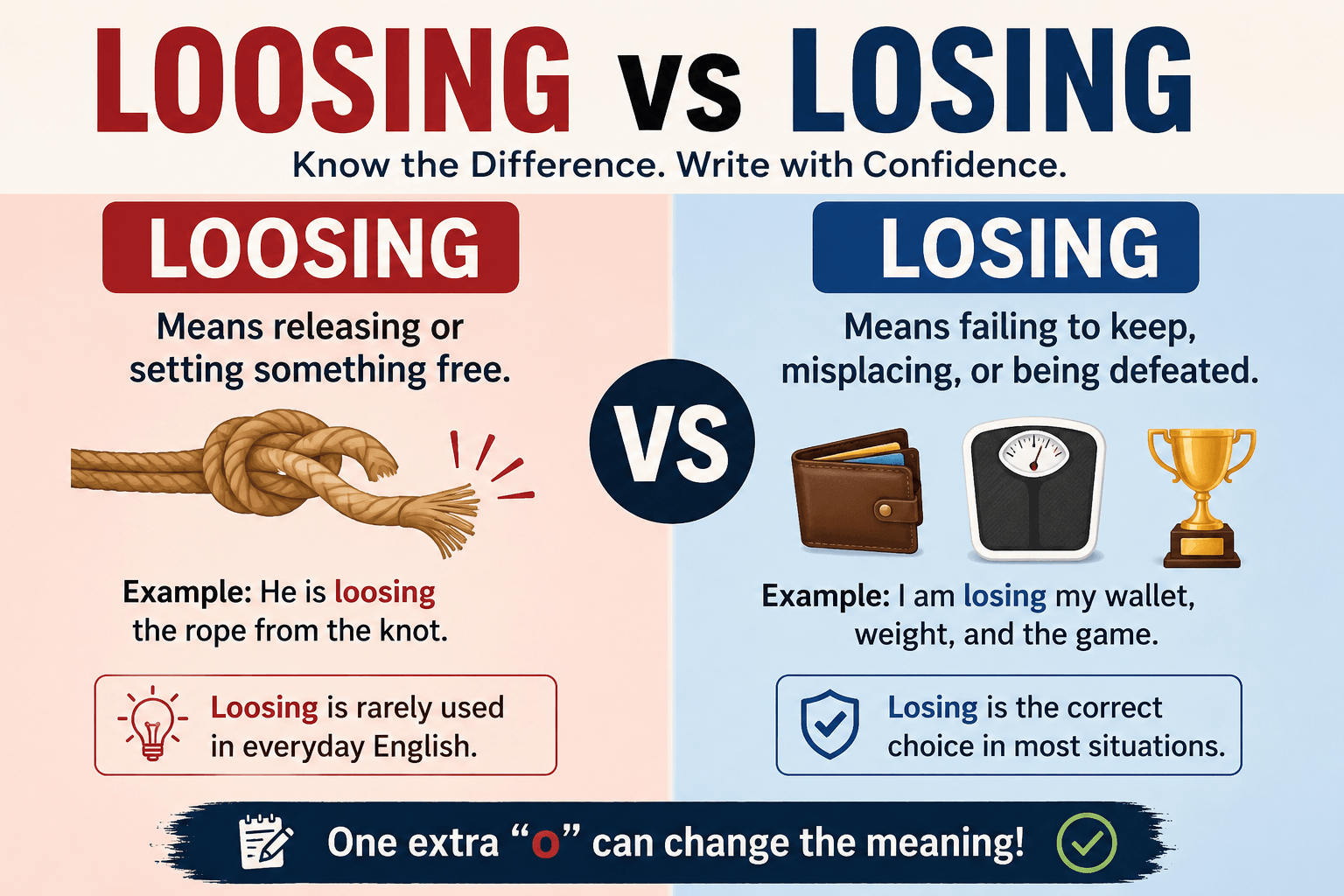
Loosing vs Losing becomes simple once you link losing to loss and loosing to release, then check the sentence meaning before you write each time. This difference starts with lose, a verb, and loose, usually an adjective. The past tense is lost, while loss is a noun.
In English usage, correct spelling depends on context, not US spelling or UK spelling. One extra o creates a meaning change. Because spellcheck tools may accept both word forms, use proofreading, grammar checking, and clear sentence examples to catch common spelling errors. It also prevents mistakes in emails, exams, business writing, and social media posts.
Write losing weight, losing a job, losing customers, losing a game, losing a loved one, and losing track of time. Use loosing only for releasing or setting free, such as loosing arrows. This word choice improves writing accuracy, reader understanding, and professional credibility.
Quick Answer: Is It Losing or Loosing?
Use losing when someone fails to keep, find, retain, or win something.
Use loosing when someone releases, frees, or discharges something.
Consider these examples:
- She is losing confidence.
- The team is losing the game.
- He keeps losing his phone.
- The archers are loosing arrows.
The first three sentences describe something disappearing, declining, or no longer being kept. Therefore, they use losing.
The final sentence describes arrows being released. That rare meaning requires loosing.
Here’s the simplest rule:
When something is disappearing, use losing. When something is being released, loosing may be correct.
Losing and Loosing at a Glance
| Word | Base Verb | Main Meaning | Pronunciation | Example |
| Losing | Lose | Failing to keep, find, retain, or win | LOO-zing | We are losing money. |
| Loosing | Loose | Releasing, freeing, or discharging | LOO-sing | The soldiers were loosing arrows. |
Although the spellings differ by one o, the words don’t mean the same thing. Their final consonant sounds also differ.
Losing contains a z sound. Meanwhile, loosing contains an s sound.
What Does Losing Mean?
Losing is the present participle and gerund form of the verb lose.
The verb lose has several related meanings. It can describe misplacing an object, suffering defeat, experiencing a reduction, or no longer having something valuable.
Because loss appears in many areas of life, losing is common in both spoken and written English.
Losing Something You Can’t Find
You use losing when an item becomes misplaced.
For example:
- “I’m always losing my keys.”
- “She worries about losing her passport.”
- “He avoided losing the receipt by putting it in his wallet.”
- “They’re losing important files because they don’t back up their computers.”
In these examples, the object hasn’t been released. Instead, the owner can no longer find or locate it.
Losing Something You No Longer Have
Sometimes, losing means that something has been taken away, removed, or allowed to disappear.
Common examples include:
- Losing a job
- Losing access
- Losing money
- Losing customers
- Losing an opportunity
- Losing a privilege
- Losing a friendship
For instance, “She is losing access to the account” means she may no longer have permission to use it.
Likewise, “The store is losing customers” means fewer people continue to shop there.
Losing a Competition
Use losing when a person or team fails to win.
This meaning appears in sports, elections, games, debates, and other competitions.
Examples include:
- “Our team is losing by three points.”
- “He hates losing at chess.”
- “The candidate appears to be losing the election.”
- “They were losing the argument because their evidence was weak.”
Here, losing describes defeat or an unfavorable position.
Losing a Feeling or Ability
You can also lose something that you can’t physically touch.
People often talk about:
- Losing patience
- Losing confidence
- Losing interest
- Losing hope
- Losing focus
- Losing control
- Losing balance
- Losing motivation
For example, “She is losing interest in the course” means her enthusiasm is fading.
Similarly, “He is losing patience” means he’s becoming less willing to wait or tolerate a frustrating situation.
Losing a Person
The phrase losing someone can carry several meanings.
In a crowded place, it may mean becoming separated:
- “We’re losing Sarah in the crowd.”
In a relationship, it can describe emotional distance:
- “He feels as though he’s losing his best friend.”
It may also refer to death:
- “Losing a loved one can cause profound grief.”
Context tells the reader which meaning applies. In every case, however, losing remains the correct spelling.
What Does Loosing Mean?
Loosing is the present participle of the verb loose.
As a verb, loose means to release, set free, discharge, or unleash. This use is grammatically correct, although it sounds formal, literary, historical, or old-fashioned in many modern conversations.
You may see loosing in writing about:
- Archery
- Historical battles
- Hunting
- Animals being released
- Powerful emotions or forces being unleashed
- Formal commands involving release
Correct Examples of Loosing
These sentences use loosing correctly:
- “The archers were loosing arrows at the targets.”
- “The handler was loosing the dogs into the field.”
- “The army began loosing a volley of arrows.”
- “The ruler risked loosing chaos upon the region.”
- “The hunters were loosing their hounds.”
Each sentence describes something being released or set free.
Even so, modern writers often choose a clearer verb. For example, “releasing the dogs” may sound more natural than “loosing the dogs.”
Why Loosing Sounds Unusual
Most people know loose as an adjective.
For example:
- A loose shirt
- A loose tooth
- A loose screw
- Loose soil
- Loose hair
Because the adjective appears far more often, many readers don’t immediately recognize loose as a verb.
That doesn’t make loosing incorrect. It simply makes the form uncommon.
Is Loosing the Same as Loosening?
Loosing and loosening can sometimes appear in similar situations, but they aren’t exact substitutes.
Loosening means making something less tight, firm, or secure.
For example:
- “She is loosening the knot.”
- “He is loosening his tie.”
- “The mechanic is loosening the bolt.”
- “Stretching helps with loosening tight muscles.”
By contrast, loosing usually means releasing something fully.
Compare these sentences:
- “She is loosening the dog’s collar.”
- “She is loosing the dog from its enclosure.”
In the first sentence, she makes the collar less tight.
In the second, she releases the dog.
The distinction matters because something can become looser without becoming completely free.
Key Differences Between Losing and Loosing
The two words differ in origin, meaning, spelling, pronunciation, and frequency.
| Feature | Losing | Loosing |
| Base form | Lose | Loose |
| Number of o’s | One | Two |
| Main idea | Loss, defeat, reduction, or misplacement | Release, freedom, or discharge |
| Final consonant sound | Z | S |
| Frequency | Very common | Rare |
| Common context | Money, games, weight, people, objects | Arrows, animals, forces |
| Example | She is losing hope. | They are loosing the horses. |
They Come From Different Verbs
Losing comes from lose.
Loosing comes from loose.
When English verbs ending in a silent e take -ing, the final e usually disappears:
- Lose + ing = losing
- Loose + ing = loosing
- Make + ing = making
- Write + ing = writing
The rule explains why loseing and looseing are incorrect.
They Describe Different Actions
Losing involves something becoming unavailable, reduced, misplaced, or defeated.
Loosing involves freeing or releasing something.
Consider this pair:
- “The company is losing employees.”
- “The company is loosing employees.”
The first sentence means employees are leaving or being lost.
The second suggests that the company is releasing or setting employees free. Although a special context could make that meaning possible, it isn’t what most writers intend.
They Sound Different
The pronunciation provides another helpful clue.
- Losing sounds like LOO-zing.
- Loosing sounds like LOO-sing.
The difference mirrors the pronunciation of their base verbs:
- Lose: looz
- Loose: loos
When you hear a z sound, choose the spelling connected to lose.
Lose vs Loose: The Source of the Confusion
Most spelling errors involving losing begin with confusion between lose and loose.
What Does Lose Mean?
Lose is a verb.
It means to misplace something, stop having it, suffer defeat, or fail to maintain something.
Examples:
- “Don’t lose your ticket.”
- “We may lose the game.”
- “She doesn’t want to lose her job.”
- “Try not to lose focus.”
The past tense of lose is lost.
- “I lost my wallet.”
- “They lost the match.”
What Does Loose Mean?
Loose usually works as an adjective.
It describes something that isn’t tight, fixed, controlled, or firmly attached.
Examples:
- “This shirt feels loose.”
- “The door has a loose handle.”
- “One of the chair legs is loose.”
- “She wore her hair loose.”
As a verb, loose means to release or set free.
- “Loose the ropes.”
- “The commander ordered the soldiers to loose their arrows.”
Lose and Loose Comparison
| Word | Part of Speech | Meaning | Example |
| Lose | Verb | Fail to keep, find, or win | Don’t lose your phone. |
| Loose | Adjective | Not tight or firmly fixed | The lid is loose. |
| Loose | Verb | Release or set free | Loose the animals. |
A useful reminder is that loose has an extra o, almost as though the word has extra room.
Related Words You Should Know
Several words belong to the same word families. Learning them together can prevent future mistakes.
| Word | Meaning | Example |
| Lose | Fail to keep or win | We may lose the contract. |
| Losing | Experiencing loss or defeat | The team is losing. |
| Lost | Past form of lose | She lost her keys. |
| Loss | The result of losing | The company reported a loss. |
| Loser | A person or side that loses | The loser congratulated the winner. |
| Loose | Not tight; to release | The rope is loose. |
| Looser | More loose | These pants feel looser. |
| Loosen | Make less tight | Loosen the cap carefully. |
| Loosening | Making less tight | He is loosening the screw. |
| Loosing | Releasing or setting free | They are loosing the hounds. |
Losing vs Loss
Losing describes an action, process, or ongoing situation.
Loss is a noun. It names the event, condition, or amount that someone loses.
Compare:
- “The business is losing money.”
- “The business reported a financial loss.”
The first sentence focuses on what’s happening now.
The second names the result.
Other examples include:
- “Losing the game disappointed the players.”
- “The loss disappointed the players.”
- “She fears losing her independence.”
- “The loss of independence can feel frightening.”
You can often identify loss because it follows words such as a, the, this, or that.
Loser vs Looser
Loser and looser also create confusion.
A loser is a person, team, or thing that loses.
- “The loser of the match received a silver medal.”
- “Nobody wants to feel like a loser.”
Looser means more loose.
- “This jacket feels looser than the smaller one.”
- “The knot became looser.”
Remember:
- Lose → loser
- Loose → looser
Is It Losing or Loosing in Common Phrases?
In nearly every common phrase about reduction, defeat, or separation, losing is correct.
Losing or Loosing Weight?
The correct phrase is losing weight.
- “She is losing weight through regular exercise.”
- “He started losing weight after changing his diet.”
Body weight decreases. It doesn’t get released like an arrow or animal.
Therefore, “loosing weight” is incorrect.
Losing or Loosing Hair?
Use losing hair.
- “He noticed that he was losing hair.”
- “Some people begin losing hair at a young age.”
Hair falls out or disappears. That meaning comes from lose.
Losing or Loosing Interest?
Use losing interest.
- “The audience is losing interest.”
- “She started losing interest in the project.”
Interest fades or decreases. Nothing gets set free.
Losing or Loosing Hope?
The correct phrase is losing hope.
- “They’re losing hope of finding a solution.”
- “Don’t start losing hope after one setback.”
Hope becomes weaker or disappears.
Losing or Loosing Money?
Use losing money.
Someone may lose money by:
- Making a poor investment
- Spending more than they earn
- Misplacing cash
- Paying unnecessary fees
- Running an unprofitable business
Example: “The restaurant is losing money every month.”
Losing or Loosing a Game?
Use losing a game.
- “The team is losing the game.”
- “Losing a game can teach players valuable lessons.”
The players face defeat. They aren’t releasing the game.
Losing or Loosing a Job?
The correct phrase is losing a job.
- “He worries about losing his job.”
- “Losing a job can create financial stress.”
The person may no longer have the position.
Losing or Loosing Access?
Use losing access.
- “You risk losing access to your account.”
- “The tenant is losing access to the parking area.”
Access disappears or gets removed.
Losing or Loosing Someone?
In ordinary situations, use losing someone.
- “She’s afraid of losing her partner.”
- “We kept losing him in the crowd.”
- “Losing someone you love can change your life.”
The word may describe separation, emotional distance, or death.
Losing or Loosing My Mind?
The correct expression is losing my mind.
People usually say this when they feel overwhelmed, confused, shocked, or frustrated.
- “I’ve searched every room. I’m losing my mind.”
- “This constant noise is making me feel like I’m losing my mind.”
The expression is often figurative rather than medical.
Losing It or Loosing It?
Use losing it.
This informal idiom means becoming extremely emotional, angry, confused, or unable to remain calm.
- “He started losing it when the computer crashed.”
- “After hours of waiting, she felt as though she was losing it.”
Losing or Loosing Yourself?
Use losing yourself.
The phrase may mean:
- Forgetting your values or identity
- Becoming deeply absorbed in something
- Becoming disoriented
- Allowing a relationship or situation to control your life
Examples:
- “You shouldn’t risk losing yourself in the relationship.”
- “She enjoys losing herself in a good book.”
“I Don’t Want to Lose You” or “Loose You”?
The correct sentence is:
“I don’t want to lose you.”
Here, lose means no longer having the person in your life.
“Loose you” would mean releasing or setting the person free. That isn’t the intended meaning in most emotional or romantic conversations.
Why People Write Loosing Instead of Losing
This mistake happens for several understandable reasons.
The Vowel Sound Causes Confusion
The word lose contains one o, yet it uses a long “oo” sound.
English learners may expect that sound to require two o’s. As a result, they write loose or loosing when they mean lose or losing.
Loose Is a Familiar Word
Many people regularly see phrases such as:
- Loose clothing
- Loose tooth
- Loose wire
- Loose change
Since loose looks familiar, its spelling can slip into unrelated sentences.
Spellcheck May Miss the Error
Spellcheck catches nonexistent words. However, loosing is a valid English word.
Therefore, a basic spellchecker may accept this sentence:
- “Our company is loosing customers.”
The spelling exists, but the context requires losing.
Grammar-aware tools may catch the mistake. Still, careful proofreading remains important.
Similar Word Patterns Can Mislead Writers
The spelling of choose may also create confusion:
- Choose → choosing
- Lose → losing
Although both words contain the “oo” sound, they follow different spellings.
English spelling isn’t always perfectly predictable. Learning the base word offers the safest solution.
Simple Memory Tricks
A strong memory trick should connect spelling with meaning.
Lose an O
Remember this sentence:
When you lose something, you also lose an o.
Lose and losing contain one o.
By contrast, loose and loosing contain two.
Loose Has Extra Room
The word loose contains an extra o.
Imagine that extra letter creating more room inside the word. That fits the meaning of something that isn’t tight.
Use the Release Test
Replace the questionable word with releasing.
For example:
- “The archers are releasing arrows.”
The sentence still makes sense, so loosing works.
Now test this sentence:
- “She is releasing weight.”
That doesn’t express the intended meaning. Therefore, use losing weight.
Check the Base Verb
Remove -ing and identify the base verb.
- Losing → lose
- Loosing → loose
- Loosening → loosen
Then ask what the base verb means in the sentence.
Listen for the Sound
Say the word aloud.
- Losing uses a z sound.
- Loosing uses an s sound.
Pronunciation won’t solve every spelling problem, but it provides another useful clue.
Common Mistakes and Corrections
| Incorrect | Correct | Explanation |
| I’m loosing patience. | I’m losing patience. | Patience is fading. |
| She is loosing weight. | She is losing weight. | Her weight is decreasing. |
| We are loosing the match. | We are losing the match. | The team faces defeat. |
| He may loose his job. | He may lose his job. | He may no longer have it. |
| Don’t loose your keys. | Don’t lose your keys. | The keys may become misplaced. |
| She is losing the knot. | She is loosening the knot. | She is making it less tight. |
| The archer was losing arrows. | The archer was loosing arrows. | The arrows were being released. |
| My shirt feels loser. | My shirt feels looser. | The shirt is less tight. |
Real-Life Examples
Workplace Communication
Incorrect spelling can make a professional message harder to understand.
Incorrect:
“We are loosing clients because of delayed deliveries.”
Correct:
“We are losing clients because of delayed deliveries.”
The corrected sentence clearly states that customers are leaving.
Health and Fitness Writing
Incorrect:
“Three habits that can help you start loosing weight.”
Correct:
“Three habits that can help you start losing weight.”
In health content, losing weight always uses one o in losing.
Sports Reporting
Incorrect:
“The Tigers are loosing by ten points.”
Correct:
“The Tigers are losing by ten points.”
The team isn’t releasing anything. It’s currently behind in the game.
Technology and Account Security
Incorrect:
“You may risk loosing access to your profile.”
Correct:
“You may risk losing access to your profile.”
The user may no longer have access.
Historical Writing
In some historical contexts, loosing may be exactly right.
“At the commander’s signal, the archers began loosing arrows over the wall.”
Here, the archers release or discharge arrows. Therefore, the unusual spelling matches the unusual action.
A Practical Case Study
Imagine a small online store experiencing a drop in sales.
The owner writes:
“We are loosing customers because our checkout page loads slowly.”
A spellchecker may not flag loosing because it’s a valid word. However, the sentence accidentally suggests that the business is freeing or releasing its customers.
The intended meaning involves customers leaving. Therefore, the sentence should read:
“We are losing customers because our checkout page loads slowly.”
Now consider another sentence from a historical novel:
“The guards were loosing the prisoners from their chains.”
In that context, loosing may work because the guards are releasing the prisoners.
Still, many modern readers would find this version clearer:
“The guards were freeing the prisoners from their chains.”
This case shows why grammatical correctness and natural style aren’t always identical. A word can be correct yet sound unusual for the audience.
Why Correct Spelling Matters
Using the wrong spelling won’t always prevent readers from understanding your message. However, it can weaken clarity and credibility.
Correct spelling matters in:
- Business emails
- Academic assignments
- Résumés
- Cover letters
- Reports
- Website content
- Customer support messages
- Professional social media posts
A sentence such as “We are loosing revenue” may distract a client or employer. Worse, it can change the literal meaning.
Strong writing removes those unnecessary bumps. Readers can then focus on your idea instead of your spelling.
Context-Based Synonyms for Losing
No single synonym can replace losing in every sentence. Choose an alternative based on the intended meaning.
| Meaning | Possible Synonyms |
| Losing an object | Misplacing, forgetting, dropping |
| Losing a game | Failing, being defeated, falling behind |
| Losing money | Wasting, spending, forfeiting, suffering a loss |
| Losing interest | Becoming bored, disengaging, drifting away |
| Losing confidence | Doubting, becoming uncertain |
| Losing control | Breaking down, becoming unstable |
| Losing a right | Forfeiting, surrendering, being deprived of |
| Losing weight | Reducing, shedding |
| Losing a person | Becoming separated, being bereaved |
Use synonyms carefully.
For example, shedding weight may work in fitness writing. However, it wouldn’t fit a sentence about misplacing a wallet.
Synonyms for Loosing
Because loosing usually means release, its alternatives include:
- Releasing
- Freeing
- Unleashing
- Discharging
- Letting go
- Setting free
- Sending forth
In modern writing, one of these verbs may sound more natural.
For example:
- “The soldiers were discharging arrows.”
- “The handler was releasing the dogs.”
- “The storm was unleashing its force.”
Practice: Choose the Correct Word
Fill each blank with losing, loosing, or loosening.
- The team is ________ its lead.
- She’s ________ interest in the project.
- The archers began ________ arrows.
- He is ________ the tight lid.
- The company risks ________ customers.
- The handler is ________ the dogs into the field.
- I’m tired of ________ my keys.
- She is ________ the knot around the package.
- They’re ________ hope of reaching an agreement.
- You could end up ________ access to your account.
Answers
- Losing — the lead is disappearing.
- Losing — her interest is fading.
- Loosing — the arrows are being released.
- Loosening — the lid is becoming less tight.
- Losing — customers may leave.
- Loosing — the dogs are being released.
- Losing — the keys become misplaced.
- Loosening — the knot is becoming less tight.
- Losing — hope is fading.
- Losing — access may be removed.
Frequently Asked Questions
Q1.Is it loosing or losing?
Both words exist, but they have different meanings. Use losing for loss, defeat, or reduction. Use loosing for releasing or setting something free.
Q2.Is it losing or loosing weight?
The correct phrase is losing weight. Weight decreases, so the word comes from the verb lose.
Q3.Is loosing a real word?
Yes. Loosing is the -ing form of loose. It means releasing, freeing, or discharging something, such as loosing an arrow.
Q4.Is it losing or loosing a game?
Use losing a game because the phrase describes defeat. “Loosing a game” would not express the intended meaning.
Q5.How can I remember the difference between losing and loosing?
Remember this simple trick: when you lose something, you also lose an o. Therefore, lose becomes losing, with only one o.
Conclusion
The difference between loosing and losing comes down to meaning. Use losing when something disappears, decreases, gets misplaced, or ends in defeat. Common examples include losing weight, losing money, losing a job, and losing a game.
Use loosing only when something is being released or set free. Since this meaning is rare in everyday English, losing is usually the correct choice. When you’re unsure, remove -ing and check the base verb: lose becomes losing, while loose becomes loosing.