Which Spelling Fits the Situation?
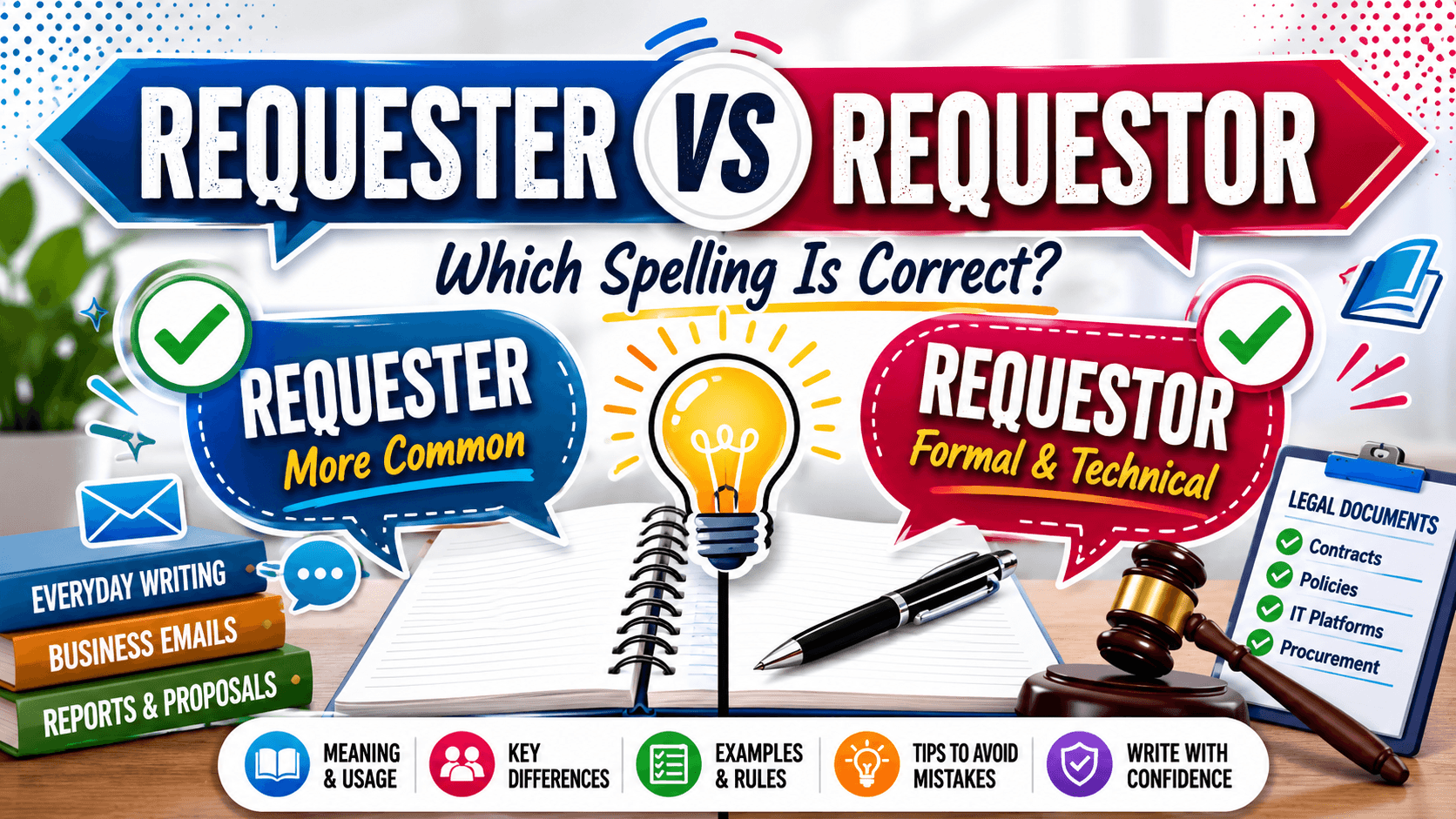
Requester vs Requestor asks which spelling fits best. Requester is the usual choice, while requestor remains a valid variant in formal systems.
Use requester in everyday business writing, emails, reports, articles, and school work because it sounds natural and clear. Keep requestor when a contract, legal document, procurement workflow, IT platform, policy, or technical system uses that official label. In those contexts, consistency matters more than personal preference, protects clarity, and keeps instructions aligned with real-world usage.
A simple writing rule removes confusion: choose requester for general prose, then match requestor in fixed forms, database fields, and defined terms. Check spelling, grammar, context, regional usage, and organizational style before publishing. This practical approach prevents common mistakes, supports professional credibility, improves communication, and helps readers understand the role without second-guessing the final word choice in professional documents and business systems today.
Quick Answer: Is Requester or Requestor Correct?
Both requester and requestor are valid words. They usually mean the same thing: a person, organization, or system that asks for information, approval, assistance, goods, services, or action.
However, requester is the safer default.
Use requester in general writing, emails, articles, reports, policies, and instructions. Use requestor when an existing form, contract, company policy, software interface, or technical system requires that spelling.
Simple rule: Write “requester” unless you have a clear reason to preserve “requestor.”
Requester and Requestor Quick Comparison
| Feature | Requester | Requestor |
| Correct English word | Yes | Yes |
| Basic meaning | Someone or something making a request | Someone or something making a request |
| General usage | More common | Less common |
| Best for everyday writing | Yes | Usually not preferred |
| Used in business systems | Frequently | Frequently in some organizations |
| Used in legal documents | Yes | Yes, when defined or established |
| Pronunciation | The same | The same |
| Plural form | Requesters | Requestors |
| Safest default | Yes | No |
| Can be organization-specific | Yes | Yes |
The key difference involves convention, not meaning. One organization may use “requester,” while another uses “requestor” for the same role.
What Does “Requester” Mean?
A requester is a person, group, organization, or system that makes a request.
That request may involve:
- Asking for information
- Seeking approval
- Ordering goods
- Requesting technical support
- Applying for access
- Asking someone to complete a task
- Seeking a public record
- Requesting a refund or service
The word comes from the verb request combined with the agent-forming suffix -er. English often uses this suffix to describe someone who performs an action.
For example:
- A person who teaches is a teacher.
- A person who works is a worker.
- A person who manages is a manager.
- A person who requests is a requester.
This formation feels natural to most English readers. As a result, requester has become the standard choice in broad, general-purpose writing.
Requester Meaning in Everyday English
In ordinary conversation, a requester is simply the person asking for something.
Suppose a customer emails a company and asks for a refund. The customer becomes the requester.
If an employee asks the information technology department for software access, that employee becomes the requester.
When a journalist seeks public records from a government agency, the journalist becomes the records requester.
The word doesn’t describe whether the request will succeed. It only identifies the person or entity making it.
Examples of Requester in Sentences
- The requester must provide a valid email address.
- We sent the completed report to the requester.
- The requester asked for additional information.
- Each support ticket lists a requester and an assignee.
- The agency contacted the requester about the missing form.
- A requester may cancel the application before approval.
- The requester received an automatic confirmation message.
- Please verify the requester’s identity before sharing the records.
These examples sound natural in everyday and professional English.
What Does “Requestor” Mean?
A requestor is also someone or something that makes a request.
In most cases, it carries the same meaning as requester. The different ending doesn’t automatically create a different role.
You may see requestor in:
- Company forms
- Procurement systems
- Legal agreements
- Government documents
- Service management platforms
- Database field names
- Software documentation
- Internal approval workflows
Some organizations adopted the spelling years ago and continue using it for consistency. Others choose it because the -or ending feels formal or technical.
Still, formality doesn’t make requestor more accurate.
Is Requestor a Real Word?
Yes. Requestor is a real and accepted variant.
Some readers assume it must be a misspelling because they see requester more often. That assumption goes too far. Less common words aren’t automatically wrong.
Major dictionaries generally treat requester as the primary form and requestor as an alternative. Therefore, writers can use either spelling when the context supports it.
The problem begins when someone invents a difference that doesn’t exist.
For example, general English doesn’t support these rigid rules:
- A requester must be a person.
- A requestor must be a computer.
- A requester makes informal requests.
- A requestor makes legal requests.
- Requester is American.
- Requestor is British.
An organization may define those roles locally. However, those definitions don’t apply everywhere.
Examples of Requestor in Sentences
- The requestor must sign the authorization form.
- Enter the requestor’s department in the required field.
- The system sends a notification to the requestor.
- Each requestor must provide supporting documentation.
- The requestor may appeal the decision within 30 days.
- The application records the requestor’s name and contact details.
These sentences remain grammatically correct. Still, they sound more specialized because general readers encounter this spelling less often.
What Is the Main Difference Between the Two Spellings?
The main difference lies in frequency and style preference.
Both words describe the party making a request. Yet requester appears more naturally in broad English usage. Requestor tends to appear in specialized environments where an organization has already adopted it.
Think of the difference like two road signs pointing toward the same destination. One sign appears on most roads. The other appears within a specific private property.
Both can guide you correctly. Still, you shouldn’t swap them randomly.
They Usually Share the Same Meaning
The spelling alone doesn’t determine the person’s authority, responsibilities, or legal status.
For example, either word could describe:
- A customer asking for assistance
- An employee seeking approval
- A citizen requesting records
- A software service sending a query
- A department ordering equipment
- A lawyer submitting a formal demand
Context defines the role more clearly than the suffix does.
Requester Is the More Familiar Form
Most readers recognize requester immediately because the -er ending follows a common English pattern.
That familiarity matters.
When readers move through instructions, policies, or forms, they shouldn’t have to pause over an unfamiliar spelling. Clear writing removes small obstacles wherever possible.
For that reason, requester works well in:
- General articles
- Educational materials
- Emails
- Reports
- User instructions
- Customer service content
- Academic writing
- Newly written policies
Requestor Often Reflects an Existing Convention
Requestor becomes appropriate when changing it would break consistency.
For example, a software platform may contain a field labeled Requestor Name. A technical writer describing that field should preserve the exact label.
Likewise, a contract may define one party as the Requestor. Once the document establishes that defined term, writers should continue using it consistently.
In these cases, accuracy beats personal preference.
Why Do Both Spellings Exist?
English forms many agent nouns with -er or -or.
An agent noun identifies a person or thing that performs an action.
Common -er examples include:
- Writer
- Builder
- Teacher
- Employer
- Manager
- Sender
Common -or examples include:
- Actor
- Editor
- Creator
- Supervisor
- Instructor
- Distributor
The -er ending remains highly productive in modern English. Speakers can attach it to many verbs and create an understandable noun.
The -or ending often appears in words shaped by Latin or French influence. However, English doesn’t follow a single perfect rule. History, convention, and repeated usage determine which form becomes standard.
Why Requester Became More Common
Requester follows a direct and familiar pattern:
Request + er = requester
Readers can understand it without specialized knowledge. The spelling also matches the way English commonly creates a noun from a verb.
As a result, dictionaries, editors, and general writers usually treat requester as the main form.
Why Organizations Still Use Requestor
Several practical reasons explain the continued use of requestor:
- A legacy database used the spelling.
- An old form established the term.
- A company style guide requires it.
- A contract defines it.
- A software product displays it.
- A technical team adopted it as a field name.
- Writers copied the term from earlier documentation.
Once an organization builds a spelling into its systems, changing it can create unnecessary work.
Imagine a company with hundreds of forms, training documents, reports, and database fields using “requestor.” Replacing every instance may offer little value. It could also make old and new documents inconsistent.
Therefore, the variant often survives for operational reasons.
Which Spelling Should You Use?
Choose requester unless an established source requires requestor.
That simple rule handles most situations.
Use Requester for General Writing
Requester works best in:
- Blog posts
- News articles
- Emails
- Essays
- Reports
- New company policies
- Customer instructions
- Academic papers
- Help center articles
- Training materials
Example:
The requester will receive a confirmation email after submitting the form.
The sentence sounds clear, familiar, and professional.
Use Requestor for an Official Label
Choose requestor when you need to match:
- A software interface
- A company form
- A contract
- A statute or regulation
- An API property
- A database column
- A product manual
- An internal style guide
Example:
Complete the “Requestor Information” section before sending the form.
Changing the label to “Requester Information” could confuse readers who need to locate the exact section.
Follow This Fast Decision Guide
Ask these questions:
- Does an existing document define the term?
- Does a screen or form display one spelling?
- Does the organization have a style guide?
- Does a technical field use one exact name?
- Are you quoting another source?
- Have earlier sections already chosen a spelling?
If the answer to every question is no, choose requester.
Usage in Everyday and Professional Writing
In everyday English, requester sounds more natural.
Consider these sentences:
- The requester forgot to attach the receipt.
- Please send the response directly to the requester.
- The requester can update the form before submission.
Each sentence communicates the role without drawing attention to the spelling.
That matters because good professional writing should make the message easy to understand. The vocabulary shouldn’t distract readers from the action they need to take.
Usage in Customer Service and Support Tickets
Customer service platforms often assign several roles to one ticket.
These roles may include:
| Role | Main Responsibility |
| Requester | Asks for help or receives the service |
| Submitter | Creates or sends the ticket |
| Assignee | Handles the ticket |
| Approver | Authorizes the requested action |
| Follower | Receives updates |
| End user | Uses the service or product |
The requester and submitter aren’t always the same person.
Real-Life Support Case Study
Consider this workplace situation:
Maria needs access to payroll software. She asks her assistant, Daniel, to submit a support ticket. An IT specialist, Aisha, receives the ticket. Maria’s manager, Robert, must approve the access.
The roles look like this:
| Person | Role |
| Maria | Requester |
| Daniel | Submitter |
| Aisha | Assignee |
| Robert | Approver |
Maria remains the requester because she needs the access. Daniel only submitted the ticket on her behalf.
This distinction matters in service management. If the team treats Daniel as the requester, it may send updates to the wrong person or grant access to the wrong account.
Usage in Procurement and Purchasing
Procurement systems use several terms that may look interchangeable. In reality, each term can describe a different role.
A requester usually identifies the person who needs a product or service.
Other procurement roles include:
- Requisitioner: Creates or initiates a purchase requisition
- Preparer: Enters the request into the system
- Approver: Reviews and authorizes the purchase
- Buyer: Negotiates and completes the purchase
- Supplier: Provides the goods or services
- Receiver: Confirms that the organization received the order
Procurement Case Study
A graphic designer needs a new monitor. She asks the purchasing department to buy one.
The workflow may proceed like this:
- The designer becomes the requester.
- An administrative assistant prepares the requisition.
- The department manager approves the cost.
- A buyer selects the supplier.
- The receiving team confirms delivery.
Calling every participant a requester would blur important responsibilities.
Some procurement platforms use requestor instead. When that happens, the spelling reflects the platform’s terminology rather than a different universal meaning.
Usage in IT Systems and Technical Documentation
Technical environments often use requester to describe either a person or a machine.
For example, the requester might be:
- A website user
- A mobile application
- A browser
- A server
- A background service
- An automated process
- Another software system
A system that sends a request can function as the requester even though it isn’t human.
However, this fact doesn’t prove that requestor means “machine.” Technical writers use both spellings for human and nonhuman actors.
Preserve Exact Technical Names
Technical documentation must often reproduce exact identifiers.
Suppose an application contains a field called “Requestor ID.” A writer shouldn’t quietly rename it “Requester ID” in the instructions. Readers may search the interface for a label that doesn’t exist.
The same rule applies to:
- Database fields
- Report headings
- Menu options
- Form labels
- System variables
- Integration settings
In technical writing, consistency can matter more than dictionary preference.
Usage in Legal and Government Documents
Legal documents may use either spelling.
The important question isn’t whether one looks more formal. The important question is whether the document defines and uses the term consistently.
A contract might state:
“Requestor” means the party seeking access to the confidential records.
After that definition, every later reference should preserve the capitalization and spelling.
Changing the term midway could raise questions about whether “Requestor” and “requester” identify different parties.
Defined Terms and Capitalization
Legal writers often capitalize defined terms.
For example:
- The Requestor must provide written notice.
- The Company may reject incomplete applications.
- The Supplier must deliver the goods within ten days.
The capital letter doesn’t mean requestor always requires capitalization. It only shows that the contract has assigned a specific meaning to the term.
Outside a defined-term context, use lowercase:
- The requester signed the form.
- The requestor provided identification.
Government and Public Records Requests
Government agencies may call someone a:
- Requester
- Requestor
- Records requester
- Applicant
- Petitioner
- Requesting party
Writers should follow the terminology used by the relevant agency or law.
A public-facing article can still use requester as its general term. However, instructions for a specific form should match the form’s exact wording.
American and British English Usage
The spelling difference doesn’t create a dependable American-versus-British distinction.
Requester appears in both American and British English. Requestor can also appear in both regions, especially in legal, technical, and organizational material.
Therefore, avoid oversimplified claims such as:
- Americans use requester.
- British writers use requestor.
- Requestor follows British spelling rules.
- Requester belongs only to American English.
None of those statements provides a reliable usage rule.
Instead, follow:
- The relevant dictionary
- Your organization’s house style
- The document’s established terminology
- The platform’s official labels
- The expectations of your audience
Grammar Rules for Requester and Requestor
Both words function as countable nouns.
That means they can take singular, plural, and possessive forms.
Singular and Plural Forms
| Singular | Plural |
| requester | requesters |
| requestor | requestors |
Examples:
- One requester submitted a complaint.
- Several requesters attended the meeting.
- One requestor signed the agreement.
- All requestors must provide identification.
Singular Possessive Forms
Add an apostrophe followed by s:
- The requester’s email address
- The requestor’s signature
- The requester’s application
- The requestor’s department
Example:
The requester’s contact information appears at the top of the form.
Plural Possessive Forms
When the plural already ends in s, place the apostrophe after it:
- The requesters’ records
- The requestors’ applications
- The requesters’ concerns
- The requestors’ responsibilities
Example:
The requesters’ names appeared in alphabetical order.
Articles: A or An?
Use a, not an.
Correct:
- A requester called the office.
- A requestor completed the form.
Incorrect:
- An requester called the office.
- An requestor completed the form.
Both words begin with a consonant sound, so they take the article a.
Capitalization Rules
Use lowercase in ordinary sentences:
- The requester received an update.
- The requestor signed the document.
Use capitalization when the word:
- Begins a sentence
- Appears in a title
- Serves as a form label
- Functions as a formally defined term
- Reproduces an interface heading
Examples:
- Requester Information
- Requestor Name
- The Requestor must submit written notice.
Pronunciation
Requester and requestor normally share the same pronunciation.
The spelling difference rarely affects speech. Most listeners couldn’t tell which version a speaker intended without seeing the word written down.
Common Mistakes to Avoid
Several mistakes create more confusion than the spelling itself.
Assuming Requestor Is Fake
Requestor may look unusual. Still, it functions as an accepted alternative.
Correcting every use of requestor can damage consistency, especially when the word appears as an official label or defined term.
Inventing a Universal Meaning Difference
Some articles claim that requester refers to a person while requestor refers to a computer. Others claim that requestor belongs only in law.
Those rules don’t apply universally.
A particular company may define the terms differently. However, a local definition shouldn’t be presented as a general grammar rule.
Mixing Spellings in One Document
Random switching makes readers wonder whether the words identify different roles.
Poor example:
The requester must complete the form. The requestor should then send it to the manager.
The sentence suggests two people even though the writer may mean one.
Better example:
The requester must complete the form and send it to the manager.
Changing Exact Interface Labels
Suppose a form displays “Requestor Department.” Your instructions should use that exact label.
Otherwise, readers may waste time looking for “Requester Department.”
Capitalizing the Word Without a Reason
Requester and requestor are common nouns. They don’t need capital letters in normal sentences.
Incorrect:
Every Requester must provide an email address.
Correct:
Every requester must provide an email address.
Capitalize the term only when a title, label, or formal definition requires it.
Confusing Requester With the Verb Request
Requester functions as a noun.
Correct:
- She is the requester.
- He submitted a request.
- They requested more time.
Incorrect:
- She requester more information.
- He will requester the document.
Use request or requested as the verb.
Real-Life Sentence Examples
Everyday Communication
- The requester asked for a copy of the receipt.
- Please contact the requester before closing the case.
- The requester changed the delivery address.
- We couldn’t identify the original requester.
Business Communication
- The requester must obtain approval from a department manager.
- Finance returned the form to the requester.
- Each requester receives a tracking number.
- The requester may withdraw the submission at any time.
Customer Service
- The agent replied directly to the requester.
- The requester rated the support experience.
- The ticket closed after the requester confirmed the solution.
- The requester added new details to the complaint.
Technical Writing
- The requester sends an authentication message to the server.
- The system verifies the requester’s permissions.
- A requester can submit several queries during one session.
- The application logs the requester’s network address.
Organization-Specific Uses of Requestor
- Enter the requestor’s employee number.
- The requestor must select a department.
- The Requestor Information section requires a signature.
- The system sends approval notices to the requestor.
Synonyms for Requester and Requestor
No single synonym fits every context. Choose a word that reflects the person’s exact role.
| Alternative | Best Context |
| Applicant | Jobs, benefits, permits, admissions, or formal applications |
| Petitioner | Courts, government, or formal petitions |
| Submitter | Someone who sends or enters information |
| Inquirer | Someone seeking information |
| Customer | Commercial services or purchases |
| Client | Professional or contracted services |
| Initiator | Someone who starts a process |
| Originator | The original creator of a request or transaction |
| Requisitioner | Procurement and purchasing |
| Claimant | Insurance, compensation, or legal claims |
| Complainant | Complaints and formal grievances |
| Requesting party | Legal, contractual, or formal contexts |
| End user | Technology and service delivery |
| Sender | Messages, files, or transmissions |
How to Choose the Best Alternative
Use applicant when someone formally applies.
Use petitioner when someone submits a legal or official petition.
Use submitter when the person sends the form but may not benefit from it.
Use requisitioner when someone initiates a purchase requisition.
Use complainant when someone files a complaint.
Precise words help readers understand the workflow immediately.
Related Words That Don’t Mean the Same Thing
Several related terms describe different parts of a request process.
Requestee
Some people use requestee for the person receiving a request. However, the word remains uncommon and may sound awkward.
Clearer alternatives include:
- Recipient
- Requested party
- Person receiving the request
- Service provider
- Assignee
Approver
An approver reviews and authorizes a request. The approver doesn’t necessarily make the request.
Assignee
An assignee handles or owns the task created by the request.
Beneficiary
A beneficiary receives the benefit. However, someone else may submit the request.
Submitter
A submitter enters or sends the request. The requester and submitter may be different people.
Respondent
A respondent answers a question, complaint, survey, or legal action. The term doesn’t simply mean “the opposite of requester.”
An Easy Memory Trick
Remember this sentence:
A person who requests is usually a requester.
The repeated -est sound in “requests” and “requester” can help the spelling feel natural.
Another useful rule works even faster:
- General writing: requester
- Existing label: copy the label
- No clear rule: requester
- One document: stay consistent
In other words, let requester become your default. Treat requestor as a context-dependent variation.
Editing Checklist
Before publishing a document, check the following points:
- Have you chosen one primary spelling?
- Does the spelling match the company style guide?
- Have you preserved official form labels?
- Do defined legal terms remain consistent?
- Have you avoided inventing a meaning difference?
- Does the word describe the correct role?
- Are plural forms correct?
- Are possessive apostrophes placed correctly?
- Have you used lowercase in ordinary sentences?
- Have you avoided changing technical field names?
A one-minute review can prevent confusing terminology across an entire workflow.
Frequently Asked Questions
Q1.Is requester or requestor correct?
Both are correct. However, requester is more common and works best in most general writing.
Q2.What does requester mean?
A requester is a person, group, or system that asks for information, help, approval, goods, or services.
Q3.Is requestor a misspelling?
No. Requestor is an accepted alternative spelling, though it appears less often than requester.
Q4.Which spelling should I use in business writing?
Use requester unless your company, software, form, or policy already uses requestor as an official label.
Q5.Can requester and requestor be used interchangeably?
Usually, yes. Still, don’t switch between them in the same document unless you’re quoting an exact label or defined term.
Conclusion
The Requester vs Requestor choice becomes simple once you focus on context. Both spellings are correct, and both describe a person or system that makes a request. However, requester is the clearer and more common choice for everyday, academic, and professional writing.
Use requestor when an existing contract, software platform, company form, or internal policy uses that exact term. Above all, stay consistent. Clear wording helps readers understand the role quickly and keeps your writing accurate, polished, and professional.