Why These Similar Words Have Different Meanings
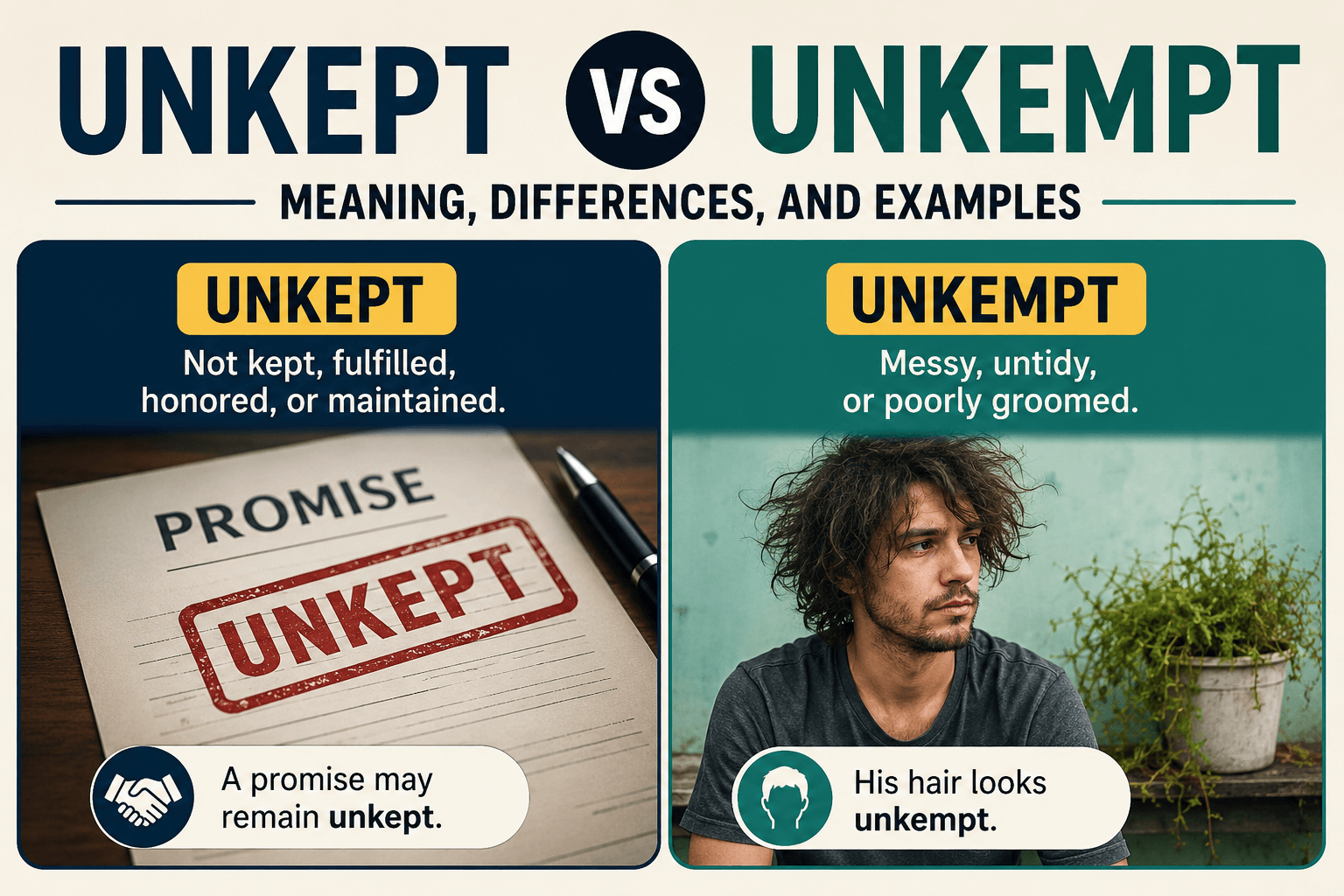
Unkept vs Unkempt compares two valid words: unkept means not kept, while unkempt describes a messy or poorly groomed appearance in standard English.
Their similar spelling and close pronunciation cause grammar confusion, but the meaning difference is clear. Use unkept for an unfulfilled promise, an unmaintained property, or something not looked after. Use unkempt for uncombed hair, a disheveled person, an untidy room, or an overgrown garden. In editing, this simple usage rule prevents most word-choice mistakes and helps students, writers, and professionals communicate accurately.
The word origin also helps. Unkempt developed from unkembed, an older word linked to uncombed hair, while unkept combines the prefix un- with kept. Kempt is a real word, though uncommon, meaning neatly combed or tidily kept. A spellcheck may question unkept because it appears less often, yet it remains correct in suitable contexts. Remember: promises go unkept; appearances look unkempt.
Unkept vs Unkempt: The Quick Answer
Unkept means not kept. It usually describes something that someone failed to honor, fulfill, preserve, or maintain.
Unkempt means messy, untidy, or poorly groomed. It usually describes appearance or visible condition.
| Word | Main Meaning | Commonly Describes | Example |
| Unkept | Not kept, honored, fulfilled, or maintained | Promises, commitments, agreements, obligations, property | He regretted his unkept promise. |
| Unkempt | Untidy, disheveled, or lacking care | Hair, beards, clothes, people, rooms, gardens | His hair looked unkempt. |
The basic rule is easy:
- Choose unkept when you could say not kept.
- Choose unkempt when you could say messy or untidy.
For example:
- Unkept promise means a promise that someone didn’t keep.
- Unkempt hair means hair that looks messy or ungroomed.
What Does Unkept Mean?
Unkept is an adjective meaning not kept.
The exact meaning depends on the noun it modifies. Something unkept may remain unfulfilled, neglected, unmaintained, dishonored, or improperly preserved.
The word has a transparent structure:
- Un- means “not.”
- Kept is the past participle of “keep.”
- Therefore, unkept literally means “not kept.”
Consider the phrase unkept promise. Someone made a promise but failed to honor it. The promise wasn’t kept, so it remained unkept.
Common Meanings of Unkept
Depending on the context, unkept can mean:
- Not honored
- Not fulfilled
- Not maintained
- Not preserved
- Not attended
- Not performed
- Not cared for properly
The word often appears with abstract nouns, especially promises and obligations.
Common Phrases With Unkept
Natural combinations include:
- Unkept promise
- Unkept commitment
- Unkept agreement
- Unkept obligation
- Unkept appointment
- Unkept assurance
- Unkept pledge
- Unkept property
However, some of these phrases sound less natural than their common alternatives.
For instance, most people say broken promise more often than unkept promise. Similarly, missed appointment usually sounds more natural than unkept appointment.
That doesn’t make unkept incorrect. It simply means another word may fit the situation more smoothly.
Examples of Unkept in Sentences
- The politician faced criticism for several unkept promises.
- One unkept commitment damaged the company’s reputation.
- Residents complained about the unkept property next door.
- Years of unkept assurances had destroyed public trust.
- The landlord received a warning about the unkept building.
- Their friendship suffered because of repeated unkept promises.
- The agreement remained unkept after the deadline passed.
- His unkept obligation created problems for the entire team.
Does Unkept Always Sound Natural?
Not always.
A word can be grammatically correct without being the most natural choice. English speakers often prefer a more precise term.
Consider these comparisons:
| Less Natural Phrase | More Natural Alternative |
| Unkept promise | Broken promise |
| Unkept commitment | Unfulfilled commitment |
| Unkept appointment | Missed appointment |
| Unkept building | Unmaintained building |
| Unkept neighborhood | Neglected neighborhood |
| Unkept contract | Breached contract |
| Unkept duty | Unfulfilled duty |
Choosing the more specific word can make your sentence clearer.
For example, an agreement might remain unkept, but breached tells readers that someone violated its terms. A building may be unkept, but unmaintained explains the problem more directly.
Can Unkept Describe a Person?
Writers rarely use unkept to describe someone’s appearance.
The phrase “an unkept man” sounds unusual. It might suggest that nobody supports, houses, or financially maintains the man. It doesn’t clearly communicate that he looks messy.
To describe appearance, use:
- Unkempt
- Disheveled
- Scruffy
- Untidy
- Ungroomed
- Rumpled
Correct:
- He arrived looking unkempt and exhausted.
Unnatural:
- He arrived looking unkept and exhausted.
What Does Unkempt Mean?
Unkempt is an adjective meaning untidy, messy, disordered, or poorly cared for.
It usually describes something you can observe. You might notice uncombed hair, wrinkled clothes, an overgrown lawn, or a cluttered room.
The word often suggests that someone hasn’t given enough attention to personal grooming, organization, or maintenance.
However, unkempt doesn’t automatically mean dirty.
A person can have clean hair that still looks unkempt. Likewise, a room may look disorganized without being filthy or unsanitary.
Common Things Described as Unkempt
Writers often use unkempt for:
- Hair
- Beards
- Mustaches
- Eyebrows
- Clothing
- Personal appearance
- Gardens
- Lawns
- Yards
- Rooms
- Houses
- Buildings
- Public spaces
The term can also describe writing, notes, presentations, or designs that feel rough and poorly organized.
Examples of Unkempt in Sentences
- His hair looked unkempt after the long journey.
- Weeds covered the unkempt garden.
- She wore wrinkled clothes that gave her an unkempt appearance.
- The abandoned house had an unkempt lawn.
- His beard had grown long and unkempt.
- Guests complained about the hotel’s unkempt rooms.
- The first draft felt unkempt and difficult to follow.
- An unkempt hedge blocked part of the sidewalk.
- He appeared tired, pale, and slightly unkempt.
- The office looked unkempt after the rushed renovation.
Unkempt Hair
Unkempt hair is one of the most common uses of the word.
It describes hair that looks uncombed, tangled, disordered, or poorly groomed.
Examples:
- The wind left her hair wild and unkempt.
- He ran into the store with unkempt hair and a wrinkled shirt.
- After sleeping on the train, my hair looked completely unkempt.
The word can carry a critical tone. Therefore, think about your purpose before using it to describe someone.
For example, “Her hair looked windblown” sounds neutral. “Her hair looked unkempt” may suggest neglect or carelessness.
Unkempt Beard
An unkempt beard looks uneven, overgrown, tangled, or poorly groomed.
- His unkempt beard covered most of his face.
- The character wore torn clothes and had an unkempt beard.
- Regular trimming kept his beard from looking unkempt.
Once again, the word describes appearance. It doesn’t necessarily mean the beard is unclean.
Unkempt Clothing and Appearance
Clothes can look unkempt when they appear wrinkled, mismatched, rumpled, stained, or carelessly worn.
A person’s overall appearance may also look unkempt.
- His untucked shirt created an unkempt appearance.
- She looked unkempt after spending the night at the airport.
- The costume gave the actor a deliberately unkempt look.
Context matters. Someone may look temporarily disheveled after traveling, working outdoors, caring for a child, or dealing with an emergency. The word describes what you see. It doesn’t explain why the person looks that way.
Unkempt Gardens, Lawns, and Properties
When people describe a garden as unkempt, they usually mean it looks overgrown or disorderly.
Common signs include:
- Tall grass
- Untrimmed hedges
- Fallen branches
- Thick weeds
- Dead plants
- Scattered tools
- Blocked pathways
- Overgrown vines
Examples:
- The unkempt garden attracted insects and blocked the walkway.
- Neighbors complained about the property’s unkempt lawn.
- Wildflowers gave the garden a natural look without making it appear unkempt.
A wild garden isn’t always unkempt. Some gardeners intentionally create natural landscapes that support birds, bees, and native plants. Design and neglect aren’t the same thing.
Key Differences Between Unkept and Unkempt
The words differ in spelling, meaning, origin, and typical use.
| Point | Unkept | Unkempt |
| Core meaning | Not kept | Untidy or poorly groomed |
| Main focus | Failure to keep, honor, or maintain | Visible messiness or disorder |
| Typical nouns | Promise, pledge, commitment, obligation | Hair, beard, clothing, garden |
| Useful replacement | Unfulfilled, broken, neglected | Messy, untidy, disheveled |
| Appearance use | Usually unnatural | Standard and common |
| Promise use | Correct | Incorrect |
| Example | An unkept commitment | An unkempt appearance |
The contrast becomes clearer when you ask two questions.
For unkept, ask:
Did someone fail to keep, honor, fulfill, or maintain something?
For unkempt, ask:
Does someone or something look messy, untidy, or poorly cared for?
Meaning Versus Appearance
Unkept often focuses on an action that didn’t happen.
Someone didn’t keep a promise. A property owner didn’t maintain a building. A person didn’t fulfill an obligation.
Unkempt focuses on visible condition.
Hair looks messy. A beard appears overgrown. A room seems disorganized. A garden looks neglected.
This difference explains why the words may overlap in property-related sentences.
A garden can be unkept because nobody maintained it. It can look unkempt because weeds and tall grass cover it.
The cause and appearance connect, but the words emphasize different ideas.
Can a Garden Be Unkept or Unkempt?
A garden can technically be either unkept or unkempt, although the intended meaning changes.
Use unkept when emphasizing the failure to maintain it:
- The owner left the garden unkept for several months.
- Because the property remained unkept, weeds spread across the fence.
Use unkempt when describing its appearance:
- The garden looked unkempt and overgrown.
- Visitors struggled to walk through the unkempt garden.
In most everyday writing, unkempt garden, neglected garden, or overgrown garden sounds more natural.
Real-Life Example: The Vacant House
Imagine a vacant house on a residential street.
Nobody has mowed the lawn, trimmed the bushes, or repaired the fence for six months. The owner has failed to maintain the property.
You could say:
- The property has remained unkept since the owner moved away.
This sentence focuses on neglected maintenance.
A neighbor sees tall weeds, broken branches, and vines covering the front steps.
The neighbor might say:
- The property looks unkempt.
This sentence focuses on visible condition.
Both statements can be correct. They simply view the same situation from different angles.
When to Use Unkept
Use unkept when something wasn’t kept in the expected sense.
It works best with promises, duties, agreements, obligations, and other commitments.
Use Unkept for Promises
- Her unkept promise left him disappointed.
- Voters remembered the governor’s unkept promises.
- One unkept promise can weaken years of trust.
However, broken promise usually sounds more natural and direct.
Compare:
- His unkept promise damaged their friendship.
- His broken promise damaged their friendship.
Both sentences work. The second sounds more familiar.
Use Unkept for Commitments
- The company apologized for its unkept commitments.
- Repeated unkept commitments made investors nervous.
- Their unkept commitment delayed the project.
In many cases, unfulfilled commitment offers a smoother alternative.
Use Unkept for Maintenance
The word may describe something that hasn’t been properly cared for.
- The unkept property became a safety concern.
- Officials inspected several unkept buildings.
- Neighbors reported an unkept vacant lot.
Still, neglected, poorly maintained, or unmaintained often communicates the meaning more precisely.
When to Use Unkempt
Use unkempt when describing an untidy appearance or poorly cared-for condition.
When Unkempt Describes Hair and Grooming
- His unkempt hair fell across his eyes.
- She brushed her unkempt hair before the interview.
- The actor wore a wig that looked deliberately unkempt.
Unkempt Clothing and Personal Appearance
- His wrinkled jacket made him look unkempt.
- The costume designer created an unkempt appearance.
- She looked tired and unkempt after the overnight flight.
Describing Untidy Places as Unkempt
- The room appeared cluttered and unkempt.
- An unkempt lawn surrounded the abandoned house.
- Customers avoided the unkempt waiting area.
Figurative Uses of Unkempt
Although the word usually describes physical appearance, writers sometimes use it figuratively.
- The report felt unkempt and poorly structured.
- His notes formed an unkempt collection of half-finished ideas.
- The presentation looked visually unkempt.
These uses suggest disorder, weak organization, or insufficient editing.
Pronunciation of Unkept and Unkempt
The two words sound similar, which causes much of the confusion.
- Unkept sounds like “uhn-KEPT.”
- Unkempt sounds like “uhn-KEMPT.”
In unkempt, pronounce the m before the final p and t sounds.
During fast conversation, that sound may seem faint. As a result, listeners may hear “unkept” even when the speaker says “unkempt.”
Try this simple contrast:
- Un-kept
- Un-kempt
Slowly pronounce the middle sound in the second word. You should feel your lips close for the m before moving into the final consonants.
The Origin and History of Unkempt
The history of unkempt helps explain its connection with messy hair.
The word developed through older English forms connected with combing. Its early meaning referred to something that hadn’t been combed.
Over time, the meaning expanded.
Instead of describing only uncombed hair, speakers began using it for a generally untidy or neglected appearance. Today, it can describe people, clothes, gardens, rooms, and other visibly disorderly things.
Is Kempt a Real Word?
Yes, kempt is a real word.
It means neat, tidy, or well groomed. However, it appears far less often than unkempt in modern everyday speech.
People sometimes use kempt playfully:
- After a haircut and a clean shirt, he finally looked kempt.
- The hotel appeared surprisingly kempt after the renovation.
Although correct, the word may sound humorous or deliberately unusual. In most situations, neat, tidy, or well groomed feels more natural.
The Origin of Unkept
The construction of unkept is much simpler.
It combines un-, meaning “not,” with kept, the past participle of “keep.”
Therefore:
- A kept promise has been honored.
- An unkept promise hasn’t been honored.
Unlike unkempt, the word doesn’t come from an old connection with combing or grooming.
British English and American English
Unkept and unkempt aren’t British and American spellings of one word.
Both varieties of English use both terms. The meanings remain the same.
Writers sometimes assume that one spelling belongs to American English while the other belongs to British English. That assumption is incorrect.
A genuine regional difference appears in a related synonym:
- American English: disheveled
- British English: dishevelled
However, both American and British writers use unkempt for messy appearances.
Examples:
- American English: His hair looked unkempt.
- British English: His hair looked unkempt.
The spelling doesn’t change.
Grammar Tips for Using Both Words
Both terms usually function as adjectives.
An adjective describes a noun or gives more information about it.
Before a Noun
Writers can place either adjective directly before a noun.
- An unkept promise
- An unkept obligation
- An unkempt beard
- An unkempt garden
After a Linking Verb
Both words can also appear after linking verbs such as be, look, seem, remain, and appear.
- The promise remained unkept.
- His beard looked unkempt.
- The building appeared unkempt.
- Several commitments remained unkept.
Choose the Adjective That Matches the Noun
Some nouns strongly favor one word.
| Noun | Best Choice | Example |
| Promise | Unkept | The unkept promise caused resentment. |
| Commitment | Unkept | Their commitment remained unkept. |
| Hair | Unkempt | Her hair looked unkempt. |
| Beard | Unkempt | He had an unkempt beard. |
| Appearance | Unkempt | His appearance seemed unkempt. |
| Garden | Usually unkempt | The unkempt garden needed attention. |
| Property | Depends on meaning | The property was unkept and looked unkempt. |
Real-Life Examples
Seeing the words in realistic situations makes the distinction easier to remember.
A Political Promise
A candidate promises to improve public transportation. After winning the election, the candidate takes no action.
The promise remains unkept.
Correct:
- Residents criticized the mayor’s unkept promise.
Incorrect:
- Residents criticized the mayor’s unkempt promise.
A promise can’t look messy. Therefore, unkempt doesn’t fit.
A Job Interview
A candidate arrives with tangled hair, an untucked shirt, and a wrinkled jacket.
The person looks unkempt.
Correct:
- His unkempt appearance affected the interviewer’s first impression.
Incorrect:
- His unkept appearance affected the interviewer’s first impression.
The sentence describes visible appearance, so unkempt is the right choice.
A Neglected Rental Property
A landlord fails to mow the lawn or repair the damaged fence. The property hasn’t received proper maintenance.
You might call it unkept.
Because tall grass, weeds, and broken boards make the place look untidy, you could also call it unkempt.
- The landlord left the property unkept.
- The property looked unkempt from the street.
The first sentence emphasizes responsibility. The second emphasizes appearance.
A Friendship
One friend promises to call but repeatedly fails to do so.
- Her unkept promises eventually weakened the friendship.
Nothing about the promise looks messy. Someone simply failed to keep it.
Common Mistakes to Avoid
Most errors happen because the words sound alike.
Writing “Unkept Hair”
Although hair can remain unmaintained, standard English strongly favors unkempt hair.
Incorrect:
- He had unkept hair.
Correct:
- He had unkempt hair.
Better alternatives may include:
- Messy hair
- Tangled hair
- Uncombed hair
- Disheveled hair
Writing “An Unkempt Promise”
A promise can be broken, forgotten, unfulfilled, or unkept. It can’t look untidy.
Incorrect:
- She apologized for her unkempt promise.
Correct:
- She apologized for her unkept promise.
More natural:
- She apologized for breaking her promise.
Treating the Words as Spelling Variants
The words aren’t alternative spellings.
Changing unkept to unkempt changes the meaning.
- Unkept = not kept
- Unkempt = messy
Assuming Unkempt Means Dirty
Something unkempt may also be dirty. However, the word itself primarily describes disorder or poor grooming.
A clean room can look unkempt if clothes, books, and papers cover every surface.
Likewise, someone can wear clean clothing that appears wrinkled and poorly arranged.
Use stronger terms when cleanliness is the real issue:
- Dirty
- Grimy
- Filthy
- Unsanitary
- Stained
Assuming Unkempt Only Describes People
The term frequently describes people, but its use extends much further.
You can describe:
- An unkempt garden
- An unkempt lawn
- An unkempt room
- An unkempt office
- An unkempt building
- An unkempt collection of notes
Using Unkept When a Better Word Exists
Technically correct writing can still sound awkward.
For example:
- The unkept road caused several accidents.
The sentence may mean that nobody maintained the road. However, unmaintained road or neglected road sounds clearer.
Strong writing doesn’t rely only on dictionary definitions. It also considers natural usage, context, and precision.
Easy Memory Tricks
A good memory trick should stay simple.
Connect the M With Messy
The word unkeMpt contains an m.
Let the m remind you of messy.
- Unkempt = messy
If someone or something looks messy, use unkempt.
Look for the Full Word Kept
The word unkept contains kept without interruption.
Ask whether someone kept the thing in question.
- Did they keep the promise?
- Did they keep the appointment?
- Did they keep the commitment?
When the answer is no, unkept may fit.
Remember One Sentence
An unkept promise can leave you with an unkempt appearance after a sleepless night.
The first word refers to something not honored. The second describes how someone looks.
Synonyms for Unkept
The best synonym depends on context.
For Promises and Commitments
- Broken
- Unfulfilled
- Dishonored
- Forgotten
- Abandoned
- Unperformed
Examples:
- Broken promise
- Unfulfilled commitment
- Dishonored pledge
- Abandoned responsibility
For Property and Maintenance
- Neglected
- Unmaintained
- Abandoned
- Poorly maintained
- Uncared-for
Examples:
- Neglected property
- Unmaintained building
- Poorly maintained road
For Agreements and Legal Duties
- Breached
- Violated
- Unfulfilled
- Dishonored
A breached agreement sounds more precise than an unkept agreement in legal or business writing.
Synonyms for Unkempt
Different alternatives create different tones.
| Synonym | Best Use | Tone |
| Messy | General disorder | Neutral and conversational |
| Untidy | Rooms, clothing, appearance | Mild |
| Disheveled | Hair, clothing, people | Descriptive |
| Scruffy | Clothing or personal appearance | Informal and sometimes critical |
| Rumpled | Clothing or fabric | Mild |
| Shaggy | Hair, fur, or beards | Visual |
| Overgrown | Gardens, lawns, vegetation | Specific |
| Ungroomed | Hair, beards, appearance | Direct |
| Disorderly | Rooms, layouts, collections | Formal |
| Neglected | Property, places, appearance | Suggests lack of care |
Disheveled Versus Unkempt
Disheveled often suggests temporary disorder.
Someone may look disheveled after running through heavy rain.
Unkempt can suggest a more general lack of grooming or care.
- After the storm, she looked disheveled.
- His long, untrimmed beard looked unkempt.
The difference isn’t absolute, but the tone often shifts.
Scruffy Versus Unkempt
Scruffy sounds more informal. It may describe shabby clothing or a rough appearance.
- He wore a scruffy jacket.
- His beard looked scruffy.
Unkempt sounds slightly more formal and often suggests insufficient grooming.
Overgrown Versus Unkempt
Use overgrown when vegetation has grown excessively.
- The lawn was overgrown.
- Vines covered the overgrown path.
Use unkempt for the overall disorderly appearance.
- The entire garden looked unkempt.
Related Words
Understanding related vocabulary can improve precision.
Kempt
Kempt means neat or well groomed. It remains uncommon in everyday language.
- He looked surprisingly kempt after the haircut.
Most writers would choose tidy or well groomed instead.
Kept
Kept is the past tense and past participle of keep.
- She kept her promise.
- The building was kept in excellent condition.
- He kept the documents in a locked cabinet.
Adding un- reverses the meaning:
- Kept promise
- Unkept promise
Groomed
Groomed means cleaned, arranged, or prepared carefully.
- He wore a neatly groomed beard.
- The horse looked healthy and well groomed.
Neglected
Neglected means something hasn’t received proper attention or care.
It often provides a stronger alternative for buildings, gardens, responsibilities, and health.
- A neglected garden
- A neglected property
- A neglected duty
Disordered
Disordered describes something that lacks arrangement or organization.
It suits objects, systems, ideas, and spaces.
- A disordered desk
- A disordered set of notes
Example Pairs That Show the Difference
These pairs reveal how each word performs a separate job.
Promise and Appearance
- His unkept promise disappointed his family.
- His unkempt appearance worried his family.
Property and Lawn
- The owner left the property unkept for years.
- The lawn looked unkempt and overgrown.
Commitment and Clothing
- Her unkept commitment delayed the project.
- Her wrinkled clothing looked unkempt.
Agreement and Office
- The unkept agreement led to a dispute.
- The office appeared cluttered and unkempt.
Assurance and Beard
- Customers complained about the company’s unkept assurances.
- The employee had a long, unkempt beard.
Test Your Knowledge
Choose unkept or unkempt for each sentence.
- His ______ hair fell across his forehead.
- The candidate apologized for an ______ campaign promise.
- Weeds filled the ______ backyard.
- Her clothes looked wrinkled and ______.
- Several ______ commitments weakened the partnership.
- The vacant house appeared ______ from the road.
- Their agreement remained ______ after the deadline.
- His beard looked long and ______.
Answers
- Unkempt hair
- Unkept campaign promise
- Unkempt backyard
- Unkempt clothes
- Unkept commitments
- Unkempt house
- Unkept agreement
- Unkempt beard
The backyard example could technically take unkept when the sentence emphasizes failed maintenance. However, unkempt sounds more natural when describing its visible condition.
Frequently Asked Questions
Q1.Is unkept a correct word?
Yes, unkept is a correct English word. It means something hasn’t been kept, honored, fulfilled, or maintained. However, words such as broken, unfulfilled, or neglected may sound more natural in some sentences.
Q2.What is the difference between unkept and unkempt?
Unkept means not kept or fulfilled. Unkempt means messy, untidy, or poorly groomed. For example, someone may break an unkept promise while having unkempt hair.
Q3.Should I write unkept hair or unkempt hair?
Write unkempt hair. The phrase describes hair that looks messy, tangled, uncombed, or poorly groomed. “Unkept hair” isn’t the standard expression for someone’s appearance.
Q4.Can a garden be unkept and unkempt?
Yes, but the meaning changes slightly. An unkept garden hasn’t received proper maintenance. An unkempt garden looks messy, overgrown, or untidy. In most everyday sentences, “unkempt garden” or “neglected garden” sounds more natural.
Q5.Is unkept the American spelling of unkempt?
No. These words aren’t American and British spelling variations. Both appear in American and British English, but they have separate meanings and uses
Conclusion
The difference between unkept and unkempt becomes simple once you focus on meaning. Use unkept when something hasn’t been kept, fulfilled, honored, or maintained. For example, a promise may remain unkept.
Use unkempt when a person, place, or object looks messy, untidy, or poorly groomed. Hair, clothing, gardens, rooms, and beards can all look unkempt.
A quick memory trick can help: the m in unkempt stands for messy. Meanwhile, unkept contains the complete word kept. Therefore, remember this final rule: a promise goes unkept, while an appearance looks unkempt.
.