Why These Two Words Look Alike but Mean Different Things
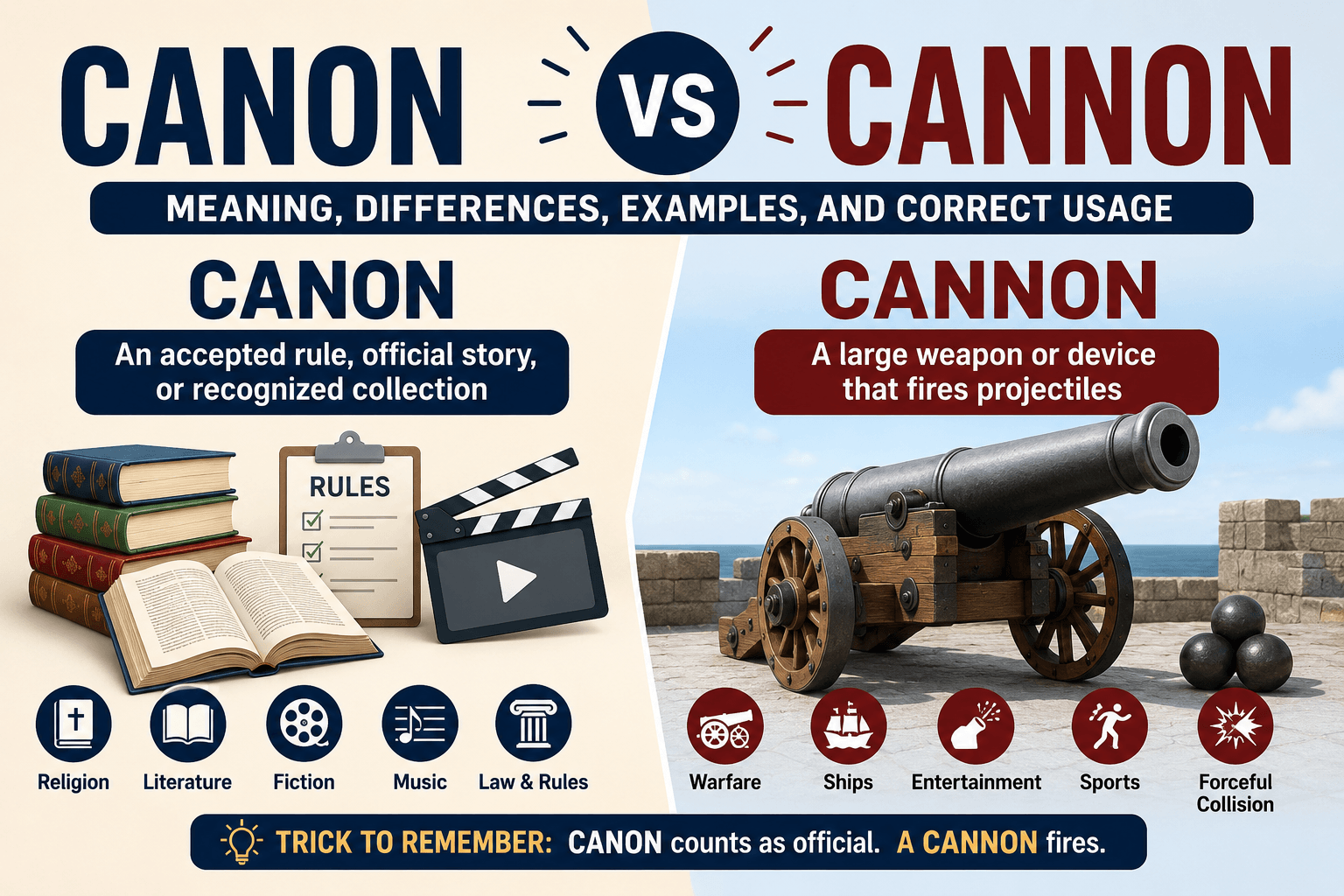
The canon vs cannon difference is simple: canon means an accepted rule or official story, while cannon means a large weapon that fires projectiles. These homophones share one pronunciation, but their spelling differs: single n for accepted material and extra n for artillery. In editing, context makes the choice clear.
Inside a fictional universe, canon protects official material and fictional continuity. This fandom use grew among Sherlock Holmes readers and now drives Star Wars and Marvel debates. In music, a musical canon repeats a melody through each voice entry, often after four beats, as in Row Row Row Your Boat.
The etymology reveals a shared root. Ancient Greek kanna and kanon linked a reed or measuring line with a rule. Latin carried the terms through Old French and Old English, while the Church connected canon with religious authority. Later, cannon named an artillery weapon. As Andy Hollandbeck, a logophile, explains, word history shows origins, not every modern meaning.
Quick Answer: The Difference at a Glance
The difference comes down to authority versus artillery.
- Canon refers to an accepted rule, recognized collection, official storyline, sacred text, or musical composition.
- Cannon refers to a large weapon, projectile launcher, powerful throwing arm, or forceful collision.
Here’s the simplest way to remember it:
Canon counts as official. A cannon fires.
Quick Comparison Table
| Word | Basic Meaning | Common Contexts | Example |
| Canon | An accepted rule or authoritative collection | Religion, literature, fiction, music, law | The novel belongs to the official canon. |
| Cannon | A large gun or forceful launching device | Warfare, ships, sports, entertainment | The ship fired its cannon. |
One-Sentence Difference
Use canon for something accepted as official or authoritative. Use cannon for a weapon or device that launches something forcefully.
Quick Examples
- The deleted scene isn’t canon.
- The Bible has a recognized canon of books.
- The old fort displayed an iron cannon.
- The mascot used a T-shirt cannon.
- The ball cannoned off the wall.
What Does Canon Mean?
The word canon has several meanings. However, they all connect to one central idea: something that people recognize as authoritative, accepted, established, or structurally ordered.
Depending on the context, canon may refer to:
- An accepted rule or principle
- An official body of religious texts
- A collection of important literary works
- An artist’s recognized body of work
- Official events in a fictional universe
- A musical composition based on imitation
- A member of cathedral clergy
Although fandom communities use the word frequently today, canon has a much longer history in religion, law, literature, and music.
Canon as an Accepted Rule or Standard
In formal writing, a canon can mean an accepted principle, rule, or standard used to guide behavior or interpretation.
This meaning often appears in professional, legal, artistic, and academic discussions.
For example:
- A canon of ethics guides professional conduct.
- A canon of interpretation helps judges understand legal language.
- The canons of journalism encourage accuracy and fairness.
- Artistic canons influence how critics judge creative work.
In this sense, canon doesn’t mean a written law that police enforce. Instead, it usually describes a recognized principle that a group treats as authoritative.
Examples in Sentences
- Accuracy remains a central canon of responsible journalism.
- The organization adopted a new canon of professional conduct.
- His argument ignored the traditional canons of historical research.
- Honesty should be a basic canon of public service.
Notice that the plural form is canons.
Canon in Religion
Religion gives us one of the oldest and most important uses of the word.
A religious canon is a collection of writings that a religious community accepts as sacred, authoritative, or divinely inspired.
The word doesn’t refer to every religious text ever written. Instead, it identifies the works that a specific tradition officially recognizes.
What Is the Biblical Canon?
The biblical canon is the collection of books accepted as scripture by a religious community.
Different Christian traditions don’t always recognize exactly the same set of books. Protestant, Roman Catholic, and Eastern Orthodox Bibles differ in their Old Testament collections.
For example, the Protestant Bible generally contains 66 books:
- 39 books in the Old Testament
- 27 books in the New Testament
The Roman Catholic Bible contains 73 books, including several books often called the deuterocanonical books.
Eastern Orthodox traditions may recognize additional texts, although the exact collection can vary among churches.
This variation highlights an important point: a canon depends on the authority or community defining it.
Canonical and Noncanonical Religious Texts
A canonical text belongs to the officially accepted collection.
A noncanonical text falls outside that collection.
Noncanonical doesn’t always mean fraudulent, useless, or unimportant. Scholars may study noncanonical writings because they reveal historical beliefs, cultural debates, or early religious traditions.
However, the community doesn’t treat those works as part of its official scripture.
What Is Canon Law?
Canon law is the system of laws and regulations that governs a church or religious organization.
The Roman Catholic Church has an extensive body of canon law. These rules address matters such as church administration, sacraments, marriage, clergy responsibilities, and disciplinary procedures.
The word takes one middle “n” because canon law concerns authoritative church rules, not artillery.
Correct:
- The scholar specialized in canon law.
Incorrect:
- The scholar specialized in cannon law.
The second phrase would sound like a legal system governing large guns.
Canon as a Clergy Title
A canon can also be a clergy member associated with a cathedral, collegiate church, or religious institution.
This meaning appears less often in everyday American English. Still, readers may encounter it in British history, church records, biographies, and formal religious writing.
Example:
- The cathedral appointed her as an honorary canon.
Here, canon identifies a person’s religious office or title.
Canon in Literature and Culture
In literature, a canon is a collection of works that scholars, teachers, critics, or cultural institutions consider important and influential.
The literary canon often includes books that have shaped language, culture, politics, philosophy, or later writing.
Well-known examples may include works by:
- William Shakespeare
- Jane Austen
- Charles Dickens
- Homer
- Toni Morrison
- Virginia Woolf
- Mark Twain
- Gabriel García Márquez
However, no single authority permanently controls the literary canon.
Schools, universities, publishers, critics, and readers constantly debate which works deserve recognition. As a result, the canon changes over time.
Why the Literary Canon Changes
Older literary canons often favored writers from powerful social groups. Many women, writers of color, Indigenous authors, working-class voices, and authors outside Europe received less attention.
Modern scholars have expanded reading lists to include a broader range of experiences and traditions.
Therefore, the literary canon isn’t a sealed vault. It behaves more like a living library. New discoveries, cultural changes, and fresh scholarship reshape it.
Examples in Sentences
- The novel eventually entered the American literary canon.
- Scholars continue to debate the boundaries of the Western canon.
- Her poetry deserves a stronger place in the modern canon.
- The course explores works outside the traditional literary canon.
An Author’s Canon
The word can also describe the recognized body of work created by a particular writer or artist.
For example:
- The Shakespeare canon
- The Sherlock Holmes canon
- The works included in an artist’s official canon
In this context, the term helps separate authentic works from disputed, misattributed, unfinished, or unofficial material.
Suppose researchers discover a play that someone claims Shakespeare wrote. Scholars would examine its language, history, paper, authorship evidence, and publication record before adding it to the Shakespeare canon.
Canonical Meaning
The adjective canonical means accepted as authoritative, officially recognized, or belonging to a canon.
Examples:
- The canonical version of the story ends differently.
- Scholars consider the text canonical.
- The character’s return became a canonical event.
- The church recognizes the book as canonical scripture.
The correct spelling is canonical.
Avoid cannonical, which incorrectly adds an extra “n.”
| Correct | Incorrect |
| Canon | Cannon, when referring to official material |
| Canonical | Cannonical |
| Noncanonical | Noncannonical |
| Headcanon | Headcannon |
Canon in Movies, Television, Books, and Games
Modern audiences often encounter canon in conversations about fictional universes.
In fiction, canon includes the events, characters, relationships, locations, and facts that the official story recognizes as true.
A creator, publisher, studio, or rights holder may determine what belongs to the official storyline.
For example, an event may count as canon if it appears in:
- An officially released novel
- A television episode
- A movie within the main continuity
- A creator-approved comic
- A licensed game recognized as part of the story
- An official guide or reference book
By contrast, fan fiction and personal theories don’t automatically become canon.
A Simple Fiction Example
Imagine a fantasy series in which the main character loses a sword during the final battle.
If the event appears in the published novel, it’s canon.
A fan may write an alternate story in which the character keeps the sword. That version may be imaginative and popular. However, it remains unofficial unless the rights holder adopts it.
Canon and Continuity Aren’t Exactly the Same
People often use canon and continuity as though they mean the same thing. They’re closely connected, but they describe different ideas.
Canon asks:
What material counts as official?
Continuity asks:
Do the story’s details remain consistent?
A work can be canonical and still contain continuity errors.
For example, an official episode may give a character two different birth dates. The episode remains canon because the studio released it as part of the official story. However, the conflicting dates create a continuity problem.
Large franchises may also contain several separate continuities.
A comic-book character might have:
- A main comic continuity
- A movie continuity
- An animated continuity
- An alternate-universe continuity
Each version can have its own canon.
Canon, Noncanon, Headcanon, and Fanon
Fandom discussions use several related terms. Understanding the differences helps you follow conversations about fictional worlds.
| Term | Meaning | Official? |
| Canon | Material recognized by the official story | Yes |
| Noncanon | Material outside the official story | No |
| Headcanon | A fan’s personal interpretation | No |
| Fanon | A fan-created idea widely accepted by a community | No |
What Does Noncanon Mean?
Noncanon describes material that doesn’t belong to the official storyline.
Common noncanon material includes:
- Fan fiction
- Parodies
- Unofficial sequels
- Promotional skits
- Alternate endings
- Crossover events
- Deleted scenes
- “What if?” stories
- Adaptations outside the main continuity
A deleted scene may reveal what the writers considered. Still, deletion often means the final work doesn’t officially include it.
However, the status of deleted material can vary. A creator may later confirm that the event still happened. In that case, fans may treat it as canon.
What Is Headcanon?
A headcanon is a personal belief or interpretation about a fictional character or story.
The official material doesn’t confirm it. Still, the fan believes the idea fits the story.
Examples of headcanon include:
- A character secretly enjoys cooking.
- Two side characters remained friends after the series ended.
- A villain fears thunderstorms because of an unseen childhood event.
- A hero visits a former mentor every year.
Headcanon can make stories feel richer. Yet personal interpretation doesn’t equal official confirmation.
Correct:
- My headcanon is that the character returned home.
Incorrect:
- My headcannon is that the character returned home.
A headcannon would literally suggest a cannon attached to someone’s head.
What Is Fanon?
Fanon combines the words fan and canon.
It describes an unofficial idea that becomes widely accepted within a fan community. Fans may repeat the idea so often that newcomers assume it came from the original story.
For instance, a fandom might agree that a minor character loves a certain food. The official books never mention it. However, fan art, jokes, and stories repeat the detail until it feels established.
Fanon can influence how people interpret a series. Still, popularity doesn’t make it official.
What Is a Canon Event?
A canon event is an event treated as an established or essential part of a character’s story.
In traditional fiction discussions, the phrase can describe an important event that shapes a character’s identity or future.
Online, the phrase has developed a broader humorous meaning. People use it for an awkward, painful, or formative life experience that someone supposedly needs to endure.
Examples include:
- Getting a regrettable haircut
- Trusting an unreliable friend
- Going through an embarrassing fashion phase
- Experiencing a first heartbreak
- Choosing an unsuitable career path before finding a better one
Someone might joke:
“Don’t stop him from wearing that outfit. It’s a canon event.”
The speaker means the experience may teach a lesson, even if it looks embarrassing now.
The correct phrase is canon event, not cannon event.
A cannon event would be an event involving artillery or a projectile launcher.
Canon in Music
Music gives canon another established meaning.
A musical canon is a composition in which one voice or instrument begins a melody. A second voice then performs the same or a closely related melody after a delay.
More voices may enter later, creating overlapping layers.
Think of several runners following the same route but starting at different times. Each follows the same musical path, yet their staggered entrances create harmony.
A round is a familiar type of canon. In a round, performers repeat the same melody continuously while entering at different times.
Example:
- The choir performed the piece as a four-part canon.
This meaning has nothing to do with fictional continuity or weapons. Context tells you which definition applies.
What Does Cannon Mean?
A cannon is traditionally a large gun that fires heavy projectiles.
Cannons have appeared in land warfare, naval battles, fortifications, aircraft, and armored vehicles. Historical versions often fired solid metal balls. Later designs used explosive shells and more advanced ammunition.
A traditional cannon typically has:
- A long metal barrel
- A firing mechanism
- A carriage, platform, or mount
- Space for gunpowder or another propellant
- The ability to launch a projectile over a distance
The extra “n” belongs to the weapon spelling.
Examples in Sentences
- The fort’s cannon overlooked the harbor.
- Soldiers moved the cannon into position.
- The museum restored a nineteenth-century naval cannon.
- Smoke rose after the cannon fired.
- The ship carried several heavy cannons.
Historical Cannon and Artillery
Early gunpowder weapons appeared in Asia before spreading into Europe and other regions. Over time, armies improved barrel design, ammunition, mobility, and accuracy.
Cannons changed warfare because they could damage:
- Castle walls
- Fortifications
- Ships
- Troop formations
- Defensive gates
As artillery improved, builders redesigned forts with lower walls, thicker defenses, and angled structures that better resisted cannon fire.
Although military history adds context, you don’t need to become an artillery expert to spell the word correctly. Just connect the double “n” with the physical weapon.
Modern Cannon Uses
Today, cannon can refer to more than an old-fashioned gun on wooden wheels.
Modern uses include:
- Aircraft cannon
- Naval cannon
- Automatic cannon
- Tank cannon
- Water cannon
- Air cannon
- T-shirt cannon
- Confetti cannon
- Snow cannon
Some of these devices aren’t weapons.
A T-shirt cannon uses compressed air to launch folded shirts into a crowd. A confetti cannon shoots paper pieces during celebrations. A snow cannon produces artificial snow at ski resorts.
The shared idea is forceful projection.
Cannon as a Verb
Cannon can also function as a verb.
To cannon into something means to strike it with sudden force.
Example:
- The cyclist lost control and cannoned into the barrier.
To cannon off something means to hit a surface and rebound at an angle.
Example:
- The ball cannoned off the goalpost.
This use appears frequently in British sports reporting. American readers may encounter it in soccer coverage, international news, or fiction.
Verb Forms
| Form | Example |
| Cannon | The ball may cannon off the wall. |
| Cannons | It cannons across the room. |
| Cannoned | The car cannoned into the fence. |
| Cannoning | The puck went cannoning off the boards. |
Cannon in Sports Language
Sports commentators often describe a powerful throwing arm as a cannon.
The expression is metaphorical. It compares the speed and force of a person’s throw to a projectile fired from a weapon.
Common expressions include:
- A cannon for an arm
- A cannon arm
- He fired the ball
- She launched the pass
Example:
- The outfielder has a cannon for an arm.
This phrase appears often in baseball because outfielders need strong throws to reach distant bases quickly.
Quarterbacks, catchers, and other throwing athletes may receive the same description.
Cannonball and Other Related Expressions
Several familiar words and idioms come from cannon.
Cannonball
A cannonball was traditionally a solid, round projectile fired from a cannon.
The word also describes a recreational jump into water. A person pulls their knees toward their chest before hitting the surface, producing a large splash.
Examples:
- The museum displayed a rusted cannonball.
- The children took turns doing cannonballs into the pool.
Cannon Fire
Cannon fire refers to shots fired from one or more cannons.
Example:
- The soldiers heard cannon fire in the distance.
Loose Cannon
A loose cannon is an unpredictable or reckless person who may create danger.
The expression comes from the image of a heavy cannon breaking free on a moving ship. As it rolled across the deck, it could injure sailors and damage the vessel.
Example:
- The manager considered him a loose cannon during negotiations.
The correct idiom is loose cannon, not loose canon.
Cannon Fodder
Cannon fodder originally referred to soldiers treated as expendable in battle.
Today, people also use the phrase figuratively for anyone placed in a risky or disposable position.
Examples:
- The inexperienced troops became cannon fodder.
- The weakest contestants served as cannon fodder for the champions.
Because the phrase describes people facing destructive force, it uses the weapon spelling.
Key Differences Between Canon and Cannon
The two words differ in meaning, spelling, and grammatical range.
| Feature | Canon | Cannon |
| Pronunciation | KAN-uhn | KAN-uhn |
| Main idea | Authority or acceptance | Force or projection |
| Common noun? | Yes | Yes |
| Can name a person? | Yes, a church official | Rarely |
| Used in religion? | Yes | Only when discussing weapons |
| Used in fiction? | Yes | Only when a weapon appears |
| Used in music? | Yes | Not as a standard musical form |
| Can function as a verb? | Rare in ordinary use | Yes |
| Related adjective | Canonical | No common direct equivalent |
| Common plural | Canons | Cannons |
Real-Life Usage Cases
Seeing the words in realistic situations makes the distinction easier.
Case Study: A Fan Discussion
A fan writes:
“The novel confirms the character survived, so the theory is now canon.”
The writer uses canon because an official publication confirms the event.
Another fan replies:
“I still prefer my headcanon that the character disappeared.”
The second fan acknowledges that their idea is personal rather than official.
Case Study: A Museum Description
A museum label says:
“This bronze cannon defended the harbor during the eighteenth century.”
The object is a weapon. Therefore, cannon needs two middle “n” letters.
Case Study: A Literature Course
A professor writes:
“This course examines how women writers reshaped the American literary canon.”
Here, canon means a recognized collection of influential works.
Case Study: A Baseball Report
A reporter writes:
“The right fielder showed off his cannon by throwing the runner out at home plate.”
The word metaphorically describes a powerful arm.
Case Study: A Church Document
A church historian writes:
“The council debated which writings should enter the scriptural canon.”
The sentence concerns officially recognized sacred texts. Therefore, canon is correct.
Common Spelling Mistakes
Most errors happen because writers spell the word according to sound. Since the pronunciation doesn’t change, the ear can’t solve the problem.
Mistake: Using Cannon for Official Fiction
Incorrect:
- That episode isn’t cannon.
Correct:
- That episode isn’t canon.
The sentence concerns official story material, not a weapon.
Mistake: Using Canon for a Weapon
Incorrect:
- The pirates loaded the canon.
Correct:
- The pirates loaded the cannon.
Pirates load weapons, so the double “n” spelling applies.
Mistake: Writing Headcannon
Incorrect:
- My headcannon is that the villain survived.
Correct:
- My headcanon is that the villain survived.
The term comes from head + canon, meaning a personal version of official lore.
Mistake: Writing Cannonical
Incorrect:
- The scene is cannonical.
Correct:
- The scene is canonical.
The adjective comes from canon, not cannon.
Mistake: Writing Loose Canon
Incorrect:
- He’s a loose canon.
Correct:
- He’s a loose cannon.
The expression refers to an unsecured weapon rolling dangerously on a ship.
Grammar and Usage Tips
A few quick checks can prevent most errors.
Look for Authority Words
Use canon when the sentence includes ideas such as:
- Official
- Accepted
- Authoritative
- Recognized
- Sacred
- Traditional
- Established
- Literary
- Musical
Example:
- Critics consider the novel part of the established canon.
Look for Force Words
Use cannon when the sentence includes ideas such as:
- Fire
- Launch
- Shoot
- Projectile
- Artillery
- Crash
- Rebound
- Weapon
- Throw
Example:
- The device launched the shirt like a cannon.
Check the Related Form
Sometimes a related word reveals the correct spelling.
- Canon → canonical
- Canon → noncanonical
- Canon → headcanon
- Cannon → cannonball
- Cannon → cannon fire
- Cannon → cannoned
Watch Capitalization
Canon with a capital “C” may refer to the Canon camera and imaging company.
Compare:
- She bought a Canon camera.
- The book entered the literary canon.
- The castle displayed an iron cannon.
Capitalization changes the first example into a proper name.
Memory Tricks That Work
Canon Counts
Think:
Canon counts as official.
Both canon and counts begin with “c.” This trick works well for books, movies, games, and fandom discussions.
A Cannon Has Extra Firepower
Cannon has an extra “n.”
Imagine that extra letter as extra ammunition, weight, or firepower.
Authority or Artillery?
Ask one quick question:
- Does the sentence involve authority? Choose canon.
- Does it involve artillery? Choose cannon.
The matching first letters make this easy to remember.
The Launch Test
Can the object launch, fire, crash, or rebound?
If yes, you probably need cannon.
Can the subject become official, accepted, sacred, or recognized?
If yes, you probably need canon.
Synonyms and Related Words
The right synonym depends on the meaning.
Synonyms for Canon as a Rule
- Principle
- Standard
- Rule
- Guideline
- Doctrine
- Precept
- Criterion
Synonyms for Canon as a Collection
- Corpus
- Body of work
- Collection
- Tradition
- Accepted works
- Authoritative texts
Related Fandom Terms
- Canonical
- Noncanon
- Headcanon
- Fanon
- Continuity
- Lore
- Retcon
- Alternate universe
A retcon, short for retroactive continuity, changes or reinterprets previously established story information.
Synonyms for Cannon
Depending on context, related words include:
- Artillery piece
- Gun
- Weapon
- Launcher
- Firearm
- Howitzer
- Field gun
These terms aren’t always interchangeable. For example, a howitzer is a specific type of artillery weapon, while cannon is a broader term.
Practice: Choose the Correct Word
Fill each blank with canon or cannon.
- The story isn’t part of the official ___.
- The ship carried a bronze ___.
- Scholars debated the biblical ___.
- The ball ___ off the post.
- The mascot aimed the T-shirt ___ at the upper seats.
- That relationship remains a popular head___.
- The choir performed the melody as a ___.
- Everyone considered the reckless adviser a loose ___.
- The novel entered the literary ___.
- The outfielder has a ___ for an arm.
Answers
- Canon — official story
- Cannon — weapon
- Canon — accepted sacred texts
- Cannoned — struck and rebounded
- Cannon — launching device
- Canon — headcanon
- Canon — musical form
- Cannon — established idiom
- Canon — recognized body of literature
- Cannon — powerful throwing arm
Frequently Asked Questions
Q1.What Is the Main Difference Between Canon and Cannon?
Canon refers to an accepted rule, official collection, or recognized storyline. Cannon refers to a large gun or a device that launches something with force.
Q2.Are Canon and Cannon Pronounced the Same?
Yes. Both words are pronounced KAN-uhn. They are homophones, which means they sound alike but have different spellings and meanings.
Q3.Is a Movie Story Canon or Cannon?
A movie story is canon when it officially belongs to a fictional universe. Use cannon only when referring to a weapon or launcher.
Q4.Is It Headcanon or Headcannon?
Headcanon is the correct spelling. It means a personal belief or idea about a story that has not been officially confirmed.
Q5.How Can I Remember Canon vs Cannon?
Remember this simple rule: canon counts as official, and a cannon fires. The extra “n” in cannon can remind you of extra power or ammunition.
Conclusion
The difference between canon and cannon becomes easy once you focus on meaning. Use canon for an accepted rule, official story, recognized collection, religious text, or musical form. Use cannon for a large weapon, launching device, or forceful impact.
Both words sound the same, but the extra “n” changes the meaning. A simple memory trick can help: canon counts as official, while a cannon fires. Check the context before choosing the spelling, and you’ll avoid one of the most common English writing mistakes.