A Practical Way to Tell Them Apart
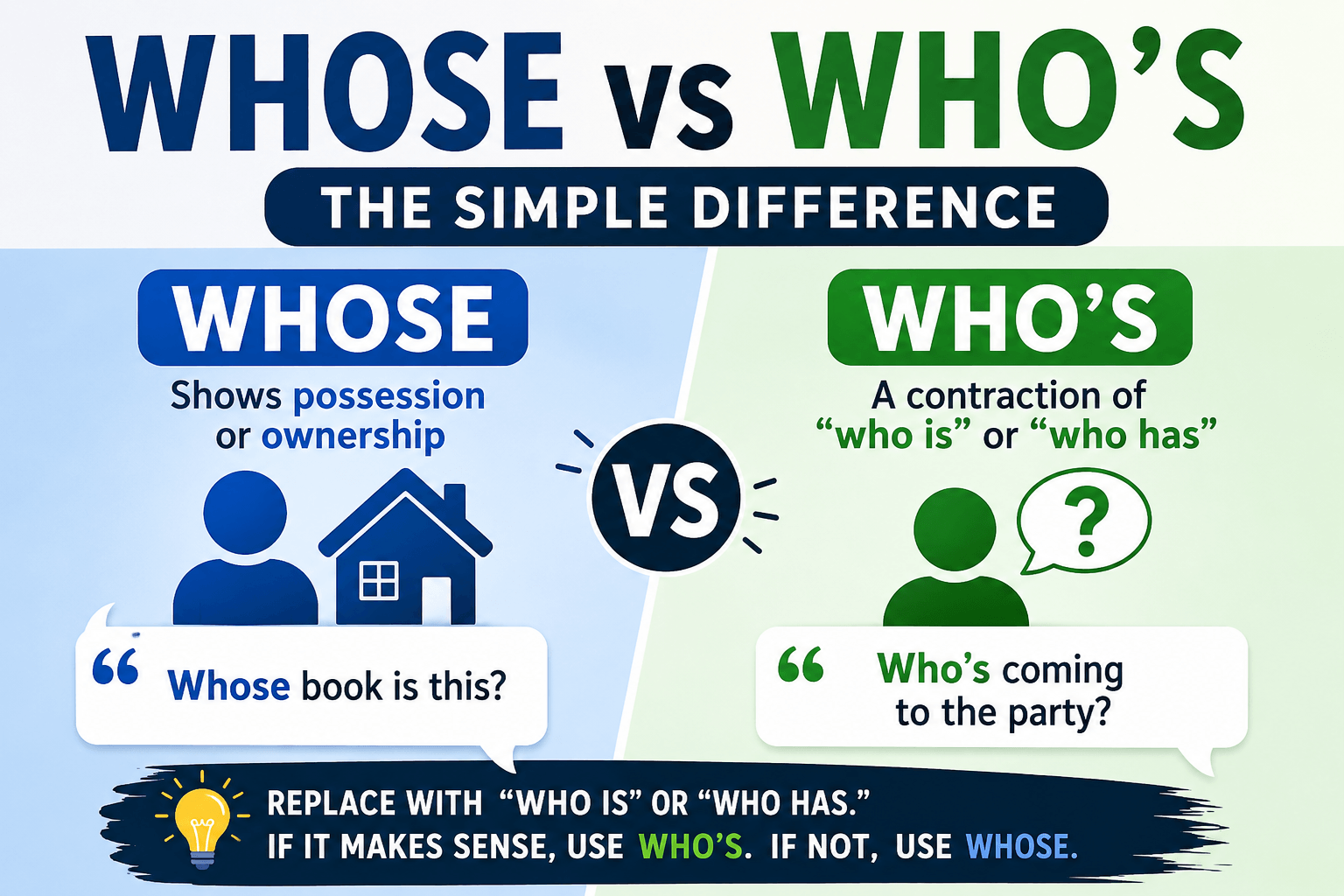
Whose vs Who’s becomes easy once you know that whose shows possession, while who’s always means who is or who has in everyday writing today.
The apostrophe causes most mistakes. Possessive pronouns such as his, hers, theirs, its, and whose never take apostrophes. By contrast, who’s is a contraction. Use the replacement test: replace it with who is or who has. If the sentence still makes sense, who’s is correct. Otherwise, use whose for ownership or belonging.
For example, “Whose book is this?” asks about possession, while “Who’s coming to the party?” means “Who is coming?” The rule also works in “the doctor whose name I forget” and “the friend who’s helped before.” Check the sentence context, expand the contraction, and choose the correct form. This method prevents common grammar mistakes in emails, chats, schoolwork, and professional writing, where one small apostrophe changes sentence meaning.
Whose vs Who’s: Quick Answer
Use whose when you’re asking about or describing possession, ownership, association, or responsibility.
Use who’s when you can replace the word with who is or who has.
| Word | Meaning | Main Function | Example |
| Whose | Belonging to whom | Shows possession or association | Whose jacket is this? |
| Who’s | Who is or who has | Forms a contraction | Who’s wearing my jacket? |
Here’s the fastest way to choose:
If “who is” or “who has” fits, write “who’s.” If the sentence shows possession, write “whose.”
For example:
- Who’s coming tonight?
“Who is coming tonight?” makes sense. - Whose car is outside?
“Who is car is outside?” doesn’t make sense. The question concerns ownership, so whose is correct.
What Does “Whose” Mean?
Whose is the possessive form of who. It asks or explains which person, animal, group, organization, or thing has a connection to something else.
Most people associate possession with physical ownership. However, whose covers a much wider range of relationships.
It can identify:
- Ownership
- Family relationships
- Responsibility
- Authorship
- Association
- Characteristics
- Control
- Membership
- Personal connection
Consider these examples:
- Whose bicycle is blocking the gate?
- She’s the author whose novel won the award.
- We need to determine whose responsibility this is.
- They bought a house whose roof needed repairs.
- Do you know whose idea started the project?
In the first sentence, whose asks about literal ownership. In the second, it connects an author with her novel. The third example concerns responsibility rather than property.
Therefore, “possession” in grammar doesn’t always mean legally owning something. It often means having a meaningful relationship with it.
“Whose” as a Possessive Determiner
A determiner appears before a noun and provides information about it.
When whose comes directly before a noun, it acts as a possessive determiner.
Examples include:
- Whose bag is on the table?
- Whose children are playing outside?
- She met a scientist whose research changed the industry.
- We contacted the customer whose payment failed.
- Nobody knows whose decision caused the delay.
In each sentence, a noun follows whose:
- Bag
- Children
- Research
- Payment
- Decision
You can often spot this structure by looking for the pattern:
Whose + noun
However, the phrase doesn’t always appear at the beginning of a question.
Compare:
- Whose keys are these?
- Do you know whose keys these are?
- I can’t remember whose keys I picked up.
All three sentences use whose correctly because each one concerns possession.
“Whose” as a Possessive Pronoun
Whose can also stand alone. In that role, it functions as a possessive pronoun.
Look at these examples:
- Whose is this?
- I found an umbrella, but I don’t know whose it is.
- Several coats look alike, so nobody knows whose is whose.
- Whose are the muddy shoes by the door?
The noun may appear elsewhere or remain understood from the context.
Imagine that someone holds up a wallet and asks, “Whose is this?” The speaker doesn’t need to repeat the word wallet. Everyone can see what the question refers to.
This use often appears in everyday conversation. It also works in formal writing when the meaning remains clear.
What Types of Possession Can “Whose” Express?
The word covers more than personal property. Understanding its broader uses can help you write more naturally.
Physical ownership
- Whose laptop is charging?
- Whose coat did you borrow?
- Whose package arrived this morning?
These examples ask who owns a physical object.
Relationships
- Whose brother works at the hospital?
- I met the woman whose daughter teaches here.
- Do you know whose parents organized the event?
The people don’t “own” their relatives. Instead, whose expresses a personal relationship.
Responsibility
- Whose job is it to close the office?
- We must establish whose fault caused the error.
- Nobody could decide whose responsibility the repairs were.
Here, the connection involves duty or accountability.
Authorship and creation
- Whose painting won first place?
- They’re discussing whose proposal should receive funding.
- Do you remember whose idea this was?
The person created, suggested, or produced something.
Features and characteristics
- They restored a building whose windows had shattered.
- We adopted a dog whose leg had healed.
- The company launched a product whose design attracted attention.
In these examples, whose connects something with one of its qualities or parts.
How to Use “Whose” in Questions
Use whose in a question when you need to identify an owner or discover a relationship.
Before a noun
The most common structure places whose before a noun.
- Whose turn is it?
- Whose name appears first?
- Whose car did you use?
- Whose account received the payment?
- Whose opinion should we trust?
The answer usually identifies a person or group:
- It’s Daniel’s turn.
- Priya’s name appears first.
- We used the manager’s car.
Without a noun
You can omit the noun when your audience already understands it.
- Whose is the blue suitcase?
- Whose are these documents?
- Whose was the final decision?
Although these sentences may sound slightly formal, they remain grammatically correct.
In direct and indirect questions
A direct question uses standard question word order:
- Whose notebook is this?
- Whose dog escaped?
An indirect question appears inside another statement or question:
- Do you know whose notebook this is?
- I wonder whose dog escaped.
- Can you tell me whose office we’re using?
Notice the word order in the first pair:
- Direct: Whose notebook is this?
- Indirect: Do you know whose notebook this is?
Writers sometimes incorrectly keep question word order inside an indirect question.
Incorrect:
- Do you know whose notebook is this?
Correct:
- Do you know whose notebook this is?
The larger sentence already forms the question. The clause after whose follows normal statement order.
How to Use “Whose” in Relative Clauses
A relative clause adds information about a person, animal, place, organization, or thing.
Words such as who, which, that, and whose often introduce these clauses.
Consider this sentence:
- I spoke with the employee whose badge was missing.
The relative clause “whose badge was missing” identifies the employee. It also connects that employee to the missing badge.
Referring to people
- The student whose essay won received a scholarship.
- I thanked the neighbor whose dog found my keys.
- The manager whose team exceeded its target received an award.
- She contacted the client whose account had expired.
This is one of the most common uses of whose.
Referring to animals
- We rescued a dog whose paw was injured.
- The bird whose nest fell returned the next day.
- They treated a horse whose leg needed surgery.
English grammar doesn’t limit whose to human beings.
Referring to objects and organizations
Many writers hesitate to use whose for things. However, standard English allows it.
Examples include:
- They entered a house whose windows were broken.
- We studied a company whose profits had doubled.
- She proposed a theory whose implications remain important.
- The committee reviewed a policy whose wording caused confusion.
- He photographed a mountain whose peak remained hidden by clouds.
These constructions often sound smoother than alternatives using of which.
Compare:
- A building whose roof collapsed
- A building the roof of which collapsed
Both versions can work. However, the first sounds more natural in most contexts.
What Does “Who’s” Mean?
Who’s is a contraction formed by replacing missing letters with an apostrophe. Depending on the sentence, the word can mean:
- Who is
- Who has
However, this contraction never shows possession.
Possessive nouns often contain apostrophes, which can make this rule confusing. For example:
- David’s car
- The teacher’s desk
- The dog’s collar
However, pronouns follow different rules. Who’s works like it’s, she’s, and he’s. The apostrophe signals missing letters.
“Who’s” Meaning “Who Is”
In many sentences, who’s expands to who is.
- Who’s at the door?
- Who’s your supervisor?
- Who’s ready to leave?
- Do you know who’s responsible?
- I wonder who’s attending the conference.
Test each sentence by expanding the contraction:
- Who is at the door?
- Who is your supervisor?
- Who is ready to leave?
The meaning stays intact. Therefore, who’s is correct.
This form can appear before:
- An adjective: Who’s ready?
- A noun: Who’s the manager?
- A verb ending in “-ing”: Who’s calling?
- A prepositional phrase: Who’s in the office?
- A past participle used with “is”: Who’s invited?
“Who’s” Meaning “Who Has”
Who’s can also mean who has when has acts as a helping verb.
Examples include:
- Who’s finished the assignment?
- Who’s seen my glasses?
- Who’s already eaten?
- Do you know who’s received the invitation?
- She asked who’s been using her computer.
Expand the contraction:
- Who has finished the assignment?
- Who has seen my glasses?
- Who has already eaten?
Again, the sentences remain correct.
However, who’s doesn’t replace who has when has means ownership.
Correct:
- Who has a spare key?
Usually incorrect or unnatural:
- Who’s a spare key?
In “Who has a spare key?” the verb has means “possesses.” It isn’t functioning as an auxiliary verb. Therefore, English speakers generally don’t contract it in that structure.
Whose and Who’s at a Glance
| Feature | Whose | Who’s |
| Basic meaning | Belonging to whom | Who is or who has |
| Grammar type | Possessive determiner or pronoun | Contraction |
| Shows possession | Yes | No |
| Contains an apostrophe | No | Yes |
| Can appear before a noun | Yes | Only when “who is” logically precedes that noun |
| Example | Whose book is missing? | Who’s reading the book? |
| Replacement test | Cannot become “who is” or “who has” | Must expand to “who is” or “who has” |
The words also answer different questions.
- Whose asks about ownership or connection.
- Who’s asks about identity, action, condition, or experience.
Compare:
| Possession or Connection | Identity or Action |
| Whose dog is barking? | Who’s walking the dog? |
| Whose presentation is next? | Who’s presenting next? |
| Whose seat is empty? | Who’s sitting here? |
| Whose report was approved? | Who’s approving the report? |
| Whose children attend this school? | Who’s picking up the children? |
Why Doesn’t “Whose” Have an Apostrophe?
Possessive nouns often use apostrophes:
- The doctor’s office
- The student’s notebook
- The company’s website
Possessive pronouns don’t.
| Possessive Pronoun | Incorrect Form |
| His | Hi’s |
| Hers | Her’s |
| Its | It’s |
| Yours | Your’s |
| Ours | Our’s |
| Theirs | Their’s |
| Whose | Who’s |
Some incorrect forms in the right column are valid contractions with different meanings. For example, it’s means it is or it has. It doesn’t mean “belonging to it.”
The same principle applies here:
- Whose shows possession.
- Who’s contains a hidden verb.
Think of the apostrophe as a small replacement marker. It stands where letters disappeared.
- Who is → who’s
- Who has → who’s
No letters disappear from the possessive word whose, so it needs no apostrophe.
The Fastest Grammar Test
When you’re unsure, don’t rely on appearance. Expand the word.
Follow these steps:
- Replace the word with who is.
- If that sounds wrong, try who has.
- If neither phrase fits, check whether the sentence expresses possession.
- Use whose when ownership or association makes sense.
Example: “___ coming to dinner?”
Try the expansion:
- Who is coming to dinner?
The sentence works. Write:
- Who’s coming to dinner?
Example: “___ shoes are by the door?”
Try:
- Who is shoes are by the door?
- Who has shoes are by the door?
Neither sentence works. The question asks who owns the shoes.
Write:
- Whose shoes are by the door?
Example: “___ already submitted the form?”
Try:
- Who has already submitted the form?
That sentence works.
Write:
- Who’s already submitted the form?
Example: “I don’t know ___ decision it was.”
Neither who is nor who has fits.
The sentence identifies the person connected with the decision.
Write:
- I don’t know whose decision it was.
This substitution method works better than memorizing a vague rhyme. It forces you to examine the sentence’s meaning.
Common Mistakes and Correct Forms
Even experienced writers make these errors because both spellings are real words. A standard spell-checker may not flag the wrong choice.
| Incorrect Sentence | Correct Sentence | Reason |
| Who’s coat is this? | Whose coat is this? | The sentence asks about ownership. |
| Whose coming with us? | Who’s coming with us? | It means “who is coming.” |
| The woman who’s car was stolen called the police. | The woman whose car was stolen called the police. | The car belongs to the woman. |
| Whose finished the report? | Who’s finished the report? | It means “who has finished.” |
| Do you know who’s keys these are? | Do you know whose keys these are? | The keys belong to someone. |
| Who’se idea was this? | Whose idea was this? | “Who’se” isn’t a valid word. |
Mistaking every apostrophe for possession
The biggest trap comes from possessive nouns.
Writers see phrases such as Emma’s bag and assume who’s bag must follow the same pattern. However, who is a pronoun, not a regular noun.
Correct:
- Emma’s bag
- Her bag
- Whose bag
Incorrect:
- Who’s bag
Choosing by sound
The two words are homophones. They have the same pronunciation.
As a result, listening won’t help you choose the spelling. You must examine the grammar and meaning.
Trusting autocorrect
Autocorrect can confirm spelling, but it may not catch a correctly spelled word used incorrectly.
Both of these words exist, so grammar checking tools may miss subtle errors. The expansion test offers a more reliable final check.
Tricky Phrases Explained
Certain combinations generate more confusion than others. Here’s how to handle them.
“Whose birthday” or “who’s birthday”?
Use whose birthday when asking which person has a birthday.
- Whose birthday is today?
- Do you know whose birthday we’re celebrating?
Use who’s when it expands to who is:
- Who’s celebrating a birthday today?
“Who is birthday?” makes no sense. Therefore, who’s birthday is incorrect in ordinary contexts.
“Whose idea” or “who’s idea”?
Use whose idea because the idea belongs to or came from someone.
- Whose idea was the surprise party?
- I don’t remember whose idea we selected.
You can use who’s in a different sentence:
- Who’s suggesting a new idea?
“Whose mom” or “who’s mom”?
Use whose mom when asking about a family relationship.
- Whose mom is picking up the children?
A sentence such as “Who’s Mom?” could be correct in a very specific context. For example, a child might look at a group photograph and ask which person is Mom. There, it means “Who is Mom?”
Context controls the meaning.
“Whose wedding” or “who’s wedding”?
Use:
- Whose wedding are you attending?
The wedding belongs or relates to a couple.
For a sentence with who’s, write:
- Who’s getting married?
“Whose there” or “who’s there”?
The correct phrase is:
- Who’s there?
It expands to “Who is there?”
“Whose been” or “who’s been”?
Use:
- Who’s been using my laptop?
- Who’s been invited?
In both cases, the contraction means who has.
“Whose your” or “who’s your”?
Use:
- Who’s your teacher?
- Who’s your favorite author?
Both sentences expand naturally:
- Who is your teacher?
- Who is your favorite author?
“Whose your teacher?” is ungrammatical because your teacher already expresses possession.
Real-Life Editing Examples
Grammar rules become easier to remember when you see how they affect actual communication.
Workplace email
Original sentence:
- Can you confirm who’s approval we need?
The writer wants to identify the person whose approval is necessary. The phrase doesn’t mean “who is approval.”
Corrected version:
- Can you confirm whose approval we need?
A small change makes the email grammatically accurate and more professional.
School assignment
Original sentence:
- The student who’s project received the highest score gave a presentation.
The project belongs to the student. Therefore, the sentence requires the possessive form.
Corrected version:
- The student whose project received the highest score gave a presentation.
Team conversation
Original sentence:
- Whose joining the video call?
Try the expansion:
- Who is joining the video call?
Corrected version:
- Who’s joining the video call?
Customer support note
Original sentence:
- We contacted the customer who’s account showed unusual activity.
The account belongs to the customer.
Corrected version:
- We contacted the customer whose account showed unusual activity.
These examples show why the distinction matters. The wrong word may not prevent understanding, but it can weaken clarity and credibility.
Grammar Tips for Error-Free Writing
Expand contractions while proofreading
Read every use of who’s as who is or who has.
When the expanded phrase sounds wrong, replace it with whose or rewrite the sentence.
Look for a following noun
When a noun comes immediately after the word, whose is often correct.
Common patterns include:
- Whose car
- Whose name
- Whose decision
- Whose responsibility
- Whose children
However, don’t treat this as an absolute rule.
Who’s can appear before a noun when it means who is:
- Who’s the manager?
- Who’s your doctor?
- Who’s that woman?
Meaning remains more reliable than position.
Identify the relationship
Ask what connects the person to the noun.
- Who owns it?
- Who created it?
- Who controls it?
- Who is responsible for it?
- Who is related to it?
When one of those questions fits, use whose.
Avoid editing by appearance alone
An apostrophe may look more “possessive,” but visual instinct can mislead you.
Instead, inspect the sentence’s structure. Grammar follows meaning, not typography.
How to Remember the Difference
The best memory trick focuses on the hidden words inside the contraction.
The hidden-verb trick
Who’s always hides a verb:
- Who is
- Who has
Whose doesn’t hide anything. It simply shows possession.
The apostrophe replacement trick
An apostrophe replaces missing letters.
In who’s, letters have disappeared from who is or who has.
In whose, no letters are missing.
A memorable phrase
Who’s has a hidden verb. Whose shows a connection.
The ownership question
When you see a noun after the word, ask:
- “Does this noun belong or relate to someone?”
If yes, whose probably fits.
Example:
- ___ passport is missing?
The passport belongs to someone, so write:
- Whose passport is missing?
Synonyms and Alternative Phrases
These words don’t have perfect one-word synonyms. Their functions are too specific. However, you can sometimes rewrite a sentence using an equivalent phrase.
Alternatives to “whose”
Depending on context, whose may mean:
- Belonging to whom
- Of whom
- Associated with whom
- Connected to whom
- Created by whom
- The person’s
- The organization’s
Examples:
- Whose bag is this?
- To whom does this bag belong?
Both questions ask the same thing. However, the second sounds more formal.
Another example:
- A writer whose books sell worldwide
- A writer the books of whom sell worldwide
The second version sounds awkward. In most cases, whose offers the clearest and most natural choice.
Alternatives to “who’s”
Because who’s is a contraction, its direct alternatives are simply:
- Who is
- Who has
Use the full forms in formal writing when you want extra emphasis or clarity.
Compare:
- Who’s responsible for this decision?
- Who is responsible for this decision?
Both are correct. The uncontracted version sounds slightly more formal or emphatic.
Related Words: Who, Whom, Whose, and Who’s
These words look similar, but each one serves a different purpose.
| Word | Function | Example |
| Who | Refers to the subject performing an action | Who called you? |
| Whom | Refers to the object receiving an action | Whom did you call? |
| Whose | Shows possession or association | Whose number is this? |
| Who’s | Means who is or who has | Who’s calling? |
Using “who”
Use who when the person performs the action.
- Who sent the message?
- Who wants coffee?
- Do you know who called?
Using “whom”
Use whom when the person receives the action or follows a preposition.
- Whom did you invite?
- To whom should I address the letter?
- She’s the person whom we hired.
In everyday English, many speakers use who instead of whom, especially in conversation. However, whom still appears in formal writing.
Using “whose”
Use it to express possession or association.
- Whose message did you receive?
- The person whose number I saved called again.
Using “who’s”
Use it as a contraction.
- Who’s sending the message?
- Who’s received my email?
Practice Exercise
Choose whose or who’s for each sentence.
- ___ responsible for locking the door?
- ___ notebook is on the table?
- Do you know ___ already arrived?
- The artist ___ painting won thanked the judges.
- ___ planning to attend the workshop?
- Can you tell me ___ keys these are?
- ___ been using this account?
- We visited a village ___ history dates back centuries.
- ___ turn is it?
- ___ the person in charge?
Answers
- Who’s responsible for locking the door?
It means “Who is responsible?” - Whose notebook is on the table?
The question asks who owns the notebook. - Do you know who’s already arrived?
It means “who has already arrived.” - The artist whose painting won thanked the judges.
The painting belongs to or was created by the artist. - Who’s planning to attend the workshop?
It means “Who is planning?” - Can you tell me whose keys these are?
The sentence asks about ownership. - Who’s been using this account?
It means “Who has been using this account?” - We visited a village whose history dates back centuries.
The history is associated with the village. - Whose turn is it?
The turn belongs to someone. - Who’s the person in charge?
It means “Who is the person in charge?”
Frequently Asked Questions
Q1.What is the difference between whose and who’s?
Whose is the possessive form of who. It shows ownership or connection, as in “Whose phone is this?” Who’s is a contraction of who is or who has, as in “Who’s calling?” or “Who’s finished the work?”
Q2.Is it whose birthday or who’s birthday?
The correct phrase is whose birthday because the sentence asks which person the birthday belongs to.
Example: Whose birthday are we celebrating?
Q3.Why doesn’t whose have an apostrophe?
Whose is a possessive pronoun, and possessive pronouns don’t use apostrophes. Other examples include his, hers, ours, theirs, and its.
Q4.Can whose refer to objects or organizations?
Yes. Whose can refer to people, animals, objects, places, and organizations.
Example: “They repaired a building whose roof was damaged.”
Q5.What is the easiest way to remember whose vs who’s?
Replace who’s with who is or who has. If the sentence still makes sense, use who’s. If it doesn’t and the sentence shows possession, use whose.
Conclusion
The difference between whose and who’s comes down to one simple rule. Use whose for possession, ownership, or connection. Use who’s when you mean who is or who has.
When you feel unsure, expand the contraction. If who is or who has fits the sentence, choose who’s. If the sentence asks who owns or relates to something, choose whose. This quick test helps you avoid common mistakes in emails, schoolwork, chats, and professional writing.