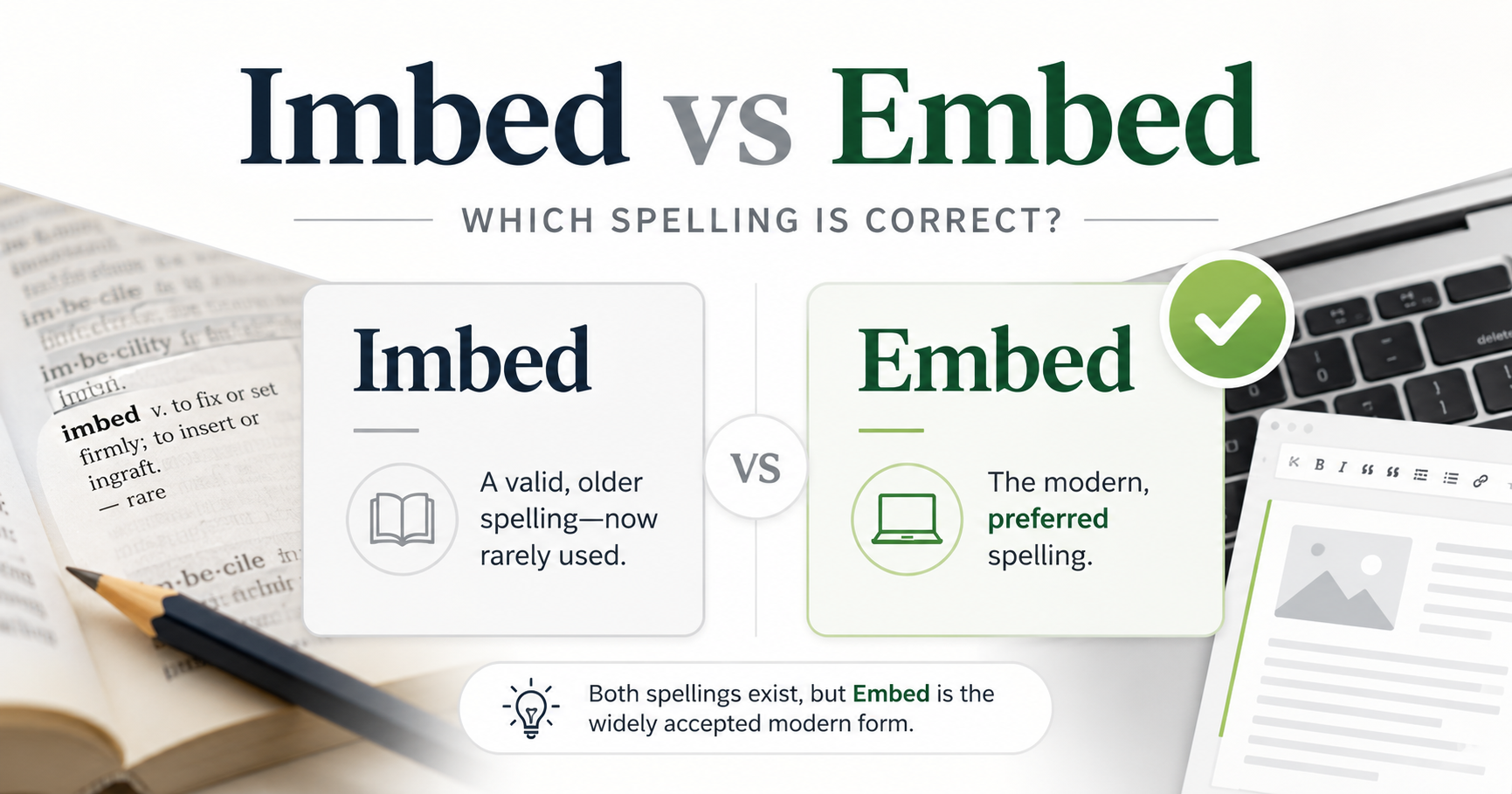
In Imbed vs Embed, both spellings are correct, but embed is the preferred form in modern English because readers recognize it faster and more easily.
Imbed remains an accepted variant with the same meaning, pronunciation, and grammar. However, most dictionaries, editors, and writing standards favor embed in academic writing, business writing, and professional writing. This simple spelling choice improves clarity, meets reader expectation, and prevents needless confusion for students and professionals.
Use embed for physical embedding, such as fossils embedded in stone. It also fits digital embedding, including an embedded video, website content, or other embedded content. In journalism, an embedded journalist travels with soldiers during military reporting. Your spell checker may flag imbed, but that does not make it wrong. The practical rule is simple: choose embed for modern usage, and keep imbed only when quoting an older source or following a required style.
Quick Answer: Which Spelling Should You Use?
Use embed in almost every modern context.
Imbed is a recognized alternative spelling with the same meaning and pronunciation. Still, it appears much less often. Because most readers expect embed, that spelling works better in professional, academic, technical, and general writing.
Here’s the simplest rule:
When you’re unsure, choose “embed.”
You should also use the related forms:
- Embedded
- Embedding
- Embeds
Although imbedded, imbedding, and imbeds are possible, they may look dated or incorrect to readers who don’t know the variant.
Read this also: Whose vs Who’s: The Simple Difference, Grammar Rules, and Correct Examples
Quick Comparison Table
| Feature | Embed | Imbed |
| Is it a real word? | Yes | Yes |
| Is it grammatically correct? | Yes | Yes |
| Meaning | To place, fix, or incorporate firmly | The same as embed |
| Pronunciation | im-BED | im-BED |
| Modern frequency | Very common | Uncommon |
| Formal writing | Preferred | Accepted but rarely preferred |
| Academic writing | Standard choice | Usually avoided |
| Technology usage | Standard | Extremely rare |
| Past tense | Embedded | Imbedded |
| Present participle | Embedding | Imbedding |
| Best choice for most writers | Yes | Usually no |
The important point is simple. These words don’t describe different actions. They represent two spellings of the same verb.
Are Embed and Imbed the Same Word?
Yes. Embed and imbed have the same definitions, grammatical roles, and pronunciation.
Both can describe placing something firmly inside a physical material.
- The worker embedded the metal posts in concrete.
- The worker imbedded the metal posts in concrete.
Both sentences are grammatically correct. However, the first sentence looks more natural to most modern readers.
The words can also describe ideas, values, habits, or feelings that become deeply established.
- The coach embedded discipline into the team’s culture.
- The coach imbedded discipline into the team’s culture.
Again, the meaning doesn’t change.
You can even use both spellings in technical settings. Still, embed dominates technology-related language.
- Embed a video on the page.
- Imbed a video on the page.
The second sentence remains understandable, but it looks strange in modern technical writing.
What Does Embed Mean?
Embed is a verb that means to place, fix, or incorporate something firmly within another object, material, system, or idea.
The word often suggests more than simple placement. An embedded object usually becomes closely connected to its surroundings.
For example, placing a coin on wet cement doesn’t necessarily embed it. Pressing the coin into the cement until it becomes partly enclosed does.
That sense of firm integration explains why the word works in so many contexts.
You can embed:
- A stone in a wall
- A splinter in your finger
- A video in a webpage
- A chart in a presentation
- A reporter within a military unit
- An idea in someone’s memory
- A value in an organization’s culture
- A safety process in daily operations
In every case, something becomes firmly situated within something larger.
The Literal Meaning of Embed
In its literal sense, embed describes an object fixed inside a surrounding material.
This meaning often appears in construction, medicine, art, manufacturing, and everyday conversation.
Physical examples
- Small shells were embedded in the surface of the table.
- The surgeon removed a fragment embedded near the bone.
- Workers embedded steel rods in the concrete foundation.
- Tiny fossils remained embedded in the rock.
- The jeweler embedded diamonds around the edge of the ring.
Each sentence describes physical contact. The object doesn’t merely rest on the surface. It sits partly or completely inside another material.
Embed compared with place
The verb place has a broad meaning.
You can place a cup on a desk without attaching it. However, when you embed an object, you usually fix it firmly or surround part of it.
Compare these sentences:
- She placed the tile on the wet cement.
- She embedded the tile in the wet cement.
The first sentence describes location. The second suggests that she pressed the tile into the cement so it would remain secure.
Read this also: Canon vs Cannon: Meaning, Differences, Examples, and Correct Usage
The Figurative Meaning of Embed
Writers also use embed when something becomes deeply established in a person, group, organization, or system.
Nothing physically enters a material. Instead, an idea, behavior, or quality becomes difficult to separate from its surroundings.
Figurative examples
- Respect should be embedded in every workplace policy.
- The childhood memory remained embedded in his mind.
- These traditions are deeply embedded in the local culture.
- The company embedded customer safety into its training program.
- Years of repetition embedded the habit in her daily routine.
This figurative use often suggests permanence.
A temporary idea may cross your mind. An embedded idea stays with you.
Likewise, a company may mention honesty in a document. However, honesty becomes embedded in its culture only when employees practice it consistently.
What Does Imbed Mean?
Imbed means exactly the same thing as embed.
It can refer to physically fixing an object in a material, incorporating content into a digital platform, or firmly establishing an idea.
Examples include:
- The artist imbedded glass fragments in the sculpture.
- The experience became imbedded in her memory.
- The editor imbedded the image in the document.
These sentences are valid. Still, most editors would replace imbed with embed because the latter spelling feels more familiar.
Is Imbed a Real Word?
Yes, imbed is a real word.
It isn’t a typing error, invented spelling, or nonstandard pronunciation. English dictionaries recognize it as a variant of embed.
However, dictionary recognition doesn’t mean two spellings enjoy equal popularity.
Consider the difference between these labels:
| Label | Meaning |
| Incorrect | Standard English doesn’t recognize the form |
| Obsolete | The form appeared historically but has largely disappeared |
| Regional | The form belongs mainly to one location or dialect |
| Variant | The form is an accepted alternative spelling |
| Less common | The form remains valid but appears infrequently |
Imbed falls into the final two categories. It’s an accepted variant, but it’s much less common.
That distinction matters.
Calling imbed wrong would be inaccurate. Yet recommending it as the best spelling for modern writing would also mislead readers.
Why Do Both Spellings Exist?
English spelling developed through centuries of borrowing, pronunciation changes, printing habits, and editorial preferences. As a result, some words have more than one accepted form.
The base word bed helps explain the meaning. To embed something is, in a sense, to set it into a surrounding “bed” or supporting material.
The prefix spelling changed over time. English uses both em- and im- forms in words connected with placement, enclosure, or movement into a state.
However, modern usage settled more strongly around embed.
That’s why related expressions usually appear with the em- spelling:
- Embedded system
- Embedded content
- Embedded journalist
- Embedded software
- Embedded image
- Embedded value
The alternative forms haven’t vanished. They’ve simply moved to the edge of everyday usage.
Why Is Embed More Common?
Several practical forces have strengthened the spelling embed.
Readers recognize it instantly
Familiar spelling improves reading speed.
When people see embed, they usually understand it without hesitation. When they see imbed, they may pause and wonder whether the writer made a mistake.
Even a correct word can weaken a sentence if it distracts the audience.
Editors prefer consistency
Publishers, companies, schools, and news organizations often follow style rules. These rules help writers use the same spelling throughout a document.
Because embed already dominates modern English, editors usually standardize that form.
Consistency creates a polished result.
For example, this sentence looks awkward:
- We imbed each image before checking the embedded files.
The writer shifts between two acceptable variants. However, the mixed spelling feels careless.
A cleaner version reads:
- We embed each image before checking the embedded files.
Technology reinforced the standard spelling
Digital language uses embed constantly.
People embed videos, maps, social media posts, forms, audio files, fonts, and images. Developers also work with embedded content, embedded systems, and embedded software.
As these phrases became common, they strengthened public familiarity with the em- spelling.
Technology didn’t create the word. It simply made one existing spelling much more visible.
International readers expect embed
Writers often publish for audiences across several countries.
Because embed appears widely in both American and British English, it creates less confusion. That makes it a practical choice for websites, software, educational resources, and global business documents.
Embed in Technology and Digital Media
In digital contexts, embed means to integrate one piece of content into another platform, document, page, or file.
You might embed:
- A video in a blog post
- A map on a contact page
- A chart in a presentation
- A font in a document
- An audio player on a website
- A social media post in an article
- An image in an email
- Metadata in a file
However, embedding doesn’t always mean the same thing technically.
Sometimes, the content becomes part of the host file. For example, a font may become stored inside a document.
In other cases, the host page displays content from an outside source. An embedded video may still remain on the video platform’s server.
Therefore, “embedded” usually describes the user experience or integration method. It doesn’t always mean that the host stores a complete copy.
Embedded content compared with linked content
Writers sometimes confuse embedded and linked content.
| Embedded Content | Linked Content |
| Appears directly within the host page or document | Opens or points to another location |
| Feels integrated into the main content | Remains visibly separate |
| May load from an external source | Usually requires the user to follow a link |
| Can improve convenience | Can keep files smaller or easier to update |
For example, an embedded video appears inside an article. A linked video requires the reader to open another page.
Embed in Journalism
The word embedded has a specific meaning in journalism.
An embedded journalist works from within a military unit, expedition, political campaign, organization, or other active group. The arrangement gives the reporter close access to events and participants.
For example:
- The newspaper embedded a correspondent with the rescue team.
The reporter becomes part of the group’s working environment, at least temporarily.
This access can produce detailed reporting. However, it may also create ethical challenges. Close contact can shape a reporter’s perspective, emotional involvement, or dependence on the host organization.
Therefore, responsible journalists still verify claims and maintain professional independence.
Embed in Science and Medicine
Scientists may embed a specimen in a supporting substance before examining or cutting it.
For instance, laboratory workers may place tissue in wax or resin. The material supports the specimen and helps preserve its structure during preparation.
Medical writing also uses embedded to describe foreign objects.
Examples include:
- A fragment embedded in soft tissue
- A tooth embedded in the jaw
- Debris embedded beneath the skin
- A medical device embedded in surrounding tissue
In each case, the word communicates firm placement within a physical structure.
Embed or Imbed in American English
American English recognizes both spellings.
However, embed remains the clearer and more familiar choice. You’ll see it far more often in American newspapers, textbooks, business documents, websites, and technical guides.
Some dictionaries identify imbed mainly as an American variant. That label doesn’t mean Americans generally prefer it.
Instead, it indicates that the alternative spelling has maintained some presence in American usage.
For practical writing, choose embed.
Embed or Imbed in British English
British English strongly favors embed.
Although readers may understand imbed, the spelling can look especially unusual in British publications. Writers addressing British or international audiences should use embed, embedded, and embedding.
This spelling avoids regional friction and matches established modern usage.
Embedded vs. Imbedded
Embedded is the past tense and past participle of embed.
Imbedded is the corresponding form of imbed.
Both are correct.
- The nail was embedded in the wood.
- The nail was imbedded in the wood.
Yet embedded appears much more frequently and looks more natural.
When to use embedded
Use embedded when something:
- Became fixed inside a material
- Was incorporated into a system
- Became deeply established
- Was placed within a group
- Was integrated into digital content
Examples:
- The gemstone was embedded in silver.
- Privacy controls are embedded in the software.
- The belief became embedded in the community.
- An embedded reporter traveled with the unit.
- The document contains embedded images.
Why does embedded have two d’s?
The final consonant doubles before adding -ed.
The base verb ends with a stressed syllable containing a short vowel followed by one consonant: em-BED.
Therefore:
- Embed + ed = embedded
- Embed + ing = embedding
The same rule applies to the variant:
- Imbed + ed = imbedded
- Imbed + ing = imbedding
Common misspellings include:
- Embeded
- Embeding
- Imbeded
- Imbeding
These forms are incorrect.
Embedding vs. Imbedding
Embedding is the present participle and gerund form of embed.
Examples:
- The designer is embedding a video in the article.
- Embedding safety checks can reduce preventable errors.
- The artist enjoys embedding stones in handmade furniture.
- The software supports font embedding.
Imbedding has the same grammatical function, but it appears much less often.
Unless you have a specific reason to use the variant, choose embedding.
Correct Word Forms
| Grammatical Function | Preferred Form | Less Common Variant |
| Base verb | Embed | Imbed |
| Third-person singular | Embeds | Imbeds |
| Simple past | Embedded | Imbedded |
| Past participle | Embedded | Imbedded |
| Present participle | Embedding | Imbedding |
| Adjective | Embedded | Imbedded |
Here are the preferred forms in sentences:
- She embeds a chart in every monthly report.
- The team embedded the file yesterday.
- We have embedded the new process across all departments.
- They’re embedding accessibility into the design.
- The device uses embedded software.
How to Pronounce Embed and Imbed
Both words have the same pronunciation:
im-BED
The stress falls on the second syllable.
The phonetic form is commonly written as:
/ɪmˈbed/
Don’t strongly pronounce the first syllable as “EM.” In normal speech, both spellings sound nearly identical.
Because listeners can’t hear the spelling difference, the distinction matters only in writing.
Embed in a Sentence
The word works in physical, figurative, professional, scientific, and digital contexts.
Physical examples
- Builders embedded the support beams in concrete.
- A tiny piece of glass remained embedded in the tire.
- The artist embedded colored stones in the plaster.
- Roots embedded themselves deep in the riverbank.
- The technician found a wire embedded in the insulation.
Figurative examples
- The experience embedded a lasting fear in his mind.
- Cooperation became embedded in the team’s culture.
- The teacher embedded critical thinking into each lesson.
- These values remain deeply embedded in the community.
- Years of repetition embedded the routine in her memory.
Technology examples
- The editor embedded the video in the article.
- The file contains an embedded font.
- You can embed the map on your contact page.
- The presentation includes an embedded audio clip.
- The platform allows users to embed public posts.
Professional examples
- Managers embedded quality checks into the production process.
- The school embedded digital safety in its curriculum.
- The organization embedded transparency into its reporting system.
- The policy embeds accountability at every level.
- The new workflow has security controls embedded throughout.
Imbed in a Sentence
Although the spelling is uncommon, these sentences remain grammatically correct:
- The mason imbedded decorative tiles in the wall.
- The event became imbedded in the town’s collective memory.
- The scientist imbedded the specimen in resin.
- The writer imbedded several historical references in the story.
- The company imbedded safety checks in its review process.
Replacing imbed with embed wouldn’t change any meaning.
However, an editor would probably recommend the standard spelling.
Side-by-Side Examples
| Less Common Form | Preferred Modern Form |
| Imbed the post in concrete. | Embed the post in concrete. |
| The stone was imbedded in the wall. | The stone was embedded in the wall. |
| She is imbedding beads in the fabric. | She is embedding beads in the fabric. |
| The idea became imbedded in his mind. | The idea became embedded in his mind. |
| Imbed the video in the page. | Embed the video in the page. |
| The file contains imbedded images. | The file contains embedded images. |
The sentences in the right column aren’t more grammatical. They simply follow the dominant spelling that modern readers expect.
Key Differences at a Glance
The two forms share a meaning, but their usage differs.
Frequency
Embed is common. Imbed is rare.
Reader expectation
Most readers recognize embed immediately. Some may mistake imbed for an error.
Professional suitability
Both forms are valid, but embed looks more polished and conventional in formal documents.
Technical usage
Technology overwhelmingly favors embed, embedded, and embedding.
Regional reach
Embed works naturally in American, British, and international English.
Meaning
There is no meaningful difference.
Real-Life Case Studies
Practical examples show why spelling choice matters.
Case study: A software company
A software company creates instructions explaining how customers can add videos to their websites.
The first draft says:
“Imbed the video in your homepage.”
The sentence is technically valid. However, customers search for phrases such as “embed a video” and “embedded content.”
The company changes the wording:
“Embed the video on your homepage.”
The revised sentence matches familiar technical language. It also reduces the chance that users will think the documentation contains a spelling mistake.
Case study: An academic paper
A student writes:
“The belief remained imbedded in the region’s political culture.”
The professor understands the sentence but marks imbedded as unusual. The student changes it to:
“The belief remained embedded in the region’s political culture.”
The revision doesn’t alter the argument. It simply follows the form academic readers expect.
Case study: A historical quotation
An editor finds imbedded in a nineteenth-century letter.
Changing the spelling could misrepresent the original text. Therefore, the editor keeps the author’s wording inside the quotation.
Outside the quotation, the editor uses embedded.
This approach preserves historical accuracy while maintaining consistency in the surrounding commentary.
Common Phrases With Embed
The following expressions appear often in modern writing:
- Embed a video
- Embed an image
- Embed a map
- Embed a file
- Embed a link
- Embed a chart
- Embed a font
- Embed data
- Embed a message
- Embed values
- Embed safety
- Embed a process
- Embedded content
- Embedded software
- Embedded system
- Embedded reporter
- Embedded image
- Deeply embedded
- Firmly embedded
Deeply embedded
This phrase usually describes something difficult to remove or change.
- The custom is deeply embedded in local culture.
- Bias can become deeply embedded in an organization’s procedures.
Embedded content
This phrase refers to media or information integrated into another page, file, or platform.
- The article contains embedded video content.
- Embedded charts make the report easier to understand.
Embedded system
An embedded system is a computer system designed to perform a specific function within a larger device.
Examples may include systems inside:
- Cars
- Medical devices
- Household appliances
- Industrial machines
- Security cameras
- Smart thermostats
The term always uses embedded in standard modern practice.
Synonyms for Embed
No single synonym works in every context.
The best alternative depends on what you’re describing.
Physical synonyms
- Insert
- Implant
- Inlay
- Lodge
- Fix
- Set
- Encase
- Bury
Examples:
- The surgeon removed the object lodged in the wound.
- The artist inlaid silver into the wooden box.
- Workers set the posts in concrete.
Figurative synonyms
- Instill
- Ingrain
- Root
- Establish
- Incorporate
- Integrate
- Internalize
Examples:
- Teachers aim to instill confidence in their students.
- The habit became ingrained over many years.
- The policy integrates safety into daily operations.
Digital synonyms
- Insert
- Add
- Include
- Integrate
- Incorporate
Still, these words aren’t always exact replacements.
For example, you may insert an image into a document without fully embedding it. The image could remain linked to an outside file.
Therefore, choose the synonym that matches the technical action.
Read this also: Unkept vs Unkempt: Meaning, Differences, and Examples
Antonyms for Embed
Possible opposites include:
- Remove
- Extract
- Dislodge
- Detach
- Separate
- Exclude
- Unroot
Context determines the best antonym.
Compare:
- Workers embedded the post in concrete.
- Workers extracted the post from the concrete.
Or:
- The team embedded the feature in the software.
- The team removed the feature from the software.
Related Words and Their Meanings
Several related words can help you understand the central idea.
Insert
To place something into another thing.
Insert doesn’t always suggest permanent attachment.
Implant
To place something deeply or securely, often inside a body or mind.
- Implant a medical device
- Implant an idea
Inlay
To decorate a surface by setting another material into it.
- Inlay wood with metal
- An inlaid table
Integrate
To combine one part with a larger whole.
Integration focuses on cooperation or unity rather than physical depth.
Ingrain
To establish an idea or habit so firmly that it becomes difficult to change.
- Ingrained behavior
- A deeply ingrained belief
Encase
To surround or cover something completely.
An object can be encased without being embedded. Likewise, it can be embedded without being fully encased.
Common Mistakes Writers Make
Assuming the spellings have different meanings
Some writers believe embed belongs to technology while imbed describes physical placement.
That distinction doesn’t exist.
Both spellings can express physical, figurative, scientific, and digital meanings.
Calling imbed incorrect
Imbed is uncommon, but it isn’t automatically wrong.
A better explanation is:
“Imbed is a valid but less common variant of embed.”
That wording remains accurate without encouraging an unusual choice.
Mixing the two spelling systems
Avoid changing from one version to another within the same document.
Inconsistent:
- The platform imbeds the file and checks the embedded data.
Consistent:
- The platform embeds the file and checks the embedded data.
Writing embeded
The correct form contains two d’s:
- Incorrect: embeded
- Correct: embedded
Writing embeding
The correct present participle also contains two d’s:
- Incorrect: embeding
- Correct: embedding
Using imbed in technical documentation
Readers expect established technical terminology.
Write:
- Embedded software
- Embedded content
- Embed code
- Embedding process
Using the im- spelling creates unnecessary friction.
Confusing embed with attach
An attachment usually remains a separate file connected to a message or document.
Embedded content appears within the main content itself.
For example:
- An attached image appears as a separate email file.
- An embedded image appears inside the email body.
Grammar Tips for Using Embed
Embed usually takes an object
Embed commonly functions as a transitive verb. That means it acts on something.
- The artist embedded stones in the wall.
- The editor embedded a video in the article.
- The company embedded safety checks in the process.
Use embed in or embed into
Both embed in and embed into occur in standard English.
Use in when focusing on position:
- The nail was embedded in the wood.
- The values are embedded in the culture.
Use into when emphasizing movement or insertion:
- She embedded the stones into the wet plaster.
- The company embedded security into the new workflow.
In many sentences, either preposition works.
Use embedded as an adjective
Embedded can describe a noun.
- Embedded software
- Embedded content
- Embedded journalist
- Embedded image
- Embedded value
Avoid unnecessary repetition
A sentence such as “The embedded image was embedded in the file” sounds clumsy.
Revise it:
- The image was stored within the file.
- The file contains an embedded image.
Easy Memory Tricks
The easiest memory trick comes from technology.
Think of the phrase:
Embed a video.
Most people have seen this wording online. Once you remember embed a video, you can apply the same spelling to other situations.
- Embed a stone
- Embed an idea
- Embed a process
- Embed a journalist
Another trick involves the related forms:
Embed, embedded, embedding.
Keep the same beginning in all three words. Then remember to double the final d before adding -ed or -ing.
Which Spelling Should You Use in Formal Writing?
Choose embed.
It works best in:
- Academic essays
- Research papers
- Business reports
- Marketing content
- News articles
- Technical manuals
- Legal documents
- Educational materials
- Website copy
- Job applications
- International communication
You might use imbed when:
- Quoting an original source
- Following a specific publication’s house style
- Preserving historical spelling
- Discussing the word itself
- Deliberately choosing the variant for stylistic reasons
Outside those situations, embed gives you a cleaner and safer option.
Frequently Asked Questions
Q.1 Is “imbed” a real word?
Yes. Imbed is a valid spelling and has the same meaning as embed. However, it appears far less often in modern writing.
Q.2 Which spelling is correct: imbed or embed?
Both spellings are correct. Still, embed is the preferred choice in academic, professional, business, and technical writing.
Q.3 Do “imbed” and “embed” have different meanings?
No. They share the same meaning, pronunciation, and grammar. Both can describe placing something firmly inside an object, system, idea, or group.
Q.4 Should I use “embedded” or “imbedded”?
Use embedded in most cases. Imbedded is acceptable, but many readers may see it as unusual or assume it is a spelling mistake.
Q.5 Why is “embed” more common?
Embed became the standard form because editors, dictionaries, publishers, and technology platforms use it more often. Familiar phrases such as embedded video, embedded content, and embedded system have also strengthened its popularity.
Conclusion
The Imbed vs Embed question has a simple answer. Both words are correct, and both carry the same meaning. However, embed is the clearer, more familiar, and more widely accepted spelling in modern English.
Use embed, embedded, and embedding in everyday, academic, business, and technical writing. Choose imbed only when preserving an original quotation, following a required style, or deliberately using the less common variant. When in doubt, embed is the safest choice.