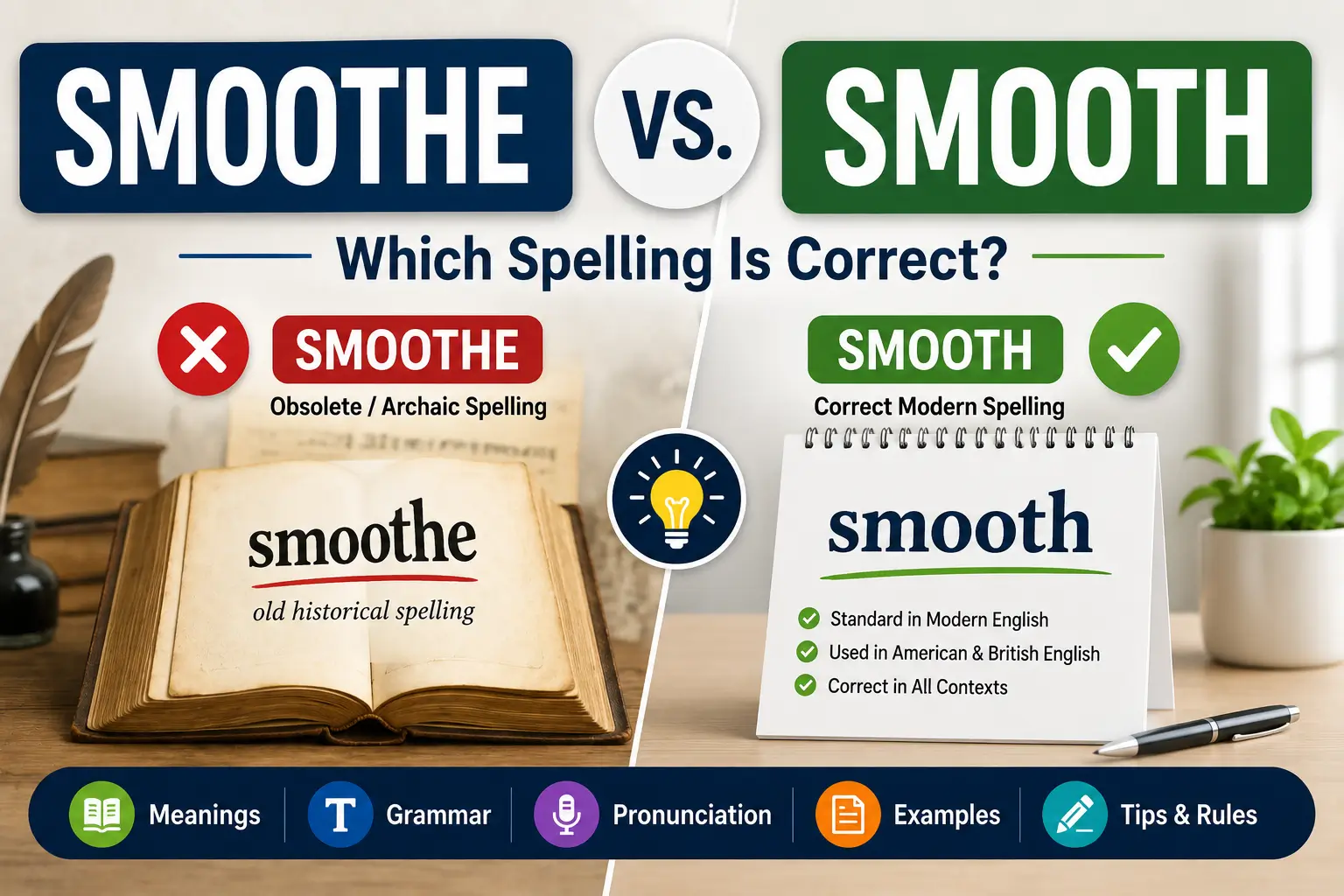
Smoothe vs smooth is a spelling question with a simple answer: use smooth in modern English. Smooth is the accepted spelling in both American English and British English, while smoothe is an obsolete variant that should normally be avoided.
The word smooth can work as an adjective or a verb. It may describe an even surface, a soft texture, or an action completed without difficulty. As a verb, it means making something flat, even, or less difficult.
People often write smoothe because it resembles soothe, which ends with a silent “e.” However, these words follow different spelling patterns. This guide explains their meanings, grammar, pronunciation, word forms, and correct usage through clear examples.
Quick Answer: Is It Smooth or Smoothe?
Use “smooth.”
| Word | Correct in Modern English? | Recommended? |
| Smooth | ✅ Yes | ✅ Always |
| Smoothe | Rare historical spelling | ❌ No |
If you’re writing in American English, British English, academic writing, journalism, or professional communication, smooth is the accepted spelling.
What’s the Difference Between Smooth and Smoothe?
Although these two spellings appear similar, they are not equally accepted today.
The biggest difference is simple:
- Smooth is the modern English spelling.
- Smoothe is an old spelling that has disappeared from everyday English.
Most dictionaries list smooth as the standard form. Meanwhile, smoothe is usually labeled as obsolete, archaic, or a historical variant.
That means modern writers should almost never use smoothe.
Smooth Is the Standard Modern Spelling
The word smooth has been part of English for centuries. Today, it appears in:
- newspapers
- books
- business writing
- emails
- websites
- academic papers
- advertising
- everyday conversation
It functions as both an adjective and a verb.
Examples:
- The road is smooth.
- She gave a smooth presentation.
- Please smooth the paper before printing it.
- He handled the situation smoothly.
Every one of these examples follows standard modern English.
Smoothe Is an Obsolete Variant
The spelling smoothe appeared in older forms of English hundreds of years ago.
Before spelling became standardized, English words often had several accepted spellings. Printers and writers frequently spelled words differently because there were no official dictionaries.
Eventually, smooth became the accepted spelling.
Today, smoothe survives mostly in:
- historical documents
- linguistic discussions
- very old literature
- dictionary entries explaining obsolete spellings
Outside these contexts, using smoothe will usually be considered a spelling mistake.
What Does Smooth Mean?
The word smooth has several closely related meanings. In every case, it suggests the absence of roughness, difficulty, or interruption.
Smooth as an Adjective
As an adjective, smooth describes something that is:
- even
- flat
- polished
- flowing easily
- free of problems
Examples
- The table has a smooth surface.
- She has smooth skin.
- Traffic was surprisingly smooth this morning.
- The negotiation was smooth and successful.
- He has a smooth speaking voice.
Notice that the meaning changes slightly depending on the context, but the idea of “without roughness” stays the same.
Smooth as a Verb
As a verb, smooth means to make something even, flat, neat, or less rough.
Examples:
- She smoothed the blanket.
- He smoothed his hair before the meeting.
- They smoothed the concrete.
- The manager tried to smooth the disagreement.
This verb is common in both literal and figurative language.
Common Expressions with Smooth
English contains many popular expressions using smooth.
| Expression | Meaning |
| smooth ride | easy experience |
| smooth transition | easy change |
| smooth operator | someone socially skilled |
| smooth sailing | no problems |
| smooth over | reduce conflict |
| smooth talker | persuasive speaker |
Examples:
- The software update went smoothly.
- We had a smooth transition into the new office.
- She managed to smooth over the disagreement.
These expressions appear frequently in American English.
Why Do People Misspell Smooth as Smoothe?
Several factors cause this confusion.
Silent “-e” Patterns
Many English words end with a silent e.
For example:
- breathe
- bathe
- soothe
- clothe
Because of these patterns, some writers mistakenly assume smooth should also end with an e.
However, English spelling isn’t always predictable.
Pronunciation Confusion
The pronunciation of smooth ends with the th sound.
Some people incorrectly believe adding an e matches the pronunciation.
It doesn’t.
The correct spelling has never required a silent e in modern English.
Typing Habits
Fast typing often causes people to add letters automatically.
Since many verbs end with -e, the fingers naturally produce smoothe.
Fortunately, most spell-checkers identify this mistake immediately.
Is Smoothe Ever Correct?
Technically, yes—but only in historical contexts.
You may encounter smoothe when reading:
- medieval writings
- old religious texts
- historical dictionaries
- early printed books
- discussions of language history
For modern writing, however, smooth is always the correct choice.
Unless you’re quoting an original historical source, avoid using smoothe.
Smooth vs. Smoothen: Are They the Same?
Another word that creates confusion is smoothen.
Unlike smoothe, smoothen is actually a real English word.
However, it is much less common.
What Does Smoothen Mean?
Smoothen means to become smooth or to make something smoother.
Examples:
- The lotion helps smoothen dry skin.
- Heat can smoothen wrinkles in fabric.
Although grammatically correct, most American speakers simply use smooth instead.
When Should You Use Smooth Instead of Smoothen?
In modern American English, smooth sounds more natural.
Compare these examples.
Less natural:
- We need to smoothen the process.
More natural:
- We need to smooth the process.
Less natural:
- The cream will smoothen your skin.
More natural:
- The cream will smooth your skin.
Professional writing generally favors smooth because it is shorter and more widely used.
Smooth vs. Smoothe Comparison Table
| Feature | Smooth | Smoothe |
| Modern spelling | ✅ Yes | ❌ No |
| American English | ✅ Standard | ❌ Obsolete |
| British English | ✅ Standard | ❌ Obsolete |
| Found in dictionaries | ✅ Yes | Historical entry only |
| Used in business writing | ✅ Yes | ❌ No |
| Used in schools | ✅ Yes | ❌ No |
| Accepted in academic writing | ✅ Yes | ❌ No |
| Recommended today | ✅ Absolutely | ❌ Avoid |
Examples of Smooth Used Correctly
Seeing the word in context makes it much easier to remember.
Everyday Conversation
- Your skin feels smooth.
- That was a smooth landing.
- The sauce has a smooth texture.
- Everything went smoothly today.
Business and Workplace
- The meeting was smooth and productive.
- We need a smooth transition between teams.
- The software installation was smooth.
- She gave a smooth presentation.
Academic Writing
- The graph displays a smooth curve.
- Researchers observed a smooth increase in temperature.
- The transition between paragraphs is smooth.
Emails and Professional Communication
- Thank you for making the onboarding process smooth.
- We appreciate your smooth coordination throughout the project.
- The event ran smoothly because of careful planning.
Social Media and Text Messages
- That game runs smooth now.
- The update was super smooth.
- Nice editing—it looks really smooth.
Common Mistakes to Avoid
Many writers repeat the same errors.
Here are the most common ones.
Mistake 1: Adding an Extra “E”
❌ The floor is smoothe.
✅ The floor is smooth.
Why?
Modern English uses smooth.
Mistake 2: Thinking “Smoothe” Is More Formal
Some people believe longer spellings sound more educated.
They don’t.
Professional editors will usually correct smoothe to smooth.
Mistake 3: Confusing Smooth and Smoothen
Although smoothen exists, it is much less common.
Whenever possible, use smooth instead.
Mistake 4: Using Historical Spellings
Old spellings belong in historical quotations—not modern writing.
Grammar Notes About Smooth
Understanding the grammar behind the word makes it easier to use correctly.
Part of Speech
Smooth can function as:
Adjective
- smooth glass
- smooth paper
Verb
- smooth the sheets
- smooth your hair
Adverb Form
- smoothly
Noun Form
- smoothness
Pronunciation
Smooth
IPA (American English):
/smuːð/
The final sound is the voiced th, like in:
- this
- breathe
- father
There is no silent final e in the spelling.
Word Forms
| Form | Example |
| smooth | smooth road |
| smoother | smoother finish |
| smoothest | smoothest fabric |
| smoothly | runs smoothly |
| smoothness | smoothness of silk |
| smoothed | she smoothed the blanket |
| smoothing | smoothing wrinkles |
How Dictionaries Treat Smoothe
Modern dictionaries consistently recognize smooth as the standard spelling.
Meanwhile, smoothe receives one of these labels:
- obsolete
- archaic
- historical spelling
- variant spelling
This reflects centuries of spelling standardization.
If you’re writing for publication, school, or work, editors expect smooth, not smoothe.
Why Modern English Dropped the Spelling Smoothe
English spelling was far less consistent before dictionaries became widely available.
Several centuries ago, writers often spelled the same word differently.
For example, one author might write one version while another used a different spelling.
As dictionaries became authoritative, standard spellings emerged.
Smooth became the accepted form because publishers, educators, and dictionaries consistently adopted it.
Today, spelling consistency improves:
- readability
- communication
- education
- digital search
- professional writing
That’s why obsolete spellings like smoothe largely disappeared.
Quick Tips to Remember the Correct Spelling
Use these simple memory tricks.
- Smooth has no extra “e.”
- Think of smooth road, not smoothe road.
- Spell-check almost always changes smoothe.
- Every major dictionary recommends smooth.
- If you’re unsure, remove the final e.
A helpful reminder:
If it looks smoother with an extra “e,” it’s actually incorrect.
Synonyms of Smooth
Depending on the context, these words may work as alternatives.
For Surfaces
- even
- polished
- sleek
- silky
- glossy
- flat
For Processes
- seamless
- effortless
- efficient
- uninterrupted
- streamlined
For Speech
- fluent
- polished
- persuasive
- refined
Choose the synonym that best matches your intended meaning.
Related Words
These words come from the same word family.
| Word | Part of Speech |
| smooth | adjective, verb |
| smoothly | adverb |
| smoothness | noun |
| smoother | adjective |
| smoothest | adjective |
| smoothing | verb |
Learning related forms expands your vocabulary and helps you write more naturally.
Frequently Asked Questions
1. Is it smoothe or smooth?
Smooth is the correct spelling in modern English. Avoid smoothe in everyday, academic, and professional writing.
2. Is smoothe a real word?
Smoothe existed as an obsolete or historical spelling. However, it is not accepted as the standard form today.
3. What does smooth mean?
Smooth can mean even, flat, polished, or free from problems. It may describe a surface, texture, process, movement, or experience.
4. Can smooth function as a verb?
Yes. As a verb, smooth means to make something flatter, neater, calmer, or easier.
Example: She smoothed the blanket before sitting down.
5. Can smooth function as an adjective?
Yes. As an adjective, smooth describes something without rough areas, sudden changes, or difficulties.
Example: The table has a smooth surface.
6. Why do people spell smooth as smoothe?
The mistake often comes from words such as soothe and breathe. Writers may wrongly assume that smooth also needs a silent e.
7. Is smooth correct in British English?
Yes. Smooth is the standard spelling in both British English and American English.
8. Is smoothen a correct word?
Yes, smoothen is grammatically correct, but it is less common. In most sentences, smooth sounds shorter and more natural.
9. What are the word forms of smooth?
Common forms include smooth, smoother, smoothest, smoothly, smoothness, smoothed, and smoothing.
10. How can I remember the correct spelling?
Remember this simple rule: smooth has no final e. If you are writing in modern English, always choose smooth, not smoothe.
Conclusion
The difference between smoothe and smooth is easy to remember. Smooth is the correct spelling for modern communication, including schoolwork, emails, articles, and professional documents.
You can use smooth as an adjective to describe something even, polished, or trouble-free. You can also use it as a verb when someone makes a surface flatter or a situation easier.
Although smoothe appears in some historical texts, modern readers and editors generally consider it incorrect. Unless you are quoting an old source, choose smooth every time.