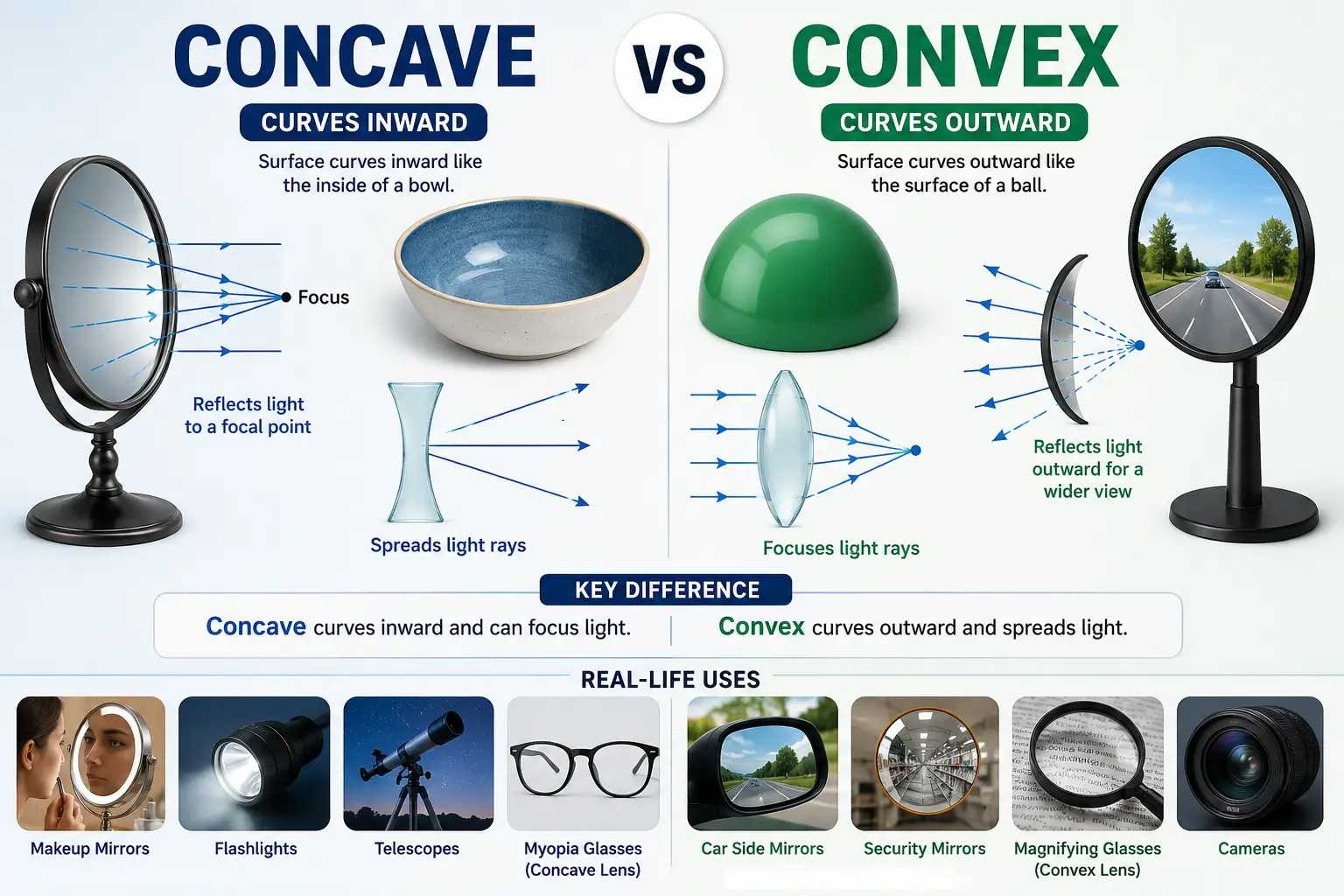
Concave vs convex becomes easy to understand when you look at the direction of a curve. Concave means curved inward, like the inside of a bowl. Convex means curved outward, like the surface of a ball.
This difference also explains how mirrors and lenses control light rays. A concave mirror can focus light and magnify nearby objects, while a convex mirror provides a wider field of view.
Similarly, a concave lens spreads light apart, whereas a convex lens brings light together. This guide explains their meanings, differences, common uses, and simple memory tricks through clear everyday examples.
Concave vs. Convex: Quick Answer
The simplest difference is:
- Concave means a surface curves inward.
- Convex means a surface curves outward.
A quick memory trick:
Concave = like a cave (goes inward).
Convex = like a ball (bulges outward).
Here is a quick comparison:
| Feature | Concave | Convex |
| Curve direction | Curves inward | Curves outward |
| Appearance | Hollow, sunken, or dipped | Rounded, raised, or bulging |
| Example object | Inside of a spoon | Outside of a spoon |
| Common uses | Concave mirrors, certain lenses | Convex mirrors, magnifying lenses |
| Main idea | Goes inward | Comes outward |
What Do Concave and Convex Mean?
The words concave and convex are adjectives used to describe the shape or surface of an object.
They do not describe whether something is large, small, thick, or thin. Instead, they describe the direction of the curve.
A curved object can be:
- Concave if the curve bends inward
- Convex if the curve bends outward
The same object can even have both types of curves.
For example, a spoon has two different surfaces:
- The inside of the spoon is concave because it dips inward.
- The back of the spoon is convex because it curves outward.
What Does Concave Mean?
Concave Definition
Concave means curved inward toward the center of a surface.
A concave shape creates a space that looks like it has been pushed inside or scooped out.
The word is often used to describe:
- Mirrors
- Lenses
- Shapes in geometry
- Body structures
- Physical objects
A helpful way to visualize concave is to imagine a cave entrance. A cave goes inward into the ground, just like a concave surface curves inward.
Examples of Concave Shapes
Common examples of concave objects include:
The Inside of a Spoon
The bowl-shaped part of a spoon is concave because it creates a hollow space.
Example:
The inside surface of the spoon is concave because it curves inward.
A Bowl
A bowl has a concave interior because the center area is lower than the edges.
Example:
The soup sits inside the concave surface of the bowl.
A Concave Mirror
A concave mirror curves inward.
These mirrors are designed to reflect light toward a central point. They are commonly used in:
- Makeup mirrors
- Telescopes
- Flashlights
- Searchlights
Example:
A concave mirror can make nearby objects appear larger.
Certain Body Curves
Doctors may use the word concave when describing inward curves in the body.
Example:
The doctor examined the concave curve of the spine.
The term describes the direction of the curve, not whether the curve is healthy or unhealthy.
What Does Convex Mean?
Convex Definition
Convex means curved outward away from the center.
A convex surface looks raised, rounded, or bulging.
You can imagine a ball or the outside of a balloon. The surface pushes outward instead of sinking inward.
Convex shapes are common in:
- Mirrors
- Lenses
- Natural objects
- Architecture
- Product design
Examples of Convex Shapes
The Outside of a Spoon
The back of a spoon curves outward, making it convex.
Example:
The convex side of the spoon reflects a wider image.
A Ball
A ball is one of the easiest examples of a convex object.
Its surface extends outward in every direction.
Example:
A soccer ball has a convex outer surface.
A Dome
Buildings with rounded tops often have convex shapes.
Examples:
- Domes
- Rounded roofs
- Decorative structures
Example:
The building’s convex dome creates a smooth curved appearance.
A Convex Mirror
A convex mirror curves outward and reflects a wider area.
They are commonly used in:
- Vehicle side mirrors
- Security mirrors
- Parking garages
- Stores
Example:
Convex mirrors help drivers see more of the road around them.
Concave vs. Convex: Key Differences
Although both words describe curves, their meanings are opposite.
The biggest difference is the direction of the curve.
| Category | Concave | Convex |
| Direction | Inward curve | Outward curve |
| Shape appearance | Hollow or dipped | Rounded or raised |
| Center position | Lower than edges | Higher than edges |
| Example from a spoon | Inside surface | Outside surface |
| Light behavior | Can focus light | Can spread light |
| Common mirror use | Magnifying mirrors | Wide-view mirrors |
How to Tell If Something Is Concave or Convex
When you see a curved object, ask one simple question:
Does the surface go inward or outward?
If the surface goes inward:
✅ It is concave.
If the surface sticks outward:
✅ It is convex.
Look at the Center of the Curve
Another way to identify the difference is by checking the center.
Concave:
- The center appears lower.
- The surface looks hollow.
- It creates a depression.
Example:
A bowl holds water because the inside curves inward.
Convex:
- The center appears higher.
- The surface looks rounded.
- It creates a bulge.
Example:
A ball pushes outward from its center.
Concave vs. Convex Comparison Examples
| Object | Concave or Convex? | Reason |
| Inside of a spoon | Concave | The surface dips inward |
| Back of a spoon | Convex | The surface curves outward |
| Magnifying glass lens | Convex | It bulges outward and focuses light |
| Eyeglasses for nearsightedness | Concave | They spread light rays |
| Car side mirror | Convex | It provides a wider view |
| Cave opening | Concave | The space curves inward |
Why Concave and Convex Are Often Confused
Many people confuse these terms because they are closely related.
They Describe Similar Things
Both words talk about curved surfaces, so it is easy to mix them up.
However, the important difference is the direction:
- Concave → inward
- Convex → outward
The Same Object Can Have Both Shapes
A common reason for confusion is that one object may contain both types of curves.
For example:
A spoon:
- Inside = concave
- Outside = convex
Therefore, simply saying “a spoon is concave” or “a spoon is convex” is incomplete. You need to specify which side you mean.
They Are Mostly Used in Technical Fields
Many people first encounter these words in:
- Science classes
- Geometry lessons
- Physics
- Medical descriptions
Because they are less common in everyday conversation, people often forget their meanings.
Simple Rule to Remember Concave vs. Convex
Use this shortcut:
If it looks like a cave, it is concave. If it looks like a ball, it is convex.
The word concave contains the idea of a cavity, which is an empty space that goes inward.
The word convex reminds many learners of something that expands outward.
Concave and Convex in Mirrors and Lenses
The terms concave and convex are especially important in optics, the study of light and how it behaves. Mirrors and lenses use curved surfaces to change the direction of light rays.
The curve of a mirror or lens determines how it affects images. A surface that curves inward behaves differently from one that curves outward.
Concave vs. Convex Mirrors
A mirror’s shape affects how it reflects light and how objects appear.
The two main types are:
- Concave mirrors: curve inward
- Convex mirrors: curve outward
Both have practical uses, but they work in different ways.
What Is a Concave Mirror?
A concave mirror has a reflective surface that curves inward, similar to the inside of a spoon.
Because the surface bends inward, it reflects light rays toward a central point called the focus.
This ability to concentrate light makes concave mirrors useful in situations where a larger or brighter image is needed.
How Concave Mirrors Work
When light hits a concave mirror:
- Light rays reflect off the curved surface.
- The rays move toward each other.
- They meet at a focal point.
- The reflected image changes depending on the object’s distance.
If an object is close to a concave mirror, it may appear:
- Larger
- Upright
- Magnified
If it is farther away, the image may appear:
- Smaller
- Upside down
- Real
Common Uses of Concave Mirrors
Concave mirrors are used in many everyday tools.
Makeup and Shaving Mirrors
These mirrors magnify nearby objects.
Example:
A concave makeup mirror helps users see small details more clearly.
Vehicle Headlights and Flashlights
Concave mirrors help focus light into a stronger beam.
Example:
A flashlight uses a concave reflector to direct light forward.
Telescopes
Large telescopes often use concave mirrors to collect and focus light from distant objects.
Example:
A telescope’s concave mirror helps gather light from stars and planets.
What Is a Convex Mirror?
A convex mirror has a reflective surface that curves outward.
Unlike a concave mirror, a convex mirror spreads reflected light rays outward.
This creates a wider viewing area, which makes convex mirrors useful for safety and observation.
How Convex Mirrors Work
When light hits a convex mirror:
- Light reflects away from the center.
- The image appears smaller.
- More of the surrounding area becomes visible.
Convex mirrors usually create images that are:
- Upright
- Smaller than the actual object
- Virtual (not projected onto a surface)
Common Uses of Convex Mirrors
Car Side Mirrors
Many vehicle side mirrors are convex.
Example:
Objects in a convex car mirror appear smaller, but drivers can see a wider area.
This is why some mirrors include the warning:
“Objects in mirror are closer than they appear.”
Security Mirrors
Stores and parking garages often use convex mirrors.
They allow people to monitor a larger space with one mirror.
Road Safety Mirrors
Convex mirrors are placed at:
- Sharp corners
- Driveway exits
- Blind intersections
They help drivers see areas they normally could not view.
Concave Mirror vs. Convex Mirror Comparison
| Feature | Concave Mirror | Convex Mirror |
| Surface shape | Curves inward | Curves outward |
| Light behavior | Focuses light | Spreads light |
| Image size | Can enlarge objects | Makes objects appear smaller |
| Field of view | Narrower | Wider |
| Common use | Makeup mirrors, headlights, telescopes | Car mirrors, security mirrors |
| Image type | Can be real or virtual | Usually virtual |
Concave vs. Convex Lenses
Mirrors reflect light, but lenses allow light to pass through them.
The curve of a lens controls how light bends.
The two main types are:
- Concave lenses
- Convex lenses
What Is a Concave Lens?
A concave lens curves inward and is thinner in the middle than at the edges.
It causes light rays to spread apart. This process is called diverging light.
Because it spreads light, concave lenses are often used to correct vision problems.
Common Uses of Concave Lenses
Eyeglasses for Nearsightedness
People with nearsightedness (myopia) can see nearby objects clearly but may struggle with distant objects.
A concave lens helps by spreading light rays before they enter the eye.
Example:
Concave lenses help people with myopia see distant objects more clearly.
Optical Devices
Concave lenses are also used in:
- Cameras
- Telescopes
- Scientific instruments
What Is a Convex Lens?
A convex lens curves outward and is thicker in the middle than at the edges.
It bends light rays inward and brings them together.
This process is called converging light.
Common Uses of Convex Lenses
Magnifying Glasses
A magnifying glass uses a convex lens to make objects appear larger.
Example:
A convex lens helps enlarge small text when reading.
Cameras
Convex lenses help focus light onto the camera sensor.
Example:
A camera lens uses convex surfaces to create a sharp image.
Microscopes
Microscopes use convex lenses to magnify tiny objects.
Example:
A microscope’s convex lenses allow scientists to view cells and microorganisms.
Concave Lens vs. Convex Lens Comparison
| Feature | Concave Lens | Convex Lens |
| Shape | Thin center, thicker edges | Thick center, thinner edges |
| Curve direction | Inward | Outward |
| Light effect | Spreads light rays | Focuses light rays |
| Common vision use | Corrects nearsightedness | Corrects some farsightedness |
| Image appearance | Smaller image | Larger image possible |
| Example | Myopia glasses | Magnifying glass |
Concave and Convex in Mathematics
The words concave and convex also appear in mathematics, especially when describing graphs and functions.
In geometry, they describe the shape of figures.
In calculus and economics, they describe how a curve behaves.
Convex Functions Explained
A function is called convex when its graph bends upward.
A simple way to visualize a convex graph:
- It looks like a bowl opening upward.
- The middle point between two places on the graph stays below the line connecting them.
Example:
A graph shaped like a smile:
\___/
is often considered convex.
Concave Functions Explained
A function is concave when its graph bends downward.
It often looks like an upside-down bowl.
Example:
A graph shaped like a hill:
/‾‾‾\
is often considered concave.
Concave vs. Convex Functions Table
| Feature | Concave Function | Convex Function |
| Graph shape | Bends downward | Bends upward |
| Appearance | Like a hill | Like a bowl |
| Direction | Curves inward | Curves outward |
| Common use | Economics, statistics, calculus | Optimization, economics, calculus |
Concave and Convex in Medicine
Doctors and healthcare professionals sometimes use these terms to describe body structures and curves.
They do not automatically mean something is healthy or unhealthy. They simply describe the direction of a curve.
Spinal Curves
The human spine naturally contains different curves.
Doctors may describe certain curves as:
- Concave
- Convex
For example:
- The lower back normally has an inward curve.
- Some spinal conditions involve excessive outward curvature.
Medical Examples
Concave Curve
A concave curve describes an inward shape.
Example:
The doctor examined the concave curve of the patient’s lower spine.
Convex Curve
A convex curve describes an outward shape.
Example:
The imaging showed a convex curve in the spinal structure.
Concave vs. Convex in Real Life
These terms appear in many professional and everyday situations.
Architecture and Design
Architects use curved surfaces to create different visual effects.
Examples:
- Domes often have convex curves.
- Decorative openings may have concave designs.
Engineering
Engineers use these terms when designing:
- Bridges
- Vehicles
- Machines
- Optical equipment
The curve direction affects strength, movement, and performance.
Photography
Camera lenses use carefully designed convex and concave surfaces to control light.
A lens designer considers:
- Image quality
- Focus
- Light direction
- Distortion
Common Mistakes When Using Concave and Convex
Mistake: Thinking All Curves Are Convex
Incorrect:
Every curved surface is convex.
Correct:
A curved surface can be either concave or convex.
The direction matters, not just the fact that it is curved.
Mistake: Confusing a Spoon’s Two Sides
Incorrect:
A spoon is always concave.
Correct:
The inside of a spoon is concave, while the back is convex.
Mistake: Mixing Up Mirror Uses
Incorrect:
Convex mirrors make objects larger.
Correct:
Concave mirrors can magnify nearby objects. Convex mirrors usually make objects appear smaller while showing a wider area.
Mistake: Assuming Concave Means Negative
Some students associate concave with something “bad” because it goes inward.
However, concave is simply a shape description.
A concave mirror, lens, or curve can be useful and important.
Practical Tip for Remembering Mirror and Lens Differences
Remember these simple rules:
- Concave mirrors collect light.
- Convex mirrors cover more area.
- Concave lenses spread light.
- Convex lenses focus light.
These four ideas explain most everyday uses.
Easy Memory Tricks for Concave vs. Convex
Remembering the difference between concave vs. convex becomes much easier when you connect each word with a familiar object or idea.
These simple tricks work well for students, professionals, and anyone learning these terms.
Memory Trick: Concave = Cave
The easiest way to remember concave is to think of a cave.
A cave goes inside the ground.
Similarly:
- Concave = curves inward
- Cave = goes inward
Example:
The inside of a bowl is concave because it creates a hollow space.
Memory Trick: Convex = Bulges Out
Think about a ball, balloon, or dome.
These objects push outward.
Similarly:
- Convex = curves outward
- Convex surfaces look raised or rounded
Example:
A ball has a convex surface because it extends outward.
Memory Trick: Bowl vs. Ball
This simple comparison helps many learners:
| Object | Shape Type | Reason |
| Inside of a bowl | Concave | Dips inward |
| Surface of a ball | Convex | Bulges outward |
Think:
- Bowl = inward = concave
- Ball = outward = convex
Memory Trick: The Spoon Test
A spoon shows both shapes at once.
Look at both sides:
- The side that holds food → concave
- The rounded back side → convex
This is useful because you can see the difference in one object.
Synonyms and Related Terms
The words concave and convex do not have many direct synonyms because they describe specific scientific shapes. However, several related words can help explain their meanings.
Words Related to Concave
| Related Word | Meaning |
| Hollow | Having an empty space inside |
| Curved inward | Bent toward the center |
| Depressed | Lower than the surrounding area |
| Caved-in | Pushed inward |
Example:
The bowl has a hollow, concave surface.
Words Related to Convex
| Related Word | Meaning |
| Rounded | Having a curved surface |
| Bulging | Pushing outward |
| Protruding | Extending outward |
| Domed | Shaped like a dome |
Example:
The convex mirror has a rounded surface.
Related Geometry and Science Terms
When learning concave vs. convex, you may also see these related terms:
Curve
A line or surface that bends instead of staying straight.
Surface
The outside layer or boundary of an object.
Example:
The surface of a mirror determines how it reflects light.
Reflection
The way light bounces off a surface.
Example:
Convex mirrors create a wider reflection area.
Focal Point
The point where light rays meet after reflection or bending.
Example:
A concave mirror focuses light toward a focal point.
Lens
A transparent object that bends light.
Examples:
- Eyeglasses
- Cameras
- Microscopes
Practice Questions: Concave vs. Convex
Test your understanding by choosing the correct answer.
Question 1
The inside of a spoon is:
A) Convex
B) Concave
Answer: B) Concave
The inside of a spoon curves inward and creates a hollow area.
Question 2
A car side mirror is usually:
A) Concave
B) Convex
Answer: B) Convex
Convex mirrors provide a wider field of view for drivers.
Question 3
A magnifying glass uses a:
A) Concave lens
B) Convex lens
Answer: B) Convex lens
A convex lens bends light inward and enlarges objects.
Question 4
A cave opening is an example of:
A) Concave shape
B) Convex shape
Answer: A) Concave shape
A cave extends inward, similar to a concave curve.
Question 5
The outside of a basketball is:
A) Concave
B) Convex
Answer: B) Convex
The surface curves outward from the center.
Quick Comparison Checklist
Before choosing between these two words, remember:
✅ Does the surface go inward?
→ Concave
✅ Does the surface stick outward?
→ Convex
✅ Does it look like a cave?
→ Concave
✅ Does it look like a ball?
→ Convex
Frequently Asked Questions About Concave vs Convex
1. What is the main difference between concave and convex?
A concave surface curves inward, while a convex surface curves outward. The inside of a spoon is concave, whereas its rounded back is convex.
2. What is the easiest way to remember concave vs convex?
Think of a cave. Concave contains “cave” and curves inward. For convex, imagine a ball or dome that bulges outward.
3. Is the inside of a spoon concave or convex?
The inside of a spoon is concave because it curves inward and creates a hollow space. The back of the same spoon is convex.
4. Which mirror makes objects appear larger?
A concave mirror can make a nearby object appear larger and upright. Makeup and shaving mirrors often use this type of curved surface.
5. Why are convex mirrors used in cars?
Many vehicle mirrors use a convex surface because it provides a wider field of view. Objects appear smaller, but drivers can see more of their surroundings.
6. Which lens is used in a magnifying glass?
A magnifying glass uses a convex lens. It bends light rays toward one another and can make a nearby object appear larger.
7. Which lens corrects nearsightedness?
A concave lens commonly corrects nearsightedness, also called myopia. It spreads incoming light rays before they enter the eye.
8. Can one object be both concave and convex?
Yes. An object can have different curved surfaces. A spoon is a clear example because its inner side is concave and its outer side is convex.
9. How do concave and convex mirrors affect light?
A concave mirror brings parallel light rays toward a focal point. A convex mirror spreads reflected rays apart and creates a wider view.
10. Are concave and convex used only in science?
No. These terms also appear in mathematics, geometry, medicine, engineering, architecture, photography, and everyday descriptions of curved objects.
Conclusion
The main difference between concave and convex is the direction of the curve. A concave shape bends inward and creates a hollow area. A convex shape curves outward and forms a raised or rounded surface.
These shapes affect how mirrors, lenses, and other curved objects work. Concave mirrors can focus light and enlarge nearby images. Convex mirrors spread reflected light and provide a wider view. Concave lenses diverge light rays, while convex lenses converge them.
Remember the simplest comparison: concave is like a cave or bowl, while convex is like a ball or dome. This memory trick can help you identify both shapes in science, mathematics, and everyday life.