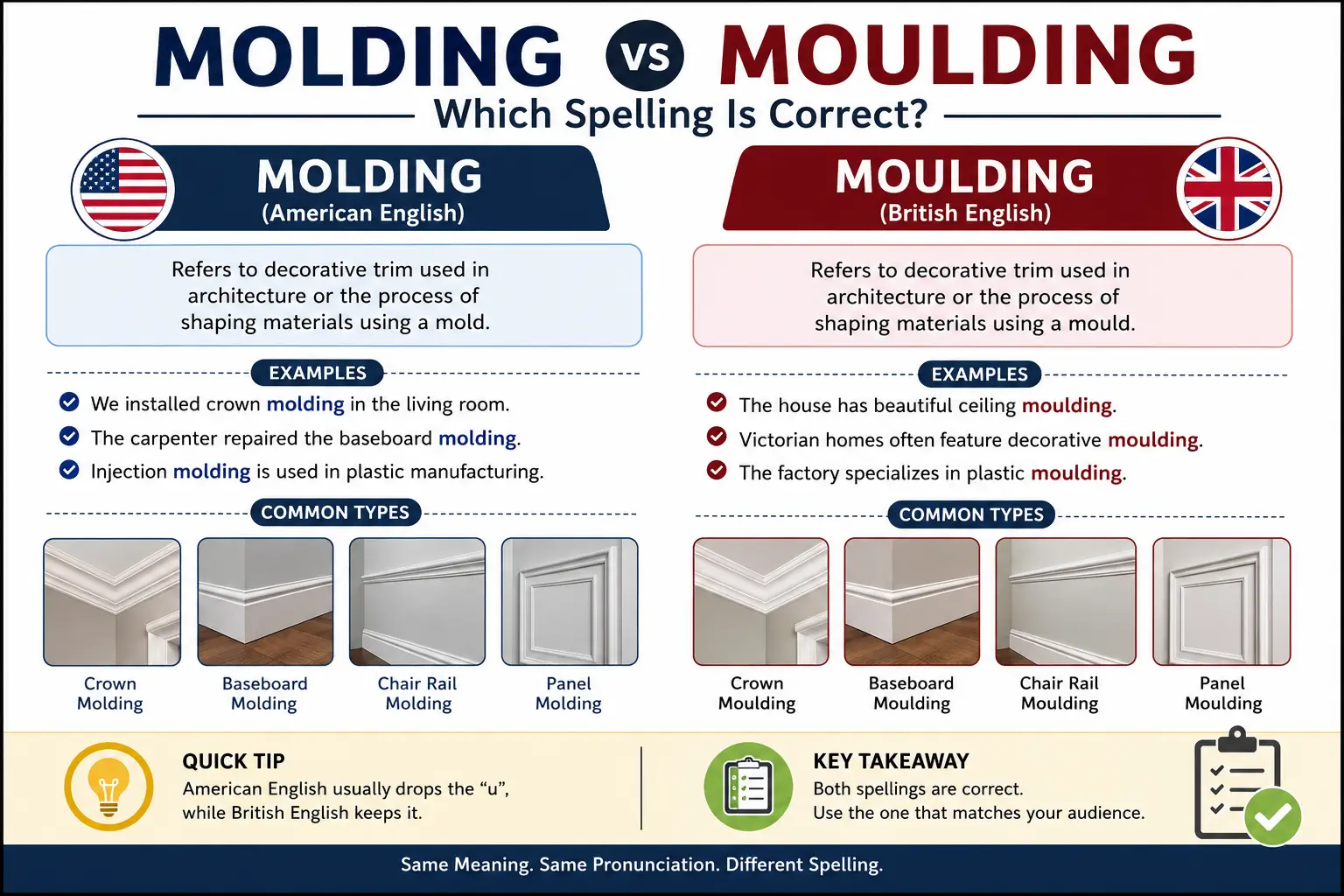
If you’ve ever stopped while writing and wondered whether molding or moulding is correct, you’re not alone. These two words look different, appear in dictionaries, and are commonly used in construction, architecture, manufacturing, and everyday writing. That naturally creates confusion.
The good news is that both spellings are correct. The difference comes down to regional spelling conventions rather than meaning. In most cases, molding is the preferred spelling in American English, while moulding is the standard spelling in British English.
This guide explains the complete molding vs moulding difference, including definitions, pronunciation, examples, grammar rules, common mistakes, and when to use each spelling. By the end, you’ll know exactly which version fits your audience and writing style.
Quick Answer: Molding or Moulding?
| Word | Region | Correct? |
|---|---|---|
| Molding | American English | ✅ Yes |
| Moulding | British English | ✅ Yes |
Short Answer
Both spellings mean exactly the same thing.
- Molding is the American spelling of moulding.
- Moulding is the British spelling of molding.
Neither spelling is wrong. The best choice depends on whether you’re writing for a US audience or a UK audience.
What Does Molding or Moulding Mean?
The word has several meanings depending on the context.
1. Decorative Architectural Trim
In construction and interior design, molding (or moulding) refers to decorative trim installed on walls, ceilings, doors, windows, and furniture.
Examples:
- The contractor installed crown molding throughout the house.
- The dining room features elegant decorative moulding.
Common examples include:
- Crown molding
- Baseboard molding
- Chair rail molding
- Panel molding
- Door molding
2. Shaping a Material
In manufacturing, molding refers to shaping a material into a specific form using a mold.
Examples:
- Injection molding is widely used to manufacture plastic products.
- Rubber components are produced through molding processes.
Common manufacturing methods include:
- Injection molding
- Compression molding
- Transfer molding
- Rotational molding
3. Influencing or Shaping Character
The word can also be used figuratively.
Examples:
- Teachers play an important role in molding young minds.
- Her experiences helped mould her personality.
Molding vs Moulding: The Key Difference
The difference is purely spelling.
| Feature | Molding | Moulding |
|---|---|---|
| Meaning | Same | Same |
| Pronunciation | Same | Same |
| Grammar | Same | Same |
| American English | Preferred | Less Common |
| British English | Less Common | Preferred |
| Dictionaries | Recognized | Recognized |
Featured Snippet Answer
Molding and moulding are the same word. “Molding” is the standard American English spelling, while “moulding” is the standard British English spelling. Both words share the same meaning and pronunciation.
Why Do the Spellings Differ?
Many English spelling differences developed over time due to regional language evolution.
American English often simplifies spellings by removing certain letters.
Examples include:
| American English | British English |
|---|---|
| Color | Colour |
| Favor | Favour |
| Honor | Honour |
| Labor | Labour |
| Mold | Mould |
| Molding | Moulding |
This spelling variation is part of a broader pattern found throughout the English language.
Molding Meaning and Definition
Molding Definition
A decorative strip, trim, or shaped material used in architecture, manufacturing, carpentry, or design.
Molding Meaning in Construction
Molding trim is often installed to:
- Improve appearance
- Cover joints
- Create visual transitions
- Increase property value
Examples:
- Crown molding
- Baseboard molding
- Window molding
- Door casing molding
Moulding Meaning and Definition
Moulding Definition
The British English spelling of molding, referring to decorative trim or the process of shaping materials using molds.
Examples:
- Decorative moulding around the ceiling enhanced the room.
- The factory specializes in plastic moulding.
The meaning remains identical to the American version.
Molding vs Moulding Pronunciation
Many learners wonder whether the pronunciation changes.
It does not.
Pronunciation
Molding: MOHL-ding
Moulding: MOHL-ding
Both versions are pronounced the same way despite the spelling difference.
Pronunciation Tip
Ignore the extra “u” in the British spelling when speaking.
American English vs British English Usage
Use “Molding” If:
You are writing for:
- United States audiences
- American businesses
- US publications
- American educational institutions
Example:
“The contractor installed crown molding throughout the property.”
Use “Moulding” If:
You are writing for:
- United Kingdom audiences
- British businesses
- UK publications
- Commonwealth English readers
Example:
“The Victorian home features decorative ceiling moulding.”
Common Types of Molding and Moulding
Crown Molding
Decorative trim installed where walls meet ceilings.
Baseboard Molding
Trim installed along the bottom of interior walls.
Chair Rail Molding
Horizontal trim that protects walls from furniture damage.
Panel Molding
Decorative trim used to create raised wall panels.
Architectural Molding
A broad category covering decorative interior and exterior trim.
Decorative Moulding
Used to add elegance and visual interest to architectural spaces.
Real Examples of Molding and Moulding in Sentences
American English Examples
- We installed crown molding in the living room.
- White molding can make a room appear larger.
- Injection molding is used to manufacture plastic products.
- The carpenter repaired the damaged baseboard molding.
British English Examples
- The dining room contains traditional Victorian moulding.
- Decorative moulding adds character to older homes.
- The company specializes in precision plastic moulding.
- Ceiling moulding was added during the renovation.
Common Mistakes People Make
Mistake 1: Assuming One Version Is Wrong
Many people think only one spelling is correct.
Reality:
Both are accepted by major dictionaries.
Mistake 2: Mixing Spellings in the Same Document
Incorrect:
- The house has beautiful molding.
- The ceiling moulding needs repair.
Correct:
Choose one style and stay consistent.
Mistake 3: Confusing Mold and Mould with Molding and Moulding
Remember:
- Mold = American spelling
- Mould = British spelling
- Molding = American derivative
- Moulding = British derivative
Mistake 4: Using the Wrong Regional Style
A British publication generally expects “moulding.”
An American publication generally expects “molding.”
Dictionary Recognition
All major dictionaries recognize both spellings.
Recognized by:
- Merriam-Webster
- Oxford Dictionary
- Cambridge Dictionary
- Collins Dictionary
However, each dictionary may prioritize the spelling most common within its target audience.
Word Origin and Etymology
The word originates from the concept of shaping materials using a mold.
Historically, British English retained the spelling “mould.”
American English later adopted the simplified spelling “mold.”
As a result:
- Mould → Moulding
- Mold → Molding
This follows the same pattern seen in many American vs British spelling differences.
Which Spelling Should You Use?
Use this simple rule:
Choose “Molding” When:
✅ Writing for American readers
✅ Following US spelling standards
✅ Using AP Stylebook conventions
Choose “Moulding” When:
✅ Writing for British readers
✅ Following UK spelling standards
✅ Using British publishing conventions
For International Websites
If your audience is primarily American, use molding.
If your audience is primarily British, use moulding.
If your audience is global, choose one spelling and maintain consistency throughout the article.
Similar American and British Spelling Differences
Understanding these examples can help you remember molding vs moulding.
| American English | British English |
|---|---|
| Color | Colour |
| Flavor | Flavour |
| Humor | Humour |
| Neighbor | Neighbour |
| Favorite | Favourite |
| Mold | Mould |
| Molding | Moulding |
Easy Memory Trick
Think of it this way:
American English Removes the “U”
- Color
- Honor
- Favor
- Mold
- Molding
British English Keeps the “U”
- Colour
- Honour
- Favour
- Mould
- Moulding
If you remember that pattern, you’ll rarely make a mistake.
Quick Recap Table
| Question | Answer |
|---|---|
| Is molding correct spelling? | Yes |
| Is moulding correct spelling? | Yes |
| Are they the same word? | Yes |
| Which spelling is American? | Molding |
| Which spelling is British? | Moulding |
| Do they have different meanings? | No |
| Do they have different pronunciations? | No |
| Should both be used in one document? | No |
Frequently Asked Questions
Is molding and moulding the same?
Yes. Both words have the same meaning. The only difference is regional spelling.
Is it crown molding or crown moulding?
In the United States, crown molding is standard. In the United Kingdom, crown moulding is preferred.
Is it wood molding or moulding?
Both are correct. Use wood molding for American English and wood moulding for British English.
What does molding mean?
Molding refers to decorative trim in architecture or the process of shaping materials using a mold.
Which spelling is correct: molding or moulding?
Both are correct. Molding is American English, while moulding is British English.
Is molding used in American English?
Yes. Molding is the standard American English spelling.
Is moulding used in British English?
Yes. Moulding is the standard British English spelling.
Do molding and moulding have different pronunciations?
No. Both words are pronounced the same way.
Can I use both spellings in one article?
It’s best to choose one spelling style and remain consistent throughout your writing.
Which spelling is better for SEO?
Use the spelling your target audience searches most often. US-focused content generally performs better with “molding,” while UK-focused content may benefit from “moulding.”
Conclusion
When comparing molding vs moulding, the answer is straightforward: both spellings are correct. The only real difference is regional usage. Molding is the preferred spelling in American English, while moulding is the standard form in British English. They share the same meaning, pronunciation, grammar, and dictionary recognition.
If you’re writing for a US audience, use molding. If you’re writing for a UK audience, use moulding. Most importantly, stay consistent throughout your document. Once you understand this simple spelling distinction, choosing the correct version becomes easy and your writing will look more professional and polished.










1 thought on “Molding vs Moulding: Which Spelling Is Correct?”