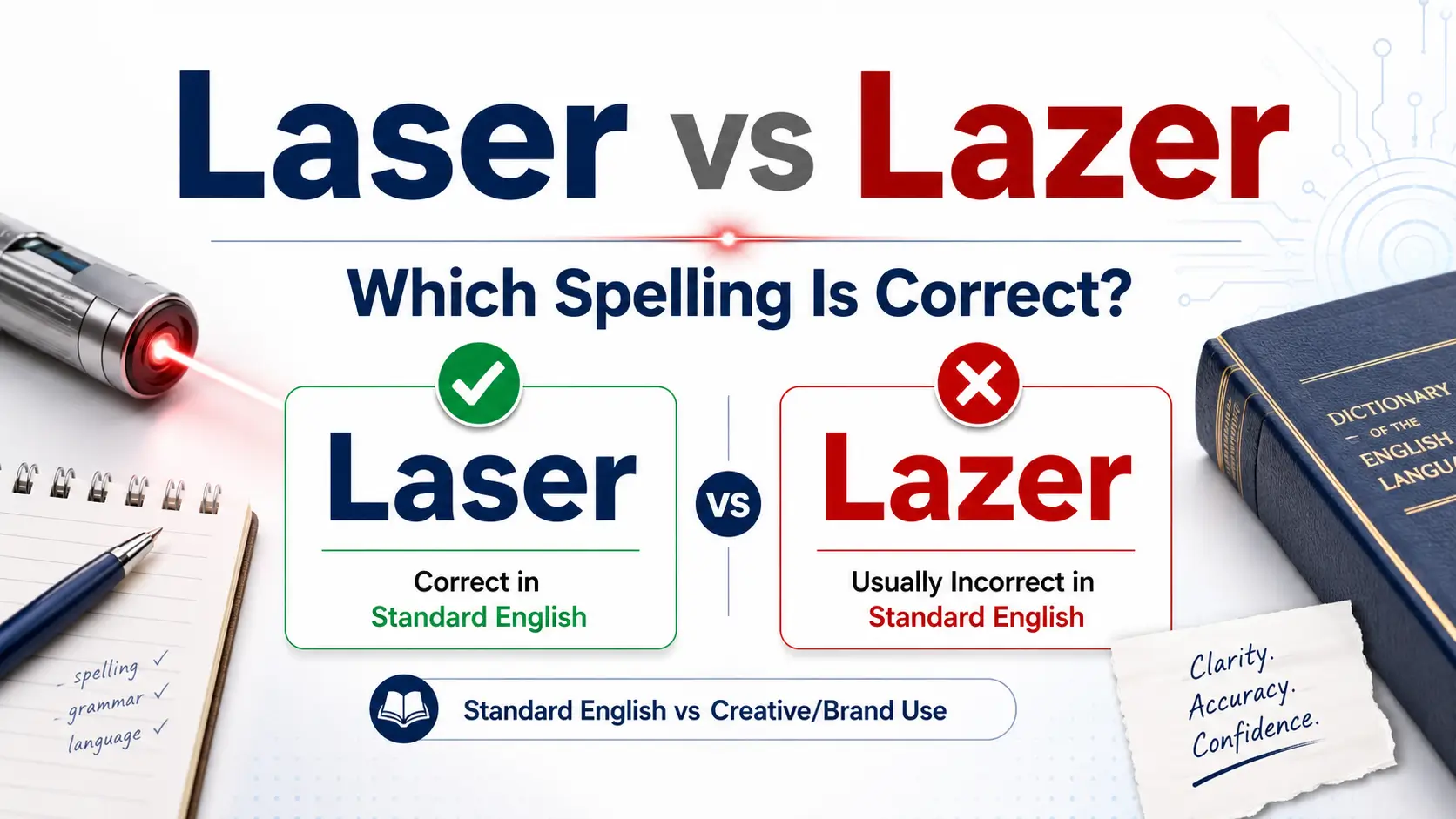
When people search Laser Or Lazer, they often feel confused about spelling, meaning, and real usage in English language today.
Many people type laser or lazer and wonder which form is right, but correct spelling in formal writing is always laser, not misspelling.
In professional writing, scientific terminology, technology, medical procedures, and industry applications, laser is used for cutting, welding, communication, accuracy.
Laser vs Lazer: Quick Answer
If you’re in a hurry, this table tells you everything you need to know.
| Word | Correct Standard English | Common Use |
| Laser | ✅ Yes | Science, medicine, technology, education, everyday writing |
| Lazer | ⚠️ Usually no | Brand names, entertainment, marketing, creative projects |
The Simple Rule
Use “laser” in almost every situation.
Use “lazer” only when referring to:
- A company name.
- A product brand.
- A musician or performer.
- A fictional object or title.
- A deliberately stylized spelling.
Think of it this way.
If you’re talking about laser surgery, laser printers, laser pointers, or laser technology, the spelling never changes.
Quick Rule to Remember
Here’s an easy trick.
LASER is an acronym, and acronyms keep their original spelling.
Since the word came from a scientific acronym, changing the “s” to a “z” creates a different word altogether.
If you can’t remember which version to use, ask yourself one question:
Am I talking about real laser technology?
If the answer is yes, write laser.
What Does “Laser” Mean?
The word “laser” carries more history than many people realize. It didn’t start as an ordinary English word. Scientists created it to describe a remarkable invention.
Read this also: Kinesthesiology vs Kinesiology: What’s the Real Difference and Which Term Is Correct?
Definition of Laser
A laser is a device that produces a concentrated beam of light through a process called stimulated emission.
Unlike ordinary light, laser light has unique properties:
- It travels in a narrow beam.
- It stays highly focused.
- It can carry enormous amounts of energy.
- It remains consistent over long distances.
Today, lasers appear almost everywhere.
You can find them in:
- Hospitals.
- Factories.
- Military equipment.
- Supermarkets.
- Construction sites.
- Schools.
- Entertainment venues.
- Home electronics.
A simple laser pointer and a sophisticated surgical laser work on the same basic principle.
What Does LASER Stand For?
Many people don’t realize that laser started as an acronym.
LASER stands for:
Light Amplification by Stimulated Emission of Radiation.
Each word has a purpose.
| Letter | Meaning |
| L | Light |
| A | Amplification |
| S | Stimulated |
| E | Emission |
| R | Radiation |
Scientists developed the term during the twentieth century to describe this groundbreaking technology.
Over time, people stopped writing the word in all capital letters. It became a common noun, much like radar and scuba.
Interestingly, radar and scuba also started as acronyms.
Examples include:
- Radar.
- Scuba.
- Sonar.
- Laser.
English naturally transforms useful acronyms into everyday vocabulary.
Why It’s Written as “Laser” Instead of “LASER”
Language evolves.
When a technical term becomes widely used, writers often switch from uppercase letters to standard capitalization.
For example:
| Original Acronym | Modern Word |
| RADAR | Radar |
| SCUBA | Scuba |
| SONAR | Sonar |
| LASER | Laser |
Eventually, dictionaries accepted these forms because ordinary speakers treated them as regular words.
That’s why you write:
- Laser surgery.
- Laser beam.
- Laser printer.
- Laser technology.
Writing “LASER” isn’t wrong in historical discussions, though modern English usually prefers lowercase letters.
What Does “Lazer” Mean?
Now comes the confusing part.
Is “lazer” a real word?
The answer depends on context.
Is “Lazer” a Real Word?
Unlike laser, “lazer” isn’t the standard English spelling for the scientific device.
Major dictionaries generally recognize laser as the accepted form.
However, “lazer” exists because people and businesses have adopted it for creative purposes.
That means the word isn’t entirely imaginary. It simply serves a different role.
You wouldn’t write:
❌ The doctor performed lazer eye surgery.
You would write:
✅ The doctor performed laser eye surgery.
The difference may seem tiny, though formal writing depends on precision.
When Is “Lazer” Acceptable?
There are several legitimate situations where “lazer” works perfectly.
Brand Names
Companies often choose unusual spellings because they’re memorable.
A unique spelling helps:
- Create trademarks.
- Build brand identity.
- Stand out from competitors.
For example:
- Lazer helmets.
- Product names.
- Gaming accessories.
Entertainment
Movies, music, and games frequently use creative spellings.
A “z” often feels:
- Modern.
- Energetic.
- Futuristic.
- Stylish.
That’s one reason artists and entertainers sometimes choose the spelling.
Personal Usernames
Online creators often replace letters to make unique usernames.
Examples:
- LazerKing.
- LazerPro.
- LazerX.
In these situations, grammar isn’t the priority. Individual branding matters more.
Fiction
Writers sometimes invent spellings for:
- Fantasy worlds.
- Science fiction.
- Video games.
- Comic books.
Creative freedom allows flexibility.
Laser vs Lazer: The Main Difference
The easiest way to understand the distinction is through comparison.
Side-by-Side Comparison
| Feature | Laser | Lazer |
| Standard English | Yes | No |
| Scientific Term | Yes | No |
| Dictionary Entry | Yes | Limited |
| Academic Writing | Yes | No |
| Professional Writing | Yes | No |
| Marketing Names | Sometimes | Common |
| Fictional Use | Possible | Common |
| Everyday Communication | Yes | Usually No |
The key takeaway stays simple.
Laser describes the actual technology.
Lazer usually describes a stylistic choice.
Why the Difference Matters
Some people think the two spellings are interchangeable.
They aren’t.
Imagine writing:
- Lazer surgery.
- Lazer printer.
- Lazer measurement.
- Lazer physics.
A teacher, editor, or employer would likely mark those as spelling mistakes.
On the other hand:
- Lazer gaming headset.
- Lazer racing team.
- DJ Lazer.
These examples may be completely correct because they’re proper names.
Context changes everything.
Why Do People Spell Laser as Lazer?
This mistake happens surprisingly often.
Several factors contribute to the confusion.
Pronunciation Confusion
English spelling rarely matches pronunciation perfectly.
Laser sounds like:
“LAY-zer.”
Many people naturally assume the middle sound should use the letter Z.
It’s a logical guess.
Unfortunately, English doesn’t always reward logic.
Phonetic Spelling Habits
People often spell unfamiliar words according to how they sound.
Examples include:
- Definately instead of definitely.
- Recieve instead of receive.
- Seperate instead of separate.
- Lazer instead of laser.
The brain tries to simplify patterns.
Brand Influence
Marketing plays a huge role.
Products using “z” spellings create familiarity.
Consumers repeatedly see:
- Lazer.
- Xtreme.
- Krazy.
- Toyz.
Eventually, these creative spellings start feeling normal.
Keyboard Mistakes
Sometimes the explanation is much simpler.
People type quickly.
Autocorrect doesn’t always catch errors immediately.
A single letter changes the entire word.
Social Media Culture
Modern internet culture encourages creative spellings.
People modify words to:
- Look unique.
- Build personal brands.
- Create memorable usernames.
- Stand out online.
While that’s perfectly acceptable for personal branding, formal writing still follows standard spelling rules.
The History of the Word Laser
The story behind laser is almost as fascinating as the technology itself.
Many everyday words have ancient roots.
Laser doesn’t.
Scientists invented it relatively recently.
The Origin of the Acronym
During the twentieth century, researchers explored ways to amplify light.
Their work built upon earlier discoveries involving quantum mechanics and stimulated emission.
Eventually, the technology needed a name.
They developed the acronym:
Light Amplification by Stimulated Emission of Radiation.
The shortened version became laser.
The name stuck almost immediately because it described the technology clearly and efficiently.
How the Word Entered Everyday English
Scientific breakthroughs rarely stay inside laboratories forever.
Laser technology quickly expanded into public life.
People encountered lasers through:
- Barcode scanners.
- Music players.
- Manufacturing.
- Medicine.
- Military applications.
- Construction tools.
- Classroom demonstrations.
- Consumer electronics.
As the technology spread, the word became familiar across the world.
Today, children recognize the term long before learning the science behind it.
Why the Spelling Never Changed
Some English words develop multiple accepted spellings.
Laser didn’t.
The original acronym established a clear spelling pattern.
Scientists, engineers, educators, publishers, and dictionaries all adopted the same form.
That consistency helped preserve the original spelling.
Meanwhile, “lazer” evolved separately through branding and popular culture rather than scientific language.
How to Use “Laser” Correctly
Now that you know the history behind the word, the next question is practical.
When should you use “laser” in everyday writing?
The answer is straightforward. If you’re referring to the actual technology or anything related to it, laser is always the correct spelling.
Let’s look at the most common situations.
Laser in Science
Scientists use lasers for research because they produce highly focused beams of light. These beams can measure tiny distances, study atoms, and even detect planets outside our solar system.
Common scientific applications include:
- Spectroscopy.
- Astronomy.
- Physics experiments.
- Environmental monitoring.
- Chemical analysis.
Correct examples
- The researchers used a laser to measure microscopic particles.
- The laboratory installed a high-powered laser system.
Notice that the spelling never changes.
Laser in Medicine
Modern medicine relies heavily on laser technology.
Doctors use lasers because they can target small areas with remarkable precision. This often reduces pain and shortens recovery time.
Common medical procedures include:
- Laser eye surgery.
- Laser skin treatments.
- Laser hair removal.
- Laser dentistry.
- Laser tattoo removal.
Correct examples
- The patient chose laser eye surgery.
- The clinic offers advanced laser treatments.
Writing “lazer surgery” would be incorrect in professional or medical contexts.
Laser in Technology
Many devices use lasers without people realizing it.
Examples include:
| Device | Uses a Laser |
| Barcode scanner | Yes |
| Laser printer | Yes |
| DVD player | Yes |
| Blu-ray player | Yes |
| Range finder | Yes |
| Construction level | Yes |
Example sentences
- The office bought a new laser printer.
- The cashier scanned the product with a laser reader.
Laser in Everyday Language
You don’t need to be a scientist to use the word correctly.
People often say:
- Laser focus.
- Laser precision.
- Laser-guided.
- Laser beam.
- Laser pointer.
These expressions have become part of everyday English.
Examples
- She has laser focus during exams.
- The engineer worked with laser precision.
When Should You Use “Lazer”?
At this point, you might wonder whether “lazer” should ever appear in your writing.
The answer is yes, though only in specific situations.
Brand and Trademark Names
Businesses often choose unusual spellings because they attract attention.
Replacing an “s” with a “z” can make a name look:
- Modern.
- Bold.
- Memorable.
If a company’s official name uses “lazer,” you should respect that spelling.
Example
✅ Lazer products.
Changing a registered brand name would actually create an error.
Entertainment and Pop Culture
Creative industries love unusual spellings.
Movies, games, and music frequently adopt alternative forms to build unique identities.
You may encounter:
- Lazer battles.
- Lazer games.
- Lazer-themed attractions.
These names are stylistic rather than grammatical.
Creative Marketing
Advertisers often tweak spelling for branding purposes.
Think about words like:
- Xpress.
- Foto.
- Toyz.
- Kutz.
“Lazer” fits into the same category.
The goal isn’t grammatical accuracy.
The goal is memorability.
Situations Where You Should Avoid It
Avoid “lazer” when writing:
- School assignments.
- College papers.
- Business reports.
- News articles.
- Technical documents.
- Medical information.
- Scientific discussions.
- Professional emails.
In these cases, use “laser.”
Laser vs Lazer in Sentences
Examples make grammar easier to understand.
Here are practical situations.
Correct Examples Using Laser
✅ The engineer repaired the laser equipment.
✅ The doctor recommended laser treatment.
✅ The teacher demonstrated a laser pointer.
✅ The factory uses laser cutting machines.
✅ The surveyors measured the distance with a laser device.
Correct Examples Using Lazer
✅ The musician released a new album under the name Lazer.
✅ The company introduced its Lazer gaming headset.
✅ The amusement park opened a Lazer battle arena.
In these examples, “Lazer” functions as a proper name.
Incorrect Examples and Corrections
| Incorrect | Correct |
| Lazer surgery | Laser surgery |
| Lazer printer | Laser printer |
| Lazer technology | Laser technology |
| Lazer beam | Laser beam |
| Lazer measurement | Laser measurement |
A good proofreading habit is simple.
If you’re discussing actual technology, replace “lazer” with “laser.”
Common Mistakes People Make
Even experienced writers occasionally mix up the two spellings.
Here are the most common errors.
Using Lazer in Formal Writing
Many people assume both spellings are acceptable.
That’s not true.
Formal English favors “laser.”
Incorrect
The company invested in lazer manufacturing.
Correct
The company invested in laser manufacturing.
Assuming Both Spellings Mean the Same Thing
They may sound identical, though their usage differs.
Laser:
- Standard English.
- Scientific.
- Professional.
Lazer:
- Creative.
- Commercial.
- Stylistic.
Context determines the right choice.
Confusing Brand Names With Common Words
Suppose you see a product called Lazer.
That doesn’t mean every use should switch to that spelling.
A brand name stays unique.
The standard word remains laser.
Laser vs Lazer: Which Should You Use?
The answer depends on your audience.
For School and Academic Writing
Always choose laser.
Teachers expect standard spelling.
For Professional Communication
Business documents should use laser.
Professional writing values consistency and accuracy.
For Scientific Content
Scientists use laser.
Technical fields rarely accept alternatives.
For Creative Projects
You have more freedom.
If you’re creating:
- A game.
- A band.
- A product.
- A fictional world.
“Lazer” may fit your style.
Words Similar to Laser That Cause Confusion
English contains plenty of spelling traps.
Laser isn’t alone.
Razor vs Rasor
Correct:
✅ Razor.
Incorrect:
❌ Rasor.
Taser vs Tazor
Correct:
✅ Taser.
Incorrect:
❌ Tazor.
Phaser vs Fazer
Context matters here because some are proper names while others are ordinary words.
English often surprises learners with unexpected spelling patterns.
Why English Creates These Problems
Several factors influence spelling.
- Historical changes.
- Borrowed words.
- Scientific terminology.
- Brand creativity.
- Regional influences.
Laser simply happens to be one of the more common examples.
Easy Tricks to Remember the Correct Spelling
Memory tricks can save time.
The Acronym Trick
Remember:
LASER = Light Amplification by Stimulated Emission of Radiation.
The acronym contains an S.
So does the correct spelling.
The Science Trick
If it’s real science, use laser.
If it’s a creative brand, check whether the official name uses lazer.
The Dictionary Trick
Ask yourself:
“Would this appear in a textbook?”
If yes, write laser.
A Quick Checklist
Before publishing your writing, ask:
- Am I discussing technology?
- Is this formal writing?
- Is this academic content?
- Is this medical information?
If you answered yes, use laser.
Quick Summary Table
| Question | Answer |
| Is laser correct? | Yes |
| Is lazer standard English? | No |
| Is laser an acronym? | Yes |
| Can brands use lazer? | Yes |
| Should students write lazer? | No |
| Is laser used in science? | Yes |
| Are they pronounced differently? | No |
A Real-World Case Study
Imagine two businesses advertising eye treatment.
Advertisement One
“We provide advanced lazer eye surgery.”
A customer may question the company’s professionalism because of the spelling mistake.
Advertisement Two
“We provide advanced laser eye surgery.”
The message appears accurate and trustworthy.
A single letter can influence credibility.
That’s why editors and marketers pay close attention to spelling.
Interesting Facts About Laser
Here are a few surprising facts.
Fact 1
The first working laser was demonstrated in 1960.
Fact 2
Laser beams can travel enormous distances while staying highly focused.
Fact 3
Scientists use lasers to measure the distance between Earth and the Moon.
Fact 4
Modern manufacturing relies on laser cutting for incredible precision.
Fact 5
Laser technology appears in medicine, communication, defense, entertainment, and space exploration.
“Small spelling differences can create big differences in meaning and credibility.”
That idea perfectly captures the laser versus lazer debate.
Frequently Asked Questions
Is lazer a correct spelling?
Not in standard English. Laser is the accepted spelling for the technology. Lazer mainly appears in brand names and creative projects.
Is laser an acronym?
Yes. It stands for Light Amplification by Stimulated Emission of Radiation.
Why do some companies spell it “lazer”?
Businesses often choose unique spellings to make their products and brands easier to remember.
Are laser and lazer pronounced differently?
No. Most speakers pronounce them the same way.
Can I use lazer in formal writing?
No. Formal, academic, and professional writing should use laser.
Is lazer found in dictionaries?
Some dictionaries mention it as a variant or proper noun, though laser remains the standard English spelling.
Which spelling should students use?
Students should always write laser unless quoting an official brand or proper name.
Conclusion
The confusion between laser and lazer is common, but the rule is actually very simple once you understand it. Laser is the correct and standard spelling used in science, technology, medicine, and professional writing. It appears in everything from cutting-edge research to everyday tools like printers and scanners.
On the other hand, lazer is mostly used in branding, creative names, and informal contexts. It may look catchy, but it doesn’t belong in formal English writing. So whenever you’re unsure, stick with laser. It keeps your writing clean, accurate, and professional without any confusion.
FAQs
Q1: Is “lazer” a correct spelling?
No, laser is the correct spelling in standard English. “Lazer” is mostly used in brand names or creative writing.
Q2: Why do people write “lazer” instead of “laser”?
People often spell it “lazer” due to pronunciation, fast typing, or influence from branding and online culture.
Q3: Is “laser” an acronym?
Yes, laser stands for Light Amplification by Stimulated Emission of Radiation.
Q4: Can I use “lazer” in formal writing?
No, formal writing like essays, reports, and professional documents should always use laser.
Q5: Do laser and lazer mean the same thing?
They sound the same, but only laser refers to the real scientific device. “Lazer” is mainly a stylistic or branding variation.